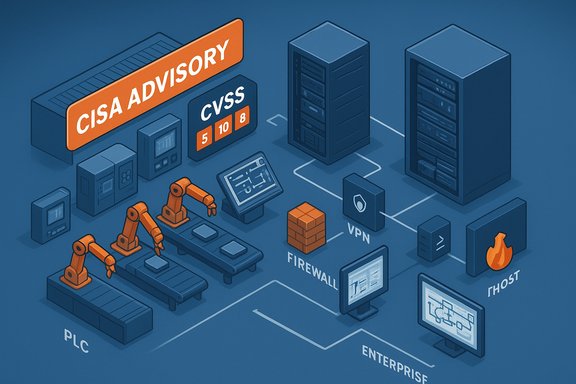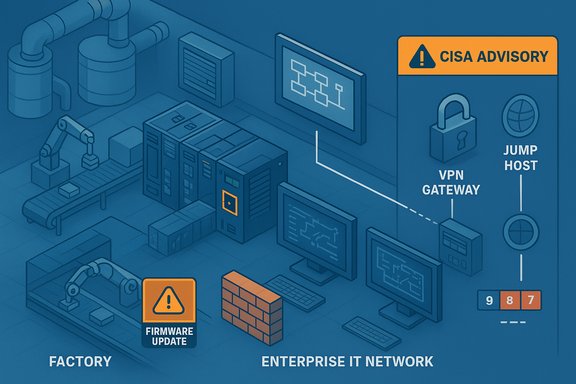
CISA’s latest consolidated advisory package is a stark reminder that industrial control systems (ICS) remain a high‑value target for attackers and a bridge between operational technology (OT) and enterprise IT — the agency published a bundle of seven ICS advisories that name multiple widely deployed products, assign high CVSS scores to several flaws, and push immediate mitigations including firmware updates, network isolation, and removal of internet exposure.
Background / Overview
Industrial control systems — PLCs, controllers, SCADA servers, HMIs and the engineering tools that manage them — power manufacturing, utilities, building automation, and medical imaging. These devices often run long‑lived firmware, expose legacy interfaces, and are increasingly connected to corporate networks for monitoring and analytics. Because of that connectivity, vulnerabilities in ICS components can become enterprise problems that affect Windows servers, engineering workstations, or production‑line endpoints as attackers pivot from poorly protected OT segments into IT environments. CISA’s advisory bundles collect vendor disclosures and prioritized mitigations to accelerate operator response. CISA has published several such seven‑advisory packages across 2025; two representative releases that illustrate the content and tone of these bulletins were published on February 20, 2025 and March 18, 2025. Each advisory in the bundles provides an executive summary, CVSS scoring, affected product lists, technical details, and recommended mitigations. Operators should treat the advisories as operational directives: identify affected assets, apply vendor updates, and implement compensating controls immediately.What CISA reported in this advisory bundle
The headline items (examples from the Feb 20, 2025 bundle)
- ABB ASPECT‑Enterprise, NEXUS, MATRIX — Use of hard‑coded credentials (CVE‑2024‑51547) with very high severity (CVSS v4 ≈ 9.3). CISA warns these credentials are embedded in firmware and can allow bypass of authentication if devices are exposed. Recommended mitigations: remove internet exposure, apply firmware updates, and strengthen physical and network controls.
- ABB FLXEON Controllers — Multiple critical issues (including a command‑injection / remote‑code execution vector assessed at CVSS 10.0 and WebSocket origin‑validation and log‑leak issues). ABB released firmware updates (9.3.5) and strongly recommends that FLXEON devices not be internet‑facing. CISA mirrors vendor guidance: disconnect exposed devices and upgrade firmware.
- Siemens SiPass Integrated — Vulnerabilities in access‑control/physical‑security software that could allow bypass of authentication or manipulation of credentials; CISA recommends patching and configuration hardening.
- Other advisories in the same bundle targeted a protocol analyzer, a remote monitoring app, updates for Mitsubishi Electric CNC families, and a medical imaging viewer (DICOM) that carries confidentiality and operational risk if abused. Each advisory includes specific mitigations — from version‑specific patches to compensating network controls.
Why this matters to Windows administrators and enterprise security
- IT‑OT convergence means Windows endpoints are part of the attack chain. Engineering workstations, Windows‑based HMIs, and corporate servers often bridge into OT segments; a compromise of an ICS device can facilitate lateral movement to Windows systems or use Windows hosts as staging infrastructure. Treat ICS advisories as enterprise‑level incidents, not just OT issues.
- High severity + easy vectors = urgent remediation. Several advisories list network‑accessible vulnerabilities (low attack complexity, no privilege required). Attackers scanning for exposed devices on the public internet can weaponize such flaws rapidly; the ABB FLXEON command‑injection CVE is a clear example where misconfiguration plus vulnerable firmware leads to remote code execution.
- Operational risk is real — not theoretical. Vulnerabilities that allow arbitrary commands, change configuration, or leak authentication material directly endanger production continuity, safety systems, or patient data (when medical imaging tools are involved). The potential for physical consequences elevates risk beyond typical IT compromise.
Technical breakdown — selected advisories and what to look for
ABB FLXEON Controllers (ICSA‑25‑051‑02)
- Affected versions: FLXEON firmware <= 9.3.4; vendor released 9.3.5 to remediate the issues.
- Vulnerability types: command injection / remote code execution (CWE‑77), missing origin validation in WebSockets (CWE‑1385), and sensitive data exposure in logs (CWE‑532).
- Practical implication: An attacker with network access to a misconfigured FLXEON may execute arbitrary commands or exfiltrate sensitive material; ABB emphasizes that FLXEON devices should not be internet‑facing, and that VPNs and firewalls be used for remote management.
ABB ASPECT‑Enterprise / NEXUS / MATRIX (ICSA‑25‑051‑01)
- Primary issue: hard‑coded credentials embedded in firmware (CVE‑2024‑51547). Score: CVSS v4 ≈ 9.3 (high).
- Practical implication: Hard‑coded credentials are a persistent exploitation vector because they are often unchangeable and can be discovered in firmware or log artifacts; attackers who find those credentials can gain unauthorized access without brute force. Mitigations include isolating devices off the public internet, upgrading firmware, and ensuring strict access controls.
Siemens SiPass Integrated (ICSA‑25‑051‑04) and Others
- These advisories typically involve authentication bypasses, insufficient input validation, or insecure default configurations. The vendor guidance emphasizes both patching and configuration hardening (e.g., removing unused services, enforcing strong passwords, applying auth best practices). Follow the SiPass vendor guide and CISA recommendations for change management.
Immediate actions every organization should take (practical checklist)
- Identify: Create an accurate inventory of ICS assets, controllers, HMIs, and engineering workstations that may be affected by the advisory lists. Prioritize devices matching the product names/versions in CISA’s advisory bundle.
- Isolate: Ensure any ICS device is not directly reachable from the public internet. If remote access is required, put devices behind a firewall and permit access only through hardened VPN gateways with MFA.
- Patch: Apply vendor firmware and software updates cited in the advisories (e.g., ABB FLXEON → 9.3.5). If a patch is not available, apply vendor workarounds and compensating controls immediately.
- Change defaults: Replace default or hard‑coded credentials where possible; if firmware contains immutable credentials, treat that device as high risk and mitigate by network controls.
- Segment: Enforce strict IT/OT network segmentation and restrict traffic flows to only the necessary management channels. Use ACLs and micro‑segmentation where possible.
- Monitor: Increase logging and EDR/IDS coverage on Windows engineering workstations and gateways that bridge to OT networks. Look for anomalous outbound connections and scanning behavior.
- Test backups and incident plans: Validate restore procedures for ICS controllers and ensure offline or configuration backups exist. Exercise incident response scenarios involving OT compromise.
- Document and report: Follow vendor reporting instructions and report suspected exploitation to CISA and local CERTs to assist correlation and response.
Why firmware updates and ‘don’t expose to the internet’ matter
Firmware updates often close memory‑safety bugs, remove backdoor/hidden credentials, and add input validation — all of which reduce the attack surface in ways that simple network filters cannot always make up for. But patches alone are not sufficient when devices ship with insecure defaults or when engineering workflows require remote access. For devices that cannot be patched immediately, the safest course is to remove direct internet exposure and use strictly controlled jump hosts, segmented VPNs, and out‑of‑band management channels. CISA and vendors repeatedly emphasize this in their advisories. Zero Science Lab and vulnerability trackers corroborate vendor timelines for fixes and often publish Proof‑of‑Concept details; that independent reporting is invaluable because it shows how quickly an exploit could be developed and why rapid patching and isolation are essential.Strengths of CISA’s advisory approach — what works well
- Consolidation and clarity: CISA’s advisory pages consolidate vendor disclosures into one place, giving ICS operators a short, actionable executive summary with CVSS scores, affected versions, and mitigation steps. That reduces confusion and speeds operator decision‑making.
- Focus on mitigations and compensating controls: Rather than only describing bugs, CISA highlights network controls (isolate, firewall, VPN), vendor upgrade paths, and recommended operational steps — a practical orientation helpful for resource‑constrained operators.
- Attribution of researcher and vendor context: Advisories name researchers and link to vendor advisories, assisting organizations in validating fixes and timeline expectations. That transparency helps organizations prioritize patch windows appropriately.
Risks, gaps, and where operators should still be cautious
- Advisory timing vs. exploitation windows: Public disclosure and exploit availability can converge quickly. Even when CISA or vendors state “no known exploitation,” independent PoCs or exploit code can appear weeks after advisories — meaning “no known exploitation” is not a guarantee of safety. Track PoC repositories and threat feeds to understand exploitation risk in real time.
- Immutable hard‑coded credentials: When firmware contains credentials that cannot be changed, network controls are the only practical defense. Such design flaws are inherently risky and often require device replacement or strict compensating controls; organizations should register these devices as high‑risk assets and plan for replacement.
- Operational disruption vs. security update tradeoffs: Patching some ICS devices can require scheduled downtime, validation of logic/runtimes, and regression testing. Organizations must weigh availability concerns against security risk and use staged rollouts and controlled maintenance windows. Document rollback procedures and test in non‑production environments when possible.
- Supply chain and update authenticity: Always obtain firmware and patches from verified vendor sources and use signed updates where supported. Attackers have been known to weaponize update processes or distribute counterfeit updates via third‑party mirrors. Verify vendor advisory references and CSAF/PSIRT feeds when planning updates.
Practical guidance for Windows admins who manage or support OT‑facing systems
- Treat Windows engineering workstations as crown jewels in OT environments: keep OS and management tools patched, enforce least privilege, and enable kernel‑level EDR that can detect lateral movement and unusual process injection attempts.
- Avoid connecting engineering workstations to general‑purpose internet or email; keep them on segregated networks with only the management ports required for the ICS toolchain.
- Harden VPN gateways: require MFA, use device posture checks, limit VPN allowances to a minimal set of source IPs, and monitor for anomalous login patterns.
- Maintain an asset register linking Windows hosts to specific OT assets and advisories — this speeds triage when a CISA bulletin names a product in your topology.
Cross‑validation: why we trust the technical claims
Key technical claims in the advisory bundle (high CVSS scores for specific CVEs, firmware version numbers, and vendor‑recommended upgrades) are verified across multiple independent sources:- The CISA ICS advisory pages list the executive summaries, CVSSs, and vendor‑recommended mitigations for each affected product.
- Independent researcher disclosures (Zero Science Lab) and vendor PSIRT advisories mirror the CVE numbers, affected versions, and mitigation timelines (for example, ABB’s FLXEON update to 9.3.5 and the researcher’s disclosure timeline).
- Third‑party vulnerability aggregators and CERT notices provide corroborating detail and often translate vendor advisory IDs into widely used CVE identifiers, which helps tracking across tooling and ticketing systems.
Judgement call: prioritization framework for operations teams
- Emergency (apply within 24–72 hours): Any advisory that lists remote code execution or authentication bypass with low complexity (CVSS 9.x–10). Example: FLXEON command‑injection CVE. Isolate and patch immediately.
- High (apply within 1–2 weeks): Hard‑coded credentials, significant info disclosure, or authentication weaknesses that enable lateral movement. Mitigate with network controls while scheduling patch rollout.
- Medium (apply in normal maintenance window): Configuration hardening, non‑exploitable info leaks, or vulnerabilities requiring local access. Maintain vigilance and monitor for attacker activity.
Final assessment and takeaways
CISA’s consolidated ICS advisories are essential operational intelligence for defenders: they distill vendor disclosures into actionable steps and make severity and remediation priorities explicit. The February/March 2025 advisory bundles illustrate recurring themes — high‑severity remote‑exploitation issues, insecure defaults/hard‑coded credentials, and the persistent problem of internet‑exposed control devices. Cross‑validation with vendor PSIRTs, CERTs, and researcher disclosures confirms the technical claims and remediation paths (for example, ABB’s FLXEON firmware 9.3.5 fix and the assigned CVEs). However, advisories alone do not fix systemic weaknesses: legacy devices with immutable credentials, operational constraints that delay patching, and weak remote‑access practices remain the core problems. Operators must pair patching with network architecture changes: segmentation, rigid access controls, hardened jump hosts, and continuous monitoring. Windows administrators are integral to that effort because Windows hosts frequently serve as the bridge between enterprise IT and OT systems.Immediate priorities for organizations confronted with these advisories: validate exposure, apply available firmware and software updates, block direct internet access to ICS devices, and escalate any devices with immutable credentials to a high‑risk remediation plan. For devices that cannot be patched immediately, assume compromise is possible and harden network protections accordingly.
CISA’s advisory package is an operational call to arms: the technology is critical, the vulnerabilities are real, and the mitigations are straightforward — but they require discipline, cross‑team coordination, and fast action to prevent a routine weakness from becoming an operational catastrophe.
Source: CISA CISA Releases Seven Industrial Control Systems Advisories | CISA