

CISA’s latest consolidated package of Industrial Control Systems advisories puts a fresh set of products — notably several Schneider Electric components and a Yokogawa recorder family — in the spotlight, urging operators to apply mitigations, review configurations, and treat OT exposure as an enterprise‑level risk. The advisory bundle was published as a set of six ICS notices (release date: April 17, 2025) and covers items ranging from licensed radio equipment and industrial gateways to recorder products and multiple updates for Modicon controllers and communication modules.
Industrial Control Systems (ICS) advisories are a core CISA service that aggregates vendor disclosures and technical analysis to accelerate remediation across critical infrastructure. These advisories typically list affected products, vulnerable versions or configurations, potential impacts, and recommended mitigations — and CISA’s role is to make that information visible to operators who may lack direct vendor notification channels. The April 17, 2025 release is one of many advisory batches CISA has published this year as part of an ongoing program to centralize ICS vulnerability notifications. Why this matters now: ICS devices often run long maintenance cycles, include legacy components, and sit at the boundary between IT and OT. That makes timely coordination of patching, segmentation, and compensating controls essential to prevent adversaries from escalating from network footholds to physical process manipulation.
Source: CISA CISA Releases Six Industrial Control Systems Advisories | CISA
 Background
Industrial Control Systems (ICS) advisories are a core CISA service that aggregates vendor disclosures and technical analysis to accelerate remediation across critical infrastructure. These advisories typically list affected products, vulnerable versions or configurations, potential impacts, and recommended mitigations — and CISA’s role is to make that information visible to operators who may lack direct vendor notification channels. The April 17, 2025 release is one of many advisory batches CISA has published this year as part of an ongoing program to centralize ICS vulnerability notifications. Why this matters now: ICS devices often run long maintenance cycles, include legacy components, and sit at the boundary between IT and OT. That makes timely coordination of patching, segmentation, and compensating controls essential to prevent adversaries from escalating from network footholds to physical process manipulation.Overview of the six advisories
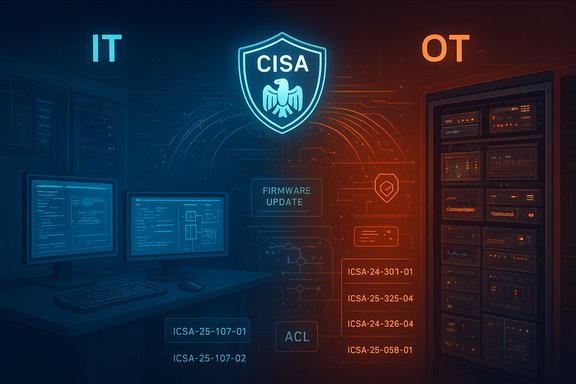
CISA’s notice lists these six advisories in the April 17, 2025 package:- ICSA-25-107-01 — Schneider Electric Trio Q Licensed Data Radio.
- ICSA-25-107-02 — Schneider Electric Sage Series.
- ICSA-25-107-03 — Schneider Electric ConneXium Network Manager.
- ICSA-25-107-04 — Yokogawa Recorder Products.
- ICSA-24-326-04 — Schneider Electric Modicon M340, MC80, and Momentum Unity M1E (Update A).
- ICSA-25-058-01 — Schneider Electric Communication Modules for Modicon M580 and Quantum Controllers (Update A).
Deep dive: what each advisory covers and the practical implications
Schneider Electric Trio Q Licensed Data Radio (ICSA-25-107-01)
The Trio Q family is used in licensed-band telemetry communications between field devices and central systems. Radios like these are often deployed in remote telemetry units (RTUs), substations, and pipeline monitoring where reliable licensed‑band links are required.- Practical impact: vulnerabilities in licensed radios can allow attackers to intercept telemetry, inject malformed commands, or disrupt connectivity, which in turn can cause loss of situational awareness or automated control loops to fail.
- Typical mitigations cited by CISA and vendors: apply firmware updates, restrict management access to out‑of‑band networks, enforce strong authentication for management interfaces, and use cryptographic protections for configuration and OTA upgrades.
Schneider Electric Sage Series (ICSA-25-107-02)
The Sage Series includes communication and protocol conversion units used to bridge legacy field devices and modern networks.- Practical impact: vulnerabilities here often give attackers a pivot point into engineering or control networks; malicious manipulation can occur if default credentials, exposed web interfaces, or weak authentication remain active.
- Recommended actions: disable unused services, change default accounts, apply vendor patches, and isolate these units behind strict access-control lists (ACLs).
Schneider Electric ConneXium Network Manager (ICSA-25-107-03)
ConneXium (formerly part of certain Schneider/HMS families) is used to centrally manage industrial gateways and routers.- Practical impact: flaws in network managers can allow large-scale misconfiguration or the distribution of malicious profiles across many edge devices, amplifying attack impact.
- Recommended actions: harden management hosts, use multi-factor authentication for admin access where supported, and restrict management to trusted IP ranges or VPN connections.
Yokogawa Recorder Products (ICSA-25-107-04)
Yokogawa’s recorder family (used for data-logging and process monitoring) is widely embedded in industrial control and process plants.- Practical impact: compromise could alter recorded telemetry (useful for forensic concealment), disrupt alarms, or prevent operators from seeing true process values.
- Recommended actions: apply vendor updates, enable secure communication protocols, and ensure recorders are not reachable from less-trusted networks.
Modicon controller updates (ICSA-24-326-04 and ICSA-25-058-01, Update A)
These are follow‑on advisories for Modicon PLC families and communication modules used in Modicon M580, Quantum, M340 and related controllers.- Practical impact: PLCs are core control elements. Vulnerabilities at this layer can lead to unauthorized control of physical processes, denial of service, or persistence in control networks.
- Recommended actions: prioritize vendor-supplied firmware updates, validate network segmentation, and audit engineering stations for exposed tools or credentials. CISA’s advisories for Modicon updates typically include explicit firmware versions and vendor mitigation steps — follow those to the letter.
Why CISA’s consolidated advisories help — and their limitations
Strengths
- Consolidation reduces fragmentation. Operators often lack direct vendor notification channels; CISA aggregates vendor advisories into one canonical notice, accelerating awareness across critical sectors.
- Actionable prioritization. The advisories call out affected product lines and usually include vendor mitigation links or suggested compensating controls that network and security teams can act on immediately.
- Cross-sector visibility. By publishing consolidated lists, CISA ensures utilities, manufacturers, and enterprises see relevant exposures simultaneously — a crucial capability when a vulnerability spans many operators and suppliers.
Limitations and caveats
- Advisory details vary by vendor. Some advisories contain precise CVE identifiers and firmware build numbers; others are summaries that point to vendor pages. Operators must consult the vendor advisories directly for the exact fix-level or configuration guidance.
- No one-size-fits-all mitigation. OT environments differ: a firmware update process that’s routine in IT can be hazardous in a live production line. Risk assessment and maintenance-window planning remain necessary.
- Potential for incomplete telemetry. CISA relies on vendor disclosures; if a vendor underreports an issue or omits exploitability context, operators must be cautious and assume conservative mitigations until proven otherwise. Flag any unverifiable claims from secondary summaries and prioritize primary vendor guidance when available.
Practical recommendations for Windows-centric IT and OT administrators
While these advisories target ICS hardware and firmware, many organizations run engineering and management tools on Windows hosts. The following checklist bridges Windows IT operations and OT responsibilities.- Inventory and map: Identify every deployment of the listed product families in your environment (including field, substation, and remote sites). Track versions, serials, and network zones.
- Prioritize updates: Where vendor patches are available, plan safe firmware update windows. For controllers and field radios, validate updates on test benches before production rollout.
- Network segmentation: Enforce strong IT/OT separation. Place PLCs, recorders, and radios in segmented VLANs or physical networks with strict ACLs to prevent lateral movement from corporate Windows endpoints.
- Harden management endpoints: Ensure engineering workstations (often Windows-based) run up-to-date OS patches, endpoint detection, and strong authentication controls. Consider just-in-time remote access tools for privileged sessions.
- Restrict remote access: Disable direct internet management of OT devices. If remote access is required, use MFA‑protected VPNs and bastion jump hosts with logging.
- Monitor and log: Forward OT device logs to centralized collectors, correlate them with Windows event logs, and craft detection rules for unusual telemetry or configuration changes.
- Prepare rollback plans: Firmware updates can have unforeseen effects; maintain tested rollback procedures and spare hardware where possible.
- Coordinate with vendors: Open support tickets and request test builds or guidance where documentation is ambiguous. Document vendor responses for compliance and audit trails.
Threat modeling: what adversaries gain and how they might exploit these advisories
Adversaries attacking ICS environments generally pursue one or more of the following goals: persistent access, disruption of service, data theft, or manipulation of process values to cause physical damage or outages.- Radios and gateways (Trio Q, Sage, ConneXium): compromise here enables interception or manipulation of sensor and actuator traffic, or distribution of malicious configurations to many devices.
- Recorders: altering historical data can conceal malicious activities or tamper with forensic evidence.
- PLC and communications-module flaws: these can provide remote code execution or privileged access to controllers, with direct consequences for machinery and safety systems.
Cross-referencing and verification: what the public record says
Two independent public records corroborate the scope of the April 17 advisory package: the CISA advisory page listing the six advisories and a separate government-delivered bulletin that mirrored the notifications. Both show overlapping advisory identifiers and vendor names, reinforcing that this is a coordinated, multi‑vendor notification rather than a single isolated disclosure. Operators should use both CISA’s portal and the vendor bulletins to confirm exact fix levels. Where CISA or vendor pages are terse, community archives and specialist forums (including industry‑focused discussion threads) often summarize the operational impacts and provide early practitioner guidance — these are useful for context but should not replace vendor or agency guidance for technical implementation. Flag any practitioner-sourced claims that lack vendor confirmation as “unverified” until a patch or vendor advisory documents them explicitly.Operational risk analysis and recommended timelines
- Immediate (0–7 days): Confirm presence of impacted devices, isolate any that are publicly accessible, and disable remote management over untrusted networks. For devices in critical production flows, ensure monitoring and enhanced logging are active.
- Short term (7–30 days): Test and deploy vendor firmware updates in controlled windows; apply configuration hardening (change defaults, disable unused services). Ensure engineering-station patching and antivirus/EDR coverage is current.
- Medium term (30–90 days): Implement long-term compensating controls such as improved segmentation, strict change management for OT devices, and automated patch validation where appropriate. Conduct tabletop exercises for OT incident response that include Windows-host compromise scenarios.
- Long term (90+ days): Review procurement and lifecycle policies: require secure update mechanisms, vendor‑supported cryptographic integrity checks, and contractual obligations for vulnerability disclosure timelines.
Strengths and risks of acting (or not acting) on these advisories
Benefits of prompt action
- Reduced attack surface and lower chance of exploitation.
- Improved cross-team coordination between Windows IT and OT engineering.
- Faster compliance with regulatory and sector-based expectations for critical infrastructure security.
Risks of delayed or incomplete action
- Adversaries that scan for known vulnerable products could achieve low-effort access to poor‑hygiene networks.
- Partial updates without configuration hardening can produce a false sense of security.
- Updating firmware without test validation can cause downtime or functional regressions in tightly balanced industrial processes.
Technical notes and verification caveats
- Exact CVE identifiers and specific vulnerable build numbers are provided in the vendor advisories linked from CISA’s pages. Operators should always validate the CVE and version mapping in the vendor advisory before assuming a patch is applicable.
- Some vendor updates for embedded devices require staged rollouts or manual intervention; assume that firmware updates are not always automatable like standard Windows patches.
- If a claim in community summaries or third‑party writeups lacks a corresponding CVE or vendor patch reference, treat it as unverified until vendor documentation or CISA confirms it.
How WindowsForum-style communities can help operators
- Share sanitized deployment experiences: operators who document test‑bench results for firmware updates (without exposing network topology or credentials) help peers plan maintenance windows.
- Exchange detection rules: Windows defenders can share SIEM or EDR indicators that correlate with OT anomalies (for example, unusual Modbus/IEC traffic originated from an engineering workstation).
- Coordinate vendor contact tips: supply chain and support navigation is often the slowest part of remediation; community knowledge can speed that process.
Conclusion
CISA’s April 17, 2025 advisory package is a reminder that ICS security is a continuous, cross‑disciplinary effort. The six advisories — primarily focused on Schneider Electric product families and on Yokogawa recorders in this round — span radios, network managers, recorders, PLCs, and communication modules, and they underscore recurring themes: the need for timely firmware management, robust segmentation between IT and OT, and the hardening of Windows engineering hosts that often serve as the attacker’s first bridge into control networks. Operators should treat these advisories as high‑priority intelligence: validate inventory, apply vendor mitigations in safely planned windows, harden management hosts, and document all steps. Where public or community summaries make claims not explicitly backed by vendor or CISA documentation, those assertions should be flagged as unverified until confirmed. The best defense remains a pragmatic combination of rapid awareness, measured patching, and operational discipline — across both Windows IT stacks and the OT devices they manage.Source: CISA CISA Releases Six Industrial Control Systems Advisories | CISA
