

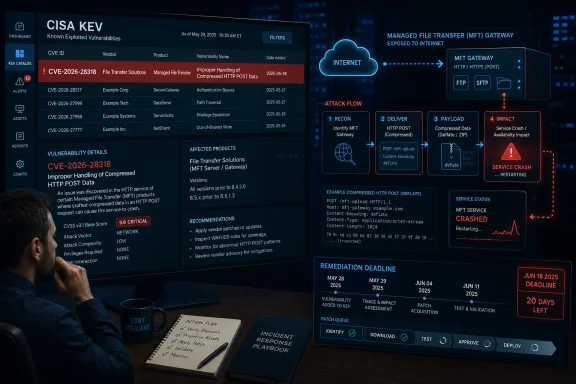
CISA’s Catalog Turns a Serv-U Crash Bug Into an Operational Deadline
The Known Exploited Vulnerabilities catalog is CISA’s way of separating theoretical risk from observed risk. A CVE can have an alarming score, a dramatic write-up, and a polished proof of concept, yet still sit in the “watch this” pile for many organizations. Once it lands in KEV, the message changes: someone is using it, defenders should assume exposure matters, and federal civilian agencies must act by the catalog’s due date.
That distinction is important for CVE-2026-28318 because the vulnerability description sounds deceptively modest. SolarWinds Serv-U can be crashed by specially crafted unauthenticated POST requests using Content-Encoding: deflate, according to public vulnerability records and vendor-linked advisories. The practical result is denial of service against a file transfer service that may sit directly on the internet.
For Federal Civilian Executive Branch agencies, Binding Operational Directive 22-01 makes the KEV catalog more than guidance. Agencies are required to remediate listed vulnerabilities on CISA’s schedule, generally by applying vendor updates, mitigations, or removing the affected product from service when fixes are not available. For everyone else, KEV is not legally binding, but it has become one of the clearest signals in vulnerability management: if you run the affected software, do not wait for the next quarterly maintenance window.
The Serv-U addition also lands in a category that defenders sometimes underrate. Remote code execution gets the emergency bridge call. Authentication bypass gets the incident-retainer treatment. Denial of service can be misfiled as nuisance, even when the targeted service is a business-critical file exchange point used by partners, customers, vendors, finance teams, and automated workflows.
The Weakness Is Availability, but the Target Is Trust
Serv-U’s role in many environments is not glamorous. It moves files. That can mean nightly reports, payroll exports, medical billing feeds, legal productions, customer uploads, firmware packages, procurement documents, or the awkward mix of legacy and modern protocols that accumulates in real enterprise networks. Managed file transfer and FTP-family services often survive because they sit at the intersection of old partner requirements and new compliance obligations.
That makes availability a security property, not just an uptime metric. If a file-transfer gateway can be remotely crashed without authentication, an attacker may not be stealing data through that bug, but they can still break business processes. The outage can force administrators into emergency changes, temporary workarounds, firewall exceptions, manual transfers, or hurried restores from snapshots.
Those moments are attractive to attackers. A denial-of-service event can be used to test whether a service exists, whether it is vulnerable, whether monitoring is alerting, and how quickly defenders respond. It can also create pressure that leads to mistakes: opening an alternate port, reviving an older server, disabling an inspection rule, or shifting traffic to a less monitored path.
There is also a reputational dimension. File-transfer systems tend to be trusted precisely because they are boring. When they fail repeatedly or unpredictably, the blast radius extends beyond the server process. Partners begin resending files, users invent shadow workflows, and help desks lose the ability to tell whether a missed transaction is a cyber event or just another failed job.
“Uncontrolled Resource Consumption” Is Bureaucratic Language for a Practical Weapon
The vulnerability class behind CVE-2026-28318 is CWE-400, uncontrolled resource consumption. In plain English, the software can be induced to consume enough memory, CPU, threads, or other resources that normal operation fails. In this case, the public description points to specially crafted POST requests and compressed content handling as the route to crashing the Serv-U service.
That does not require the attacker to log in. It does not require tricking a user into opening a document. It does not require a stolen password. The network vector, low attack complexity, and lack of required privileges are what make a “mere” availability flaw meaningful for internet-facing infrastructure.
The CVSS vector published for the vulnerability emphasizes high availability impact while showing no confidentiality or integrity impact. That is technically useful and operationally incomplete. A CVSS score describes the direct effect of the vulnerability; it does not describe what happens in a real company when the service that moves regulated files or contractual deliverables goes down at 2 a.m.
Security teams have learned this lesson from ransomware, DDoS extortion, and identity outages: attackers do not need to own every system to create leverage. Sometimes they only need to interrupt the system everyone else depends on. A file-transfer outage can become an incident because the business process around it is fragile.
SolarWinds’ Name Still Changes the Room
It is impossible to write about a SolarWinds security advisory without acknowledging the shadow cast by the 2020 supply-chain compromise of Orion. Serv-U is a different product, CVE-2026-28318 is a different vulnerability class, and there is no reason to conflate a denial-of-service bug with the historic Orion campaign. Still, defenders do not assess vendors in a vacuum.
SolarWinds has spent years rebuilding trust in its secure development and disclosure practices. That means every new SolarWinds vulnerability receives extra scrutiny, sometimes fairly and sometimes reflexively. The correct response is neither panic nor dismissal; it is disciplined inventory, exposure analysis, and rapid remediation.
Serv-U itself has had a busy recent vulnerability history. Earlier in 2026, SolarWinds released Serv-U 15.5.4 to address multiple critical issues, including flaws that drew attention because of their potential for elevated execution paths under certain conditions. CVE-2026-28318 follows as a separate availability issue, with public vulnerability data indicating that versions up to but excluding 15.5.4 and 15.5.4 without the hotfix are affected.
That version nuance matters. Many administrators hear “we upgraded to 15.5.4” and move on. The hotfix distinction means asset owners need to verify the precise build and patch state, not just the broad major or minor version displayed in a procurement spreadsheet.
The Patch Window Is Really an Exposure Window
CISA’s KEV listing does not tell defenders that exploitation might happen someday. It says exploitation has been observed. That should collapse the usual debate about whether the vulnerability is interesting enough to patch quickly.
For agencies bound by BOD 22-01, the remediation clock is formal. For private-sector organizations, the more important clock is the one set by attackers scanning the internet. Once a vulnerability is public, cataloged, and tied to active exploitation, defenders should assume automated probing will follow or has already begun.
The exposed systems are not always where central IT thinks they are. File-transfer servers often live in DMZs, subsidiary networks, acquisition leftovers, lab environments, vendor-managed enclaves, and “temporary” partner exchange zones that became permanent five years ago. They may be documented in firewall rules before they are documented in the configuration management database.
That is why the first useful question is not “Do we own SolarWinds Serv-U?” It is “What systems answer like Serv-U from the internet, partner networks, or internal segmentation boundaries?” The difference between those questions is the difference between a software inventory exercise and an exposure management exercise.
Windows Shops Should Not Treat This as Someone Else’s Edge Problem
WindowsForum readers know the pattern. A server product is not part of Windows itself, so it falls between desktop patching, Microsoft Patch Tuesday processes, and network security tooling. It runs on Windows Server, uses Windows service accounts, writes to Windows file shares, authenticates against directory infrastructure, and quietly becomes part of the Windows estate without being governed like a Windows component.
Serv-U deployments can be especially awkward in that respect. They may be administered by application teams, network teams, infrastructure teams, or business-unit operators. The Windows server may be patched on schedule while the application running on it lags behind. Endpoint detection may monitor the host but not understand the semantics of FTP, SFTP, FTPS, or HTTPS file-transfer workflows.
That creates a governance gap. Administrators may know the OS build, the EDR status, and the last reboot time, but not the exact Serv-U build or whether the hotfix is installed. Security teams may see traffic volume and service restarts without connecting them to a known exploited vulnerability.
The fix is not exotic. Confirm the product version, confirm whether the hotfix or later release is installed, reduce public exposure, and review logs for unexplained service crashes or suspicious POST requests. The harder part is ownership. Someone has to be accountable for the application layer on servers that otherwise look healthy.
Denial of Service Still Belongs in the Incident Playbook
Many organizations still separate “security incident” from “availability incident” too cleanly. That separation is convenient for ticket routing, but attackers do not respect it. A remotely triggerable crash against an externally reachable file-transfer service should be investigated as potentially hostile until proven otherwise.
The signs may not look like a breach. There may be no malware alert, no suspicious process tree, no new administrator account, and no obvious data exfiltration. Instead, the evidence may be repeated service termination, unusual compressed HTTP requests, bursts from hosting providers, failed partner transfers, and users reporting intermittent portal failures.
That is still worth preserving. Web logs, Serv-U logs, Windows Event Logs, crash dumps, reverse proxy telemetry, firewall records, and packet captures can help establish whether an outage was random, accidental, or exploit-driven. If the service is business-critical, defenders should resist the temptation to “just restart it” repeatedly without collecting enough evidence to understand the pattern.
There is also a containment question. If the server must remain online before a patch can be applied, mitigation should not rely solely on hope. Restricting access to known partner IP ranges, placing the service behind a VPN or access proxy, disabling unneeded HTTP/S interfaces where feasible, and adding detection for suspicious compressed POST traffic can reduce risk while operations teams schedule the permanent fix.
None of those mitigations should become a substitute for patching. Temporary controls have a habit of becoming architecture. KEV entries are a reminder that attackers are already testing the gap between “we know” and “we fixed.”
The Vendor Advisory Is Necessary but Not Sufficient
Vendor advisories are written to identify affected versions, provide fixes or mitigations, and communicate severity. They are not designed to map an individual organization’s business dependency graph. That is the defender’s job.
For CVE-2026-28318, SolarWinds’ advisory and related release notes point customers toward updated Serv-U builds and mitigation steps for cases where the update cannot be deployed immediately. Public vulnerability data describes the affected configurations as versions prior to 15.5.4 and a 15.5.4 release state that requires the hotfix. That makes validation more important than assumption.
Administrators should be wary of three common failure modes. The first is patching a test instance while leaving the internet-facing production gateway untouched. The second is updating the application but forgetting a standby node, disaster recovery host, or partner-specific instance. The third is relying on a vulnerability scanner that identifies the product family but cannot reliably distinguish the hotfix level.
This is where change records become security artifacts. If the organization cannot prove which Serv-U servers exist, which versions they run, which interfaces are exposed, and which controls sit in front of them, the KEV listing should trigger more than an update. It should trigger a cleanup of the asset story.
The Federal Mandate Has Become the Private-Sector Shortcut
BOD 22-01 formally applies to federal civilian agencies, but its influence reaches much further. Private companies use the KEV catalog because it solves a prioritization problem that CVSS alone never solved. Severity tells you what could happen; KEV tells you what attackers are known to care about.
That matters because vulnerability management is drowning in numbers. Enterprises may see thousands of open findings across endpoints, servers, network appliances, cloud workloads, and applications. If every critical vulnerability is “urgent,” urgency loses operational meaning. KEV gives defenders a defensible way to say: this one moves ahead because exploitation is not hypothetical.
The model is not perfect. CISA does not always disclose exploitation details, and defenders may want more telemetry than the catalog provides. But the catalog’s restraint is part of its utility. It is not a rumor feed. A KEV addition means CISA believes the vulnerability meets criteria for known exploitation and available remediation or meaningful action.
For boards and executives, that makes the message simpler. This is not a debate over theoretical scoring. A U.S. government cyber agency has placed the vulnerability on the list it uses to compel federal remediation. If a business chooses to delay, it should be a conscious risk decision, not an artifact of backlog gravity.
Serv-U Sits in the Awkward Zone Between Legacy Protocols and Modern Risk
File transfer is one of the oldest enterprise IT problems, and somehow it remains one of the least solved. Organizations have moved identity to cloud directories, email to hosted platforms, workloads to containers, and security telemetry to data lakes. Then a supplier still needs SFTP on Tuesdays, a bank requires a fixed IP allowlist, and an internal application exports CSV files to a folder watched by a transfer daemon.
That is how products like Serv-U remain strategically important even when they are operationally invisible. They are glue. They connect systems that were not designed to connect cleanly. Glue systems rarely get the architectural attention they deserve because they are judged by whether they keep yesterday’s workflow alive.
Attackers understand this. Edge-facing transfer services, VPNs, remote management tools, and secure gateways all share an attractive trait: they sit at the boundary between trust zones. They are reachable enough to be useful and privileged enough to matter. Even when a vulnerability only knocks the service over, the target’s placement gives the attack operational weight.
The lesson is not that organizations should abandon managed file transfer overnight. The lesson is that these systems should be treated like identity providers, VPN concentrators, and email gateways: internet-exposed infrastructure with strong patch expectations, hardened configurations, monitored logs, and clear owners.
The Real Remediation Is Boring, Which Is Why It Works
There is no clever trick required here. The effective response is the kind of operational discipline security teams preach constantly and struggle to enforce consistently. Find every Serv-U instance. Determine whether it is affected. Patch or apply vendor mitigations. Reduce exposure. Look for evidence of exploitation.
The details matter. Teams should verify version and hotfix level from the application itself, not only from package inventory. They should check whether Serv-U is bound to public interfaces, internal-only networks, partner VPN ranges, or reverse proxies. They should review whether the service runs with more privileges than necessary and whether file repositories have excessive access to downstream shares.
Monitoring should focus on both application and platform signals. Repeated crashes of the Serv-U service, unexplained restarts, abnormal POST traffic, and bursts of compressed requests deserve attention. So do changes made under pressure after outages begin, because emergency workarounds often create the next incident.
For organizations with mature programs, CVE-2026-28318 should be a fast operational ticket. For organizations with weaker visibility, it may expose a larger problem: they cannot quickly answer whether an actively exploited vulnerability affects them. That inability is itself a security finding.
The Serv-U KEV Entry Leaves Little Room for Comfortable Delay
The concrete lesson from this CISA alert is not that every SolarWinds customer is in crisis. It is that exposed file-transfer infrastructure deserves the same urgency defenders already give to VPNs, firewalls, and identity systems. A crash bug with active exploitation is still an attacker-controlled failure mode.
- Organizations running SolarWinds Serv-U should verify the exact installed build and hotfix state, not merely whether they are on the 15.5.x branch.
- Internet-facing Serv-U instances should be patched or mitigated before routine maintenance cycles if they are affected by CVE-2026-28318.
- Security teams should review logs for suspicious compressed POST requests, repeated service crashes, and unexplained restarts around the disclosure and KEV-addition window.
- Administrators should reduce exposure by limiting access to trusted networks or partner IP ranges wherever business requirements allow.
- Private-sector defenders should treat the KEV listing as a prioritization signal even though BOD 22-01 formally binds only federal civilian agencies.
- Asset owners should use this incident to confirm who is responsible for third-party server applications running on Windows infrastructure.
CVE-2026-28318 will probably not be remembered as the most dramatic vulnerability of 2026, and that is exactly the point. Modern defensive work is increasingly about closing the unglamorous holes attackers actually use: the crashable gateway, the forgotten hotfix, the public-facing service no one fully owns. CISA’s latest KEV addition is a small entry in a very large catalog, but for any organization relying on Serv-U to move important files, it should be treated as a deadline, a detection opportunity, and a reminder that availability is part of security.
References
- CISA Adds One Known Exploited Vulnerability to Catalog CISA · 2026-06-05T12:00:00+00:00