

CISA has added a GeoServer XML External Entity (XXE) flaw — tracked as CVE-2025-58360 — to its Known Exploited Vulnerabilities (KEV) catalog, elevating the bug from a vendor patch notice to an operational priority for federal agencies and an urgent remediation signal for the wider community.
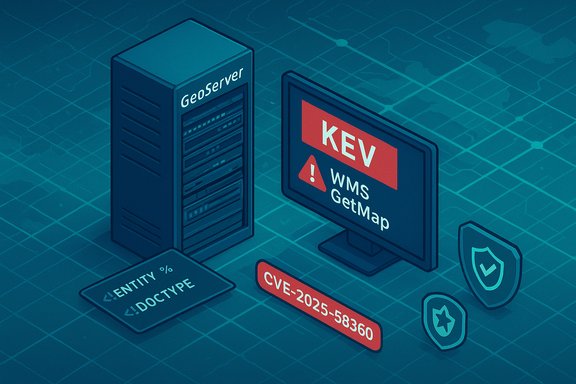
GeoServer is an open‑source server used to publish geospatial data and maps via OGC services such as WMS (Web Map Service). The newly cataloged flaw is an unauthenticated XML External Entity (XXE) vulnerability that affects the WMS GetMap endpoint, allowing attackers to submit crafted XML to the /geoserver/wms GetMap operation and abuse entity expansion to reach local files, internal services, or otherwise disrupt service. Public vulnerability databases and the GeoServer project list the vulnerability as CVE‑2025‑58360 and show that fixes were released in the GeoServer maintenance stream. CISA’s KEV catalog is maintained under Binding Operational Directive (BOD) 22‑01, which requires Federal Civilian Executive Branch (FCEB) agencies to remediate listed vulnerabilities by the due dates specified in the catalog. When CISA places a CVE on KEV, it is because there is credible evidence of active exploitation in the wild — the operational signal is clear: agencies must act quickly and private sector operators should treat the entry as high priority. At the project level, GeoServer’s advisory and release notes confirm the technical root cause (XXE via WMS GetMap) and identify patched versions in the 2.25.x, 2.26.x, and 2.27.x lines. Independent vulnerability trackers and multiple security advisories also summarize the same attack surface effects: file disclosure, SSRF, and DoS potential.
Recommended priority:
Source: CISA CISA Adds One Known Exploited Vulnerability to Catalog | CISA
 Background / Overview
GeoServer is an open‑source server used to publish geospatial data and maps via OGC services such as WMS (Web Map Service). The newly cataloged flaw is an unauthenticated XML External Entity (XXE) vulnerability that affects the WMS GetMap endpoint, allowing attackers to submit crafted XML to the /geoserver/wms GetMap operation and abuse entity expansion to reach local files, internal services, or otherwise disrupt service. Public vulnerability databases and the GeoServer project list the vulnerability as CVE‑2025‑58360 and show that fixes were released in the GeoServer maintenance stream. CISA’s KEV catalog is maintained under Binding Operational Directive (BOD) 22‑01, which requires Federal Civilian Executive Branch (FCEB) agencies to remediate listed vulnerabilities by the due dates specified in the catalog. When CISA places a CVE on KEV, it is because there is credible evidence of active exploitation in the wild — the operational signal is clear: agencies must act quickly and private sector operators should treat the entry as high priority. At the project level, GeoServer’s advisory and release notes confirm the technical root cause (XXE via WMS GetMap) and identify patched versions in the 2.25.x, 2.26.x, and 2.27.x lines. Independent vulnerability trackers and multiple security advisories also summarize the same attack surface effects: file disclosure, SSRF, and DoS potential. What CVE‑2025‑58360 actually is
Technical summary
- Vulnerability type: XML External Entity (XXE) — improper handling of XML input that allows external entity definitions to be resolved by the XML parser.
- Affected component and endpoint: GeoServer WMS GetMap (/geoserver/wms) when XML is accepted as part of a POST request or request body used to produce map images.
- Authentication: Unauthenticated — no credentials are required to trigger the vulnerability if the endpoint is exposed to an attacker.
- Impact vectors:
- Local file disclosure (read arbitrary server files).
- Server‑Side Request Forgery (SSRF) to internal services or metadata endpoints.
- Denial‑of‑Service (DoS) through entity expansion or resource exhaustion.
- Patched versions: GeoServer 2.25.6, 2.26.3, and 2.27.0 (or later). Operators on older maintenance releases should upgrade or apply vendor mitigations immediately.
Why XXE remains dangerous in 2025
XXE is a mature but persistent web‑application weakness: it can be exploited with relatively simple XML payloads, often without user interaction, and the impact is contextual — from information disclosure to full pivot capability when internal metadata or credentials are reachable. In map servers like GeoServer, the feature set expects structured requests that can include XML fragments, which makes the attack surface non‑trivial and remote exploitation straightforward where endpoints are public. Independent advisories detail exploit consequences consistent with XXE behavior: file reads, SSRF, and DoS.Why this KEV listing matters — operational and compliance implications
- Federal remediation deadlines (BOD 22‑01): KEV entries trigger specific remediation deadlines for FCEB agencies. While the exact due date for this CVE is listed in the KEV catalog entry, the practical effect is the same: agencies must either patch, mitigate, or isolate affected assets within the specified time window. The KEV process converts threat telemetry into enforceable timelines.
- Signal for the private sector: Even though BOD 22‑01 binds federal agencies, the KEV list acts as a de‑facto priority ranking for industry. Managed service providers, cloud operators, and enterprises that host GeoServer instances are strongly advised to treat this as a critical patching priority.
- Attack surface concentration: GeoServer often sits at the boundary between internal GIS datasets and public web mapping portals. Unpatched instances exposed to the Internet are attractive targets for reconnaissance and lateral movement because geospatial stacks often integrate with file stores, databases, and internal APIs.
- Evidence of exploitation: CISA only lists CVEs in KEV when there is credible evidence of active exploitation. That evidentiary threshold means that defenders should assume weaponization has already occurred in the wild and that opportunistic scans and broad exploitation campaigns are likely. Where telemetry is available, incident responders should hunt for known exploit indicators.
Immediate action checklist (what organizations should do now)
The following tasks are presented in order of speed and impact. These are practical, defensible actions for security teams, GIS operators, and system administrators.- Patch or upgrade
- Upgrade GeoServer to a fixed version: 2.25.6, 2.26.3, 2.27.0, or later as appropriate for your deployment and compatibility needs. If using packaged distributions (OS packages, Docker, vendor appliances), apply the vendor’s security update immediately.
- If immediate patching is impossible, apply temporary mitigations
- Restrict access to the WMS endpoint (/geoserver/wms) using network ACLs, firewalls, or load‑balancer rules to allow only known/required clients.
- Configure a Web Application Firewall (WAF) with rules to block POST requests with XML payloads to /geoserver/wms or to block suspicious entity declarations.
- Disable or restrict XML entity resolution in the XML parser configuration if that’s configurable in the deployment stack.
- Detection and hunting
- Search logs for HTTP POST or unusual GET requests to /geoserver/wms, especially those with Content-Type: application/xml or requests that contain <!ENTITY or <!DOCTYPE fragments.
- Hunt for spikes in 400/500 responses from WMS endpoints and for long request processing or memory spikes indicative of entity expansion or DoS attempts.
- Use IDS/IPS signature sets that include XXE/SSRF indicators; run targeted scans across your asset inventory for exposed /geoserver/wms endpoints (internal and Internet‑facing).
- Hardening and configuration
- Ensure the GeoServer process runs with least privilege and that filesystem access is restricted to non‑sensitive directories.
- Harden Java XML parsers: disable external entities and DTD processing (set secure processing flags depending on parser implementation) and use secure XML factories.
- Segment GIS servers from critical back‑end systems; treat them as internet‑facing services and apply the same network segmentation as front‑end web services.
- Validate and verify
- After patching, validate by performing controlled functional tests: run canonical GetMap requests and validate behavior.
- Verify that mitigations (WAF rules, ACLs) do not unduly break legitimate client use-cases.
- Run vulnerability scans and passive monitoring to confirm endpoints no longer accept external entities.
Detection specifics and example hunts
Short, actionable detection steps security operations teams can use immediately:- Search web server access logs and proxies for the string "<!ENTITY" or "<!DOCTYPE" in requests to /geoserver/wms.
- Look for requests with Content-Type: application/xml or text/xml where the request size is small but server processing time is large (possible external entity resolution).
- Query SIEM for connections that include internal IPs being accessed by the GeoServer host — potential SSRF footprints.
- Use YARA/Snort/Suricata rules that detect common XXE payload patterns and entity declarations in HTTP bodies.
- HTTP logs: source_ip, request_uri = "/geoserver/wms", http_method = POST, request_body contains "<!ENTITY"
- Proxy logs: http_response_code >= 500 and request_uri contains "/geoserver/wms" and response_time > 5s
Technical mitigation details (developer & operator guidance)
- For Java deployments, set the following parser properties (or equivalent in your stack) to disable DTDs and external entities:
- javax.xml.XMLConstants.FEATURE_SECURE_PROCESSING = true
- Set the underlying SAX/DOM parser features that disable external-general-entities and external-parameter-entities.
- Review and patch any XML libraries and middleware that perform XML parsing on behalf of GeoServer extensions.
- If GeoServer is embedded behind other middleware (reverse proxies, API gateways), ensure they validate and normalize request bodies before passing them to the backend.
Risk assessment: who is most at risk?
- Public‑facing GeoServer WMS instances are at highest risk because the vulnerability is unauthenticated and network‑accessible endpoints are trivially exploitable by remote attackers.
- Multi‑tenant or shared hosting where GeoServer runs with broader filesystem or network privileges amplifies impact: an exploited instance can read sensitive configuration or keys.
- Organizations that use GeoServer to mediate requests to internal GIS back‑ends or metadata services (databases, internal REST APIs) could see SSRF pivoting into confidential systems.
- Legacy deployments that cannot be patched quickly are uniquely vulnerable; compensating controls and rapid isolation strategies are essential in those environments.
Strengths and limitations of the public response
- Strengths:
- Timely vendor patches: GeoServer release notes and advisories show the project issued fixes in the maintenance stream, giving operators clear upgrade paths.
- KEV listing accelerates remediation: CISA’s catalog entry elevates the issue to a compliance and operational priority for federal agencies, which typically drives broader patch adoption across government and enterprise partners.
- Limitations and risks:
- Potential lag in KEV publication visibility: Sometimes the public-facing CISA narrative or the catalog entry is available before full telemetry or vendor guidance is widely disseminated; confirm patch instructions and test plans before broad rollout.
- Exploit simplicity: XXE payloads are easy to craft — defenders must assume scanning and exploitation attempts will proliferate rapidly once public disclosure and PoCs appear.
- Operational compatibility: Upgrading GeoServer in production GIS stacks often requires coordination with data stores, style libraries, and client applications; rushed upgrades without staging can lead to service disruptions.
Practical rollout and testing plan for administrators
- Inventory & exposure mapping
- Identify all GeoServer instances (public and private).
- Flag instances exposing /geoserver/wms to the Internet or broad internal networks.
- Staging & testing
- Deploy the vendor patch or upgraded GeoServer to a staging environment.
- Run canonical GetMap calls, client integrations, and performance tests to ensure compatibility with map clients and tile caches.
- Production deployment
- Schedule a maintenance window where necessary and deploy in a controlled manner.
- Monitor server metrics (CPU, memory) and logs immediately after rollout for anomalies.
- Post‑deployment validation
- Re-scan the asset with vulnerability scanners to confirm the CVE is addressed.
- Continue hunting for pre‑patch exploitation artifacts in logs for at least 30 days.
- Communication
- Notify downstream users and clients of the maintenance window and expected compatibility impacts.
- For FCEB agencies, document actions taken to satisfy BOD 22‑01 requirements.
Long‑term resilience: lessons from this KEV addition
- Treat internet‑facing GIS services like any other public web application: adopt the same secure SDLC practices, automated testing, and layered defenses that apply to general web apps.
- Adopt assume breach practices for exposed services — deploy strict network segmentation and least‑privilege runtime environments.
- Build an automated inventory and patch pipeline that covers OSS stacks like GeoServer. The KEV process demonstrates that open‑source infrastructure can be exploited at scale and must be managed with the same rigor as commercial stack components.
- Keep XML parsing libraries and middleware under lifecycle vigilance: many vulnerabilities arise not in the application logic but in parsers and configuration defaults.
Final verdict and recommended priority
CVE‑2025‑58360 is a high‑risk, weaponized XXE vulnerability in a widely used geospatial server. The availability of vendor patches and GeoServer’s targeted releases removes any technical excuse to leave affected instances unpatched. Because the vulnerability is unauthenticated and supports information disclosure and SSRF, it poses a substantive risk to both confidentiality and downstream trust in GIS pipelines.Recommended priority:
- For public‑facing instances: Immediate — patch, or at minimum block the WMS endpoint from untrusted networks and deploy WAF rules now.
- For internal instances: High — patch during the next maintenance window but use compensating controls (ACLs, network isolation) until the patch can be applied.
- For federal agencies: follow the KEV remediation timelines mandated by BOD 22‑01 and document mitigation steps to meet compliance requirements.
Source: CISA CISA Adds One Known Exploited Vulnerability to Catalog | CISA
