

Background / Overview
CISA’s KEV Catalog is intentionally pragmatic: it lists CVEs for which the agency has credible evidence of exploitation in the wild and uses that evidence to set remediation expectations for federal networks under BOD 22‑01. The directive requires federal agencies to remediate or mitigate listed vulnerabilities by the due dates in the KEV entries; while the mandate does not legally apply outside the federal enterprise, the operational signal is universauld immediately reorder patching priorities everywhere.
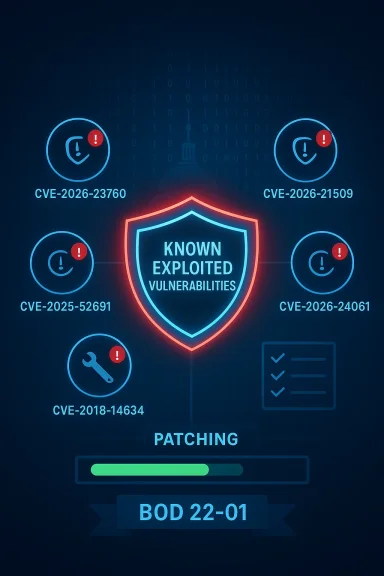
This January 26, 2026 update named five CVEs spanning very different ecosystems and risk profiles:
- CVE‑2018‑14634 — Linux kernel integer overflow (local privilege escalation).
- CVE‑2025‑52691 — SmarterTools SmarterMail unrestricted upload of files with dangerous types (unauthenticated arbitrary file upload leading to RCE).
- CVE‑2026‑21509 — Microsoft Office security feature bypass (local bypass of mitigation mechanisms).
- CVE‑2026‑23760 — SmarterTools SmarterMail authentication bypass via an alternate path (password reset API allowing admin account takeover).
- CVE‑2026‑24061 — GNU Inetutils argument injection (telnetd USER environment argument injection leading to authentication bypass / root access).
Each entry highlights an important defender reality: attackers keep returning to the highest‑impact, lowest‑friction primitives — remote unauthenticated uploads, forgotten legacy protocols, and as that convert access to complete control. The KEV designation confirms these are not theoretical; they are prioritized because of active or credible exploitation evidence.
CVE deep dives: what was added, why it matters, and what to do now
CVE‑2025‑52691 — SmarterMail: unrestricted upload of file with dangerous type (RCE risk)
- What it is: A critical, unauthenticated arbitrary file upload vulnerability in SmarterTools’ SmarterMail that allows attackers to write files to arbitrary paths on the mail server. Attackers who can place web shells, scripts, or binaries into web‑accessible or executable locations can achieve remote code execution and full server compromise.
- Affected versions and timeline: SmarterMail builds through 9406 were reported vulnerable; SmarterTools released a patch (Build 9413) in October 2025 and later builds in December 2025. Multiple independent trackers (security research blogs, CSA advisory summaries, and comprehensive CVE trackers) assigned a maximum or near‑maximum severity (CVSS v3.1 = 10.0 in several feeds).
- Exploitation status: Public reporting indicates proof‑of‑concepts and large numbers of internet‑exposed servers were observable during the disclosure window; the widespread presence of SmarterMail on hosting infrastructure raised the stakes because a single compromised mail server can be used to host phishing, spam, or lateral movement into hosting customers’ environments. Observers documented thousands of potentially vulnerable hosts exposed to the internet prior to patching push.
- Why defenders should care: Email servers handle sensitive data, hold admin credentials and tenant configuration, and often run with elevated privileges. A remote, unauthenticated RCE on a mail server is a rapid path to data theft, persistent footholds, cryptomining, and mass abuse of outbound email.
- Immediate mitigations:
- Apply the vendor update (SmarterMail Build 9413 or later) without delay.
- If immediate patching is impossible, implement network controls: block public access to SmarterMail management and upload endpoints, place the server behind a WAF with strict POST size/type rules, and restrict admin panel access to trusted IP ranges.
- Hunt for signs of arbitrary file writes, web shells, unexpected executables, and anomalous outbound SMTP connections. Use file integrity monitoring to detect new, suspicious files in web and system directories.
CVE‑2026‑23760 — SmarterMail: authentication bypass using an alternate path or channel (password‑reset API)
- What it is: An authentication bypass in SmarterMail’s password reset API where the force‑reset endpoint permitted anonymous requests and failed to validate reset tokens or existing credentials, effectively permitting unauthenticated resets of administrator passwords. The NVD description notes that successful exploitation can give an attacker system administrator privileges, which may be translated into OS‑level command execution via management functionality.
- Affected versions and timeline: Versions prior to Build 9511 were reported vulnerable; the CVE was publicly cataloged January 22, 2026. Security trackers put the CVSS in the critical range when considering the practical consequences of admin account takeover.
- Exploitation status: Rapid public disclosures and proof‑of‑concept descriptions followed the disclosure window; because an unauthenticated attacker can take control of an administrator account, the impact is effectively complete compromise for affected instances.
- Immediate mitigations:
- Apply vendor updates to Build 9511 or later and confirm release notes address the reset endpoint.
- Rotate all SmarterMail administrative credentials, inspect for unauthorized changes to admin accounts, and examine management logs for anomalous password reset events.
- Consider additional hardening: enforce IP whitelisting for password‑reset/admin endpoints, and centralize authentication through an identity provider (SAML/OAuth) if supported.
CVE‑2026‑21509 — Microsoft Office: security feature bypass (local bypass of OLE/COM mitigations)
- What it is: A Microsoft Office security feature bypass vulnerability that allows reliance on untrusted inputs to defeat an Office protection mechanism — effectively, attackers who can convince a user to open malicious content may bypass mitigations designed to stop malicious COM/OLE controls from executing. This class is particularly dangerous because it targets the defensive logic that platform hardening is built on.
- Affected products and timeline: Microsoft’s advisory and multiple CVE feeds listed affected Office versions including Microsoft 365 Apps for Enterprise, Office LTSC releases, and earlier Office builds; Microsoft released out‑of‑band updates the same day the CVE was published (January 26, 2026), with registry‑based mitigations available for some legacy off‑cycle builds where full updates were not yet available.
- Exploitation status: Microsoft indicated active exploitation and issued emergency updates; independent security outlets corroborated that weaponized documents were observed in targeted attacks. The vendor’s remediation guidance included temporary registry mitigations for Office 2016/2019 customers who could not immediately install the cumulative fix.
- Immediate mitigations:
- Deploy Microsoft’s out‑of‑band Office updates immediately to affected endpoints.
- Apply Microsoft’s recommended registry mitigations where full updates are delayed.
- Tighten macros/COM control policies, disable preview handlers in email clients where practical, and limit opening of Office attachments from untrusted sources.
- Hunt for suspicious Office document indicators and unusual child processes spawned by Office applications.
CVE‑2026‑24061 — GNU Inetutils: argument injection in telnetd (remote auth bypass => root)
- What it is: A critical argument‑injection vulnerability in GNU Inetutils’ telnetd where the USER environment variable could be set to a special value (for example, “-f root”) and passed unsanitized to the system login process; in many environments this results in authentication bypass and immediate root access. Because telnetd invokes system login with the supplied USER argument, the null‑sanitization of the variable translates into a direct privilege jump.
- Affected versions and timeline: telnetd in GNU Inetutils up through 2.7 was reported vulnerable; the CVE was published January 21, 2026, with vendor and distribution fixes and patches rolling out almost immediately to mainstream distros. Security advisories from national CERTs urged emergency remediation or disabling telnet altogether.
- Exploitation status: Multiple threat telemetry vendors observed exploitation attempts within hours of public disclosure; because telnet is a legacy protocol still present in some embedded and industrial environments, the quick weaponization was predictable and widely observed.
- Immediate mitigations:
- Remove or disable telnetd entirely and migrate services to SSH with modern key management.
- If telnet cannot be removed immediately (rare but possible in legacy OT/embedded systems), apply vendor or distro patches as soon as available and block TCP/23 from untrusted networks.
- Use network segmentation and strict firewall policies to ensure telnet endpoints are not internet‑acces14634 — Linux kernel create_elf_tables integer overflow (local privilege escalation)
- What it is: An integer overflow in the Linux kernel’s create_elf_tables() function that can enable privilege escalation when an unprivileged user can trigger execution via SUID or otherwise privileged binaries — historically important because it demonstrates how local vector bugs in exec/load paths can be turned into root compromises.
- Affected versions and status: Originally disclosed in 2018, the vulnerability affected many kernel lines (2.6.x, 3.10.x, 4.14.x series) and was patched by distributions at the time; NVD and vendor advisories still list the CVE for the historical record, and the KEV addition reiterates that known older CVEs can resurface in environments that never received timely kernel updates.
- Why it’s resurfacing in KEV: CISA’s KEV list occasionally includes legacy CVEs when intelligence shows attackers are successfully using old, unpatched vulnerabilities against still‑running systems. The practical lesson: system lifecycles and patch-management discipline matter as much as the discovery date of a CVE.
What this mix of CVEs tells us about the threat landscape
- Attackers prefer high‑impact primitives: Unauthenticated RCE via file upload and authentication bypasses are extremely high payoff and low friction for adversaries. SmarterMail’s tandem (upload + reset API bypasses) shows how a vendor’s multiple weaknesses can be chained into immediate full compromise.
- Legacy protocols remain a recurring liability: The GNU Inetutils telnetd issue is a classic example where old protocols (telnet) and old assumptions (passing environment variables unsafely) create an outsized blast radius in specific sectors (OT, embedded, lab equipment). The systemic advice is simple: stop using telnet unless you absolutely must and isolate it when unavoidable.
- Old bugs can become new campaigns: The inclusion of CVE‑2018‑14634 underscores that decades‑old CVEs matter if devices were never patched. Attackers scan for low‑hanging fruit — old kernels, forgotten appliances, long‑lived VMs — and exploit them en masse.
- KEV is both regulatory and operational: For federal agencies KEV triggers operational deadlines under BOD 22‑01; for private sector teams it’s a prioritized threat intelligence feed you should mirror in your patching and vulnerability‑management processes.
Operational guidance: immediate actions for IT and security teams
Below is a pragmatic, prioritized checklist you can adopt in the next 24–72 hours.
- Triage and confirm exposure
- Inventory all Internet‑exposed services and appliances. Search for SmarterMail instances, telnetd listeners (TCP/23), and legacy Linux kernels across your estate.
- Use authenticated vulnerability scanners to map exact builds and versions (e.g., SmarterMail build numbers, inetutils versions, kernel ABI). Tools that track exact product build metadata will save time.
- Patch and mitigate
- Apply vendor patches immediately:
- SmarterMail: upgrade to fixed builds 9413 (for CVE‑2025‑52691) and 9511 (for CVE‑2026‑23760) or later.
- Microsoft Office: deploy Microsoft’s out‑of‑band Office updates and follow registry mitigations for legacy Office 2016/2019 until full updates are installed.
- GNU Inetutils: upgrade telnetd to the patched release or disable telnetd.
- Linux kernels: ensure all hosts run updated, vendor‑patched kernels; prioritize SUID binaries and systems with heavy local‑user exposure.
- Contain and harden
- Block public access to management endpoints and legacy protocols. If SmarterMail must be Internet‑accessible, front it with a proxy/WAF that enforces strict request validation, size limits, and file type controls.
- Disable telnet and remove telnetd where possible; migrate to SSH authentication.
- Harden Office document handling: disable preview panes for mail clients where practical, restrict macro execution policies, and apply application control to prevent Office from spawning unsigned child processes.
- Hunt and validate
- Search logs for evidence of exploitation: unauthorized file writes, sudden admin password resets, new scheduled tasks, unusual telnet sessions, suspicious Office‑spawned processes, and anomalous outbound traffic.
- Use EDR and file integrity monitoring to detect web shells, unexpected executables, and persistence artifacts.
- Post‑remediation validation and reporting
- Validate fixes with vulnerability scans and penetration test reconfirmation.
- For federal entities: respond to BOD 22‑01 requirements and confirm remediation in the KEV tracking flow as required.
- Share indicators of compromise with your peer community and incident‑response vendor if you detect confirmed exploitation.
Strengths and risks in CISA’s KEV approach (critical analysis)
- Strengths
- Operational clarity: KEV converts intelligence into prioritized action, giving defenders an evidence‑backed signal to triage scarce patching resources. Publicizing exploited CVEs accelerates mitigation across the ecosystem.
- Timeliness: adding CVEs rapidly after exploitation reports helps reduce dwell time by focusing attention on live threats rather than theoretical risk.
- Policy teeth: BOD 22‑01 creates measurable deadlines and accountability for federal agencies, which raises baseline cyber hygiene across government services.
- Risks and potential gaps
- Patch availability and compatibility: Many organizations — especially those with complex vendor ecosystems or legacy stacks — cannot instantly apply patches without risking service outages. Vendor fixes sometimes lag public disclosure, forcing mitigations rather than full remediation.
- Supply‑chain and multi‑tenant hosting exposure: Vulnerabilities in hosting or managed services (e.g., shared SmarterMail hosts) mean the risk to tenants is outsized; even immediate patching of a tenant’s application won’t help if the underlying shared infrastructure remains vulnerable.
- Signal‑to‑noise for smaller teams: Non‑federal teams with limited SOC capacity may struggle to prioritize across many KEV updates; CISA’s KEV list helps, but operational friction remains in mapping CVEs to actual inventory and patches.
- Legacy/embedded devices: For devices that cannot be patched easily (OT, embedded controllers, appliances), KEV entries can spotlight hard risks without a straightforward remediation path, leaving operators with containment‑only options. The GNU Inetutils telnetd CVE is a case in point.
Special considerations for Windows environments and administrators
- Microsoft Office CVE‑2026‑21509 is the most immediately relevant KEV entry for Windows‑centric organizations. Deploy Microsoft’s out‑of‑band Office updates immediately and apply recommended registry mitigations for older installations where necessary. Disable dangerous Office features (macro execution, external content) through Group Policy while updates are deployed.
- If your Windows estate relies on Linux‑backed mail services, hosting providers, or third‑party appliances, the SmarterMail items are still relevant because compromised mail servers can weaponize Windows users via phishing and malicious attachments. Ensure email gateways and endpoint protection inspect and block known malicious payloads and
- For organizations running mixed infrastructure, prioritize:
- EDR and process‑level monitoring on endpoints for unusual child process creation coming from Office apps.
- Network egress controls to prevent compromised servers from calling back to attacker infrastructure.
- Centralized logging and correlation to detect password reset anomalies and unexpected admin activities across tenant services.
Closing assessment and recommended roadmap
CISA’s January 26, 2026 KEV update reinforces a few immutable truths about operational security:
- Attackers will always favor the highest impact routes: unauthenticated uploads, authentication bypasses, and unsanitized legacy protocols.
- Vulnerability management is no longer cyclical — it’s continuous and must be integrated with rapid inventorying, prioritized patching, and compensating controls.
- KEV entries should be treated as emergency triage items by every security team, not just federal agencies; the combination of proven exploitation and high impact makes them first‑order risks.
Practical next steps (executive summary):
- Immediately map exposures for the five CVEs listed in the KEV update.
- Patch SmarterMail and Office per vendor guidance, disable telnetd and edge‑expose legacy services, and update Linux kernels on susceptible hosts.
- Hunt, contain, and validate: look for signs of exploitation while verifying patches actually removed the vulnerable behavior.
- Convert KEV urgency into organizational policy: integrate KEV monitoring into your vulnerability‑management SLA and automate as much of the triage, patching, and verification pipeline as possible.
CISA’s KEV additions offer a timely operational alarm bell — heed it. Prioritize the fixes, isolate exposed services, and rebuild patch discipline around the reality that evidence‑backed exploitation will always attract attackers faster than most organizations can react.