

CISA’s latest KEV catalog update — which adds three high-profile, actively exploited vulnerabilities impacting Cisco, SonicWall, and ASUS products — is another hard reminder that modern vulnerability management is no longer optional. Federal agencies already face binding deadlines under BOD 22-01, and private-sector IT teams need to treat these entries as emergency priorities: the flaws are weaponized in the wild, they affect management interfaces and update channels, and at least one represents a supplier-side compromise that can bypass conventional update validation. This story explains what was added, why each item matters, how vendors and defenders are responding, and concrete, step-by-step guidance for Windows-centric environments and enterprise defenders to reduce exposure immediately.
On December 17, 2025, three vulnerabilities were flagged as known exploited vulnerabilities and called out for prioritized remediation:
Source: CISA CISA Adds Three Known Exploited Vulnerabilities to Catalog | CISA
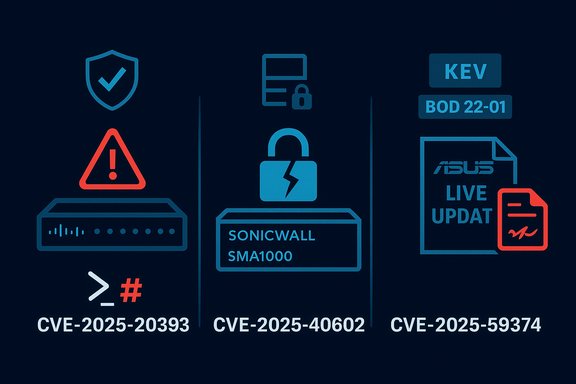 Overview: what CISA added and why it matters
On December 17, 2025, three vulnerabilities were flagged as known exploited vulnerabilities and called out for prioritized remediation:- CVE-2025-20393 — Cisco: Improper input validation in Cisco Secure Email Gateway and Cisco Secure Email and Web Manager that allows remote command execution as root on affected appliances.
- CVE-2025-40602 — SonicWall: Missing authorization in SonicWall SMA1000 Appliance Management Console (local privilege escalation), observed chained with earlier SMA zero-days to enable full compromise.
- CVE-2025-59374 — ASUS: Supply-chain compromise in older ASUS Live Update client builds resulting in embedded malicious code in distributed update packages.
Background: Binding Operational Directive (BOD 22-01) and the KEV catalog
BOD 22-01 created the operational muscle behind the KEV catalog: vulnerabilities that show evidence of exploitation are treated as time-sensitive operational priorities for federal agencies. The practical effect is straightforward: if a CVE appears in CISA’s KEV, federal IT teams must act within the deadline specified in the KEV entry, and organizations should treat KEV entries as top-tier items in their vulnerability management workflows. The KEV catalog is run as a living list and is intentionally focused on CVEs with demonstrable in-the-wild exploitation to help defenders prioritize scarce patching capacity. This latest KEV update is a textbook example of the sorts of risks BOD 22-01 targets: remote command execution on edge appliances (Cisco), chained local authorization bugs enabling root (SonicWall), and a software update supply-chain compromise (ASUS). Each of these attack vectors has a long record of being used by both sophisticated nation-state actors and financially motivated cybercrime groups.Deep dive: CVE-2025-20393 — Cisco Secure Email Gateway and Secure Email and Web Manager
What is it?
CVE-2025-20393 is described by Cisco as an improper input validation vulnerability in Cisco AsyncOS used on Cisco Secure Email Gateway (SEG) and Cisco Secure Email and Web Manager (SEWM) appliances. The bug permits unauthenticated or otherwise low-privilege actors to execute arbitrary OS commands with root privileges on vulnerable appliances when certain configurations (notably, internet-exposed Spam Quarantine interfaces) are present. Cisco’s PSIRT published an advisory after observations of a real campaign using the flaw.Evidence of exploitation
Cisco detected the activity during a TAC support case, and Talos (Cisco’s threat intelligence unit) linked campaign artifacts to a Chinese-nexus threat cluster (tracked in Talos telemetry). Independent reporting and multiple incident-response writeups describe the use of implants (custom backdoors and log-purge tools) dropped post-exploitation — confirming active abuse rather than theoretical risk. Those observations are central to why this CVE was escalated into the KEV process.Why defenders should be alarmed
- Root-level control on email gateways is particularly dangerous: these appliances sit at the boundary between external mail and internal networks and often store or proxy sensitive mail flow. Full compromise can yield credentials, mail dumps, lateral access, and persistent footholds.
- The attack requires the Spam Quarantine functionality (or another exposed management surface) to be reachable from the internet, a configuration that — while not default for all deployments — is common in some shops. That means a non-trivial population of appliances is at risk.
Practical mitigations for Windows-dominant shops
- Immediately audit all network-attached Cisco SEG/SEWM appliances for internet-facing management ports, especially any Spam Quarantine web interfaces.
- If a management/Spam Quarantine port is internet-reachable, block it at the perimeter or put it behind an internal-only management VLAN and restrict access to specific jump hosts.
- Apply vendor-provided patches the moment Cisco publishes them. If a patch is not yet available, follow Cisco’s guidance for isolation, and treat any systems with exposed management ports as incident response priorities (assume compromise if you see abnormal behavior).
Deep dive: CVE-2025-40602 — SonicWall SMA1000 Appliance Management Console (AMC)
What is it?
CVE-2025-40602 is a missing authorization / local privilege escalation vulnerability in SonicWall’s SMA1000 Appliance Management Console (AMC). On its own it is a local authorization weakness; in the wild, attackers have chained this LPE with previously disclosed pre-authentication deserialization vulnerabilities (notably CVE-2025-23006) to escalate to root after achieving remote code execution. SonicWall has released hotfixes and emergency guidance for impacted versions.Evidence of exploitation and chaining
Security researchers and incident reports indicate that threat actors have chained the SMA deserialization RCE (CVE-2025-23006, with a high CVSS) with the missing-authorization LPE (CVE-2025-40602) to move from unauthenticated remote execution to persistent root-level control. Multiple vendor advisories and SOC writeups documented the chain and warned customers to apply fixes or restrict AMC/CMC access until patched builds are installed.Why it matters to Windows shops
- SonicWall SMA appliances are frequently used to provide remote access to corporate networks — compromise of their management interfaces often yields an attacker-controlled network pivot point into internal Windows estates.
- Attackers who successfully chain remote compromise with local privilege escalation can drop tools to harvest domain credentials, deploy lateral movement frameworks (e.g., pass-the-hash/NTLM relay tools), and exfiltrate data from Windows servers.
Immediate action items
- Verify SMA1000 firmware versions; upgrade to the patched hotfix versions SonicWall published (apply vendor hotfixes per advisory).
- If you cannot upgrade immediately, restrict AMC/CMC management interfaces to trusted admin IPs (ACLs) and disable internet-facing AMC/CMC interfaces. Consider placing SMA management behind a bastion host or management VPN.
- Hunt for indicators of compromise (IoCs): look for unusual reverse shells, network tunnels (Chisel/AquaTunnel-like tools reported in analogous campaigns), and log-clearing artifacts. If compromise is suspected, rebuild appliances from known-good images after forensic capture.
Deep dive: CVE-2025-59374 — ASUS Live Update supply-chain compromise
What is it?
CVE-2025-59374 is an instance of embedded malicious code in some builds of the ASUS Live Update client — a supply-chain compromise where unauthorized modifications were introduced into distributed installer/update packages. ASUS states the affected Live Update client versions are legacy builds that reached End-of-Support in October 2021; only devices that installed those specific compromised builds are impacted. The NVD and other CVE aggregators characterize it as a CWE-506 (embedded malicious code) event with a high CVSS rating.Why this is different (and more dangerous in some ways)
- A supply-chain compromise that results in digitally signed but malicious builds can bypass many endpoint defenses: signed installers appear legitimate to the OS and to many management controls.
- Live Update is an automatic update mechanism; if compromised builds were pushed to targeted users, the attacker could deliver arbitrary payloads with elevated privileges on affected systems. That risk is acute where legacy software is still present on corporate devices or in managed imaging repositories.
What to do now
- Inventory: identify machines that have ASUS Live Update installed — especially older corporate imaging caches or user devices that never retired legacy utilities. Use software inventory tooling and endpoint management solutions to scan for known Live Update binaries and versions.
- Remove or isolate legacy Live Update clients where possible. Because the product hit End-of-Support in 2021, ASUS may not provide patches for those old builds — the safest route is uninstall or prevent execution.
- Assume targeted systems that installed compromised builds may be impacted; elevate monitoring on endpoints showing Live Update artifacts and look for signs of persistence, unusual outbound connections, or unknown signed processes.
Detection guidance: what to look for across these incidents
- Unusual management-plane access or configuration changes: For Cisco and SonicWall appliances, monitor for unexpected configuration changes, disabled or cleared logs, and new administrative users. Alert on any management interface connections from external IPs.
- Shells / reverse tunnels: Public reporting tied to the Cisco incidents included custom backdoors and reverse-SSH-style tunnels. Hunt for outbound SSH/tunnel sessions originating from email and network appliances.
- Signed binaries installed outside approved pipelines: For ASUS supply-chain issues, identify signed executables that appeared on endpoints but were not pushed through corporate update systems. Compare installed binaries against vendor-known-good checksums where available.
- Cross-correlation with vulnerability telemetry: Use your CMDB, asset inventory, and vulnerability scanner outputs to map KEV-listed CVEs to actual asset footprints; prioritize remediation where public-facing or internet-exposed management surfaces exist.
Remediation checklist — prioritized, actionable steps
- Triage and map exposure
- Use vulnerability scanning and asset inventories to list appliances and endpoints potentially affected by the three CVEs. Prioritize internet-facing or publicly routable management interfaces.
- Immediate mitigations (apply now)
- For Cisco SEG/SEWM: disable or block internet-facing Spam Quarantine and management ports; isolate appliances to management VLANs and restrict access to a small set of admin hosts.
- For SonicWall SMA: upgrade to vendor hotfixes; restrict AMC/CMC to trusted IPs; disable public AMC/CMC access where possible.
- For ASUS Live Update: detect and uninstall legacy Live Update clients (pre-3.6.6 or vendor-specified compromised versions); replace images that include Live Update.
- Patching and rebuild
- Apply vendor patches the moment they are available. For appliances with confirmed compromise, rebuild from known-good firmware or factory images and rotate any credentials used by those appliances.
- Detection and monitoring
- Enhance logging and alerting for abnormal outbound connections, unexpected SSH sessions, and log deletion activity; instrument EDR and network monitoring to capture IoCs.
- Post-compromise remediation
- If compromise is confirmed, perform full incident response playbooks: forensic capture, triage, eradication (rebuild), credential rotation, and evidence preservation for later threat hunt/attribution.
- Supply-chain hygiene (ASUS-specific)
- Block and remove unsupported update clients from corporate images; require software distribution via an internal trusted update channel that verifies vendor checksums before deployment.
Risk assessment: what these entries mean for the enterprise
- High operational risk to email and remote-access infrastructure. Email gateways and remote-access appliances are high-value targets: they connect external users and services to internal networks. Root-level compromise of those devices can create long-term persistence without obvious endpoint indicators.
- Increased likelihood of post-exploit credential theft. Appliances often hold cached credentials, TLS private keys, or integration tokens; attackers who control appliances can harvest those artifacts to escalate into Windows domains or cloud environments.
- Supply-chain compromises raise the bar for detection. Signed, modified updater binaries undermine the trust model most organizations assume for updates; defenders must assume an attacker with such access can spoof vendor updates to bypass basic signature checks.
What federal agencies must do — and why non-federal orgs should act too
Under BOD 22-01, Federal Civilian Executive Branch agencies are required to remediate KEV catalog entries by the KEV-specified deadlines; failing to do so is not merely a compliance lapse, it’s an operational exposure to an active exploitation vector. Industries that feed directly into federal supply chains or handle regulated data should align patching cadence with the KEV urgency model — and every enterprise should treat KEV entries as immediate priorities, regardless of regulatory status. The KEV catalog’s purpose is to focus scarce resources on CVEs with confirmed exploitation, not to supplant normal vulnerability prioritization workflows.Broader lessons and strategic priorities
- Reduce attack surface on all management interfaces. Internet-facing management consoles remain one of the lowest-hanging-fruit categories for attackers. Lock them down, restrict access, and require jump hosts/vPNs for administration.
- Adopt an “assume compromise” posture for edge appliances. Appliances are often neglected by endpoint detection tooling; add network-level monitoring and integrity checks for these devices.
- Harden software supply chains. The ASUS incident reiterates the need for stronger vendor-side build validation, as well as internal controls that prevent direct installation of vendor-signed update clients on corporate images without verification.
- Maintain an accurate, continuously updated asset inventory. KEV entries are only useful if you can quickly determine whether your estate includes impacted product versions and whether they are internet-exposed. Automated discovery and CMDB hygiene are essential.
Recommended timeline for IT teams (first 72 hours)
- Within 2 hours: Identify whether you have any of the affected products (Cisco SEG/SEWM, SonicWall SMA1000, ASUS Live Update legacy installs) and determine internet reachability.
- Within 8 hours: Apply mitigations — block public management ports, restrict access using ACLs, and disable vulnerable features (Spam Quarantine web interface, AMC/CMC public exposure, auto-update clients) where feasible.
- Within 24–48 hours: Deploy vendor hotfixes and patch appliances. If patches are unavailable, escalate to a containment posture and prepare for more intrusive defensive steps (rebuild procedures, credential rotation).
- Within 72 hours: Complete a focused hunt for IoCs, capture network and appliance logs, and if any signs of compromise exist, begin incident response workflows including isolation and rebuild.
Final analysis: strengths of the KEV approach — and remaining risks
The KEV mechanism and BOD 22-01 provide an operationally valuable mechanism for forcing prioritization against the most dangerous, actively exploited CVEs. By flagging these three vulnerabilities, CISA helps focus attention where real-world exploitation is occurring and drives agencies to decisive remediation steps. That effort is a critical strength for national cyber resilience. However, risks remain. KEV is reactive — it flags problems after evidence of active exploitation — and attackers will continue to find novel ways (e.g., supply-chain compromises, chained bugs across disparate components) to gain access. Defender capacity, asset visibility, and procedural readiness are the limiting factors in remediation speed. The ASUS supply-chain compromise is a stark warning: even well-run patching programs can be undermined if the integrity of vendor build systems or update distribution channels is compromised.Bottom line and immediate priorities
- Treat the addition of CVE-2025-20393, CVE-2025-40602, and CVE-2025-59374 to the KEV catalog as a critical operational alert. Audit, isolate, and remediate now.
- For Windows-focused organizations, focus on protecting upstream appliances and gateways: block internet-facing management interfaces, patch appliances promptly, and hunt for lateral movement attempts into Windows domains.
- Remove unsupported ASUS Live Update clients from corporate images and endpoints, and treat any endpoint that installed a compromised update as potentially impacted.
Source: CISA CISA Adds Three Known Exploited Vulnerabilities to Catalog | CISA
