

Microsoft’s Intune security posture is suddenly under a much harsher spotlight after the U.S. government urged organizations to harden endpoint management systems in the wake of the Stryker intrusion. The concern is not just that attackers got into a large medical technology company’s Microsoft environment, but that they allegedly used Intune itself to wipe employee devices and deepen the disruption. CISA’s warning lands at a moment when endpoint management tools are becoming high-value attack surfaces — the same consoles IT teams rely on to keep fleets compliant can, in the wrong hands, become the fastest way to take them apart. Microsoft’s own guidance now reinforces what the industry has long known but too often fails to implement: least privilege, stronger role separation, and tighter administrative control.
The Stryker incident is a useful reminder that cyberattacks are no longer confined to data theft or encrypted file servers. They increasingly target the tools that manage identity, devices, and access because those platforms can affect entire enterprises at once. When an attacker reaches an endpoint management plane, the blast radius can be far wider than a single endpoint or a single department.
Stryker said on March 11, 2026 that it was “experiencing a global network disruption to our Microsoft environment as a result of a cyber attack,” while also stating it had no indication of ransomware or malware and believed the incident was contained. That language is revealing: organizations often frame such events carefully when they are still mapping how deeply the attacker moved through cloud identity, endpoint management, and device enrollment systems. In this case, a source familiar with the investigation told The Register that employees’ devices were wiped using Intune, which would fit the broader pattern of management-plane abuse rather than traditional payload-driven malware.
CISA’s response matters because it shifts the story from a single company breach to a broader warning for U.S. organizations. The agency said it was aware of malicious activity targeting endpoint management systems and directed companies toward Microsoft’s published best practices for securing Intune. That is a subtle but important distinction: CISA is not just warning about a vulnerability, but about how legitimate administrative features can be weaponized if an attacker captures the wrong credentials or role assignments.
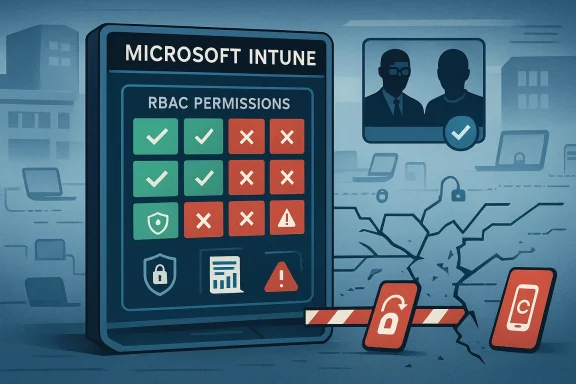
Microsoft’s own documentation reinforces that Intune should be treated as a privileged control plane. The company recommends least-privilege administration, role-based access control, and, where possible, multi-admin approval for sensitive changes. Those recommendations may sound obvious, but real-world incidents keep proving that organizations still assign overly broad privileges, leave admin surfaces too open, and underinvest in governance around cloud management tools.
This is why endpoint management systems have become attractive to sophisticated intruders. They are trusted by design, often exempt from the skepticism applied to conventional network traffic, and deeply embedded in day-to-day operations. A malicious admin in Intune is not trying to break into the building; they are acting like someone already carrying the master key.
In practical terms, this changes the defensive priority list. Security teams are used to protecting data repositories, email accounts, and exposed servers, but management consoles now deserve equivalent attention. The irony is that the very tools intended to centralize control can amplify an incident if they are not segmented and tightly governed.
The agency’s logic aligns with a broader pattern in public-sector cyber guidance: high-value cloud and identity tools should be treated as crown jewels. In CISA and Microsoft terminology, that means least privilege, strong authentication, and approval workflows for sensitive changes. This is not new advice, but the Stryker case gives it fresh urgency because the outcome of failing those basics can be operationally devastating.
The shift in emphasis is also telling from a market perspective. Security teams no longer have the luxury of viewing admin tooling as purely operational infrastructure. Once attackers start using those tools offensively, the security standard rises from “keep it working” to “keep it compartmentalized, auditable, and hard to misuse.”
The key point is not merely to shrink the admin list. It is to ensure that the permissions needed for policy management, device actions, and configuration changes are separated so that compromise of one operator does not automatically grant total control. In an incident like Stryker’s, that difference can determine whether attackers can merely view settings or can actively destroy fleet trust by triggering device wipes.
The practical implication is that organizations should map each Intune task to the narrowest role that can do the job. That includes controlling who can enroll devices, who can alter compliance policies, who can approve escalations, and who can execute remote wipe actions. If that sounds bureaucratic, that is precisely the point: bureaucratic friction is often what stops a compromised account from becoming a catastrophe.
This is especially relevant in the Stryker context because once an attacker controls the right admin account, they can move very quickly. A second approval requirement introduces a human checkpoint, which is often the simplest way to disrupt attacker momentum. It will not stop every adversary, but it can force them to reveal themselves earlier or fail when no second privileged account is available. That matters more than it sounds.
There is also a governance advantage. Approval records create an audit trail that helps security teams understand whether a change was legitimate, rushed, or suspicious. For organizations running distributed support teams, the feature can also help separate operational convenience from true authority.
This is why remote wipe capabilities deserve special scrutiny. They exist for lost, stolen, or retired devices, but they can be devastating when used by an intruder with administrative access. From the defender’s perspective, a wipe command is both a containment tool and a sabotage tool, depending entirely on who issues it.
That is why management systems should be designed so that destructive actions require the highest level of scrutiny. Convenience is the enemy of resilience here. If the wipe button is too easy to reach from a compromised account, then the attacker has effectively turned a legitimate endpoint hygiene feature into a denial-of-service mechanism.
It also means rethinking monitoring priorities. Security teams should be able to spot unusual role creation, unexpected policy edits, device wipe actions, and changes to admin scopes. If those events are not being logged, retained, and correlated with identity activity, then the organization is flying blind in exactly the place adversaries are most likely to strike.
A mature enterprise response should include access reviews, break-glass account validation, approval workflows for sensitive actions, and a measured incident response playbook for management-plane compromise. It should also include tabletop exercises that assume the endpoint management layer is itself untrustworthy. That is painful to rehearse but far cheaper than discovering it during a live incident.
Frontline and field workers are especially vulnerable because they often depend on managed mobile devices and tightly controlled applications. If a fleet is wiped or reconfigured unexpectedly, those workers may lose access to core workflows immediately. In a manufacturing, logistics, or med-tech environment, that can ripple into customer support, service delivery, and compliance obligations.
That matters because security depends on user cooperation. Enrollment notifications, clear device policy communication, and transparent remediation steps all help preserve trust after an incident. Microsoft’s updated guidance on secure onboarding and device notifications is therefore not cosmetic; it is part of maintaining the social contract of managed IT.
The broader competitive issue is that all major device-management and identity platforms now carry similar risk. Microsoft, VMware, Jamf, Ivanti, and others all live in the same trust ecosystem, and attackers will keep looking for whichever console grants the widest administrative leverage. In that sense, the Stryker case is less a Microsoft-only problem than a warning to the entire endpoint management market.
Microsoft’s advantage is that it controls both the platform and much of the surrounding identity stack, which gives it room to integrate controls more deeply than smaller vendors can. Its challenge is that breadth of control also means breadth of blame when something goes wrong. In cloud management security, the more you centralize, the more you must prove you can contain.
A second concern is that heavy reliance on cloud management can create false confidence. If companies assume Microsoft’s default stack automatically protects them, they may miss the reality that permissions, scopes, and approvals still need explicit tuning. A third concern is that device wipes and admin changes can have cascading business effects far beyond the security team’s immediate visibility.
The other thing to watch is how attackers respond. Once defenders start locking down RBAC, multi-admin approvals, and scope boundaries, adversaries tend to shift to identity theft, help-desk social engineering, token abuse, and other ways of reclaiming the same control. Security is never static, and management-plane defense will need continuous tuning rather than one-time hardening.
Source: theregister.com Microsoft Intune: Lock it down, warn feds after Stryker
 Background
The Stryker incident is a useful reminder that cyberattacks are no longer confined to data theft or encrypted file servers. They increasingly target the tools that manage identity, devices, and access because those platforms can affect entire enterprises at once. When an attacker reaches an endpoint management plane, the blast radius can be far wider than a single endpoint or a single department.Stryker said on March 11, 2026 that it was “experiencing a global network disruption to our Microsoft environment as a result of a cyber attack,” while also stating it had no indication of ransomware or malware and believed the incident was contained. That language is revealing: organizations often frame such events carefully when they are still mapping how deeply the attacker moved through cloud identity, endpoint management, and device enrollment systems. In this case, a source familiar with the investigation told The Register that employees’ devices were wiped using Intune, which would fit the broader pattern of management-plane abuse rather than traditional payload-driven malware.
CISA’s response matters because it shifts the story from a single company breach to a broader warning for U.S. organizations. The agency said it was aware of malicious activity targeting endpoint management systems and directed companies toward Microsoft’s published best practices for securing Intune. That is a subtle but important distinction: CISA is not just warning about a vulnerability, but about how legitimate administrative features can be weaponized if an attacker captures the wrong credentials or role assignments.
Microsoft’s own documentation reinforces that Intune should be treated as a privileged control plane. The company recommends least-privilege administration, role-based access control, and, where possible, multi-admin approval for sensitive changes. Those recommendations may sound obvious, but real-world incidents keep proving that organizations still assign overly broad privileges, leave admin surfaces too open, and underinvest in governance around cloud management tools.
Why Intune Became the Target
Intune is not just a device-management product; it is a policy engine, compliance gate, and remote control system rolled into one. That means a compromised Intune session can potentially let an attacker alter device posture, push configuration changes, revoke access, or issue wipe commands. If the attacker also has identity-plane leverage, the result can be rapid organizational paralysis.This is why endpoint management systems have become attractive to sophisticated intruders. They are trusted by design, often exempt from the skepticism applied to conventional network traffic, and deeply embedded in day-to-day operations. A malicious admin in Intune is not trying to break into the building; they are acting like someone already carrying the master key.
The strategic value of management-plane access
The Stryker episode appears to illustrate a modern intrusion model: reach the cloud management layer, then use it to reshape the victim’s own environment against itself. That can mean device wipes, policy changes, or account manipulation rather than ransomware encryption. It is a cleaner, faster, and often quieter way to create business disruption without needing to detonate a visibly noisy malware campaign.In practical terms, this changes the defensive priority list. Security teams are used to protecting data repositories, email accounts, and exposed servers, but management consoles now deserve equivalent attention. The irony is that the very tools intended to centralize control can amplify an incident if they are not segmented and tightly governed.
- Endpoint management systems can affect many devices at once.
- A compromised admin role can outperform malware in speed and reach.
- Wipe actions and policy changes can disrupt operations immediately.
- Trust in management tools often leads to weaker monitoring.
- Broad permissions make attacker movement easier after initial access.
What CISA Is Really Warning About
CISA’s warning is best understood as a governance alert, not merely a technical advisory. The agency told organizations to better secure endpoint management systems after observing malicious activity targeting those systems, and it specifically pointed companies to Microsoft’s hardening guidance for Intune. That framing suggests a pattern of abuse that may not depend on a single zero-day exploit, but rather on misconfiguration, stolen credentials, or overprivileged administrators.The agency’s logic aligns with a broader pattern in public-sector cyber guidance: high-value cloud and identity tools should be treated as crown jewels. In CISA and Microsoft terminology, that means least privilege, strong authentication, and approval workflows for sensitive changes. This is not new advice, but the Stryker case gives it fresh urgency because the outcome of failing those basics can be operationally devastating.
Why “best practices” matter more than ever
Microsoft’s recent Intune guidance emphasizes segmented administrative control, scope tags, role-based access control, and containment. The company is effectively acknowledging that one compromised account should not be able to dominate an entire tenant. That is exactly the kind of blast-radius reduction enterprises need if adversaries are already probing their management layers.The shift in emphasis is also telling from a market perspective. Security teams no longer have the luxury of viewing admin tooling as purely operational infrastructure. Once attackers start using those tools offensively, the security standard rises from “keep it working” to “keep it compartmentalized, auditable, and hard to misuse.”
- Treat endpoint management as a privileged control plane.
- Assume credentials, not software bugs, may be the weak point.
- Use alerting for new privileged role assignments.
- Audit wipe, enrollment, and policy-change actions closely.
- Plan for containment if the admin plane is compromised.
Microsoft’s Least-Privilege Guidance, Explained
Microsoft’s own Intune guidance is now far more explicit about daily administration being performed with the minimum permissions necessary. The company recommends assigning the built-in Intune Administrator role only where needed and then delegating narrower built-in roles for routine operations. That is a substantial departure from the old “just make a few admins global” mentality that still haunts many IT departments.The key point is not merely to shrink the admin list. It is to ensure that the permissions needed for policy management, device actions, and configuration changes are separated so that compromise of one operator does not automatically grant total control. In an incident like Stryker’s, that difference can determine whether attackers can merely view settings or can actively destroy fleet trust by triggering device wipes.
Role-based access control is not optional
Microsoft’s RBAC guidance for Intune and Entra is rooted in a simple idea: access should match task scope. The company says least privilege is best practice, recommends Privileged Identity Management for just-in-time access, and calls for MFA on administrator accounts. Those controls are hardly exotic, but they are often inconsistently deployed in the real world, especially in large enterprises with distributed IT teams.The practical implication is that organizations should map each Intune task to the narrowest role that can do the job. That includes controlling who can enroll devices, who can alter compliance policies, who can approve escalations, and who can execute remote wipe actions. If that sounds bureaucratic, that is precisely the point: bureaucratic friction is often what stops a compromised account from becoming a catastrophe.
- Use least privilege for every role.
- Prefer just-in-time access over standing admin rights.
- Turn on MFA for all administrators.
- Limit the number of highly privileged assignments.
- Review access whenever responsibilities change.
Multi-Admin Approval Changes the Game
One of the most interesting developments in Microsoft’s recent Intune roadmap is Multi Admin Approval. Microsoft’s documentation says that a second administrator must approve certain role-based access control changes, and recent updates show the feature is now part of a broader “admin tasks” experience. That is a clear sign that Microsoft recognizes the need to slow down potentially dangerous changes before they hit production.This is especially relevant in the Stryker context because once an attacker controls the right admin account, they can move very quickly. A second approval requirement introduces a human checkpoint, which is often the simplest way to disrupt attacker momentum. It will not stop every adversary, but it can force them to reveal themselves earlier or fail when no second privileged account is available. That matters more than it sounds.
Why approval workflows are more than process theater
Approval workflows are sometimes dismissed as paperwork, but they are really a technical control in disguise. They reduce the chance that a single compromised identity can alter policies, expand permissions, or trigger destructive commands unilaterally. In a cloud-first environment, where the admin console is often the real perimeter, that extra check is often the difference between a contained compromise and a full-scale outage.There is also a governance advantage. Approval records create an audit trail that helps security teams understand whether a change was legitimate, rushed, or suspicious. For organizations running distributed support teams, the feature can also help separate operational convenience from true authority.
- Second approval reduces unilateral abuse.
- Approval logs improve post-incident review.
- The workflow can slow attacker escalation.
- Sensitive changes become easier to audit.
- Governance improves without removing functionality.
Device Wipes Are a Particularly Sharp Weapon
The most alarming part of the Stryker reporting is the allegation that Intune was used to wipe employees’ devices. That is not a routine nuisance; it is a deliberate disruption of the endpoint trust model itself. If a company cannot trust that enrolled devices remain intact and manageable, then normal user operations, identity validation, and service access all become suspect.This is why remote wipe capabilities deserve special scrutiny. They exist for lost, stolen, or retired devices, but they can be devastating when used by an intruder with administrative access. From the defender’s perspective, a wipe command is both a containment tool and a sabotage tool, depending entirely on who issues it.
The operational impact goes beyond the endpoint
A device wipe may appear localized, but in a modern enterprise it can cascade rapidly. It can break access to internal apps, interrupt login workflows, and create support backlogs as employees try to rebuild trust in their equipment. If shipping and ordering systems are already degraded, as Stryker said, then wiping endpoints can compound an existing business continuity problem into a broader operational crisis.That is why management systems should be designed so that destructive actions require the highest level of scrutiny. Convenience is the enemy of resilience here. If the wipe button is too easy to reach from a compromised account, then the attacker has effectively turned a legitimate endpoint hygiene feature into a denial-of-service mechanism.
- Wipes can destroy local access and trust quickly.
- They can create secondary help-desk overload.
- They may disrupt shipping, ordering, and field operations.
- They are powerful both for IT and for attackers.
- They should be tightly scoped and logged.
Enterprise Impact: What Security Teams Should Change
For enterprise defenders, the lesson is to stop treating Intune as a niche admin portal and start treating it like a security-critical control plane. That means reviewing every role assignment, every admin group, every delegated permission, and every path that can lead to policy changes or device actions. If the attack path is identity plus configuration, then your security program needs to understand both layers equally well.It also means rethinking monitoring priorities. Security teams should be able to spot unusual role creation, unexpected policy edits, device wipe actions, and changes to admin scopes. If those events are not being logged, retained, and correlated with identity activity, then the organization is flying blind in exactly the place adversaries are most likely to strike.
Practical hardening priorities
The most useful response is not panic but disciplined reduction of privilege and blast radius. Microsoft’s guidance already points in that direction, and CISA’s warning suggests organizations should accelerate adoption rather than wait for a formal compromise. In large environments, the difference between “recommended” and “implemented” is often where attacks succeed.A mature enterprise response should include access reviews, break-glass account validation, approval workflows for sensitive actions, and a measured incident response playbook for management-plane compromise. It should also include tabletop exercises that assume the endpoint management layer is itself untrustworthy. That is painful to rehearse but far cheaper than discovering it during a live incident.
- Review Intune RBAC assignments immediately.
- Restrict destructive actions like wipe and retire.
- Enforce MFA and just-in-time admin elevation.
- Validate break-glass accounts and alerting.
- Test recovery from management-plane compromise.
Consumer and Frontline Worker Impact
While Intune is mainly an enterprise tool, the consequences of misuse can reach ordinary workers very quickly. In many organizations, employees simply wake up to find their devices locked, reset, or unable to access company services because the management layer has been tampered with. That makes endpoint management abuse a people problem as much as a technical one.Frontline and field workers are especially vulnerable because they often depend on managed mobile devices and tightly controlled applications. If a fleet is wiped or reconfigured unexpectedly, those workers may lose access to core workflows immediately. In a manufacturing, logistics, or med-tech environment, that can ripple into customer support, service delivery, and compliance obligations.
Human cost is part of the threat model
The human impact of these incidents is easy to underestimate because the damage is expressed in device states and support tickets. But every wiped laptop or phone represents lost time, disrupted routines, and often a trust deficit between employees and the IT team. When workers see corporate devices reset without warning, they may also become more suspicious of legitimate management actions later on.That matters because security depends on user cooperation. Enrollment notifications, clear device policy communication, and transparent remediation steps all help preserve trust after an incident. Microsoft’s updated guidance on secure onboarding and device notifications is therefore not cosmetic; it is part of maintaining the social contract of managed IT.
- Workers can lose access instantly.
- Field operations may be disrupted more than office work.
- Help desks absorb the fallout.
- Trust in IT can erode after unexpected wipes.
- Clear communication becomes part of recovery.
Competitive and Strategic Implications for Microsoft
For Microsoft, this incident is awkward but not surprising. Intune is central to the company’s broader endpoint and identity strategy, which means every security story about it has platform-level implications. If the market begins to believe that endpoint management products are an easy route to mass disruption, Microsoft will face pressure to keep hardening controls visible, simple, and default-on.The broader competitive issue is that all major device-management and identity platforms now carry similar risk. Microsoft, VMware, Jamf, Ivanti, and others all live in the same trust ecosystem, and attackers will keep looking for whichever console grants the widest administrative leverage. In that sense, the Stryker case is less a Microsoft-only problem than a warning to the entire endpoint management market.
Why this could influence buying decisions
Security-conscious buyers may begin asking harder questions about approval workflows, role granularity, and emergency controls during procurement. They will also want to know how quickly they can detect unauthorized changes and whether a compromised admin can wipe or reconfigure devices without a second gate. Those are not niche requirements anymore; they are becoming table stakes.Microsoft’s advantage is that it controls both the platform and much of the surrounding identity stack, which gives it room to integrate controls more deeply than smaller vendors can. Its challenge is that breadth of control also means breadth of blame when something goes wrong. In cloud management security, the more you centralize, the more you must prove you can contain.
- Buyers will demand stronger approval controls.
- RBAC granularity becomes a selling point.
- Logging and auditability will matter more.
- Security posture may influence vendor selection.
- Platform integration cuts both ways: power and risk.
Strengths and Opportunities
The good news is that Microsoft and CISA are pointing in the right direction, and the guidance is specific enough to act on. Organizations that treat the Stryker case as a wake-up call can use it to reduce attack surface, clean up role sprawl, and finally bring their admin plane under the same discipline they apply to production systems. That is not just defensive work; it is operational maturity.- Least privilege is now clearly mapped to Intune administration.
- Multi Admin Approval can slow or stop unilateral abuse.
- Scope tags help segment admin authority by geography or business unit.
- MFA remains a high-value control for admin accounts.
- Better logging and audit trails improve incident response.
- Intune hardening can reduce both insider risk and external compromise.
- Organizations can use the incident to justify overdue governance cleanup.
Risks and Concerns
The biggest risk is that many organizations will read the guidance, nod, and do little. Security programs are full of controls that are technically available but practically underused, especially when they require role redesign, operational process changes, or political pushback from IT teams who are used to broad access. If the attacker model has changed but the admin model has not, the risk remains.A second concern is that heavy reliance on cloud management can create false confidence. If companies assume Microsoft’s default stack automatically protects them, they may miss the reality that permissions, scopes, and approvals still need explicit tuning. A third concern is that device wipes and admin changes can have cascading business effects far beyond the security team’s immediate visibility.
- Organizations may leave overly broad admin roles in place.
- Destructive actions may still be too easy to trigger.
- Logging may be insufficient for rapid investigation.
- Recovery plans may not account for cloud management compromise.
- Help desks may be overwhelmed during remediation.
- Employees may lose trust in managed devices.
- Vendors may offer controls that customers do not fully deploy.
Looking Ahead
The next phase of this story will likely center on whether Microsoft, CISA, and affected customers convert good advice into enforced controls. If that happens, Intune could become a case study in how to harden a privileged management platform after a high-profile abuse incident. If it does not, then Stryker will be remembered as another warning that the industry heard but failed to internalize.The other thing to watch is how attackers respond. Once defenders start locking down RBAC, multi-admin approvals, and scope boundaries, adversaries tend to shift to identity theft, help-desk social engineering, token abuse, and other ways of reclaiming the same control. Security is never static, and management-plane defense will need continuous tuning rather than one-time hardening.
- Whether more organizations adopt Multi Admin Approval by default.
- How quickly enterprises audit Intune admin roles and scopes.
- Whether CISA issues follow-on guidance for other endpoint tools.
- If Microsoft adds more friction to destructive administrative actions.
- How attackers adapt when permissions become tighter.
Source: theregister.com Microsoft Intune: Lock it down, warn feds after Stryker
