
On May 26, 2026, CISA published a medical industrial-control advisory warning that all versions of Eppendorf’s BioFlo 320 bioreactor are affected by a hard-coded VNC password vulnerability that can give a remote attacker full control of the device interface when remote access is enabled. The flaw is not a Windows bug, but it belongs squarely in the same operational universe WindowsForum readers know well: networked equipment, legacy remote-access assumptions, and the dangerous gap between “disabled by default” and “impossible to abuse.” The uncomfortable lesson is that medical and laboratory devices are still shipping with administrative pathways that look like conveniences until the day they become attack surfaces.
The BioFlo 320 is not a consumer gadget or an office printer. It is a benchtop bioreactor control system used in bioprocessing environments, a class of equipment where availability, repeatability, and operator trust matter as much as ordinary IT confidentiality. That is why CISA’s advisory lands with more force than its simple wording suggests.
The vulnerability, tracked as CVE-2026-7251, is a classic hard-coded password problem in a VNC server. If an attacker knows the network address of a BioFlo 320 model with remote access enabled, they can use the password to connect and take full control of the user interface. CISA assigned the issue a CVSS 3.1 score of 9.8, the familiar “critical” rating reserved for bugs that combine network reachability, low complexity, no required authentication, no user interaction, and high impact.
Eppendorf’s mitigation is unusually blunt: install version 5.0 software, which permanently removes VNC access from the controller. That is more than a patch. It is an admission that this remote-access pathway is not worth defending in its old form.
For sysadmins and security teams, the advisory is a reminder that the riskiest computers in an organization are often not the ones managed by Microsoft Intune, Group Policy, Defender for Endpoint, or an EDR console. They are embedded controllers attached to expensive workflows, reachable from networks designed for convenience, and maintained by teams whose first responsibility is keeping experiments, production runs, or clinical support processes moving.
In ordinary IT, that design would be laughed out of a serious security review. In operational technology, laboratory systems, and medical-adjacent equipment, it still appears with depressing regularity because remote support has historically been treated as a service feature rather than a privileged control plane. A technician needs a way in. A vendor needs a way to guide a customer. A local operator needs a quick screen-sharing method. VNC has long been the duct tape of that world.
The problem is that VNC was never designed to be the crown jewel of access control. Traditional VNC deployments frequently lack encryption unless wrapped in another secure channel, and CISA specifically notes that VNC traffic in this case is not encrypted. That means the vulnerability is not merely that an attacker could authenticate with a known password. It is that the entire remote-control model is out of step with the threat environment laboratories now inhabit.
Eppendorf’s position has an important caveat: affected systems shipped with VNC disabled by default, and VNC could only be enabled locally at the tower. That lowers the population of exposed devices. It does not eliminate the risk. The history of enterprise security is filled with “disabled by default” features that were enabled later for troubleshooting, vendor support, convenience, or because someone followed an old manual during a stressful maintenance window.
The company has also removed VNC configuration information from current BioFlo 320 documentation. That helps prevent future enablement, but it cannot rewrite the history of deployed equipment, internal SOPs, archived PDFs, printed binders, or operators who already know where the setting lives. Once a remote-access pattern becomes part of a workflow, removing it from documentation is a cleanup step, not a containment boundary.
CISA’s advisory says successful exploitation could allow an attacker to gain full access to functionality and data with the bioreactor. That is the core issue. This is not simply about stealing a password or popping a shell for bragging rights. It is about unauthorized access to a system that exists to regulate biological or bioprocessing activity.
A compromised bioreactor interface could create multiple classes of harm depending on how a particular system is deployed. Data integrity could be undermined if an attacker views, alters, or manipulates process-related information. Availability could be affected if controls are changed or workflows are interrupted. Process reliability could be damaged even by small unauthorized changes, because bioprocessing often depends on controlled conditions and repeatability.
The advisory does not say public exploitation has occurred, and CISA says it has no known reports of active targeting. That matters. This is not the same as an emergency warning that ransomware gangs are already using the flaw in the wild. But the absence of known exploitation is not the same as safety, especially when the exploit path depends on knowledge of a password and network reachability rather than a complex chain.
In security terms, this is a low-drama bug with high-consequence implications. There is no need for an attacker to trick a user, win a race condition, or assemble a delicate exploit. If the device is reachable and VNC is enabled, the attacker’s job becomes brutally simple.
But default-off is not the same thing as secure-by-design. A hard-coded password sitting behind a disabled feature is still a loaded mechanism inside the product. The vendor is relying on configuration state to compensate for a credential design that should not exist in a privileged remote-control service.
This is where the advisory becomes especially relevant for IT administrators. Enterprise environments are full of systems that began life on isolated benches or lab VLANs and slowly became connected to support data collection, remote troubleshooting, monitoring, backups, or vendor access. Nobody flips a switch labeled “increase cyber risk.” They add a network cable, open a firewall rule, enable a remote viewer, approve a VPN exception, or allow a vendor laptop onto a maintenance network.
Over time, the original security assumption erodes. The device was safe because it was local. Then it was safe because it was behind a firewall. Then it was safe because only the vendor knew how to reach it. Eventually, the organization discovers that the real boundary was a hard-coded password shared across a product line.
That is why the strongest mitigation in this advisory is not “check the setting” but “install the software that removes VNC access.” Removing the feature collapses the risk instead of asking every customer to maintain perfect configuration hygiene indefinitely.
That convenience made sense in earlier eras of closed networks and vendor-serviced appliances. It makes far less sense in 2026, when laboratory networks are entangled with enterprise identity, cloud analytics, shared storage, compliance reporting, remote support, and sometimes internet-facing pathways nobody fully remembers creating. The network is no longer a moat. It is a transit system.
The use of VNC also creates a subtle accountability problem. A graphical remote-control session can blur the line between operator action, vendor support, and unauthorized manipulation unless the system has robust logging, identity, and change tracking around the session. A shared or hard-coded credential makes that worse because it destroys user attribution. If everyone enters through the same door with the same key, security teams cannot easily prove who turned the handle.
Modern remote administration should be tied to named identities, role-based permissions, session auditing, encrypted transport, and preferably time-limited access. That is not exotic anymore. It is the baseline for managing Windows servers, cloud consoles, developer platforms, and enterprise SaaS. Industrial and laboratory equipment cannot remain exempt simply because its interface was designed around a touchscreen and a support technician.
Eppendorf’s decision to remove VNC access in version 5.0 suggests the company reached the same conclusion. Some features are not worth preserving once the risk model changes. A remote-control service with a hard-coded password and unencrypted traffic is not a feature to harden around the edges; it is a feature to retire.
Those environments often have complicated ownership boundaries. IT may manage the network but not the instrument. Lab operations may own the process but not the firewall. Vendors may maintain the controller but not the site’s segmentation strategy. Security may see the asset only when a scan finds an unexpected service.
That fragmentation is exactly where vulnerabilities like this become dangerous. A Windows workstation with a critical vulnerability usually has a known owner, patch channel, inventory record, and security agent. A bioreactor controller may be known to facilities, procurement, lab management, validation teams, or a vendor service contract, but not necessarily to the people responsible for network exposure.
The advisory’s recommended practices are therefore not boilerplate, even if they read like familiar CISA language. Minimize network exposure. Keep control systems off the internet. Place control system networks behind firewalls. Isolate them from business networks. Use secure remote access methods such as VPNs when remote access is required. Perform impact analysis before defensive changes.
Those lines are repeated so often in ICS advisories that they risk becoming wallpaper. In this case, they are the difference between a critical vulnerability that remains mostly theoretical and one that becomes an easy remote-control path into a live laboratory instrument.
Eppendorf recommends installing version 5.0 software as soon as possible. That should be the destination. But organizations still need to plan the route. They must determine which BioFlo 320 systems they own, whether VNC was ever enabled, what software version is installed, whether the system is in active use, and whether the update changes any validated workflow or support process.
This is not an argument for delay. It is an argument for treating the patch as an operational change rather than a casual download. The worst outcome would be for teams to postpone the update indefinitely because it touches a process system, while also failing to verify that VNC is disabled or segmented away from risky networks.
There is a practical middle path. First, verify whether VNC is disabled on every controller. Second, ensure only Admin and Supervisor roles can change VNC settings. Third, restrict network access so the controller is not reachable from ordinary user subnets, guest networks, vendor staging areas, or the public internet. Then schedule and apply version 5.0 with the same seriousness used for any change to a controlled environment.
For many organizations, the most revealing part of this exercise will not be the patch itself. It will be discovering whether anyone can answer basic asset questions quickly. If a critical advisory lands and the team cannot identify affected devices, network paths, or owners, the vulnerability has exposed an inventory failure as much as a product flaw.
These devices commonly live near Windows systems even when they do not run Windows themselves. They export data to Windows file shares. They are accessed from Windows desktops. They sit on VLANs routed through Windows-heavy enterprise networks. Their operators authenticate to adjacent systems with Active Directory accounts, even if the device’s own local access model is primitive.
That adjacency matters. An attacker who controls a specialized device may not need it to run Windows to make trouble. They can disrupt operations, observe sensitive workflows, pivot through weak network segmentation, or use the device as leverage in an extortion campaign. In ransomware incidents, the scariest systems are often not the ones encrypted first but the ones whose downtime gives the attacker negotiating power.
The BioFlo 320 advisory is also a test of how well IT and operational teams communicate. Security may say “remove VNC.” Lab staff may hear “remove remote support.” The vendor may say “install version 5.0.” Compliance may ask whether the update changes validated behavior. Leadership may ask whether any patient, research, or production impact exists. None of those concerns are illegitimate, but they must be reconciled before an attacker does the prioritization for them.
A mature organization should already know where such devices are, which networks can reach them, who is allowed to administer them, and how emergency vendor advisories become operational work orders. If that process does not exist, CVE-2026-7251 is a good reason to build it.
That decision signals a shift in the risk calculation. In a world of routine scanning, stolen credentials, flat networks, and increasingly capable criminal operators, an old support tunnel can become a liability greater than its support value. The software update does not merely patch a password. It deletes an architectural assumption.
There is an obvious downside for customers who relied on VNC for convenience. Some support workflows may need to change. Some local procedures may need to be rewritten. Some operators may complain that a useful capability disappeared because of a security advisory.
But that is the trade-off modern product security increasingly demands. Features that bypass identity, encryption, auditability, or role separation are not neutral. They transfer risk from the vendor’s support model to the customer’s operational environment. Removing them can be disruptive, but leaving them in place can be worse.
This is where more vendors should follow the example. The embedded world has too often treated insecure remote access as a customer configuration problem. Eppendorf’s version 5.0 mitigation implicitly says the safer answer is to eliminate the remote-control path altogether. That is a stronger security posture than telling customers to remember not to enable a dangerous option.
The BioFlo 320 case fits a broader pattern in which product functionality once considered harmless becomes unacceptable when connected to modern networks. Hard-coded credentials, unencrypted remote sessions, shared service accounts, and vendor backdoors are not merely technical sins. They are governance failures because they prevent organizations from enforcing their own access policies.
If an enterprise requires named accounts, MFA, logging, and least privilege for server administration, it should not accept a critical process device that can be remotely controlled through a shared hard-coded password. If an organization audits privileged access to domain controllers but not to lab equipment, it has drawn its control boundary around the wrong assets. Attackers care about leverage, not organizational charts.
The advisory also puts responsibility on customers. Eppendorf can ship version 5.0 and remove VNC from current documentation, but deployed systems still need attention. CISA can publish defensive practices, but no federal advisory can segment a customer network. BIO-ISAC can report the vulnerability, but asset owners must decide whether their own environments turn the flaw into an incident.
That division of responsibility is the defining challenge of industrial and medical device security. Vendors control design. Customers control deployment. Attackers exploit the seam between them.
If VNC is enabled only on a tightly isolated maintenance network, reachable only during controlled service windows, and wrapped in compensating controls, the practical risk is lower. If it is reachable across broad internal networks, exposed through permissive VPN access, or discoverable from poorly segmented sites, the practical risk rises quickly. Same CVE, different reality.
That means remediation should not end with installing version 5.0, even though installing it is the critical vendor-specific fix. Teams should use the advisory to review how remote access is approved for laboratory and control equipment. They should ask whether vendor support paths are documented, whether old manuals still guide operators, whether firewall rules are reviewed, and whether device access generates logs anyone sees.
They should also look for the neighboring problem: other instruments with similar remote access features. A single BioFlo 320 advisory may reveal a broader class of inherited practices. If one controller had VNC for convenience, others may have RDP, web admin panels, Telnet, shared local accounts, default credentials, or vendor-only maintenance ports.
That is the painful but useful part of a good advisory. It gives defenders a concrete defect to fix and a pattern to hunt.
The most concrete reading is straightforward:
For Windows administrators, the lesson is not that every bioreactor is suddenly an IT problem. It is that every networked controller becomes part of the enterprise risk model the moment it can be reached, managed, logged into, or disrupted across a network. The old bargain — operational equipment on one side, IT security on the other — is collapsing because the network erased the wall. The organizations that adapt fastest will not be the ones that write the most policies; they will be the ones that can find their devices, understand their remote-access paths, patch without panic, and say no to convenience features that no longer belong in critical environments.
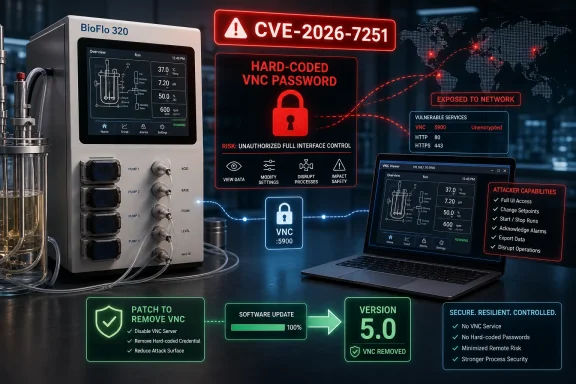 A Lab Controller Became a Network Security Story
The BioFlo 320 is not a consumer gadget or an office printer. It is a benchtop bioreactor control system used in bioprocessing environments, a class of equipment where availability, repeatability, and operator trust matter as much as ordinary IT confidentiality. That is why CISA’s advisory lands with more force than its simple wording suggests.The vulnerability, tracked as CVE-2026-7251, is a classic hard-coded password problem in a VNC server. If an attacker knows the network address of a BioFlo 320 model with remote access enabled, they can use the password to connect and take full control of the user interface. CISA assigned the issue a CVSS 3.1 score of 9.8, the familiar “critical” rating reserved for bugs that combine network reachability, low complexity, no required authentication, no user interaction, and high impact.
Eppendorf’s mitigation is unusually blunt: install version 5.0 software, which permanently removes VNC access from the controller. That is more than a patch. It is an admission that this remote-access pathway is not worth defending in its old form.
For sysadmins and security teams, the advisory is a reminder that the riskiest computers in an organization are often not the ones managed by Microsoft Intune, Group Policy, Defender for Endpoint, or an EDR console. They are embedded controllers attached to expensive workflows, reachable from networks designed for convenience, and maintained by teams whose first responsibility is keeping experiments, production runs, or clinical support processes moving.
The Password Was Hard-Coded, but the Real Problem Was Trust
Hard-coded passwords are one of those vulnerability classes that sound almost too primitive for 2026. The defect is not subtle. A password is built into the product rather than set uniquely per device, rotated by an administrator, stored securely, or managed through a modern authentication flow.In ordinary IT, that design would be laughed out of a serious security review. In operational technology, laboratory systems, and medical-adjacent equipment, it still appears with depressing regularity because remote support has historically been treated as a service feature rather than a privileged control plane. A technician needs a way in. A vendor needs a way to guide a customer. A local operator needs a quick screen-sharing method. VNC has long been the duct tape of that world.
The problem is that VNC was never designed to be the crown jewel of access control. Traditional VNC deployments frequently lack encryption unless wrapped in another secure channel, and CISA specifically notes that VNC traffic in this case is not encrypted. That means the vulnerability is not merely that an attacker could authenticate with a known password. It is that the entire remote-control model is out of step with the threat environment laboratories now inhabit.
Eppendorf’s position has an important caveat: affected systems shipped with VNC disabled by default, and VNC could only be enabled locally at the tower. That lowers the population of exposed devices. It does not eliminate the risk. The history of enterprise security is filled with “disabled by default” features that were enabled later for troubleshooting, vendor support, convenience, or because someone followed an old manual during a stressful maintenance window.
The company has also removed VNC configuration information from current BioFlo 320 documentation. That helps prevent future enablement, but it cannot rewrite the history of deployed equipment, internal SOPs, archived PDFs, printed binders, or operators who already know where the setting lives. Once a remote-access pattern becomes part of a workflow, removing it from documentation is a cleanup step, not a containment boundary.
Full Control of the Interface Means Full Control of the Process
The phrase “full control of the user interface” can sound oddly modest, as if the attacker gets a screen view and some buttons. In a bioreactor controller, the user interface is the operational boundary between software and process. If the control panel can change parameters, start or stop functions, adjust settings, or expose process data, then compromise of that interface is compromise of the work being performed.CISA’s advisory says successful exploitation could allow an attacker to gain full access to functionality and data with the bioreactor. That is the core issue. This is not simply about stealing a password or popping a shell for bragging rights. It is about unauthorized access to a system that exists to regulate biological or bioprocessing activity.
A compromised bioreactor interface could create multiple classes of harm depending on how a particular system is deployed. Data integrity could be undermined if an attacker views, alters, or manipulates process-related information. Availability could be affected if controls are changed or workflows are interrupted. Process reliability could be damaged even by small unauthorized changes, because bioprocessing often depends on controlled conditions and repeatability.
The advisory does not say public exploitation has occurred, and CISA says it has no known reports of active targeting. That matters. This is not the same as an emergency warning that ransomware gangs are already using the flaw in the wild. But the absence of known exploitation is not the same as safety, especially when the exploit path depends on knowledge of a password and network reachability rather than a complex chain.
In security terms, this is a low-drama bug with high-consequence implications. There is no need for an attacker to trick a user, win a race condition, or assemble a delicate exploit. If the device is reachable and VNC is enabled, the attacker’s job becomes brutally simple.
“Disabled by Default” Is Not a Security Architecture
Eppendorf deserves some credit for shipping the systems with VNC disabled by default. Many embedded-device disasters begin because a remote management service is exposed from day one and nobody realizes it until a scan finds it. Local-only enablement also introduces friction that can prevent casual or accidental exposure.But default-off is not the same thing as secure-by-design. A hard-coded password sitting behind a disabled feature is still a loaded mechanism inside the product. The vendor is relying on configuration state to compensate for a credential design that should not exist in a privileged remote-control service.
This is where the advisory becomes especially relevant for IT administrators. Enterprise environments are full of systems that began life on isolated benches or lab VLANs and slowly became connected to support data collection, remote troubleshooting, monitoring, backups, or vendor access. Nobody flips a switch labeled “increase cyber risk.” They add a network cable, open a firewall rule, enable a remote viewer, approve a VPN exception, or allow a vendor laptop onto a maintenance network.
Over time, the original security assumption erodes. The device was safe because it was local. Then it was safe because it was behind a firewall. Then it was safe because only the vendor knew how to reach it. Eventually, the organization discovers that the real boundary was a hard-coded password shared across a product line.
That is why the strongest mitigation in this advisory is not “check the setting” but “install the software that removes VNC access.” Removing the feature collapses the risk instead of asking every customer to maintain perfect configuration hygiene indefinitely.
VNC Is the Fossil Layer of Remote Administration
There is a reason VNC keeps appearing in industrial and embedded advisories. It is simple, portable, familiar, and good enough for remote viewing when the network is assumed to be trusted. It lets someone see and control a graphical interface without redesigning the product around proper remote administration.That convenience made sense in earlier eras of closed networks and vendor-serviced appliances. It makes far less sense in 2026, when laboratory networks are entangled with enterprise identity, cloud analytics, shared storage, compliance reporting, remote support, and sometimes internet-facing pathways nobody fully remembers creating. The network is no longer a moat. It is a transit system.
The use of VNC also creates a subtle accountability problem. A graphical remote-control session can blur the line between operator action, vendor support, and unauthorized manipulation unless the system has robust logging, identity, and change tracking around the session. A shared or hard-coded credential makes that worse because it destroys user attribution. If everyone enters through the same door with the same key, security teams cannot easily prove who turned the handle.
Modern remote administration should be tied to named identities, role-based permissions, session auditing, encrypted transport, and preferably time-limited access. That is not exotic anymore. It is the baseline for managing Windows servers, cloud consoles, developer platforms, and enterprise SaaS. Industrial and laboratory equipment cannot remain exempt simply because its interface was designed around a touchscreen and a support technician.
Eppendorf’s decision to remove VNC access in version 5.0 suggests the company reached the same conclusion. Some features are not worth preserving once the risk model changes. A remote-control service with a hard-coded password and unencrypted traffic is not a feature to harden around the edges; it is a feature to retire.
The Healthcare Label Understates the Real Blast Radius
CISA places this advisory in the Healthcare and Public Health sector, with worldwide deployment and Eppendorf headquartered in Germany. That classification is accurate, but it may make some readers think too narrowly. Bioreactors can exist in research labs, pharmaceutical development, academic environments, biotech facilities, and production-adjacent settings that straddle healthcare, manufacturing, and research.Those environments often have complicated ownership boundaries. IT may manage the network but not the instrument. Lab operations may own the process but not the firewall. Vendors may maintain the controller but not the site’s segmentation strategy. Security may see the asset only when a scan finds an unexpected service.
That fragmentation is exactly where vulnerabilities like this become dangerous. A Windows workstation with a critical vulnerability usually has a known owner, patch channel, inventory record, and security agent. A bioreactor controller may be known to facilities, procurement, lab management, validation teams, or a vendor service contract, but not necessarily to the people responsible for network exposure.
The advisory’s recommended practices are therefore not boilerplate, even if they read like familiar CISA language. Minimize network exposure. Keep control systems off the internet. Place control system networks behind firewalls. Isolate them from business networks. Use secure remote access methods such as VPNs when remote access is required. Perform impact analysis before defensive changes.
Those lines are repeated so often in ICS advisories that they risk becoming wallpaper. In this case, they are the difference between a critical vulnerability that remains mostly theoretical and one that becomes an easy remote-control path into a live laboratory instrument.
Patch Management Gets Harder When the Device Runs the Process
For ordinary Windows endpoints, the security answer to a critical vulnerability is often obvious even when the execution is messy: test the update, deploy it, monitor for failures, and keep moving. For laboratory and medical-adjacent equipment, patching has a different operational texture. A controller may be tied to validated procedures, scheduled runs, service windows, or documentation requirements that make “install immediately” easier to write than to do.Eppendorf recommends installing version 5.0 software as soon as possible. That should be the destination. But organizations still need to plan the route. They must determine which BioFlo 320 systems they own, whether VNC was ever enabled, what software version is installed, whether the system is in active use, and whether the update changes any validated workflow or support process.
This is not an argument for delay. It is an argument for treating the patch as an operational change rather than a casual download. The worst outcome would be for teams to postpone the update indefinitely because it touches a process system, while also failing to verify that VNC is disabled or segmented away from risky networks.
There is a practical middle path. First, verify whether VNC is disabled on every controller. Second, ensure only Admin and Supervisor roles can change VNC settings. Third, restrict network access so the controller is not reachable from ordinary user subnets, guest networks, vendor staging areas, or the public internet. Then schedule and apply version 5.0 with the same seriousness used for any change to a controlled environment.
For many organizations, the most revealing part of this exercise will not be the patch itself. It will be discovering whether anyone can answer basic asset questions quickly. If a critical advisory lands and the team cannot identify affected devices, network paths, or owners, the vulnerability has exposed an inventory failure as much as a product flaw.
Windows Shops Should Read This as an Asset-Management Warning
WindowsForum readers may be tempted to file this under “specialized medical device issue” and move on. That would be a mistake. The same patterns appear across environments that Windows administrators are often asked to secure: badge systems, HVAC controllers, lab instruments, imaging systems, manufacturing HMIs, conference-room appliances, print infrastructure, and vendor-managed boxes nobody wants to touch.These devices commonly live near Windows systems even when they do not run Windows themselves. They export data to Windows file shares. They are accessed from Windows desktops. They sit on VLANs routed through Windows-heavy enterprise networks. Their operators authenticate to adjacent systems with Active Directory accounts, even if the device’s own local access model is primitive.
That adjacency matters. An attacker who controls a specialized device may not need it to run Windows to make trouble. They can disrupt operations, observe sensitive workflows, pivot through weak network segmentation, or use the device as leverage in an extortion campaign. In ransomware incidents, the scariest systems are often not the ones encrypted first but the ones whose downtime gives the attacker negotiating power.
The BioFlo 320 advisory is also a test of how well IT and operational teams communicate. Security may say “remove VNC.” Lab staff may hear “remove remote support.” The vendor may say “install version 5.0.” Compliance may ask whether the update changes validated behavior. Leadership may ask whether any patient, research, or production impact exists. None of those concerns are illegitimate, but they must be reconciled before an attacker does the prioritization for them.
A mature organization should already know where such devices are, which networks can reach them, who is allowed to administer them, and how emergency vendor advisories become operational work orders. If that process does not exist, CVE-2026-7251 is a good reason to build it.
Removing VNC Is a Product Security Line in the Sand
The most interesting choice in Eppendorf’s response is not the recommendation to verify settings. It is the release of software that permanently removes VNC access from the controller. Vendors do not take away remote access lightly, because remote access lowers support costs and makes field troubleshooting easier.That decision signals a shift in the risk calculation. In a world of routine scanning, stolen credentials, flat networks, and increasingly capable criminal operators, an old support tunnel can become a liability greater than its support value. The software update does not merely patch a password. It deletes an architectural assumption.
There is an obvious downside for customers who relied on VNC for convenience. Some support workflows may need to change. Some local procedures may need to be rewritten. Some operators may complain that a useful capability disappeared because of a security advisory.
But that is the trade-off modern product security increasingly demands. Features that bypass identity, encryption, auditability, or role separation are not neutral. They transfer risk from the vendor’s support model to the customer’s operational environment. Removing them can be disruptive, but leaving them in place can be worse.
This is where more vendors should follow the example. The embedded world has too often treated insecure remote access as a customer configuration problem. Eppendorf’s version 5.0 mitigation implicitly says the safer answer is to eliminate the remote-control path altogether. That is a stronger security posture than telling customers to remember not to enable a dangerous option.
The CISA Advisory Is Also a Policy Document in Disguise
CISA’s medical advisories are written in a standardized format, but the policy message underneath is clear. Critical infrastructure operators cannot assume that specialized devices are protected by obscurity, physical location, or vendor documentation. The agency’s repeated guidance on segmentation, firewalling, VPNs, and impact analysis is a call to treat operational devices as first-class security assets.The BioFlo 320 case fits a broader pattern in which product functionality once considered harmless becomes unacceptable when connected to modern networks. Hard-coded credentials, unencrypted remote sessions, shared service accounts, and vendor backdoors are not merely technical sins. They are governance failures because they prevent organizations from enforcing their own access policies.
If an enterprise requires named accounts, MFA, logging, and least privilege for server administration, it should not accept a critical process device that can be remotely controlled through a shared hard-coded password. If an organization audits privileged access to domain controllers but not to lab equipment, it has drawn its control boundary around the wrong assets. Attackers care about leverage, not organizational charts.
The advisory also puts responsibility on customers. Eppendorf can ship version 5.0 and remove VNC from current documentation, but deployed systems still need attention. CISA can publish defensive practices, but no federal advisory can segment a customer network. BIO-ISAC can report the vulnerability, but asset owners must decide whether their own environments turn the flaw into an incident.
That division of responsibility is the defining challenge of industrial and medical device security. Vendors control design. Customers control deployment. Attackers exploit the seam between them.
The Hard-Coded Password Is the Easy Part to Understand
Security teams should resist the temptation to treat this as a one-off credential mistake. The password is the easy part to understand, which makes it the part everyone will focus on. The deeper issue is whether the environment allowed a remote graphical control plane to exist without modern safeguards.If VNC is enabled only on a tightly isolated maintenance network, reachable only during controlled service windows, and wrapped in compensating controls, the practical risk is lower. If it is reachable across broad internal networks, exposed through permissive VPN access, or discoverable from poorly segmented sites, the practical risk rises quickly. Same CVE, different reality.
That means remediation should not end with installing version 5.0, even though installing it is the critical vendor-specific fix. Teams should use the advisory to review how remote access is approved for laboratory and control equipment. They should ask whether vendor support paths are documented, whether old manuals still guide operators, whether firewall rules are reviewed, and whether device access generates logs anyone sees.
They should also look for the neighboring problem: other instruments with similar remote access features. A single BioFlo 320 advisory may reveal a broader class of inherited practices. If one controller had VNC for convenience, others may have RDP, web admin panels, Telnet, shared local accounts, default credentials, or vendor-only maintenance ports.
That is the painful but useful part of a good advisory. It gives defenders a concrete defect to fix and a pattern to hunt.
The Immediate Playbook Is Short, but It Is Not Optional
The BioFlo 320 advisory does not require exotic incident response. It requires discipline. Organizations with these systems should treat the next few days as an opportunity to turn a public critical advisory into a controlled maintenance action rather than a future emergency.The most concrete reading is straightforward:
- Every organization using an Eppendorf BioFlo 320 should identify all deployed units and confirm whether remote access or VNC has ever been enabled.
- Administrators should verify that VNC is disabled on the controller and restrict the ability to change VNC settings to Admin and Supervisor roles.
- Network teams should ensure BioFlo 320 controllers are not reachable from the internet or broad enterprise networks, even temporarily.
- Owners should download and install Eppendorf’s version 5.0 software update, which removes VNC access from the controller.
- Security teams should review adjacent laboratory and control devices for similar remote-access features, shared credentials, and undocumented vendor support paths.
- Organizations should document any suspected malicious activity and follow internal reporting procedures, including reporting to CISA when appropriate.
The Future of Lab Security Will Be Less Convenient by Design
The Eppendorf BioFlo 320 vulnerability is a small window into a larger transition. Laboratory and medical-adjacent devices are being pulled into the same security expectations that reshaped servers, endpoints, cloud consoles, and enterprise identity systems. Remote access must become authenticated, encrypted, attributable, time-bound, and removable when it cannot meet that bar.For Windows administrators, the lesson is not that every bioreactor is suddenly an IT problem. It is that every networked controller becomes part of the enterprise risk model the moment it can be reached, managed, logged into, or disrupted across a network. The old bargain — operational equipment on one side, IT security on the other — is collapsing because the network erased the wall. The organizations that adapt fastest will not be the ones that write the most policies; they will be the ones that can find their devices, understand their remote-access paths, patch without panic, and say no to convenience features that no longer belong in critical environments.
References
- Primary source: CISA
Published: 2026-05-26T12:00:00+00:00

Eppendorf BioFlo 320 | CISA
www.cisa.gov
- Related coverage: eppendorf.com
