

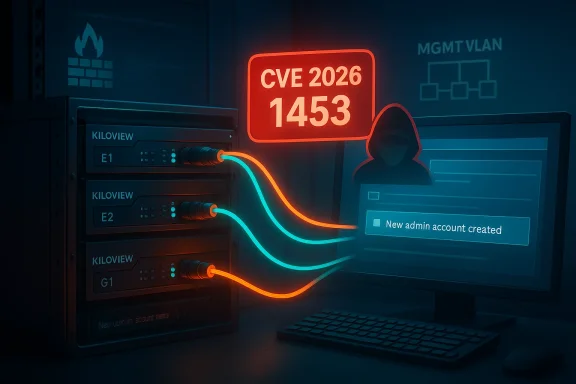
A high-severity advisory from the U.S. Cybersecurity and Infrastructure Security Agency (CISA) warns that multiple models in the KiloView Encoder Series contain a missing authentication for a critical function vulnerability (tracked as CVE‑2026‑1453 in the advisory) that — if successfully exploited by an unauthenticated attacker — could allow creation or deletion of administrator accounts and grant full administrative control over affected encoders. CISA assigned a CVSS v3.1 base score of 9.8 (Critical) and published a product-and‑version table identifying affected E‑, G‑, P‑ and RE‑series encoders; the advisory additionally notes that the vendor had not responded to coordination requests at the time of publication. This article unpacks what the advisory means for administrators, integrators, and Windows-based management environments; verifies and cross-checks the core claims where possible; and provides concrete, prioritized mitigation, detection, and incident‑response guidance you can act on today.
KiloView (also styled Kiloview) manufactures a broad family of video encoders — E‑series, G‑series, P‑series and rack/remote models — widely used for live streaming, security camera integration and remote monitoring. The product line supports common streaming protocols (SRT, RTMP, RTSP, HLS, NDI), includes both SDI and HDMI input models, and is sold into broadcast and security markets globally. Kiloview’s product pages and download center show active firmware releases and ongoing product development across encoder families, underscoring the prevalence of these devices in live‑video and monitoring deployments.
CISA’s advisory frames CVE‑2026‑1453 as a Missing Authentication for a Critical Function (CWE‑306): specifically, a flaw that permits unauthenticated requests to perform administrative account management actions (create/delete administrator accounts). The practical result of such a flaw is immediate: an attacker with network reachability to a vulnerable encoder can gain persistent, administrative control without any valid credentials. CISA’s advisory lists detailed firmware/version ranges and assigns the 9.8 CVSS rating to reflect the remote‑network attack vector, no required privileges or user interaction, and the potential for full confidentiality, integrity and availability impact.
Note on verification and indexing: CISA’s public advisory is the primary authoritative disclosure for this issue; at the time of this writing the vendor’s public support/notice pages do not appear to have published a corroborating security bulletin and widely used vulnerability databases may not yet have a fully indexed entry for CVE‑2026‑1453. This lack of vendor response and indexing is important context for risk decisions and patch planning.
Practical verification step: gather a definitive inventory that includes model, hardware version, and exact firmware string for each encoder — these are the three data points CISA uses to determine exposure. If you manage these devices via a centralized MDM or a management server, export configuration reports and cross‑check firmware strings immediately.
Action steps for procurement & ops teams:
Source: CISA KiloView Encoder Series | CISA
 Background / Overview
KiloView (also styled Kiloview) manufactures a broad family of video encoders — E‑series, G‑series, P‑series and rack/remote models — widely used for live streaming, security camera integration and remote monitoring. The product line supports common streaming protocols (SRT, RTMP, RTSP, HLS, NDI), includes both SDI and HDMI input models, and is sold into broadcast and security markets globally. Kiloview’s product pages and download center show active firmware releases and ongoing product development across encoder families, underscoring the prevalence of these devices in live‑video and monitoring deployments. CISA’s advisory frames CVE‑2026‑1453 as a Missing Authentication for a Critical Function (CWE‑306): specifically, a flaw that permits unauthenticated requests to perform administrative account management actions (create/delete administrator accounts). The practical result of such a flaw is immediate: an attacker with network reachability to a vulnerable encoder can gain persistent, administrative control without any valid credentials. CISA’s advisory lists detailed firmware/version ranges and assigns the 9.8 CVSS rating to reflect the remote‑network attack vector, no required privileges or user interaction, and the potential for full confidentiality, integrity and availability impact.
Note on verification and indexing: CISA’s public advisory is the primary authoritative disclosure for this issue; at the time of this writing the vendor’s public support/notice pages do not appear to have published a corroborating security bulletin and widely used vulnerability databases may not yet have a fully indexed entry for CVE‑2026‑1453. This lack of vendor response and indexing is important context for risk decisions and patch planning.
Why this is urgent: technical and operational impact
Missing‑authentication vulnerabilities that permit unauthenticated administrative actions are top‑tier operational risks in both CCTV/streaming and industrial‑control contexts. The worst outcomes are straightforward and immediate:- Full administrative takeover — create an administrator account, log in, change settings, export credentials, modify streams, or lock out legitimate operators.
- Persistent foothold & lateral movement — compromised encoders are networked devices that can be used to scan or pivot into management VLANs, NVRs, or Windows management stations used for video analytics.
- Data exposure and privacy risk — live streams and stored footage may be exfiltrated; device configuration can disclose backend cloud pairing tokens or NVR credentials.
- Operational disruption & tampering — recording schedules, retention, or alarm triggers can be changed to hide malicious activity or deny monitoring coverage.
What products and versions are affected
CISA’s advisory enumerates multiple KiloView Encoder Series models and firmware versions as affected. The advisory’s product mapping is granular (per‑model and per‑firmware strings), and CISA highlights these families specifically:- Encoder Series E1 (multiple hardware versions and firmware strings)
- Encoder Series E1‑s
- Encoder Series E2 (hardware versions 1.7.20 and 1.8.20 entries)
- Encoder Series G1
- Encoder Series P1 / P2
- Encoder Series RE1 (hardware versions 2.0.00 and 3.0.00 with listed firmware)
Practical verification step: gather a definitive inventory that includes model, hardware version, and exact firmware string for each encoder — these are the three data points CISA uses to determine exposure. If you manage these devices via a centralized MDM or a management server, export configuration reports and cross‑check firmware strings immediately.
Immediate mitigations you should apply (first 24–72 hours)
When a vulnerability allows unauthenticated administrative control, time matters. Use this prioritized checklist to reduce risk immediately:- Isolate affected devices from untrusted networks:
- Remove direct Internet exposure — block public IPs, close NAT/port forwards, and restrict any cloud‑facing tunnels.
- Move encoders to an isolated management VLAN or firewall zone only reachable by known jump hosts or management servers.
- Harden remote access:
- If remote maintenance is required, force access through a hardened jump host or dedicated VPN with MFA and tight allow‑lists. Recognize a VPN is only as secure as its endpoints.
- Audit and change management credentials:
- Replace default and factory credentials on all encoders, even if the device appears patched.
- Rotate any credentials that the device may store in cleartext or that are shared across devices/teams.
- Monitor and log:
- Enable and centralize device logs where possible. Create SIEM alerts for new admin account creation, deletion, or privilege changes.
- Apply compensating network controls:
- Implement firewall rules that permit management only from explicitly authorized IPs.
- Use network access control (NAC) to restrict device behavior and prevent lateral movement from the encoder network.
- If vendor updates are available, schedule urgent firmware patching: prioritize devices based on exposure (Internet‑facing first), business impact, and ability to patch safely in your maintenance windows.
Detection and hunting: what to look for in Windows and network telemetry
Encoders are typically managed from Windows workstations (NVR clients, management consoles) or via centralized management platforms. Windows administrators and SOC teams can run the following detections immediately:- Host & account alerts:
- Alert on the creation of new local accounts on NVR/management servers and on unusual administrator account creation/configuration events in logging systems.
- On Windows hosts used for encoder management, monitor Security Event Log IDs related to account creation, group membership changes, and failed/successful logons.
- Network telemetry:
- Watch for HTTP(S) POST/GET requests to encoder management endpoints that result in admin‑level actions. A new pattern of POST requests that produce 200/201 responses followed by account changes is suspicious.
- Detect outbound connections from encoders to unexpected cloud services or IPs that could indicate exfiltration.
- Configuration drift:
- Use configuration management to snapshot encoder settings; alert on changes to user lists, firmware update URLs, FTP/SFTP endpoints, or NVR pairing configurations.
- Scanning indicators:
- Detect heavy scanning activity on device management ports (80, 443, ONVIF/554, or vendor‑specific ports). Mass scanning is a common exploitation precursor.
Patching, vendor engagement, and the long term
CISA’s advisory notes that KiloView did not respond to CISA coordination requests prior to publication. That non‑response matters operationally — it leaves asset owners without vendor‑issued mitigations or verified firmware fixes and increases reliance on network‑level controls while the vendor establishes a remediation path.Action steps for procurement & ops teams:
- Contact vendor support immediately and request:
- A formal security bulletin that maps the advisory CVE to affected SKUs and the firmware build(s) that fix it.
- SHA256 hashes and signed firmware images for any patch updates.
- Guidance on safe patching procedures (rollback, config backup, expected reboot behavior).
- If vendor patching is not available, maintain the compensating controls above and treat any Internet‑accessible encoders as high‑risk assets.
- For environments subject to regulations or federal directives, document your compensating controls and timelines; for federal systems, CISA and other agencies may require rapid mitigation actions when KEV items are involved.
Concrete, step‑by‑step remediation playbook (recommended sequence)
- Inventory (0–4 hours)
- Identify every Kiloview encoder model, hardware revision, and firmware string on your network.
- Tag devices reachable from the Internet or business networks.
- Containment (0–12 hours)
- Block external access (disable port forwards; block IP at perimeter).
- Move devices to a management VLAN with strict firewall rules.
- Short‑term hardening (12–48 hours)
- Replace default credentials; enable strongest available authentication (local passwords, client certs if supported).
- Restrict management to jump hosts with MFA and endpoint protections.
- Monitoring & detection (12–72 hours)
- Turn on verbose logging, enable SIEM rules for admin account events and suspicious HTTP management traffic.
- Start packet captures when suspicious actions are seen and preserve evidence.
- Vendor coordination & patch (days → weeks)
- Request official patch and verify authenticity of firmware images (signatures/hashes).
- Test updates on non‑production devices first.
- Remediate and recover
- Apply vendor patch, verify device functionality, rotate credentials, and monitor for persistent indicators.
- If possible, conduct a post‑patch forensic sweep on devices to ensure no backdoors or added accounts remain.
- Post‑incident hardening
- Review network architecture; segment video/OT devices away from critical business networks.
- Adopt a vendor management policy that requires security vulnerability disclosure and timely patches.
Detection rule examples (starter signatures)
- SIEM rule: Alert if “new local admin user created” on a known encoder-management workstation or NVR server within X minutes after an HTTP POST to an encoder’s management IP.
- Network rule: Alert on unauthenticated requests to encoder management API endpoints that contain parameters that affect user accounts (e.g., payloads with username, role, isAdmin flags).
- EDR rule: On Windows hosts used for encoder management, alert on processes that download firmware images or run signed installers that are not part of approved change windows.
Broader lessons: why embedded devices need security parity with Windows hosts
This advisory is not unique — CISA has published multiple ICS advisories for missing‑authentication failures in cameras, gateways, metering equipment and encoders. The operational lesson for Windows-centric admins: embedded devices are not peripheral; they are often doorways into your environment. The best defenses combine hardening at the device layer, network segmentation, and vigilant Windows host hardening on any machines used to manage or integrate with IoT and OT devices. CISA’s ICS recommended practices and defense‑in‑depth guidance are an essential companion to vendor patching workflows.Risk scenarios: how attackers may exploit this in the wild
- Automated mass‑scanning & takeover
- Attacker scans public IP space for Kiloview management ports, calls unauthenticated account endpoints, and creates admin accounts across thousands of devices. Result: wide‑scale monitoring compromise and credential harvesting.
- Targeted infiltration of a high‑value camera
- A targeted actor compromises a single encoder guarding a sensitive facility, deletes alerts, or exfiltrates footage, then uses the encoder as staging ground to probe adjacent NVRs and Windows management workstations.
- Supply‑chain chaining
- Compromised encoders used by integrators provide credentials that let attackers pivot into integrator networks, then into customer environments where Windows jump hosts provide access to more sensitive systems.
What we verified and what remains unverified
Verified or corroborated:- The vulnerability class (missing authentication for a critical function) and the high impact of unauthenticated administrative control are consistent with CISA’s reporting and with prior ICS advisories for similar device classes.
- Kiloview is an active vendor producing E/G/P-series encoders and maintains a downloads/firmware portal — operators should check those vendor channels for updates.
- Vendor patch availability and vendor‑published advisory details: CISA reported that KiloView did not respond to coordination requests; consequently, a signed vendor firmware bulletin mapping CVE‑2026‑1453 to fixed versions was not available at the time of the advisory. Operators should treat vendor silence as a risk factor and insist on signed firmware. This claim (lack of vendor response) comes from the coordinating advisory and should be rechecked against vendor notices and NVD/CVE records before closing out remediation.
- Public CVE registry indexing: at time of writing the major vulnerability databases may not yet have fully enriched or indexed CVE‑2026‑1453. If canonical CVE metadata is required for compliance reporting, confirm CVE/NVD/MITRE listings before final audit reporting; absence in a registry does not mean the vulnerability is not real — CISA advisories are authoritative and actionable.
Final recommendations — prioritized and practical
- Treat KiloView encoders as high‑priority assets for immediate triage. Inventory them today and block external access until you have confirmed firmware and mitigations.
- If you operate a mixed environment with Windows NVRs and encoder fleets, prioritize jump‑host hardening: reduce the number of Windows hosts that have direct management access to encoders, enable MFA, apply EDR, and enforce application control.
- Set up SIEM alerts now to detect account creation, privilege changes, and anomalous traffic to encoder management ports.
- Demand vendor transparency and signed firmware. If your vendor will not or cannot supply a timely patch, escalate to procurement/integration partners and apply network compensations as a long‑term control.
- Document every action, preserve logs and copies of firmware images, and be ready to share indicators with your incident‑response team or with CISA if you observe suspicious activity.
Conclusion
CVE‑2026‑1453 as reported by CISA against the KiloView Encoder Series is a textbook high‑impact device‑management flaw: an unauthenticated path to administrative control, rated CVSS 9.8 and affecting multiple encoder families. The most pragmatic path for defenders is not to wait for a vendor patch: assume the worst, isolate the devices, enforce strict network segmentation and credential hygiene, and instrument detection to spot account changes or unexpected management traffic. For Windows administrators and SOC teams, the priority is to harden the host side (jump hosts/NVRs), ensure strong logging and alerting, and treat embedded video gear as first‑class security assets — because when an attacker gets admin on an encoder, the consequences go well beyond a single camera stream.Source: CISA KiloView Encoder Series | CISA
