

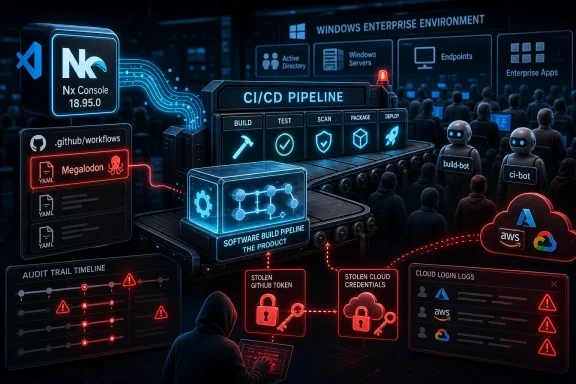
The Build Pipeline Has Become the Product
The story CISA is telling is bigger than Nx Console, bigger than GitHub, and bigger than any one malicious version number. In modern software shops, a developer’s editor, a GitHub repository, a CI runner, a package registry, a cloud account, and a deployment key can sit in one continuous trust chain. Compromise any link in that chain and the attacker may not need to exploit the application at all.
That is why the Nx Console incident matters. Nx Console is a popular extension for Visual Studio Code used by developers working with Nx monorepos, and VS Code’s extension ecosystem is deeply embedded in the daily workflow of Windows, Linux, and macOS developers alike. A poisoned extension update is not like a suspicious executable downloaded from a random forum; it arrives through a mechanism users have been trained to trust.
The malicious version identified in the CISA alert, Nx Console 18.95.0, was distributed through the extension update path. That detail is the whole plot. If a developer already had the extension installed, the risk was not necessarily a bad click or an obviously reckless choice. The danger was that software maintenance itself became the delivery channel.
This is the supply-chain problem in its purest form: the safest behavior in normal times becomes the risky behavior during a compromise. Keeping tools up to date is good hygiene until the update channel carries the attacker’s payload. Automating builds is good engineering until the automation has enough secrets to become an attacker’s cloud credential harvester.
CISA’s Alert Turns a Developer Incident Into an Enterprise Problem
CISA’s involvement raises the stakes because the agency is not treating this as a niche developer inconvenience. By adding CVE-2026-48027 to the Known Exploited Vulnerabilities catalog, CISA has effectively said that this is not hypothetical and not merely reputational. It is a known exploited condition that defenders must handle with the same urgency they would bring to a server-side vulnerability.
The practical impact is especially sharp for federal agencies and organizations that model their own remediation programs on CISA’s KEV catalog. KEV entries are useful because they cut through a familiar security-team argument: whether something is theoretically severe or actually being used. Here, the answer is that exploitation is part of the story.
The reported chain is also unnerving because it crosses organizational boundaries. According to the alert, threat actors leveraged a prior compromise of Nx developer systems to compromise a GitHub employee’s device through the poisoned VS Code extension, leading to unauthorized access and exfiltration of internal GitHub repositories. In other words, a tool used by developers became a path into the infrastructure of one of the world’s most important developer platforms.
That does not mean every organization using Nx Console suffered the same outcome. It does mean every organization that had the affected extension version in its environment has to think in terms of exposure, not simple patching. The right question is not merely “Did we remove version 18.95.0?” It is “What secrets, repositories, workflows, tokens, machines, and cloud accounts could that developer environment reach while the malicious code was present?”
The Extension Marketplace Was Always a Soft Target
Visual Studio Code’s success has created one of the most important plugin ecosystems in software development. That ecosystem is also a sprawling trust market where small extensions can enjoy deep local privileges, broad filesystem access, and user confidence that is often inherited from the editor itself. For attackers, this is an obvious place to hunt.
Extensions occupy a strange middle ground in enterprise security. They are not usually treated with the same rigor as endpoint agents, VPN clients, or privileged administrative tools. Yet in practical terms, they may run on machines that hold source code, SSH keys, npm credentials, GitHub tokens, browser sessions, cloud CLI profiles, and access to internal documentation.
On Windows developer workstations, the problem is compounded by convenience. Developers often run terminals inside VS Code, authenticate to GitHub from the editor, invoke Docker or Kubernetes tooling, and work with local environment files containing secrets that were never meant to survive outside a laptop. The editor becomes a cockpit for the organization’s production lifecycle.
This is why “poisoned VS Code extension” is not a side note. It is a warning that the IDE has become part of the security perimeter. If an organization inventories endpoint software but ignores editor extensions, it has drawn the perimeter in the wrong place.
Automatic Updates Are a Security Feature Until They Aren’t
The most painful detail in the Nx Console case is that the malicious build may have reached systems through automatic updates. Security teams have spent years convincing users and administrators to stop delaying patches. Now attackers are learning to turn that muscle memory against them.
This does not mean automatic updates are bad. The opposite is closer to the truth: disabling automatic updates everywhere would create a larger and more predictable vulnerability window. But the incident shows that automatic updates need a surrounding control plane, especially for developer tools that can touch code and secrets.
Enterprise IT has long understood this for operating systems. Windows Update for Business, WSUS, Intune rings, staged deployments, and deferral policies exist because even legitimate updates can create operational risk. Developer tooling has often escaped that same discipline because the culture around it prizes speed, autonomy, and local customization.
That bargain is becoming harder to defend. If a VS Code extension can become a credential harvester, then organizations need visibility into which extensions are installed, which versions are allowed, and how quickly risky versions can be blocked. This is not glamorous security work. It is asset management, policy, telemetry, and enforcement — the unromantic machinery that tends to matter most when an incident moves from Slack panic to incident-response clock.
The three-hour package-delay recommendation in CISA’s alert points in the same direction. CISA is not saying the open-source community can magically prevent every bad package. It is saying that a short cooling-off period can give maintainers, researchers, and automated scanners time to detect the obvious fires before enterprises ingest them at scale.
Megalodon Shows the New Target Is the Workflow File
The “Megalodon” campaign adds a second, equally important lesson: attackers do not have to poison application code if they can poison the workflow that builds it. GitHub Actions workflow files are often treated as operational scaffolding, not production code. That assumption is obsolete.
Reports around Megalodon describe thousands of repositories receiving malicious workflow changes in a short window, with commits attributed to plausible automated identities such as build-bot, auto-ci, ci-bot, and pipeline-bot. The technique is effective because it blends into the background noise of modern repositories. Repositories are full of routine chores, generated commits, dependency bumps, CI tweaks, and bot-authored changes that few humans read closely.
A malicious workflow can do what application code may not be allowed to do. It can access repository secrets, request cloud credentials, run shell commands, build containers, publish packages, sign artifacts, and contact external infrastructure. It sits at a privileged intersection where trust is assumed because the job is to automate trust.
That is why a workflow change after May 18, 2026 — the date CISA highlights for review — deserves special scrutiny. An attacker who lands a small YAML file may not need to persist in the source tree forever. A single workflow run can be enough to exfiltrate secrets, and those secrets can outlive the malicious commit that stole them.
The Bot Name Is the Camouflage
The use of automated-looking commit authors is not a trivial social-engineering flourish. It exploits a real weakness in how teams review operational changes. Humans are bad at noticing routine-looking automation, especially in repositories where bots already generate a large share of activity.
The names CISA calls out — build-bot, auto-ci, ci-bot, pipeline-bot — are effective precisely because they are boring. They sound like the kind of thing a previous team might have created three years ago and forgotten to document. They are plausible enough to pass through the first filter of human suspicion.
This is also where AI-assisted development and agentic automation will make the problem harder. As organizations invite more bots into repositories to triage issues, update dependencies, summarize pull requests, and propose code changes, the visual distinction between legitimate automation and hostile automation gets thinner. The attacker does not need to impersonate a person if the repo already trusts machines.
The defensive response cannot be “pay more attention” in the abstract. It has to be structural. Automated accounts need ownership, provenance, signing where practical, scoped permissions, and review rules that treat workflow changes as sensitive changes. A bot touching .github/workflows should be more suspicious than a bot fixing a typo in documentation.
Secret Rotation Is the Expensive Part Everyone Wants to Avoid
The easy part of incident response is deleting the malicious file or uninstalling the bad extension. The expensive part is assuming that every exposed secret may already be gone. CISA’s guidance is blunt because it has to be: rotate or revoke credentials, tokens, and secrets accessible to CI/CD pipelines, including cloud keys, SSH keys, package-registry tokens, repository tokens, Vault credentials, Terraform secrets, Kubernetes tokens, and developer or pipeline secrets.
This is where many organizations discover that their secret-management maturity is not what they thought it was. Rotating one GitHub token is easy. Rotating every secret a workflow could read, every cloud role a runner could assume, every deployment credential that might have been present in a job log, and every package token used by release automation is a different kind of exercise.
The hardest cases are the secrets that nobody can confidently map. Old deployment keys, long-lived cloud credentials, inherited organization secrets, environment-level tokens, and self-hosted runner permissions often survive because they are invisible until something breaks. An incident like this forces a painful inventory under pressure.
Windows-heavy enterprises are not exempt just because the compromised machinery lives in GitHub and VS Code. Windows developers commonly use VS Code, WSL, GitHub Desktop, PowerShell, Azure CLI, Docker Desktop, and cloud SDKs together. A compromised developer workstation can bridge local Windows credentials, SSH material, browser sessions, and cross-platform build tooling in ways that traditional Windows endpoint models do not always capture.
The Cloud Credential Is the Real Prize
Supply-chain intrusions are often discussed as if the final target is a malicious package shipped to unsuspecting users. That can happen, and it is dangerous. But in campaigns targeting CI/CD systems, the more immediate prize is often cloud access.
A CI pipeline may hold AWS keys, Azure federated credentials, Google Cloud tokens, Docker registry credentials, npm publishing tokens, PyPI tokens, Slack webhooks, signing material, and access to private package feeds. In a mature environment, some of those secrets may be short-lived and tightly scoped. In the real world, many are still broad, persistent, and under-monitored.
Once stolen, these credentials can move the attacker outside the repository. A compromised GitHub Action can become an Azure subscription incident. A stolen package token can become a downstream software distribution problem. A leaked SSH key can become access to build hosts or internal infrastructure. The repository is the door, not necessarily the destination.
This is why forensic review matters. CISA’s recommendation to examine CI/CD logs, cloud audit trails, and affected developer machines is not bureaucratic padding. It reflects the fact that the visible compromise may be only the earliest stage. If defenders stop at the Git commit, they may miss the cloud session that followed.
Pinning Versions Is Not Paranoia Anymore
CISA’s package-repository guidance reads like the sort of conservative advice developers often resist: wait before pulling a new package, pin trusted versions, and use known sources. Those recommendations can feel slow in a culture that prizes continuous everything. But the security argument for pinning has become stronger with every registry, workflow, and extension compromise.
Pinning is not a magic shield. A pinned malicious version is still malicious, and pinned dependencies can become stale. But pinning changes the failure mode. It prevents a build from silently consuming the newest thing just because the newest thing exists. It gives humans and automated systems a chance to decide when trust should move.
The same logic applies to GitHub Actions. Referencing actions by mutable tags is convenient, but it leaves room for surprise when a tag is moved or a dependency chain shifts underfoot. Pinning to immutable commits, limiting permissions, and reviewing workflow changes can make CI compromise harder to scale.
The three-hour delay recommendation is similarly pragmatic. It does not ask teams to abandon velocity; it asks them to recognize that attacker speed is part of the threat model. In an ecosystem where malicious packages can be published, detected, removed, mirrored, cached, and still consumed by automated systems, a short delay can be a meaningful defensive buffer.
GitHub Is Infrastructure, Not Just a Website
One reason incidents like this resonate so widely is that GitHub has become infrastructure in the same way DNS, certificate authorities, package registries, and cloud identity providers are infrastructure. It is where code lives, but also where permissions, reviews, releases, build jobs, security scanning, issue automation, and developer identities converge.
That centrality creates leverage for both defenders and attackers. GitHub can roll out platform-level controls, advisories, token changes, and detection logic at a scale most individual organizations cannot match. But a successful compromise touching GitHub-related trust paths can ripple across thousands of downstream environments.
For enterprises, this means GitHub cannot be treated as “the developers’ SaaS app” and left outside central risk management. The platform is tied to production deployment, software provenance, compliance evidence, and incident response. Security teams that carefully govern Microsoft 365, Entra ID, and endpoint management but have only loose visibility into GitHub organizations are missing a critical control plane.
That is particularly true for organizations building on Azure or shipping Windows software. GitHub Actions often integrates directly with Azure deployments, container registries, code signing workflows, and release pipelines. The boundary between source control and production has blurred so thoroughly that pretending they are separate systems is now a liability.
Vendor Trust Needs a Blast-Radius Budget
The Nx Console and Megalodon incidents also expose a philosophical problem in software security. Modern development depends on delegated trust: trust the extension maintainer, trust the package registry, trust the workflow author, trust the CI runner, trust the cloud identity provider, trust the bot. The question is no longer whether to trust vendors and open-source maintainers. The question is how much blast radius each unit of trust receives.
A VS Code extension should not automatically become a path to every secret on a developer workstation. A GitHub Action should not automatically receive broad repository and cloud permissions. A bot should not be able to alter workflows without stronger review than an ordinary documentation change. A package update should not silently cross from untrusted novelty into production release without a gate.
The old perimeter model failed because it assumed a clean boundary between inside and outside. The newer supply-chain model fails when it assumes that being inside a trusted development tool is enough. Trust has to become more granular, shorter-lived, and more observable.
This is where many organizations will need to accept friction. Least privilege slows down the first pipeline setup. Secret rotation requires ownership. Extension allow-listing annoys developers who are used to installing whatever improves their workflow. But the alternative is a development environment where attackers only need one trusted update channel or one sleepy workflow review to reach the organization’s crown jewels.
The Windows Angle Is Bigger Than VS Code
WindowsForum readers will naturally notice the VS Code angle, but the Windows relevance goes beyond Microsoft’s editor ecosystem. Windows remains a primary enterprise desktop platform, and many development teams now use Windows as a hybrid environment: native tooling, WSL, containers, remote dev environments, cloud CLIs, and browser-based identity all running side by side.
That hybrid setup is powerful, but it complicates detection. A malicious extension may interact with files in a user profile, shell out to platform tools, read environment variables, or touch credentials used by cross-platform toolchains. Traditional endpoint controls may see a trusted editor process doing unusual work, but whether that stands out depends on the telemetry and baselines in place.
Defender teams should care about editor processes spawning shells, unexpected network connections from development tools, new workflow files appearing in repositories, and tokens used from strange locations. None of those signals is perfect. Together, they form the difference between discovering a compromise during the first wave and discovering it after stolen credentials have been reused somewhere else.
The broader point is that developer endpoints deserve the same seriousness as privileged admin workstations. In many companies, the developer with package-publishing rights and cloud deployment access can create more downstream risk than a conventional domain admin. The security model should reflect that reality.
The Audit Trail Is Now a First-Class Control
CISA’s recommendations emphasize monitoring workflow files, contributor activity, suspicious pull requests, direct commits, and automated accounts. That is not accidental. In supply-chain incidents, the audit trail often becomes the only way to reconstruct what the attacker reached.
The challenge is that many organizations do not retain enough CI/CD telemetry, or they retain it in systems that are hard to search during an emergency. Build logs expire. Workflow histories get pruned. Cloud audit logs may be split across accounts or subscriptions. Developer workstation evidence may be overwritten by normal use.
A mature response requires joining these sources. Which developer machines had the affected extension? Which repositories did those developers access? Which workflows ran during the exposure window? Which secrets were available to those workflows? Which cloud tokens were minted? Which package versions were published afterward? Those questions cross team boundaries, and during an incident the boundaries become delays.
This is where platform engineering and security engineering should meet. The goal is not to bury developers under process but to make the secure path the observable path. If workflows are standardized, secrets are centrally managed, tokens are short-lived, and releases are traceable, incident response becomes less of an archaeological dig.
Open Source Is Not the Weak Link; Unbounded Automation Is
It is tempting after any supply-chain compromise to blame open source as a category. That misses the point. The problem is not that developers use shared code, extensions, and automation. The problem is that organizations often consume them with insufficient constraints and then hand them access to secrets and deployment paths.
Open-source ecosystems are also where many of these compromises are detected first. Researchers, maintainers, and security companies routinely identify malicious packages, suspicious commits, and backdoored workflows at speeds that closed environments often cannot match. CISA’s recommendation to wait before pulling new packages implicitly depends on the community’s detection capability.
The better criticism is that modern software delivery has made automation more powerful than governance. CI/CD systems were designed to remove manual bottlenecks, and they succeeded. But some of those bottlenecks were also informal security checks. When automation can merge, build, sign, publish, and deploy, the controls around that automation must become correspondingly stronger.
Megalodon is a case study in what happens when the workflow file becomes a privileged program but is reviewed like configuration. Nx Console is a case study in what happens when a development convenience becomes a trusted execution path. Neither lesson argues for abandoning modern tooling. Both argue for treating modern tooling as production infrastructure.
The Practical Response Starts With Boring Questions
The immediate response for organizations is not to panic-remove every extension or disable every workflow. It is to ask specific, testable questions. Did any developer workstation install Nx Console 18.95.0? Did any repository receive suspicious workflow changes after May 18, 2026? Did automated-looking accounts commit to protected branches? Did CI jobs run with secrets during the exposure window? Were any packages published from repositories later found to have malicious workflow changes?
Those questions should be answered with logs, not vibes. Endpoint inventory should identify extension versions. Git history should be searched for suspicious authors, messages, and workflow modifications. GitHub audit logs should be reviewed for unusual token usage, workflow-run deletions, branch protection changes, and direct commits. Cloud logs should be checked for new sessions, unusual API calls, and credential use from unexpected infrastructure.
The remediation sequence should assume that deletion is not enough. Unauthorized workflow files should be reverted, but secrets exposed to those workflows still need rotation. Bad extension versions should be removed or upgraded, but developer machines that ran them may need forensic review. Package releases built from compromised repositories may need to be reissued, deprecated, or investigated downstream.
The hardest part is deciding how far to go. Not every exposure warrants a full company-wide credential reset. But organizations should resist the comforting fiction that no evidence of abuse is the same as evidence of no abuse. In credential theft incidents, logging gaps tend to favor the attacker.
The Real Test Is Whether Enterprises Change Defaults
Security advisories often produce a burst of activity and then fade into backlog sediment. This one deserves a more durable response because it points to defaults that are no longer safe enough. The organizations that learn from it will not merely hunt for one malicious extension version. They will change how developer trust is granted.
That means tighter controls on extension installation and updates, especially for users with access to sensitive repositories. It means treating .github/workflows changes as high-risk changes. It means pinning dependencies and actions where practical, delaying automatic ingestion of new packages, and limiting what CI jobs can access by default. It means replacing long-lived secrets with short-lived, scoped credentials and making secret rotation routine rather than heroic.
It also means recognizing that developer experience and security cannot be solved as separate disciplines. If security teams impose controls that make development painful, developers will route around them. If platform teams optimize only for speed, attackers will inherit that speed. The winning model is a paved road where secure defaults are also the easiest defaults.
Microsoft, GitHub, extension maintainers, package registries, and enterprise security teams all have work to do here. Marketplace review can improve, but it will not catch everything. GitHub can harden workflow permissions and detection, but repository owners still decide what automation they trust. Enterprises can buy tools, but they still need ownership of secrets, logs, and release paths.
The Signal CISA Sent Is Clear Enough to Act On
CISA’s alert is useful because it converts a messy chain of developer compromises into a short operational mandate: look at your workflows, look at your bots, look at your extension versions, and assume exposed secrets may be compromised. The details matter, but the strategic message is simpler. The software factory has become a target.
The most concrete takeaways are not exotic. They are the controls many teams already knew they should implement but had not prioritized because the build system felt internal, trusted, or too complicated to govern.
- Organizations should identify any installation of Nx Console 18.95.0 and treat affected developer machines as potentially exposed until reviewed.
- Repository owners should audit workflow changes and automated-looking commits made after May 18, 2026, especially changes under
.github/workflows. - Security teams should rotate or revoke secrets that were available to affected CI/CD jobs, rather than assuming that removing a malicious workflow fully remediates the incident.
- Platform teams should pin trusted dependency and GitHub Action versions where practical, and avoid automatically consuming brand-new packages without a short delay.
- Enterprises should treat developer workstations, editor extensions, CI runners, and repository automation as privileged infrastructure rather than informal productivity tooling.
- Automated accounts should have clear ownership, narrow permissions, and stronger review requirements when they touch build, release, or workflow configuration.
The unsettling part of the Nx Console and Megalodon incidents is not that attackers found a clever new trick. It is that they attacked the places where software teams had already concentrated trust for perfectly rational reasons. The next phase of supply-chain defense will not be won by pretending development can slow back down to a pre-automation era. It will be won by making the automated path narrower, more observable, and less generous with secrets before the next poisoned update or bot-shaped commit turns routine engineering into an intrusion path.
References
- Supply Chain Compromises Impact Nx Console and GitHub Repositories CISA · 2026-05-28T12:00:00+00:00