

The Old Bug Is Still Sitting in the Control Room
RSLinx Classic is not a household Windows application, but inside Rockwell Automation environments it has long been one of those pieces of software that quietly makes the architecture work. It brokers communications between Windows-based software and industrial controllers, which means its reliability often matters more than its visibility. When it stalls, the failure can feel less like “an app crashed” and more like a blind spot appearing in the plant.
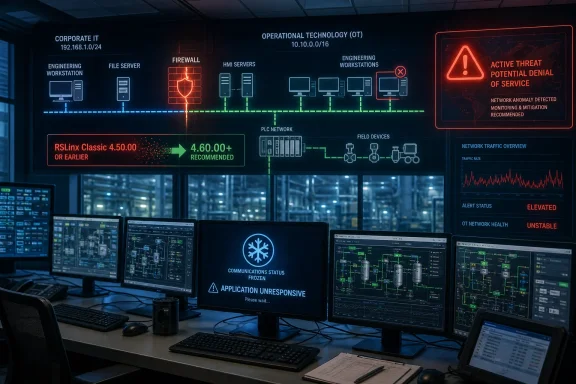
CISA’s advisory frames the issue as a denial-of-service condition: successful exploitation can make the application unresponsive, and it will not recover on its own. That last clause is doing a lot of work. In enterprise IT, a service crash may trigger a restart, a failover, or a help desk ticket. In industrial operations, an unresponsive communications layer can interrupt monitoring, engineering access, data collection, or maintenance workflows in ways that operators may have to diagnose under time pressure.
The affected versions are listed as RSLinx Classic 4.50.00 and earlier, with Rockwell recommending an upgrade to 4.60.00 or later. For sites that cannot upgrade immediately, the vendor points to patch BF31213 for current versions and the usual control-system security practices. The practical message is simple enough: if RSLinx Classic is in the environment, version inventory is not optional housekeeping anymore.
The advisory also carries a slightly odd tension. CISA’s summary describes an out-of-bounds read and denial of service, while the CVE description text refers to a stack-based buffer overflow that may allow remote code execution. That mismatch does not mean administrators should ignore the alert; it means they should treat vendor remediation as authoritative while understanding that vulnerability metadata in industrial advisories can be messy, especially when older CVEs are republished into newer formats.
Industrial Windows Risk Rarely Looks Like Desktop Windows Risk
WindowsForum readers are used to thinking about patching through the lens of Patch Tuesday, Defender signatures, driver regressions, and endpoint management. RSLinx Classic lives in a different world. It may run on Windows, but it often belongs to a production ecosystem where change control is measured in maintenance windows, vendor qualification, operator training, and the cost of downtime.
That is why a high-severity denial-of-service flaw in industrial middleware lands differently than a bug in a consumer application. The impact is not necessarily data theft or full machine takeover. The impact is loss of availability in a place where availability is the main security objective.
The CVSS 3.1 vector tells the same story in compressed form: network attack vector, low complexity, no privileges, no user interaction, and high availability impact. Confidentiality and integrity are scored as unaffected. In plain English, the advisory is saying that a remote attacker who can reach the vulnerable service may not need a password or a tricked user to make the software stop doing its job.
For Windows administrators who have inherited manufacturing networks, that should sound uncomfortably familiar. Many industrial systems are built around Windows machines that are not treated like conventional endpoints, yet they still have IP addresses, services, drivers, credentials, and patch levels. The operational label does not make them immune to ordinary network abuse.
The RSLinx Role Makes “Just Patch It” Too Easy an Answer
The recommended fix is straightforward: move to RSLinx Classic 4.60.00 or later, or apply Rockwell’s patch where a full upgrade is not feasible. But in industrial environments, remediation is rarely a one-line instruction. A communications package like RSLinx can be tied to engineering tools, HMI systems, OPC clients, licensing components, controller firmware expectations, and vendor support matrices.
That does not excuse inaction. It does explain why old vulnerabilities remain present long after fixes exist. A site may have a validated application stack that nobody wants to disturb, a production line that runs around the clock, or a vendor-integrated workstation image that has not been rebuilt in years. The result is a familiar industrial security paradox: the systems most costly to interrupt are often the systems most difficult to update.
The real test for administrators is not whether they can quote the advisory. It is whether they can answer three operational questions quickly. Where is RSLinx Classic installed? Which versions are running? Which of those systems are reachable from networks that should never be able to touch them?
If those answers are not already available, the vulnerability has exposed an asset-management problem as much as a software problem. Many OT security incidents begin with that kind of fog. The attacker does not need to understand every controller in the plant if the defender cannot see every Windows workstation in the control environment.
CISA’s Network Advice Is Boring Because It Is Usually Right
CISA’s recommended practices are the standard ICS canon: minimize exposure, keep control systems off the public internet, put firewalls between business and control networks, and use secure remote access where remote access is necessary. These points can read like boilerplate, but boilerplate becomes boilerplate because the same mistakes keep appearing in incident reports.
The most important word in the advisory may be reachable. A network-exploitable vulnerability only matters to an attacker who can send traffic to the vulnerable service. That makes segmentation more than a compliance diagram. It is the difference between a flaw being a theoretical plant-floor concern and a remotely triggerable outage path.
VPN language deserves particular attention. CISA correctly notes that VPNs are not magic; they inherit the security posture of the connected devices and the VPN platform itself. In many manufacturing organizations, remote access expanded for good business reasons: vendor support, after-hours troubleshooting, centralized engineering, and lean staffing. The security debt arrives later, when an old engineering workstation becomes reachable through a remote access path nobody wants to disable.
For IT teams working with OT counterparts, this is where the conversation has to mature beyond “block everything” versus “production needs access.” The better question is what access is actually required, from which identities, through which jump hosts, during which maintenance windows, and with what monitoring. Availability-focused security is not less disciplined than enterprise security. It is just disciplined around different failure modes.
The Republished Advisory Shows the Value and Limits of Vulnerability Feeds
The initial CISA release date for this republication is June 16, 2026, even though CVE-2020-13573 dates back years. That distinction matters. Security teams that ingest advisories mechanically may see a “new” item and assume a fresh vulnerability has emerged. Others may dismiss it as ancient history and miss the fact that their installed version range is explicitly covered.
This is one of the recurring problems with vulnerability management in industrial environments. Databases, advisories, vendor bulletins, scanner plugins, and asset inventories do not always speak the same language. Product names shift. Version ranges expand. CVE descriptions are revised. Advisory pages are republished. A vulnerability that was once associated with a narrower observed version can later be mapped to a broader supported product line.
That is not a reason to distrust the process. It is a reason to make vulnerability management less dependent on headlines. A security program that only reacts to “new CVE” alerts will miss risk that reappears through changed applicability, changed exposure, or changed operational context.
For RSLinx Classic, the safe interpretation is conservative. If the product is at or below 4.50.00, it belongs in the remediation queue. If it cannot be upgraded, it belongs behind tighter network controls and a documented exception with a review date. If nobody knows where it is installed, the first remediation task is discovery.
Windows Administrators Are Becoming OT First Responders
The affected sectors listed by CISA — critical manufacturing, energy, food and agriculture, and water and wastewater — are not abstract policy categories. They are places where Windows machines often sit at the seam between corporate IT and physical process control. That seam is increasingly where security work happens.
A decade ago, many Windows admins could plausibly say that PLC communications software was someone else’s problem. That boundary is harder to defend now. Domain services, backup agents, remote management tools, EDR platforms, patch servers, virtualization clusters, and identity providers frequently cross into or adjacent to OT networks. Even when the controller logic is owned by engineering, the Windows substrate often belongs to IT.
The challenge is cultural as much as technical. Enterprise IT tends to optimize for confidentiality, identity enforcement, and rapid patching. OT tends to optimize for safety, availability, determinism, and change control. When a vulnerability like this appears, each side can sound reckless to the other: IT thinks OT is delaying a known fix, while OT thinks IT is proposing untested disruption.
The better posture is joint ownership. IT brings discovery, logging, segmentation, credential hygiene, and patch orchestration. OT brings process knowledge, safety constraints, vendor dependencies, and maintenance timing. Neither side can solve the risk alone, because the vulnerable asset is both a Windows system and a production component.
Denial of Service Is a Serious Industrial Outcome
In consumer software, denial of service can sound less severe than code execution. In industrial settings, that hierarchy is not always so clean. A remote code execution bug is obviously dangerous, but a reliable way to make a key communications process hang can still be operationally significant.
The advisory says the application becomes unresponsive and does not recover on its own. That implies a human recovery step, whether that is restarting a service, rebooting a workstation, failing over to another system, or escalating to a vendor. During that period, visibility or control pathways may be degraded depending on how the site uses RSLinx Classic.
The practical impact will vary widely. In one environment, the affected installation may be a lightly used engineering workstation. In another, it may support data collection, operator tooling, or integration with legacy systems. CVSS cannot encode that difference. Asset context can.
That is why impact analysis should precede blunt remediation. CISA says organizations should perform proper impact analysis and risk assessment before deploying defensive measures, and that advice cuts both ways. Patching without testing can break production dependencies; doing nothing can leave a reachable outage path in place. The security work is finding the controlled route between those two failures.
The Version Number Is the First Control
The most actionable part of the advisory is the version boundary. RSLinx Classic 4.50.00 and earlier are affected; 4.60.00 or later is the recommended upgrade path. That gives administrators a concrete starting point, not merely a theoretical vulnerability class.
A serious response should begin with inventory. Look for RSLinx Classic on engineering workstations, HMI support machines, maintenance laptops, virtualized OT servers, vendor-managed boxes, and old images retained for disaster recovery. Do not assume the only exposed copy is the one everyone remembers.
From there, teams should sort systems by exposure and role. A vulnerable installation on a segmented engineering workstation is still a concern, but a vulnerable installation reachable from a broader network is a different risk. A system that supports production uptime deserves more careful testing than a spare lab machine, but it does not deserve indefinite exemption.
Administrators should also resist the temptation to treat patch BF31213 as an excuse to preserve old architecture forever. Backported fixes are valuable, especially in tightly validated environments, but they should not become a substitute for lifecycle planning. Industrial software estates age quietly until one day the upgrade path is not just inconvenient but structurally painful.
Segmentation Is the Patch You Can Often Apply First
Not every site can move to RSLinx Classic 4.60.00 immediately. Some will need vendor validation, maintenance approval, application testing, or downtime coordination. That makes network containment the near-term control.
The advisory’s defensive recommendations map cleanly to a practical sequence. Remove any internet exposure. Restrict access to only the hosts that require it. Place engineering workstations and control-system services behind firewalls that enforce explicit rules. Require remote users to traverse controlled access points rather than flat VPN routes into sensitive segments.
Monitoring matters too. A denial-of-service vulnerability may not leave the same trail as malware, but unusual traffic toward RSLinx hosts, unexpected service hangs, or repeated communications failures should be investigated. In OT, availability symptoms are security signals when they coincide with network anomalies.
The goal is not to make the vulnerable version safe forever. The goal is to reduce the probability that a remote actor can touch it before the software is corrected. In industrial security, temporary controls are legitimate when they are documented, monitored, and tied to a remediation plan.
The Advisory Is Also a Test of Vendor Dependency
Rockwell’s recommendation to upgrade or apply a vendor patch is expected, but it highlights a dependency that many industrial sites underestimate. If the plant’s operational resilience depends on a Windows application from a third party, then that third party’s security advisory process becomes part of the plant’s risk model.
That means procurement and lifecycle management matter. Which software is still supported? Which versions are compatible with the rest of the automation stack? Which patches have been qualified? Who receives security advisories, and who has authority to schedule remediation?
Too often, the answers live in different departments. Engineering knows the process. IT knows the endpoints. Procurement knows the support contract. Security sees the advisory. Operations owns the outage risk. A vulnerability like CVE-2020-13573 forces those threads into one conversation.
This is where mature organizations separate vendor positioning from observed effect. The vendor says upgrade; CISA republishes the advisory; the CVE metadata describes the technical weakness; scanners may report a different affected range; plant personnel know what the software actually does in production. The defensible decision is made by reconciling those views, not by pretending one of them is the whole truth.
The RSLinx Warning Leaves Administrators With a Short List, Not a Mystery
The value of this advisory is that it turns an old vulnerability into a current checklist for Rockwell environments. The risk is not mysterious, but it is easy to postpone because it sits in the uncomfortable space between Windows administration and plant operations.
- Organizations should identify every RSLinx Classic installation and record the exact version, especially any deployment at or below 4.50.00.
- Sites that can upgrade should move to RSLinx Classic 4.60.00 or later after appropriate operational testing.
- Sites that cannot upgrade promptly should evaluate Rockwell’s BF31213 patch and document any compensating controls.
- Vulnerable systems should not be reachable from the internet or broad corporate networks, and remote access should be tightly brokered through controlled pathways.
- Service hangs, unexplained communications failures, or unusual traffic toward RSLinx hosts should be treated as security-relevant events, not merely nuisance outages.
- Exceptions should have owners and dates, because an unsupported “temporary” mitigation is how old industrial risk becomes permanent infrastructure.
The larger lesson is that industrial Windows security is becoming less about dramatic intrusions and more about disciplined maintenance of the software that keeps production visible, reachable, and supportable. CVE-2020-13573 may be an old identifier, but CISA’s 2026 republication makes the operational question current again: if a reachable RSLinx Classic instance can be made to stop responding, who would know, who could fix it, and how long would the plant be willing to wait?