

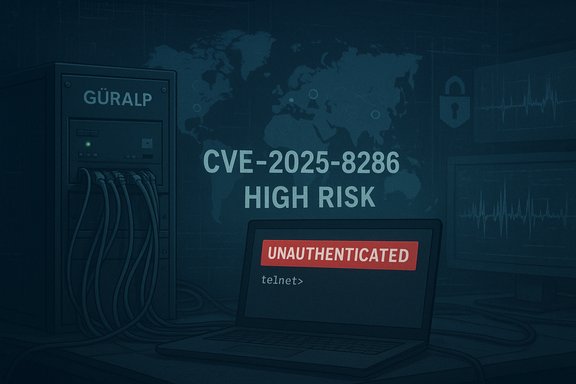
CISA has issued a high‑severity industrial control systems (ICS) advisory describing an unauthenticated Telnet command‑line interface in Güralp Systems seismic monitoring devices that can be remotely accessed with no credentials, enabling attackers to modify hardware settings, manipulate seismic data, or factory‑reset units. The vulnerability is tracked as CVE‑2025‑8286 and carries critical severity ratings (CVSS v3 ≈ 9.8; CVSS v4 ≈ 9.3). The advisory warns of remote exploitability with low attack complexity, and at the time of publication there was no coordinated vendor patch and limited vendor response to disclosure requests.
Two concurrent realities raise the threat profile: (1) the attack prerequisites are minimal and network‑based, and (2) vendor remediation was not immediately available or coordinated at disclosure time, forcing organizations to rely on network‑level compensations and architecture changes. Operators should assume that this vulnerability increases the risk of data manipulation, service disruption, and potential pivoting toward enterprise assets — including Windows servers used for aggregation and analysis — until definitive vendor fixes are available and deployed. Finally, because product families (Fortimus and Certimus) incorporate Minimus digitiser firmware, organizations must explicitly include those models in their inventories and treat them as potentially vulnerable unless vendor statements or firmware checks indicate otherwise. Where decisive remediation is not possible, isolation and replacement planning are the most sustainable long‑term mitigations.
Conclusion: treat the advisory as urgent, inventory and isolate affected assets, apply strict network controls, harden Windows aggregation hosts, and maintain active pressure on the vendor for firmware remediations. The next steps taken in the coming days will materially determine whether these monitoring platforms remain a controlled component of your infrastructure or become an opportunistic attack surface for adversaries.
Source: CISA Güralp Systems Fortimus Series, Minimus Series, and Certimus Series | CISA
 Background / Overview
Güralp Systems and the affected product families
Güralp Systems is a U.K.‑based vendor of seismic instrumentation used in scientific, industrial, and critical‑infrastructure monitoring. The product families implicated include the FMUS series (seismic monitoring units) and the MIN series (Minimus digitiser family). Güralp’s product documentation indicates that the Fortimus and Certimus products integrate a Minimus digitiser or equivalent firmware family; in other words, Fortimus/Certimus devices share firmware characteristics and management services with Minimus devices. That relationship means Minimus‑family vulnerabilities are likely to affect Fortimus and Certimus devices in deployed environments.What the advisory says (short)
The U.S. Cybersecurity and Infrastructure Security Agency (CISA) published an ICS advisory describing an unauthenticated Telnet‑based command interface that allows remote actors to invoke critical device functions without authentication. The advisory assigns CVE‑2025‑8286 to the finding, classifies it under CWE‑306 (Missing Authentication for Critical Function), and reports CVSS scores in the critical range. CISA’s technical writeup emphasizes the ability to change configuration, manipulate measurement data, or reset the device to factory defaults remotely.Technical analysis
The root cause: unauthenticated Telnet command interface
At its core, the issue is an exposed command interface reachable over Telnet that does not enforce authentication or access controls. Telnet is an unencrypted, legacy protocol. When an embedded device exposes a command shell or management CLI via Telnet without authentication, any network‑reachable attacker can send commands, alter configuration, or trigger factory resets. CISA classifies this as CWE‑306: Missing Authentication for Critical Function. The combination of a network service, no authentication, and Telnet’s lack of encryption produces an elevated risk profile because exploitation requires neither credentials nor sophisticated exploit development.CVE, severity, and exploitability
CVE‑2025‑8286 is the canonical identifier listed by CISA for this vulnerability. CISA reports a CVSS v3 base score of 9.8 (AV:N/AC:L/PR:N/UI:N/S:U/C:H/I:H/A:H), and independent CVE trackers reproduce high severity metrics and the CWE mapping. Some vulnerability repositories include an EPSS (Exploit Prediction Scoring System) estimate that the probability of exploitation in the short term is non‑zero but not yet widespread — which aligns with coordinated‑disclosure timelines where public proof‑of‑concepts can appear after advisories are published. Operators should treat the risk as urgent because the attack prerequisites are minimal: network reachability and an exposed service.Potential impact and likely attack paths
- Remote configuration modification: attackers could change sampling parameters, channel mapping, gain settings, or network targets — altering the fidelity or integrity of seismic telemetry.
- Data manipulation and falsification: altering recorded measurements can undermine monitoring systems, skew event detection, or hide recorded events.
- Factory reset and denial of service: resetting units can remove calibration and network configuration, producing outages in monitoring networks.
- Lateral movement: compromised devices at the network edge can be pivot points into monitoring servers, data concentrators, or maintenance tunnels if protections are weak.
Because many seismic and monitoring systems integrate with enterprise networks (for data aggregation, backups, and remote maintenance), the safety and operational impacts extend beyond a single sensor: attackers can influence analytic pipelines, alerting thresholds, and downstream decision systems.
Fortimus and Certimus: why they matter here
Güralp product documentation explicitly notes that Fortimus accelerometers and Certimus seismometers include the Minimus digitiser firmware or an integrated Minimus component. That means firmware‑level flaws or exposed management interfaces in the Minimus family can translate directly to Fortimus/Certimus models in the field. In practice, an operator who only inventories “Fortimus” or “Certimus” by hardware name but not firmware lineage may underestimate exposure. Treat Fortimus and Certimus devices as in‑scope for Minimus‑family advisories unless vendor guidance says otherwise.Vendor coordination and patch status
Vendor response (or lack thereof)
Public reporting and aggregator writeups indicate Güralp did not respond to some coordination attempts by national authorities at the time of the advisory’s publication. That non‑response means CISA and system operators were left to recommend network‑level mitigations rather than a straight vendor patch or firmware upgrade path. Several news outlets and security bulletins reiterated that Güralp had not provided a vendor fix immediately after disclosure. Operators should treat vendor non‑response as an operational risk factor — it forces reliance on compensating controls until an official fix is available.What CISA recommends (high level)
CISA’s standard ICS mitigation guidance applies here and includes immediate actions such as:- Minimize network exposure: remove direct Internet access to affected devices.
- Segmentation and firewalls: place devices behind OT firewalls and deny unnecessary cross‑network routes.
- Use secure remote access: if remote management is required, use secured and monitored VPNs, jump hosts, or out‑of‑band access that does not expose Telnet to untrusted networks.
- Monitor and log: increase detection and monitoring for anomalous Telnet sessions, configuration changes, or unexpected reboots.
Because the advisory lists no vendor patch at disclosure, network controls and operational procedures are primary defense levers until an official remediation appears.
Practical mitigation playbook for operators
Immediate (within 24 hours)
- Inventory: compile a precise list of deployed Güralp FMUS, MIN, Fortimus, and Certimus devices, including IP addresses, firmware versions, and network paths.
- Block Telnet at the perimeter: if Telnet (TCP/23) is reachable from untrusted networks (internet or corporate segments), block it using firewall rules.
- Isolate: if blocking is not immediately possible, place affected devices on a dedicated, isolated management VLAN that has no direct route to the internet and restrict access to a small set of vetted maintenance hosts.
- Monitor: enable logging for devices and inspect gateway/firewall logs for unexpected Telnet connections or configuration‑change events.
- Emergency access: if remote maintenance is needed, require a secure, authenticated jump host or VPN that enforces multi‑factor authentication and session logging.
Short term (days to weeks)
- Harden management hosts: ensure all engineering/data‑collector hosts that communicate with Güralp devices are patched, have endpoint detection, and run strict application‑whitelisting where possible.
- Disable unused services: where vendor guidance permits, disable Telnet or any management service that is not essential. If the device requires a CLI for local operations, restrict it to local console ports or authenticated sessions only.
- Apply network controls: implement micro‑segmentation and firewall policies that restrict device communication to only necessary data collectors/aggregators.
- Audit access credentials and logs: confirm that maintenance accounts are unique, complex, and limited; look for evidence of reuse or credential stuffing across remote maintenance paths.
Long term (weeks to months)
- Vendor engagement and patch management: continue to press the vendor for a firmware update or mitigations, and subscribe to vendor and national CERT channels.
- Replace or retire: for devices that cannot be safely isolated or that remain unsupported, build a replacement plan; unsupported embedded devices in critical monitoring roles are long‑term liabilities.
- Architecture review: redesign monitoring architecture with robust telemetry validation, redundancy, and out‑of‑band device management channels that are auditable and authenticated.
Detection and hunting guidance (technical indicators)
- Network telemetry: alert on any incoming Telnet (TCP/23) connections to Güralp device IPs from external or non‑maintenance subnets.
- Unexpected resets: correlate unexpected device reboots or factory‑reset events with administrative actions or outside connection attempts.
- Configuration diffs: maintain and periodically check a known‑good configuration snapshot for each device and flag any unauthorized changes.
- Suspicious maintenance sessions: require and monitor authenticated access via jump hosts; flag sessions that originate outside approved IPs or at unusual hours.
- Anomalous seismic data: since data manipulation is a realistic goal, look for statistical anomalies in streams (sudden gaps, repeated constant values, or impossible sensor readings) that could indicate tampering.
Windows and enterprise implications
Why Windows admins should care
Seismic monitoring infrastructures commonly use Windows servers and workstations for data acquisition, archival, analysis, and reporting pipelines. A compromised edge device that feeds false data can cause Windows‑hosted analytics to produce erroneous alerts or fail to detect events. Additionally, compromised devices with network access can be used to attack Windows jump hosts, data store servers, or remote maintenance consoles. In short, this vulnerability is an OT→IT escalation risk: a gateway for attackers to move from field devices into Windows environments if network segmentation or host hardening is insufficient.Concrete steps for Windows operators
- Harden acquisition servers: ensure Windows hosts that aggregate Güralp telemetry are fully patched, run endpoint detection, and have least‑privilege policies for network access.
- Enforce least‑privilege RDP/VPN: restrict administrative remote access to management hosts; turn on multi‑factor authentication and session recording.
- Control file ingestion: validate incoming telemetry and project files; don't accept configuration or firmware updates from untrusted sources without verification.
- Network segmentation: implement firewall rules that prevent lateral movement between OT acquisition networks and enterprise Windows subnets except through vetted, monitored gateways.
Risk evaluation — who is most exposed and what to expect
- Most exposed: installations where Güralp devices are directly reachable from the internet, maintenance tunnels are poorly segregated, or where default/unrestricted management networks exist. Critical‑infrastructure operators (energy, manufacturing, research facilities near seismic activity zones) that rely on continuous, accurate monitoring are especially at risk.
- Likely attacker goals: data manipulation to conceal or fabricate events, denial of monitoring capability, or establishment of persistent footholds for follow‑on activity. The simplicity of the attack method (unauthenticated Telnet) means opportunistic scanning and mass exploitation are realistic if the vulnerability becomes widely publicized with proof‑of‑concept scripts.
- Exploitation status: as of the advisory and immediate reporting window, there were no confirmed large‑scale in‑the‑wild exploit campaigns tied to this CVE. That is a snapshot in time — “no known exploitation” should not be taken as safety. Rapid weaponization is common for low‑complexity, network‑accessible issues.
Strengths and limitations of the public advisory landscape
Notable strengths
- CISA’s advisory provides clear technical classification, CVE assignment, and mitigation guidance focused on network isolation, segmentation, and secure remote access techniques — all practical and implementable measures for defenders.
- Multiple independent trackers (CVE aggregators, CERT bulletins, security news outlets) reproduced the advisory findings quickly, increasing transparency and enabling defenders to cross‑check vendor‑agnostic mitigation steps.
Potential risks and open questions
- Vendor patch availability: vendor non‑response at disclosure time forced reliance on compensating controls. Until Güralp publishes firmware updates or remediation guidance, operators must maintain an elevated posture and consider replacement options for unsupported hardware.
- Scope ambiguity: CISA’s advisory names FMUS and MIN series explicitly; mapping Fortimus and Certimus to Minimus firmware is supported by vendor documentation but requires inventory confirmation in each deployment. Operators must validate whether their Fortimus/Certimus units run the affected firmware or service stacks before assuming they are safe. This mapping is verifiable in product documentation but may vary by hardware revision and firmware branch.
- Deployment counts and exposure metrics: public advisories rarely provide accurate device population counts; any claim about “hundreds” or “thousands” of devices deployed globally should be treated as unverified unless vendor or registry data are presented. Operators should run active discovery and asset inventories to quantify exposure within their environments. (This is an unverifiable claim when stated generally.
What operators should prioritize now (concise checklist)
- Inventory every Güralp device IP and firmware level (Fortimus/Minimus/Certimus included).
- Deny Telnet (TCP/23) from untrusted networks; enforce allow‑lists for maintenance hosts.
- Put affected devices behind OT firewalls and restrict management to authenticated jump hosts or VPNs with MFA.
- Increase logging and monitoring for device‑level anomalies and suspicious Telnet activity.
- Press vendor channels for firmware updates; if no timely patch, plan device replacement or continued isolation.
- Treat any unusual telemetry as potentially malicious until proven benign; verify alerts via out‑of‑band channels.
Final analysis and takeaway
The Güralp FMUS/MIN family vulnerability (CVE‑2025‑8286) is a textbook example of why legacy management interfaces and insufficient authentication remain top risks for operational environments. The flaw is simple — an unauthenticated Telnet CLI — but the consequences are not. Seismic monitoring systems provide critical data for scientific research, public safety, and industrial protections; their integrity matters.Two concurrent realities raise the threat profile: (1) the attack prerequisites are minimal and network‑based, and (2) vendor remediation was not immediately available or coordinated at disclosure time, forcing organizations to rely on network‑level compensations and architecture changes. Operators should assume that this vulnerability increases the risk of data manipulation, service disruption, and potential pivoting toward enterprise assets — including Windows servers used for aggregation and analysis — until definitive vendor fixes are available and deployed. Finally, because product families (Fortimus and Certimus) incorporate Minimus digitiser firmware, organizations must explicitly include those models in their inventories and treat them as potentially vulnerable unless vendor statements or firmware checks indicate otherwise. Where decisive remediation is not possible, isolation and replacement planning are the most sustainable long‑term mitigations.
Conclusion: treat the advisory as urgent, inventory and isolate affected assets, apply strict network controls, harden Windows aggregation hosts, and maintain active pressure on the vendor for firmware remediations. The next steps taken in the coming days will materially determine whether these monitoring platforms remain a controlled component of your infrastructure or become an opportunistic attack surface for adversaries.
Source: CISA Güralp Systems Fortimus Series, Minimus Series, and Certimus Series | CISA
