

The Charger Is Now Part of the Attack Surface
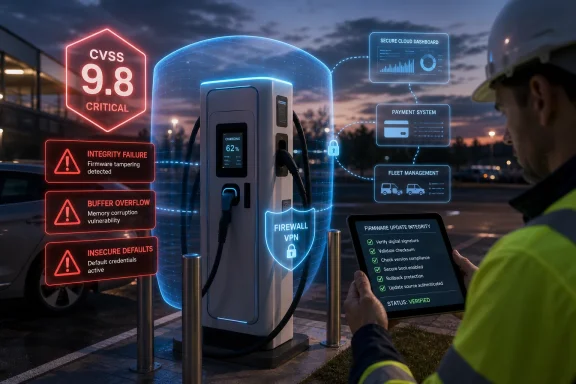
The vulnerable product is XCharge C6, a charging system associated with transportation-sector deployments and a vendor headquartered in the United States. CISA’s advisory assigns the issue a CVSS v3 score of 9.8, the kind of number that should make asset owners stop treating the device as a metal box with a cable and start treating it as a computer with consequences.
The vulnerabilities described by CISA fall into three familiar categories: downloading code without an integrity check, stack-based buffer overflow, and insecure default resource initialization. In plainer English, the device may accept code it cannot properly trust, mishandle memory in a way that can lead to code execution, and start from a configuration state that is too permissive for a system exposed to hostile networks.
That combination matters because EV charging infrastructure lives in awkward territory. It is physically public, operationally important, and often remotely managed. A charger may sit in a parking lot, serve a commercial fleet, report to cloud software, process user interactions, and depend on backend services that are invisible to the driver but critical to the operator.
The result is a device class that has many of the headaches of industrial control systems without always getting the same conservative treatment. Chargers are deployed quickly, expected to be always available, and frequently integrated into business networks that were not designed around operational technology risk. That is where a 9.8-rated advisory stops being abstract.
A 9.8 Score Is Not a Vibe Check
CVSS scores are imperfect, and security teams rightly complain when executive dashboards flatten risk into a single decimal. But a 9.8 rating normally signals a vulnerability profile with remote exploitability, low attack complexity, limited privilege requirements, and high impact. In other words, CISA is not describing a bug that requires a lab bench, a soldering iron, and a cooperative moon phase.
The stated impact is blunt: successful exploitation could allow an attacker to gain administrator rights or execute code on the affected device. Administrator access on an EV charger is not the same thing as administrator access on a domain controller, but it is still control over a deployed asset. At scale, that can become a service disruption, a pivot point, a fraud vector, or a means of tampering with operational telemetry.
The absence of known public exploitation is welcome, but it should not be mistaken for safety. CISA advisories often land in the window between responsible disclosure and adversarial weaponization. Once a bug class, product name, and impact statement are public, defenders and attackers are reading the same page.
The practical question for operators is not whether someone has already exploited the XCharge C6. It is whether the devices are reachable, whether remote management is exposed, whether firmware updates are controlled, and whether anyone can prove what version is running in the field.
Unsigned Code Is the Oldest Modern Mistake
The most alarming item in the trio may be the download of code without an integrity check. Secure update mechanisms are the root of trust for embedded devices. If a charger cannot verify that the code it downloads is authentic and unmodified, then every other control sits on unstable ground.
Integrity checking is not exotic. Modern update systems should validate cryptographic signatures, reject tampered packages, and prevent rollback to known-vulnerable versions. The reason this keeps appearing in advisories is not because the industry lacks the technology; it is because embedded product timelines often reward shipping connectivity before hardening lifecycle management.
For EV chargers, that lifecycle problem is especially sharp. Devices may remain installed for years in lots, depots, campuses, and highway corridors. They may be serviced by contractors, monitored by platform vendors, and owned by organizations whose core business is not device security. If the update channel is weak, the very mechanism intended to fix vulnerabilities can become the delivery path for compromise.
This is why “apply the patch” is necessary but not sufficient advice. Operators need to know whether the patch process itself is trustworthy, auditable, and constrained. If the system previously accepted code without integrity checks, security teams should be asking not only whether the vulnerable version is gone, but whether unauthorized changes could already have been introduced.
Memory Safety Keeps Returning to the Crime Scene
The stack-based buffer overflow is the more traditional exploit primitive, and that is precisely what makes it frustrating. The industry has had decades to understand why copying too much data into too little memory can lead to crashes, corruption, and code execution. Yet embedded systems continue to ship with C and C++ code paths where a malformed input can become an attacker’s instruction pointer.
This does not mean every buffer overflow is trivially exploitable. Modern mitigations, compiler protections, memory layout randomization, and non-executable memory can make exploitation harder. But the advisory’s impact language says code execution is on the table, and that is the detail defenders should care about.
Chargers have numerous places where input arrives from outside the trusted core. Network services, management interfaces, protocol handlers, mobile app interactions, payment components, and backend integrations all increase parser exposure. A single unsafe string or packet-handling routine can convert a networked appliance into a foothold.
The WindowsForum audience will recognize the broader pattern. The computing world spent years pushing desktop and server software toward memory-safe practices, exploit mitigations, and secure update discipline. Operational devices are now replaying some of that history, except they are bolted to infrastructure and deployed in places where “just reimage it” is not a serious incident response plan.
Insecure Defaults Are a Business Model Problem
The third vulnerability, initialization of a resource with an insecure default, sounds less dramatic than code execution. It should not be dismissed. Insecure defaults are where vendor convenience, installer speed, and operational neglect converge.
Default states matter because many infrastructure devices are deployed under time pressure. Installers want the charger online. Operators want dashboards populated. Fleet managers want vehicles charging before the morning route. Security hardening can become the thing everyone assumes someone else did.
An insecure default may be a permissive service, a predictable credential state, an exposed interface, a weak configuration flag, or some other resource that starts life in a dangerous posture. The exact mechanics matter for remediation, but the strategic lesson is already clear: secure systems should fail closed, not ask overworked operators to discover every sharp edge before an adversary does.
The EV charging market has grown by promising scale. Scale punishes insecure defaults. A risky factory setting repeated across hundreds or thousands of chargers is not a configuration oversight; it is a fleet-wide vulnerability distribution mechanism.
The Transportation Label Understates the Blast Radius
CISA places the affected equipment in the Transportation Systems sector, and that is accurate as far as it goes. EV charging supports vehicle movement, public charging networks, commercial fleets, depots, transit operations, and logistics. If chargers fail or are manipulated, transportation operations can feel it.
But the sector label understates the interdependence. Charging infrastructure also touches electric utilities, real estate, retail, municipal services, payment providers, cloud platforms, and identity systems. A compromised charger may not directly threaten the bulk power grid, but it can still disrupt local operations, damage trust, or provide a beachhead into adjacent systems.
For a public charging operator, the immediate risk may be availability and customer confidence. For a fleet, the risk may be operational continuity: vans, buses, service vehicles, or delivery trucks that do not charge on schedule do not meet routes. For a campus or municipality, the charger may be one more unmanaged networked device attached to facilities infrastructure.
The security conversation around EV charging too often jumps to cinematic grid-collapse scenarios. The more probable risk is messier and more mundane: localized outages, compromised management consoles, tampered firmware, unreliable telemetry, and incident response teams discovering too late that no one had a complete inventory.
Network Exposure Is the First Firebreak
CISA’s recommended practices are familiar because they remain the foundation of industrial defense. Minimize network exposure. Keep control system devices off the public internet. Put them behind firewalls. Isolate them from business networks. Use VPNs for remote access, and keep those VPNs updated.
None of that is glamorous, and all of it is still routinely violated. The internet is full of systems that were exposed because remote management was convenient, a vendor asked for access, a firewall rule was temporary, or a cellular modem was treated as someone else’s problem. EV chargers add another twist: many are designed around remote serviceability, cloud telemetry, and distributed physical deployment.
The right architecture assumes the charger is hostile-adjacent. It sits in public, communicates over networks, and may be touched by strangers. That does not mean every charger requires a fortress, but it does mean asset owners should avoid flat networks, shared credentials, open management ports, and undocumented vendor tunnels.
VPNs are not magic either. CISA’s language correctly notes that VPNs have vulnerabilities and are only as secure as the connected devices. A VPN protecting an unpatched charger, accessed from an unmanaged laptop, using shared credentials, is a ritual rather than a control.
The Patch Is Only the Middle of the Story
The advisory text supplied here does not name a specific fixed firmware version, and that absence matters. In many enterprise software incidents, the remediation path is obvious: upgrade to version X, verify package Y, monitor indicator Z. In embedded infrastructure, the path can be slower and more opaque.
Operators should press vendors and integrators for precise remediation details. Which firmware versions are affected? Which versions correct each vulnerability? Does the update mechanism now enforce integrity checks? Are there compensating controls for devices that cannot be immediately updated? Is there a way to verify firmware state remotely and locally?
The answer may vary by deployment, contract, and management platform. Some chargers may be vendor-managed. Others may be maintained by site operators or third-party service providers. Still others may be part of a broader charging network where the asset owner sees only a portal, not the device internals.
That ambiguity is exactly why procurement needs to change. Buyers should demand secure update design, vulnerability disclosure commitments, software bill of materials support where appropriate, documented hardening guides, and lifecycle guarantees. Security cannot be retrofitted entirely through advisories after the concrete has been poured and the chargers are in the ground.
Disclosure Worked, But Disclosure Is Not Defense
The vulnerabilities were reported to CISA by Lionel R. Saposnik of SaiFlow, according to the advisory text. That is the healthy part of the story. Researcher disclosure, coordination, and public advisories give defenders a chance to act before incidents define the timeline.
But disclosure is not the same as defense. It is a signal flare. The defensive work begins after the advisory: finding the devices, identifying exposure, confirming versions, applying mitigations, monitoring for anomalies, and documenting what changed.
For many organizations, the hard part will be inventory. EV chargers may have been purchased by sustainability teams, facilities departments, fleet operations, or local site managers rather than central IT. They may not appear in conventional endpoint management tools. They may not be scanned because no one wants to break operational equipment.
That organizational gap is where attackers often live. If no team owns the asset as a computer, no team patches it like one. If no team monitors it as infrastructure, no team notices when it behaves like a compromised host.
Windows Admins Should Care About the Parking Lot
At first glance, an EV charger advisory may seem distant from the daily work of Windows administrators. It is not. The modern enterprise network is no longer made only of PCs, servers, printers, and phones. It includes cameras, HVAC controllers, badge systems, conference-room panels, building sensors, and increasingly, charging infrastructure.
Windows environments often sit beside these systems, share identity providers with them, or provide the administrative workstations used to manage them. A compromised charger does not need to exploit Windows directly to create Windows-relevant risk. It can become an internal reconnaissance point, a credential-harvesting opportunity, or a reason an administrator logs into a management interface from the wrong machine at the wrong time.
The lesson is not that every charger is a domain threat. The lesson is that IT and OT boundaries are porous in practice. A facilities device with a web console may be administered from a Windows laptop joined to the corporate domain. A vendor portal may use email-based identity. A service contractor may ask for remote access through an exception that outlives the maintenance window.
For sysadmins, the right response is to pull these assets into the security conversation. Put them in the inventory. Segment them. Restrict who can administer them. Log access. Treat vendor remote support as privileged access, not customer service.
The EV Buildout Is Repeating the IoT Mistake at Industrial Scale
The XCharge C6 advisory lands in a market that is racing to deploy. Governments want charging corridors. Companies want electrified fleets. Property owners want amenities. Drivers want reliability. Vendors want market share.
That pressure creates the classic IoT bargain: connect first, secure later. The difference is that EV chargers are more operationally significant than many consumer gadgets and more publicly exposed than many industrial systems. They occupy a middle ground where the consequences are serious but governance may be immature.
Security debt is easy to hide during growth. A device works, a dashboard lights up, a driver charges, and the project is declared successful. The debt becomes visible only when a vulnerability disclosure forces everyone to ask basic questions: Who owns the risk? Who applies the update? Who can disconnect the charger from the internet? Who knows whether the fix worked?
This is not an argument against EV infrastructure. It is an argument that infrastructure deserves infrastructure-grade security. The charging network being built now will be part of transportation for decades. Decisions made in firmware signing, network architecture, and procurement language today will echo through that lifecycle.
The Real Test Is the Operator’s Runbook
CISA’s recommendations are deliberately broad because it publishes for many environments. The operator’s job is to turn them into a runbook. That runbook should start with exposure, because an internet-reachable vulnerable device is a different emergency than a segmented device behind controlled access.
Next comes version verification. Operators need to identify every XCharge C6 in their environment and determine whether it is affected. If a vendor platform manages the devices, the operator still needs evidence, not reassurance. “The vendor handles it” is not an audit finding; it is a dependency.
Then comes mitigation. If patches or firmware updates are available, they should be tested and deployed according to operational risk. If updates are not immediately available, network controls become more important: block unnecessary inbound access, restrict outbound destinations, isolate management paths, and monitor for unusual traffic.
Finally comes validation. A device that was patched but remains exposed through a forgotten management service may still be risky. A charger isolated from the business network but reachable through a weak vendor VPN may still be risky. Security is not a checkbox attached to the advisory date.
The Charging-Cable Lesson for Security Teams
The concrete takeaways from this advisory are less about panic and more about discipline. XCharge C6 operators should move quickly, but the broader EV charging ecosystem should treat this as a preview of the recurring work ahead.
- Organizations should identify whether XCharge C6 chargers are present in their environments and determine which firmware or software versions are running.
- Operators should remove charger management interfaces from direct internet exposure and place charging infrastructure behind appropriate firewalls and segmentation.
- Remote access should be limited to controlled, monitored channels, and VPN use should not be treated as a substitute for patching or device hardening.
- Asset owners should ask XCharge or their service provider for precise remediation guidance, including whether update integrity checks are enforced after mitigation.
- Security teams should add EV charging equipment to inventory, vulnerability management, incident response, and procurement review processes.
- Administrators should monitor for unusual charger behavior, unexpected network connections, failed management logins, and unexplained firmware or configuration changes.
The XCharge C6 advisory is not proof that EV charging infrastructure is uniquely insecure. It is proof that EV charging infrastructure is now ordinary networked infrastructure, with all the ordinary failure modes that phrase implies. The next phase of the EV rollout will be judged not only by how many chargers appear on maps, but by whether the industry can make them trustworthy enough to disappear into daily life without becoming yet another unmanaged edge of the enterprise.