

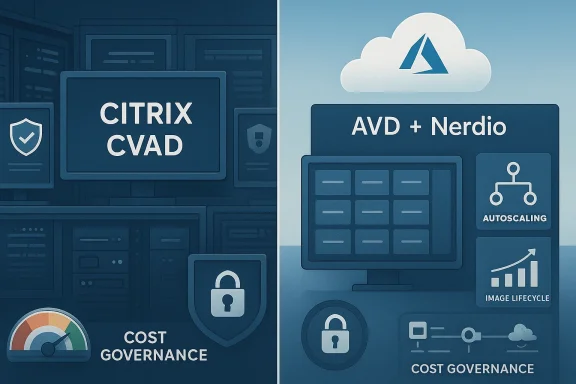
Comparing Citrix Virtual Apps and Desktops with Azure Virtual Desktop plus Nerdio Manager for Enterprise is really a comparison between two different philosophies of virtual desktop delivery. Citrix remains the platform of choice for organizations that need deep hybrid flexibility, mature policy control, and a long history in complex enterprise environments, while AVD with Nerdio leans into a cloud-first operating model that reduces day-to-day management overhead and fits naturally inside Microsoft-centric estates. That split has become more important as IT teams face higher cloud scrutiny, tighter governance expectations, and a stronger mandate to do more with less.
Virtual desktop infrastructure has moved far beyond being a contingency plan for remote work. It is now a core part of how enterprises deliver secure applications, support distributed teams, and preserve business continuity when users are outside the office. The modern market has been shaped by a simple tension: organizations want the control of traditional VDI, but they also want the elasticity and lower friction promised by cloud services.
Citrix helped define that market. For years, Citrix Virtual Apps and Desktops has been associated with large, demanding environments where application compatibility, brokered access, endpoint diversity, and policy control matter more than simplicity. TechTarget’s comparison of Citrix with Microsoft’s earlier Windows Virtual Desktop lineage notes that Citrix can provision across multiple on-premises and cloud platforms, while also supporting environments that need more than a purely Azure-native model can provide.
Microsoft’s response evolved into Azure Virtual Desktop, a cloud-native service built on Azure Resource Manager and tightly tied to the Microsoft ecosystem. That design lowered the barrier to entry for many IT teams, especially those already invested in Microsoft 365, Entra ID, Intune, and Azure. But simplicity came with a tradeoff: AVD does not try to be the universal control plane that Citrix is, and that narrower scope is both its strength and its limitation. TechTarget has repeatedly emphasized that AVD’s management model is simpler, but also more dependent on Azure-native administration patterns.
That is where Nerdio Manager for Enterprise enters the story. Nerdio did not set out to compete with Citrix as a full-stack digital workspace platform; instead, it positioned itself as an automation and management layer on top of AVD. TechTarget’s reporting describes Nerdio as a tool that can simplify AVD deployment and operations, reduce the need for Azure expertise, and automate image management and scaling.
The result is a market that is no longer just Citrix versus Microsoft. It is now Citrix versus AVD plus orchestration, which is a more nuanced decision. Buyers are increasingly choosing between a deeply integrated but more complex enterprise platform and a cloud-native stack that can be made more enterprise-friendly through third-party automation. That distinction matters because the economics, staffing model, and compliance posture of a virtual desktop program often matter as much as the user experience itself.
Citrix’s architecture reflects its history. It is built to handle componentized deployments, and that gives enterprises flexibility across delivery controllers, gateways, profiles, policies, and infrastructure options. The downside is that every layer can become a management responsibility, which means more tuning, more moving parts, and more specialized expertise. TechTarget’s analysis of Citrix vs. AVD repeatedly points to this complexity as a reason some organizations find Citrix expensive or overbuilt for cloud-native use cases.
AVD takes the opposite route. Because it lives inside Azure, it inherits Microsoft’s cloud primitives rather than recreating them. That makes it attractive for enterprises that already centralize identity, security, and endpoint management in Microsoft tools. The tradeoff is that AVD’s native administrative experience can feel bare-bones at scale, especially when teams need image lifecycle automation, scheduling, or cost controls beyond the default portal experience.
Nerdio is effectively the bridge between those two worlds. It layers automation, policy, image handling, and autoscaling over AVD to make it feel less like raw infrastructure and more like a managed service. TechTarget has described Nerdio as giving AVD a more Citrix-like management experience without requiring enterprises to adopt a separate VDI control plane.
TechTarget’s coverage of Citrix notes that its component-based model offers architectural flexibility, but also requires IT teams to install, configure, deploy, and maintain multiple server roles and a dedicated control plane. That can raise both operational overhead and the cost of expansion as business needs change.
By contrast, AVD is designed to fit the cloud-native automation model. It is controlled through Azure’s service fabric and can be managed with the same identity, policy, and resource-management tools used elsewhere in Azure. Yet the native management layer still leaves many enterprises wanting more automation, more scheduling intelligence, and better cost governance. That is the gap Nerdio addresses.
Nerdio’s long-standing pitch has been straightforward: make AVD easier to deploy, easier to scale, and easier to run without forcing administrators to become Azure specialists. TechTarget reports that Nerdio deploys into the customer’s Azure environment and can automate session host scaling, even scheduling changes around known usage patterns.
AVD benefits from Microsoft’s broader security stack, which is both a strength and a constraint. On the positive side, AVD can integrate naturally with Azure identity, policy, and security tooling. On the negative side, its built-in control surface is not as feature-rich as Citrix’s in many advanced scenarios, which means some governance responsibilities are pushed into adjacent Microsoft services or third-party tools.
That is where Nerdio changes the conversation. By centralizing management and layering automation onto AVD, Nerdio can help enforce operational consistency, including scaling behavior and policy-driven administration. This does not make AVD into Citrix, but it does close enough of the gap that many buyers no longer need Citrix-level complexity for Citrix-like discipline.
AVD, by contrast, is fundamentally consumption-oriented. That can be a major advantage because it aligns cost with usage and gives organizations more flexibility to grow and shrink their footprint. But it also introduces budget volatility, especially if host pools are not well governed. TechTarget has noted the unpredictability of AVD’s consumption-based model in other comparisons, which is exactly why tooling like Nerdio matters.
Nerdio does not eliminate the economics of Azure; it helps make them legible. Its autoscaling and operational controls can reduce idle compute time, which is one of the biggest hidden costs in virtual desktop estates. That makes Nerdio a financial tool as much as an administrative one.
AVD is inherently narrower. It runs in Azure, and that is the point. For organizations already committed to Microsoft’s cloud, that limitation is acceptable or even desirable because it reduces architectural sprawl. But for companies that want portability across clouds or have existing investment in non-Azure infrastructure, that same limitation becomes a blocker rather than a benefit.
Nerdio does not change that fundamental scope. It makes AVD easier to manage; it does not make AVD more portable. That distinction is crucial because some buyers confuse better operations with broader architecture. Nerdio improves the former, not the latter.
Citrix has historically been strong for latency-sensitive workloads, graphics-heavy applications, and multi-site deployments where sophisticated optimization matters. TechTarget’s coverage emphasizes that Citrix remains attractive for larger organizations and for certain workloads that benefit from mature optimization and broad delivery options.
AVD can deliver excellent user experiences too, especially when paired with the right Azure regions, properly tuned host pools, and well-managed images. Nerdio helps here by making the environment more consistent and easier to scale. That consistency matters because a VDI program fails less often because of platform weakness than because of image drift, capacity mismatches, or admin inconsistency.
The practical lesson is that application fit should drive the choice. If the estate includes legacy software, graphics-intensive workloads, or highly variable user conditions, Citrix deserves serious consideration. If the estate is standardized, cloud-native, and tied closely to Microsoft 365, AVD with Nerdio may deliver good enough experience with substantially less friction.
Citrix, however, still speaks to a different enterprise mindset. It assumes the buyer is willing to invest in control, customization, and a broader platform for the sake of resilience and flexibility. That mindset is common in sectors such as finance, healthcare, manufacturing, and global services, where technical variety is a feature rather than a flaw.
The divergence is also organizational. Teams with strong Azure adoption, tight Microsoft governance, and limited VDI staff will see more value in the AVD plus Nerdio stack. Teams with decentralized infrastructure, multiple cloud providers, and specialized desktop/application delivery requirements will still see Citrix as the safer long-term anchor.
TechTarget notes that Nerdio can automate deployment and operations, reduce the need for Azure expertise, and provide a more Citrix-like management experience for image handling. It also highlights autoscaling as a way to reduce Azure compute costs while keeping performance aligned with demand.
That is especially important for organizations that want to modernize without adopting a heavy new platform culture. Nerdio lets them remain in the Microsoft ecosystem while still introducing discipline around scaling, provisioning, and cost governance. It is not merely a convenience tool; it is a migration enabler.
The broader market implication is that the winner may not be the vendor with the most features, but the one that best matches enterprise operating discipline. As cloud spending comes under more scrutiny and compliance demands become more exacting, buyers will care less about theoretical capability and more about whether the platform can be run efficiently by the team they actually have.
Source: TechTarget Comparing Citrix vs. Azure Virtual Desktop with Nerdio | TechTarget
 Background
Virtual desktop infrastructure has moved far beyond being a contingency plan for remote work. It is now a core part of how enterprises deliver secure applications, support distributed teams, and preserve business continuity when users are outside the office. The modern market has been shaped by a simple tension: organizations want the control of traditional VDI, but they also want the elasticity and lower friction promised by cloud services.Citrix helped define that market. For years, Citrix Virtual Apps and Desktops has been associated with large, demanding environments where application compatibility, brokered access, endpoint diversity, and policy control matter more than simplicity. TechTarget’s comparison of Citrix with Microsoft’s earlier Windows Virtual Desktop lineage notes that Citrix can provision across multiple on-premises and cloud platforms, while also supporting environments that need more than a purely Azure-native model can provide.
Microsoft’s response evolved into Azure Virtual Desktop, a cloud-native service built on Azure Resource Manager and tightly tied to the Microsoft ecosystem. That design lowered the barrier to entry for many IT teams, especially those already invested in Microsoft 365, Entra ID, Intune, and Azure. But simplicity came with a tradeoff: AVD does not try to be the universal control plane that Citrix is, and that narrower scope is both its strength and its limitation. TechTarget has repeatedly emphasized that AVD’s management model is simpler, but also more dependent on Azure-native administration patterns.
That is where Nerdio Manager for Enterprise enters the story. Nerdio did not set out to compete with Citrix as a full-stack digital workspace platform; instead, it positioned itself as an automation and management layer on top of AVD. TechTarget’s reporting describes Nerdio as a tool that can simplify AVD deployment and operations, reduce the need for Azure expertise, and automate image management and scaling.
The result is a market that is no longer just Citrix versus Microsoft. It is now Citrix versus AVD plus orchestration, which is a more nuanced decision. Buyers are increasingly choosing between a deeply integrated but more complex enterprise platform and a cloud-native stack that can be made more enterprise-friendly through third-party automation. That distinction matters because the economics, staffing model, and compliance posture of a virtual desktop program often matter as much as the user experience itself.
The Core Strategic Difference
The most important difference between Citrix and AVD with Nerdio is not feature checklists. It is operational philosophy. Citrix aims to be a broad, adaptable platform that can span multiple infrastructure choices, while AVD with Nerdio assumes the organization is comfortable standardizing on Azure and wants to simplify everything around that decision.Citrix’s architecture reflects its history. It is built to handle componentized deployments, and that gives enterprises flexibility across delivery controllers, gateways, profiles, policies, and infrastructure options. The downside is that every layer can become a management responsibility, which means more tuning, more moving parts, and more specialized expertise. TechTarget’s analysis of Citrix vs. AVD repeatedly points to this complexity as a reason some organizations find Citrix expensive or overbuilt for cloud-native use cases.
AVD takes the opposite route. Because it lives inside Azure, it inherits Microsoft’s cloud primitives rather than recreating them. That makes it attractive for enterprises that already centralize identity, security, and endpoint management in Microsoft tools. The tradeoff is that AVD’s native administrative experience can feel bare-bones at scale, especially when teams need image lifecycle automation, scheduling, or cost controls beyond the default portal experience.
Nerdio is effectively the bridge between those two worlds. It layers automation, policy, image handling, and autoscaling over AVD to make it feel less like raw infrastructure and more like a managed service. TechTarget has described Nerdio as giving AVD a more Citrix-like management experience without requiring enterprises to adopt a separate VDI control plane.
Why the distinction matters
The real question is not, “Which platform has more features?” It is, “Which platform best matches the organization’s operating model?” If a company wants a globally distributed control plane across hybrid and multi-cloud infrastructure, Citrix keeps its edge. If the company wants to simplify around Azure and reduce administrative toil, AVD with Nerdio becomes the stronger strategic fit.- Citrix favors architectural breadth.
- AVD with Nerdio favors operational efficiency.
- Citrix often suits legacy-heavy or multi-cloud enterprises.
- AVD with Nerdio often suits Microsoft-standardized environments.
- The wrong choice usually shows up as overengineering or undergoverning.
Deployment and Management
Deployment is where the user experience often diverges from the marketing pitch. Citrix can be remarkably powerful, but its power comes from an ecosystem of components that must be integrated, configured, and maintained. That is why many IT teams describe Citrix as mature but demanding: it rewards expertise, but it does not hide complexity.TechTarget’s coverage of Citrix notes that its component-based model offers architectural flexibility, but also requires IT teams to install, configure, deploy, and maintain multiple server roles and a dedicated control plane. That can raise both operational overhead and the cost of expansion as business needs change.
By contrast, AVD is designed to fit the cloud-native automation model. It is controlled through Azure’s service fabric and can be managed with the same identity, policy, and resource-management tools used elsewhere in Azure. Yet the native management layer still leaves many enterprises wanting more automation, more scheduling intelligence, and better cost governance. That is the gap Nerdio addresses.
Nerdio’s long-standing pitch has been straightforward: make AVD easier to deploy, easier to scale, and easier to run without forcing administrators to become Azure specialists. TechTarget reports that Nerdio deploys into the customer’s Azure environment and can automate session host scaling, even scheduling changes around known usage patterns.
Operational implications
For IT leaders, the significance is not just convenience. Reduced complexity can translate into faster onboarding, fewer configuration errors, and lower support burden. In an era where teams are trying to cut cloud waste, the ability to automate shutdowns, scale-up events, and image management can have a direct financial impact.- Citrix tends to require deeper platform knowledge.
- AVD with Nerdio tends to reduce the need for specialized VDI administrators.
- Automation can improve consistency across host pools and images.
- Simpler management can shorten time-to-value.
- But simplification only works if the organization is already aligned with Azure.
Security and Governance
Security is one of the clearest places where Citrix still differentiates itself. Its enterprise reputation has been built partly on zero-trust access patterns, granular policy enforcement, and the ability to protect complex application delivery scenarios. For organizations with sensitive data, multi-site access patterns, or unmanaged endpoints, those controls are not optional extras; they are the reason the platform exists. TechTarget specifically highlights Citrix’s strong security posture and granular controls for sensitive assets.AVD benefits from Microsoft’s broader security stack, which is both a strength and a constraint. On the positive side, AVD can integrate naturally with Azure identity, policy, and security tooling. On the negative side, its built-in control surface is not as feature-rich as Citrix’s in many advanced scenarios, which means some governance responsibilities are pushed into adjacent Microsoft services or third-party tools.
That is where Nerdio changes the conversation. By centralizing management and layering automation onto AVD, Nerdio can help enforce operational consistency, including scaling behavior and policy-driven administration. This does not make AVD into Citrix, but it does close enough of the gap that many buyers no longer need Citrix-level complexity for Citrix-like discipline.
Security model differences
Citrix is often the better choice when security requirements are broad and highly customized. AVD with Nerdio is often the better choice when the organization wants to rely on Microsoft-native identity and governance controls, then add automation rather than another standalone control plane.- Citrix emphasizes fine-grained, purpose-built controls.
- AVD emphasizes integration with Azure-native security services.
- Nerdio emphasizes operational policy and repeatability.
- Enterprises with unmanaged endpoints may prefer Citrix’s mature controls.
- Cloud-first teams may prefer the simpler governance stack around AVD.
- In practice, the best security model is the one your admins can actually sustain.
Licensing and Commercial Complexity
Licensing is often the least glamorous part of the decision, but it may be the most consequential. Citrix is usually associated with more structured licensing and support arrangements, which can offer predictability in larger, more carefully negotiated deployments but also create administrative drag. That is not inherently bad; it just means procurement and platform design are more tightly coupled. TechTarget’s comparison repeatedly frames Citrix as more expensive and more complex for smaller or cloud-native organizations.AVD, by contrast, is fundamentally consumption-oriented. That can be a major advantage because it aligns cost with usage and gives organizations more flexibility to grow and shrink their footprint. But it also introduces budget volatility, especially if host pools are not well governed. TechTarget has noted the unpredictability of AVD’s consumption-based model in other comparisons, which is exactly why tooling like Nerdio matters.
Nerdio does not eliminate the economics of Azure; it helps make them legible. Its autoscaling and operational controls can reduce idle compute time, which is one of the biggest hidden costs in virtual desktop estates. That makes Nerdio a financial tool as much as an administrative one.
What buyers should watch
The most important financial question is whether the platform’s commercial model matches actual usage behavior. AVD with Nerdio can be very efficient when demand is variable and policy-driven. Citrix can be worthwhile when stability, flexibility, and broader deployment options justify the higher management overhead.- Citrix often means more formal procurement.
- AVD often means more variable monthly costs.
- Nerdio can lower waste through autoscaling.
- Consumption pricing can reward disciplined operations.
- It can also punish poor lifecycle management.
- Budget clarity depends on operational maturity, not just vendor choice.
Hybrid and Multi-Cloud Flexibility
Hybrid and multi-cloud support remains Citrix’s strongest strategic card. Many enterprises are not fully cloud-native, and many never will be. They carry legacy applications, regional constraints, data residency requirements, and technical debt that make a single-cloud operating model unrealistic. Citrix’s ability to span those environments gives it staying power in exactly the kinds of organizations that cannot take a purity-driven approach.AVD is inherently narrower. It runs in Azure, and that is the point. For organizations already committed to Microsoft’s cloud, that limitation is acceptable or even desirable because it reduces architectural sprawl. But for companies that want portability across clouds or have existing investment in non-Azure infrastructure, that same limitation becomes a blocker rather than a benefit.
Nerdio does not change that fundamental scope. It makes AVD easier to manage; it does not make AVD more portable. That distinction is crucial because some buyers confuse better operations with broader architecture. Nerdio improves the former, not the latter.
Enterprise implications
For multinational organizations, or companies with acquired businesses running mixed infrastructure, Citrix still has the edge because it tolerates complexity rather than demanding its removal. AVD with Nerdio makes more sense when the organization wants to simplify future-state architecture and has the internal discipline to keep the environment Azure-centered.- Citrix is better suited to mixed infrastructure estates.
- AVD with Nerdio is better suited to Azure standardization.
- Hybrid complexity often favors platform breadth.
- Cloud consolidation often favors management simplicity.
- A strategic fit matters more than a feature race.
User Experience and Application Fit
End-user experience is one of the most misunderstood dimensions in VDI selection. Buyers often assume the platform with the most features automatically produces the best experience, but that is not always true. In practice, performance depends on workload type, network design, image discipline, and operational tuning just as much as on the platform itself.Citrix has historically been strong for latency-sensitive workloads, graphics-heavy applications, and multi-site deployments where sophisticated optimization matters. TechTarget’s coverage emphasizes that Citrix remains attractive for larger organizations and for certain workloads that benefit from mature optimization and broad delivery options.
AVD can deliver excellent user experiences too, especially when paired with the right Azure regions, properly tuned host pools, and well-managed images. Nerdio helps here by making the environment more consistent and easier to scale. That consistency matters because a VDI program fails less often because of platform weakness than because of image drift, capacity mismatches, or admin inconsistency.
The practical lesson is that application fit should drive the choice. If the estate includes legacy software, graphics-intensive workloads, or highly variable user conditions, Citrix deserves serious consideration. If the estate is standardized, cloud-native, and tied closely to Microsoft 365, AVD with Nerdio may deliver good enough experience with substantially less friction.
Workload considerations
- Graphics-heavy apps often benefit from mature optimization.
- Legacy applications can be easier to support in broader Citrix environments.
- Microsoft-centric productivity workloads map well to AVD.
- User experience depends heavily on image and session-host discipline.
- Good enough at lower operational cost can beat best possible at higher complexity.
Enterprise vs. Consumer Mindset
Virtual desktop decisions are enterprise decisions, but the buying logic increasingly resembles consumer software selection in one respect: people expect the experience to be intuitive. This is why AVD with Nerdio resonates with cloud-first organizations. It reduces the number of specialist tasks administrators must remember and allows a smaller team to manage a more modern service model.Citrix, however, still speaks to a different enterprise mindset. It assumes the buyer is willing to invest in control, customization, and a broader platform for the sake of resilience and flexibility. That mindset is common in sectors such as finance, healthcare, manufacturing, and global services, where technical variety is a feature rather than a flaw.
The divergence is also organizational. Teams with strong Azure adoption, tight Microsoft governance, and limited VDI staff will see more value in the AVD plus Nerdio stack. Teams with decentralized infrastructure, multiple cloud providers, and specialized desktop/application delivery requirements will still see Citrix as the safer long-term anchor.
Practical decision lens
Decision-makers should ask who is going to run the platform five years from now, not just who can stand it up this quarter. The answer often reveals the real winner.- If you have a small team, AVD with Nerdio may be more sustainable.
- If you need broad infrastructure flexibility, Citrix may be safer.
- If Microsoft is already your standard, AVD becomes more attractive.
- If multiple business units run different infrastructure, Citrix can absorb that chaos better.
- Operational fit often beats theoretical superiority.
Why Nerdio Changes the AVD Story
Nerdio matters because it transforms AVD from a promising platform into an operationally realistic one. Without a management layer, AVD can require more hands-on Azure work than many enterprises are prepared to support. With Nerdio, the story becomes automation, repeatability, and cost control rather than manual portal navigation.TechTarget notes that Nerdio can automate deployment and operations, reduce the need for Azure expertise, and provide a more Citrix-like management experience for image handling. It also highlights autoscaling as a way to reduce Azure compute costs while keeping performance aligned with demand.
That is especially important for organizations that want to modernize without adopting a heavy new platform culture. Nerdio lets them remain in the Microsoft ecosystem while still introducing discipline around scaling, provisioning, and cost governance. It is not merely a convenience tool; it is a migration enabler.
Management outcomes
The strategic value of Nerdio is that it lowers the skill threshold for running AVD. In a market where cloud cost discipline and staff efficiency matter more than ever, that is a meaningful differentiator.- Automation reduces repetitive admin work.
- Autoscaling improves utilization.
- Image management becomes more predictable.
- Provisioning can be standardized.
- Azure teams can move faster with fewer specialist bottlenecks.
- The platform becomes operationally tractable, not just technically possible.
Strengths and Opportunities
The strongest opportunity in this market is choice. Enterprises are no longer forced into an all-or-nothing decision between expensive complexity and cloud-native simplicity. Citrix can serve the high-control end of the market, while AVD with Nerdio can serve the standardized Azure end, and both can coexist as legitimate answers to different business problems.- Citrix remains compelling for large, heterogeneous, regulated enterprises.
- AVD with Nerdio offers a cleaner path for Microsoft-first organizations.
- Autoscaling can materially reduce idle Azure spend.
- Centralized management can cut operational toil.
- Cloud alignment can simplify identity and security integration.
- Nerdio helps smaller teams run enterprise-grade VDI.
- Citrix still supports advanced scenarios that simpler stacks may not handle well.
Risks and Concerns
The main risk is treating these products as interchangeable. They are not. Choosing Citrix when the organization really wants cloud simplification can lead to unnecessary complexity, while choosing AVD with Nerdio when the organization needs cross-cloud or highly specialized delivery can create capability gaps that surface later as technical debt.- Platform mismatch can create long-term operational drag.
- Consumption pricing can surprise teams without strong governance.
- Complex Citrix deployments can be difficult to staff.
- Azure dependence limits architectural flexibility.
- Automation tools can hide, rather than eliminate, bad design decisions.
- Security expectations may outgrow basic defaults.
- The wrong abstraction layer can be more expensive than the wrong product.
Looking Ahead
The virtual desktop market is moving toward a clearer division of labor. Citrix will likely continue to own the high-flexibility, high-control segment, especially where hybrid, multi-cloud, or legacy application requirements remain unavoidable. AVD with Nerdio, meanwhile, will keep gaining traction where organizations want to standardize on Azure and reduce the day-to-day burden of desktop operations.The broader market implication is that the winner may not be the vendor with the most features, but the one that best matches enterprise operating discipline. As cloud spending comes under more scrutiny and compliance demands become more exacting, buyers will care less about theoretical capability and more about whether the platform can be run efficiently by the team they actually have.
- Expect more automation-first AVD adoption.
- Expect Citrix to remain relevant in complex estates.
- Expect cloud cost governance to shape buying decisions.
- Expect Microsoft ecosystem alignment to matter more.
- Expect third-party management layers to keep growing in importance.
Source: TechTarget Comparing Citrix vs. Azure Virtual Desktop with Nerdio | TechTarget
Last edited:
