

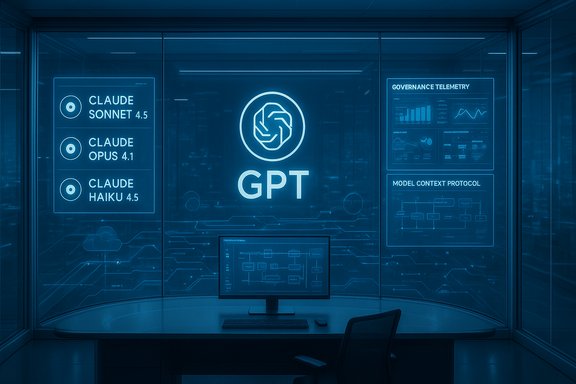
Microsoft has added Anthropic’s Claude family to Microsoft Foundry, making Claude Sonnet 4.5, Claude Opus 4.1 and Claude Haiku 4.5 available to Azure customers and embedding Claude as the reasoning core inside the Foundry Agent Service — a move presented by Microsoft as widening enterprise model choice and tying Anthropic’s frontier models more tightly into the Azure and Copilot ecosystems.
Anthropic, Microsoft and NVIDIA announced a coordinated set of commercial and technical commitments that position Claude as a first-class model across multiple clouds while committing enormous compute and investment resources to support its scale-up. Anthropic has publicly committed to purchasing approximately $30 billion of Azure compute capacity and to contract additional dedicated capacity potentially scaling up to an electrical footprint described as “up to one gigawatt.” NVIDIA and Microsoft announced staged investment commitments — reported in public coverage as up to $10 billion from NVIDIA and up to $5 billion from Microsoft — and engineering collaboration to optimize Claude for NVIDIA’s next-generation architectures. Microsoft frames this as an extension of its multi-model strategy: Foundry will now expose both Anthropic Claude models and OpenAI / GPT family models on the same platform, while Claude will also be surfaced across Microsoft 365 Copilot, GitHub Copilot and Copilot Studio. That cross-surface availability is being pitched as a practical win for enterprises seeking model choice under a unified governance, observability and billing surface.
Microsoft’s claim of unique cross-platform access to both Claude and GPT frontier models reflects a meaningful platform milestone for Azure, but it remains a vendor framing and should be evaluated against the specific account-level availability and contractual terms that enterprises require. The broader market implications — including infrastructure concentration and regulatory scrutiny — will shape how widely and quickly this multi-model strategy becomes the de facto enterprise approach.
Anthropic’s and Microsoft’s public announcements and product documentation provide the official roadmap for immediate rollout, while independent reporting confirms the scale and strategic contours of the partnership; enterprises should treat those public commitments as the starting point for their own validation and procurement planning.
Source: LatestLY Microsoft Brings Claude Models to Foundry, Expands Azure’s Access to Frontier AI Tool | LatestLY
 Background / Overview
Anthropic, Microsoft and NVIDIA announced a coordinated set of commercial and technical commitments that position Claude as a first-class model across multiple clouds while committing enormous compute and investment resources to support its scale-up. Anthropic has publicly committed to purchasing approximately $30 billion of Azure compute capacity and to contract additional dedicated capacity potentially scaling up to an electrical footprint described as “up to one gigawatt.” NVIDIA and Microsoft announced staged investment commitments — reported in public coverage as up to $10 billion from NVIDIA and up to $5 billion from Microsoft — and engineering collaboration to optimize Claude for NVIDIA’s next-generation architectures. Microsoft frames this as an extension of its multi-model strategy: Foundry will now expose both Anthropic Claude models and OpenAI / GPT family models on the same platform, while Claude will also be surfaced across Microsoft 365 Copilot, GitHub Copilot and Copilot Studio. That cross-surface availability is being pitched as a practical win for enterprises seeking model choice under a unified governance, observability and billing surface. What changed: product and platform details
Claude inside Microsoft Foundry and Agent Service
- Foundry integration: Claude Sonnet 4.5, Opus 4.1 and Haiku 4.5 are available in Microsoft Foundry (public preview), where developers can deploy them with Azure authentication, SDKs (Python, TypeScript, C#) and Foundry’s governance and monitoring capabilities.
- Agent reasoning core: Microsoft states Claude models act as the reasoning core inside Foundry Agent Service, powering multi-step workflows, skill chaining and long-context agent scenarios. The Model Context Protocol and Foundry’s model router are intended to let customers direct workloads to the most appropriate Claude variant for cost, latency and capability trade-offs.
- Copilot integration: Anthropic models are likewise available as selectable backends inside Microsoft 365 Copilot and Copilot Studio for Researcher and agent-centric scenarios, giving teams the option to pick Claude for deep reasoning tasks in Copilot workflows.
Model differentiation (how Microsoft positions the Claude variants)
Microsoft’s product brief groups the Claude line by capability and cost profile:- Claude Sonnet 4.5 — marketed as the smartest Sonnet-family model for complex agents, coding and deep reasoning.
- Claude Opus 4.1 — positioned for specialized reasoning and advanced, long-horizon tasks.
- Claude Haiku 4.5 — presented as the fastest and most cost-efficient option for high-throughput sub-agents and real-time experiences.
Pricing and endpoints
Microsoft published sample pricing tiers for the Foundry marketplace deployments of Claude models (per 1M tokens for input/output) as part of the announcement, and noted regional availability. Pricing tables and endpoint locations were included in the Azure blog post announcing the integration. These numbers should be treated as the vendor’s published rates at launch and are subject to change.Why this matters: industry and enterprise implications
1) Model choice consolidated under one platform
For enterprise IT teams that already adopt Azure identity, billing and governance, Foundry’s ability to host both Claude and GPT frontier models in one place removes a lot of procurement and integration friction. Microsoft’s messaging emphasizes that enterprises can now test and route between models without leaving their Azure tenancy — an operational win if teams trust the governance and data controls provided.2) Scale, compute and vendor alignment
The compute and investment headlines make this more than a product integration: securing predictable capacity and optimized hardware pathways is now a first-order business need for frontier model vendors. Anthropic’s reported $30 billion Azure compute commitment and the “up to 1 GW” engineering footprint signal long-term planning for very large model hosting, while NVIDIA’s and Microsoft’s investments align chip, cloud and model roadmaps. This reduces the likelihood of surprise capacity constraints for Anthropic but also centralizes economic value around a few major infrastructure vendors.3) Enterprise AgentOps and operationalization
Foundry’s Agent Service, Model Context Protocol and Skills framework are specifically aimed at moving from prototypes to production-grade agent fleets. The combination of modular skills, observability, and model routing can make agentic automation repeatable and auditable — provided organizations invest in the requisite AgentOps practices, data hygiene and testing disciplines. The platform promises to scale operational efficiency, but that promise depends on governance maturity inside customer organizations.Strengths and notable positives
- Immediate model choice inside a single enterprise platform: Teams can select Claude or GPT variants for different tasks without building complex multi-cloud integrations. This simplifies experiments and production routing.
- Enterprise-grade controls: Foundry brings unified telemetry, governance and billing to these models, which is a real advantage for IT departments that require compliance, tracing and auditability.
- Hardware co-design potential: Co-engineering efforts with NVIDIA (Grace Blackwell / Vera Rubin family) promise practical TCO improvements once optimizations are implemented, which is meaningful at the scale Anthropic intends to run.
- Familiar developer tooling: SDKs and Entra-based auth, plus Copilot / GitHub integrations, reduce friction for developer adoption and internal certifying of agent behaviors.
Risks, unknowns, and critical caveats
Vendor claims vs. independent verifiability
Microsoft’s statement that “Azure is now the only cloud providing access to both Claude and GPT frontier models to customers on one platform” is a vendor framing and should be treated as such. While Azure now offers both families in its Foundry surface, other cloud and platform players may present different model combinations or distributions; the claim is accurate as Microsoft is describing its own platform position, but it is a marketing statement rather than an objective industry classification. Readers should treat it as a Microsoft position unless independently validated for specific account-level availability.Data routing, hosting and compliance concerns
Some integrations may route requests to Anthropic-hosted endpoints or otherwise process data outside of Microsoft‑managed infrastructure depending on routing and product choices. That introduces compliance and data residency considerations: enterprise legal, security and privacy teams must validate where inference happens and what data controls apply in each integration. The public documentation flags these routing nuances; they are not hypothetical.Circular deals, optics and regulatory scrutiny
Large reciprocal commitments — investments from NVIDIA and Microsoft combined with Anthropic’s $30 billion compute purchase — raise familiar questions about circularity, competitive dynamics and regulatory optics. Analysts and regulators will likely examine whether such interlocking investments materially affect competition, pricing or disclosure. These are reasonable concerns for corporate governance and for investors considering long-term market structure. Independent reporting highlighted these dynamics in parallel coverage of the deal.Execution and timeline risk
“Up to $X billion” and “up to 1 GW” language are stage-gated commitments rather than immediate deployments. Realizing gigawatt-class AI campuses requires utility agreements, permitting, hardware deliveries and months-to-years of staging; the announced figures are strategic public commitments, not instant capacity. Enterprises should not assume immediate, global capacity expansion overnight.Cost and workload placement trade-offs
While Haiku aims to be the cost-efficient option and Sonnet the capability-focused option, cross-model routing, telemetry, and the price-performance trade-offs in production will require practical benchmarking. Token pricing from vendor tables is a starting point, not a full TCO analysis; real workload cost depends on request patterns, fine-tuning, RAG/embedding architectures and operational support costs. Microsoft published sample pricing, and customers should validate on representative workloads.Practical guidance for IT and procurement teams
- Map workloads to model profiles. Identify which workflows need Sonnet-class deep reasoning, which benefit from Opus-level specialized reasoning, and which should use Haiku for scale. Use representative test data for cost and latency benchmarking.
- Audit data routing and residency. Confirm where inference will occur for each integration (Azure-managed hosts vs. Anthropic-hosted endpoints) and update contracts, DPIAs and data processing addenda as needed.
- Define AgentOps disciplines. Implement structured observability, versioning, skill-level audits and canarying for agent fleets deployed with Foundry Agent Service. Treat agentic automations as first-class production systems.
- Negotiate pricing and committed usage carefully. If committing to multi-year spend or reserved capacity, validate breakpoints, refund/offset terms and flexibility for workload shifts. Use pilot results to inform long-term capacity decisions.
- Plan for multi-model validation. Build objective test suites that compare Claude and GPT variants on the same tasks to ensure the selected model meets business SLAs for accuracy, hallucination rates, bias, latency and cost.
Strategic analysis: what this deal signals about the market
A shift from single-supplier to multi-supplier orchestration
Large enterprises are increasingly treating model selection as a configurable, governable variable rather than betting everything on one provider. Microsoft’s Foundry orchestration of multiple frontier models reflects this industry evolution: cloud providers now compete on the value of the orchestration layer, governance and the ability to combine best-of-breed models under a single control plane.Infrastructure-led consolidation
The economics of frontier models pivot heavily on access to dense, efficient hardware. The parties’ co-investment and co-engineering move underscores that model owners need long-term, preferential access to hardware, and chip/cloud vendors benefit from anchoring that demand. The practical effect: infrastructure considerations will shape who can economically operate frontier models at scale.Regulatory, audit and market-power considerations are rising
Interlocking investments and compute commitments will attract regulatory attention in multiple jurisdictions — particularly where procurement, supply chain concentration and data jurisdiction intersect. Enterprises and policy makers must pay attention to how these commercial arrangements affect competition, price transparency and operational resilience.Short-term outlook and what to watch
- Monitor Foundry’s public preview for regional availability, SLA commitments and precise pricing on the Claude endpoints to determine true production readiness.
- Watch for technical benchmarks and case studies showing how Sonnet, Opus and Haiku compare to GPT models on enterprise tasks — those results will drive adoption decisions.
- Track regulatory filings or disclosures about the investment tranche mechanics and any competition inquiries that may arise as these multi-billion dollar commitments are executed.
Conclusion
The arrival of Anthropic’s Claude models in Microsoft Foundry — coupled with the broader tripartite arrangement involving NVIDIA and large compute commitments — is a consequential step in the enterprise AI market. It marries model choice to enterprise-grade tooling and commits significant capital and compute planning to sustain frontier-model workloads at scale. For IT teams, the update reduces integration friction and adds compelling options for agentic automation, but it also raises familiar trade-offs: governance complexity, data-residency checks, long-term contractual commitments and the need for disciplined AgentOps around production agents.Microsoft’s claim of unique cross-platform access to both Claude and GPT frontier models reflects a meaningful platform milestone for Azure, but it remains a vendor framing and should be evaluated against the specific account-level availability and contractual terms that enterprises require. The broader market implications — including infrastructure concentration and regulatory scrutiny — will shape how widely and quickly this multi-model strategy becomes the de facto enterprise approach.
Anthropic’s and Microsoft’s public announcements and product documentation provide the official roadmap for immediate rollout, while independent reporting confirms the scale and strategic contours of the partnership; enterprises should treat those public commitments as the starting point for their own validation and procurement planning.
Source: LatestLY Microsoft Brings Claude Models to Foundry, Expands Azure’s Access to Frontier AI Tool |
LatestLY