
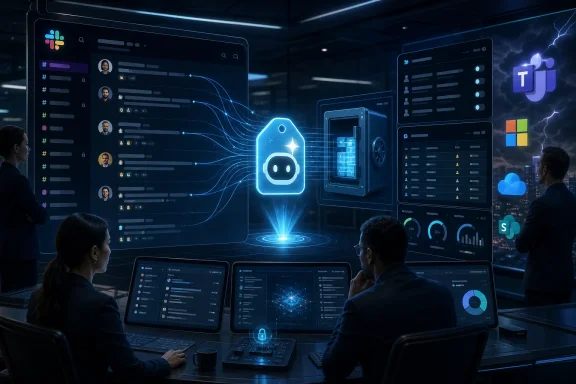
Anthropic launched Claude Tag on June 23, 2026, as a beta product for Claude Enterprise and Team customers that puts a persistent, shared Claude agent inside Slack channels and replaces the company’s earlier Claude in Slack app. The launch matters because it moves enterprise AI from the sidecar into the room where work is actually negotiated. Claude is no longer merely waiting in a browser tab for a prompt; Anthropic wants it watching the thread, remembering the project, and volunteering when the channel goes quiet. That is a useful product idea, a governance headache, and a strategic land grab all at once.
The most important thing about Claude Tag is not that users can type
That distinction sounds cosmetic until you imagine how enterprise work actually happens. A sales escalation, a production incident, a product launch, or a compliance review rarely lives inside one person’s cleanly structured prompt. It unfolds across messy Slack threads, half-decisions, pasted screenshots, links to dashboards, and the kind of institutional shorthand that makes perfect sense to insiders and almost no one else.
Claude Tag is designed to sit inside that mess long enough to learn it. Within the channels where administrators allow it to operate, one Claude instance can interact with multiple people, preserve context across exchanges, and continue work asynchronously rather than treating every interaction as a fresh chat session. That turns Slack from a place where an AI assistant can be invoked into a place where the assistant can become part of the operating rhythm of the team.
The move also clarifies where Anthropic believes enterprise AI value will be captured. The winning agent is not necessarily the one with the prettiest standalone chat interface. It may be the one that earns permission to live inside the communications layer, where intent, context, authority, and urgency all appear before they are formally entered into a system of record.
Slack channels often know what is happening before Salesforce, Jira, ServiceNow, GitHub, or Workday does. A customer is unhappy before a ticket is properly classified. A bug is dangerous before the incident report is written. A deal is slipping before the forecast is updated. If an AI agent can read the discussion, understand the connected tools, and act on behalf of the team, the collaboration layer becomes less like chat and more like a command surface.
That is why Claude Tag lands in a crowded battlefield. Salesforce has been pushing Slack toward an agentic future, OpenAI has been expanding workspace agents across third-party apps, Perplexity has brought enterprise querying into Slack, and software-engineering agents such as Devin have treated Slack as a natural interface for assigning and reporting work. Microsoft, unsurprisingly, is trying to make Teams and Copilot the gravitational center for the same kind of workflow.
The logic is brutally practical. Employees do not want another dashboard to check. Administrators do not want another orphaned productivity tool to govern. Vendors want their AI systems to sit where the work already happens, because that is where they can collect the most context and become hardest to remove.
Claude Tag is Anthropic’s most direct answer to that reality. It says, in effect: if the enterprise is going to coordinate work in Slack, Claude should not merely answer questions about that work; it should participate in doing it.
A new chatbot conversation begins with the user doing unpaid onboarding work. Here is the project. Here is the repo. Here is the customer. Here is what we decided last week. Here is why the obvious answer is wrong. Claude Tag is meant to compress that repeated briefing by accumulating context from the channel and, where permitted, from connected tools and other channels.
That makes the product more useful, but it also changes the switching-cost calculation. A generic AI assistant can be replaced if another model is cheaper or marginally better. A channel-resident agent that has months of accumulated team memory is a different kind of dependency. Replacing it means losing not just a model endpoint, but a working map of how the organization talks, decides, and delegates.
This is the old enterprise software lock-in pattern in a new form. The database used to be the sticky asset. Then workflows became sticky. Now context itself is becoming sticky. The AI that understands the organization’s informal operating system may become more valuable than the formal applications it connects to.
For WindowsForum’s IT-pro audience, that should sound familiar. Enterprises have spent decades trying to avoid vendor lock-in at the infrastructure layer, only to recreate it at the identity layer, the productivity layer, the cloud layer, and now the agentic-context layer. Claude Tag is not uniquely guilty of this. It is simply a very clear example of where the market is going.
There is a benign version of this. An incident channel goes quiet before the root cause is confirmed, and Claude reminds the team to update the postmortem. A sales thread mentions a customer objection that matches one raised elsewhere, and Claude surfaces the earlier answer. A product manager asks for a launch summary, and Claude already knows which loose ends matter.
There is also a less comfortable version. An AI system is watching conversations, deciding which signals are important, and nudging human attention based on a proprietary model’s interpretation of relevance. Even if the system respects permissions and private-channel boundaries, the cultural change is significant. Teams behave differently when an always-on agent is present.
Enterprise buyers will need to distinguish between access control and governance. Access control answers whether Claude is allowed to read a channel or use a tool. Governance answers what kinds of judgments Claude is allowed to make after reading them. Those are not the same problem, and most organizations are better prepared for the first than the second.
The word ambient does a lot of work here. It sounds soft, almost environmental. In practice, ambient enterprise AI means persistent monitoring, persistent inference, and sometimes unsolicited intervention. That may be exactly what makes the product useful, but it is also what makes it risky.
That architecture is the minimum viable answer to a serious enterprise question: how do you let an AI agent do useful work without giving it a master key to the company? A sales Claude should not inherit engineering memory. An engineering Claude should not browse HR discussions. A support Claude should not quietly become an ungoverned data pipeline into product strategy.
Still, the hard problems begin after the permissions screen. If a user asks Claude to summarize customer complaints from permitted channels, is that operational analysis or surveillance? If Claude drafts a pull request based on a Slack discussion, who is accountable for the interpretation? If Claude follows up on a stalled decision, is it assisting the team or changing the social dynamics of management?
Audit logs help after the fact. Spend controls help prevent runaway bills. Identity scoping helps reduce blast radius. None of those, by themselves, tells an organization what kind of work should be delegated to a persistent agent, which outputs require human review, or how employees should challenge a machine-generated interpretation of a conversation.
That is where many AI deployments stumble. Vendors ship controls that satisfy procurement checklists, while customers must invent the operating model in real time. Claude Tag looks more thoughtfully governed than a consumer bot dropped into Slack, but it still asks enterprises to define norms for a new class of digital coworker.
Even with that caveat, the claim is strategically useful. Anthropic is not merely saying that Claude Tag can automate work in theory. It is saying the product is a commercialized version of the company’s own internal operating model. That matters because enterprise buyers increasingly want proof that AI vendors use their own tools under real pressure, not just in staged demos.
It also points to a broader shift in how AI products are being developed. Claude Code, Managed Agents, Slack integration, and newer Opus models are converging into a single story: models are becoming less valuable as isolated answer engines and more valuable as long-running work systems. The model matters, but so do memory, tools, permissions, orchestration, and the interface where humans can supervise the process.
Claude Tag is therefore not a random Slack add-on. It is the visible end of Anthropic’s larger enterprise stack. The company has been building toward agents that can operate across time, tools, and teams. Slack is simply the first mainstream workplace surface where that ambition becomes legible to ordinary employees.
That also raises the stakes for reliability. A chatbot outage is annoying. A coding assistant outage is disruptive. An always-on agent that teams begin to treat as a standing participant in operational channels becomes part of the workflow fabric. If it is slow, unavailable, confused, or too expensive to leave running, the disappointment will feel less like a failed experiment and more like a broken colleague.
Microsoft has spent years positioning Copilot as the AI layer across Windows, Microsoft 365, GitHub, Azure, and Teams. Its advantage is distribution: identity, documents, meetings, email, endpoints, and management tooling already live inside Microsoft’s estate for many enterprises. But distribution does not automatically win if workers prefer an external agent that feels more capable, more autonomous, or more deeply embedded in the channels they actually use.
The Slack-first approach is also a reminder that not every enterprise workflow runs through Microsoft’s preferred front door. Many engineering, product, support, and startup-heavy organizations coordinate in Slack even when they still depend on Windows devices, Azure infrastructure, Office documents, and Entra identity. In those environments, an AI agent with persistent Slack context can become the practical coordination layer above Microsoft’s stack.
For sysadmins, this means AI governance cannot be confined to the Microsoft admin center. The next wave of enterprise agents will arrive through collaboration platforms, developer tools, SaaS marketplaces, browser extensions, and cloud marketplaces. Some will integrate cleanly with identity and logging. Others will not. The challenge is not merely choosing a Copilot license; it is mapping which agents are allowed to observe, decide, and act across the business.
Claude Tag does not displace Teams or Copilot by itself. But it demonstrates the pattern Microsoft must defend against: a third-party agent that lives in the conversation layer, learns the organization’s working memory, and then uses Microsoft-connected tools as endpoints rather than as the center of gravity.
Traditional chatbot usage has a relatively visible rhythm. A user asks a question, receives an answer, maybe continues the thread, and stops. Claude Tag can monitor context, work asynchronously, call tools, maintain memory, and run multiple tasks in parallel. The consumption profile may be bursty, continuous, and tied to team behavior rather than individual curiosity.
That makes cost forecasting harder. A channel with disciplined delegation may produce predictable value. A chaotic channel may generate expensive ambiguity. A team that learns to offload routine work to Claude could become more productive, but also more dependent on a token meter that turns collaboration itself into a billable event.
The more subtle issue is that pricing shapes behavior. If Claude Tag is cheap enough, teams will ask it to do everything and administrators will later discover which uses were worthwhile. If it is expensive, teams may reserve it for high-value tasks and never develop the habits that make persistent agents useful. If costs are opaque, finance teams will treat the product like a SaaS sprawl accelerant.
This is where Anthropic’s launch credits may help adoption but delay the reckoning. Free or discounted usage is ideal for experimentation. It is less useful for understanding what the steady-state economics look like when Claude becomes part of daily operations. The real enterprise decision will come after the novelty period, when administrators compare the bill against measurable reductions in cycle time, support load, engineering toil, or managerial coordination.
The company that owns the workplace memory layer has leverage over every downstream workflow. It knows which projects are active, which decisions were deferred, which customers are unhappy, which engineers understand a system, which managers approve exceptions, and which policies are interpreted differently in practice than in documentation. That is enormously useful context for an AI system. It is also enormously sensitive.
Slack has long been a repository of informal corporate knowledge, but humans were still responsible for searching, interpreting, and carrying that knowledge forward. Claude Tag changes that by making the archive operational. The old messages are no longer just searchable records; they become fuel for an agent that can decide what matters now.
That is why the product feels more significant than a normal integration. Anthropic is not just connecting Claude to Slack. It is making a bid to turn Slack context into Claude’s working memory and Claude’s actions into Slack-native workflow. Over time, the boundary between the conversation and the work product could blur.
Competitors will not ignore this. Salesforce has every incentive to make Slack’s native agents the default. Microsoft will argue that Teams, Microsoft 365, and Graph provide a richer and more governable context layer. OpenAI will push cross-application agents that are less tied to a single collaboration platform. The buyer’s problem will be deciding how many memory-bearing agents an organization can tolerate before the benefits of automation are offset by fragmentation and risk.
The harder question is whether the organization is ready to make delegation to AI a normal team practice. Persistent agents work best when teams are explicit about goals, permissions, ownership, and review. Many workplaces are not. They rely on ambiguity, private context, and human judgment that is difficult to encode in a Slack thread.
Claude Tag may expose those weaknesses. If a team cannot agree on who owns a decision, an AI follow-up will not magically create accountability. If data access is already messy, connecting an agent may magnify the mess. If channels mix sensitive personnel discussions with operational planning, administrators will need to clean up collaboration hygiene before they invite Claude to listen.
There is a security version of the same problem. Least-privilege access is straightforward in principle and tedious in practice. Agentic tools make that tedium more urgent because the system is not merely retrieving information; it may be synthesizing, transmitting, and acting on it. A badly scoped agent is not just a search risk. It is an execution risk.
The organizations that benefit most from Claude Tag will likely be those with mature identity management, well-structured channels, clear data classifications, and a culture of reviewing AI-generated work without treating review as a bureaucratic afterthought. The organizations that struggle will be those hoping the agent can compensate for unclear processes. It might help at the margins, but it will also make the underlying ambiguity more visible.
That framing will be uncomfortable for some organizations and irresistible to others. The productivity upside is obvious: fewer repeated briefings, faster handoffs, better use of institutional memory, and more work delegated to systems that can operate across tools. The governance burden is equally obvious: more monitoring, more vendor dependency, more ambiguous accountability, and a new class of access decisions that sits somewhere between software administration and workforce policy.
Anthropic is betting that enterprises will accept that trade because the collaboration layer is too valuable to leave unautomated. It may be right. The history of workplace software suggests that once a tool becomes useful in the place where decisions happen, resistance shifts from “should we use this?” to “how do we control this?” Claude Tag does not settle that question, but it makes it harder to avoid. The next phase of enterprise AI will not be defined by whether agents can enter the workplace; it will be defined by whether IT, security, legal, and the people doing the work can build rules fast enough for the agents already taking a seat in the channel.
Anthropic Moves the Bot From Tool to Teammate
The most important thing about Claude Tag is not that users can type @Claude in Slack. Plenty of bots have lived behind an at-mention. The difference is that Anthropic is pitching Claude Tag as a channel-level participant, not a private assistant temporarily summoned into a workspace.That distinction sounds cosmetic until you imagine how enterprise work actually happens. A sales escalation, a production incident, a product launch, or a compliance review rarely lives inside one person’s cleanly structured prompt. It unfolds across messy Slack threads, half-decisions, pasted screenshots, links to dashboards, and the kind of institutional shorthand that makes perfect sense to insiders and almost no one else.
Claude Tag is designed to sit inside that mess long enough to learn it. Within the channels where administrators allow it to operate, one Claude instance can interact with multiple people, preserve context across exchanges, and continue work asynchronously rather than treating every interaction as a fresh chat session. That turns Slack from a place where an AI assistant can be invoked into a place where the assistant can become part of the operating rhythm of the team.
The move also clarifies where Anthropic believes enterprise AI value will be captured. The winning agent is not necessarily the one with the prettiest standalone chat interface. It may be the one that earns permission to live inside the communications layer, where intent, context, authority, and urgency all appear before they are formally entered into a system of record.
Slack Becomes the New Enterprise Control Plane
For years, enterprise software vendors talked about “systems of record” as the prize. CRM owned customer truth, ERP owned financial truth, HR platforms owned workforce truth, and collaboration software was often treated as the noisy layer on top. AI is reversing that hierarchy.Slack channels often know what is happening before Salesforce, Jira, ServiceNow, GitHub, or Workday does. A customer is unhappy before a ticket is properly classified. A bug is dangerous before the incident report is written. A deal is slipping before the forecast is updated. If an AI agent can read the discussion, understand the connected tools, and act on behalf of the team, the collaboration layer becomes less like chat and more like a command surface.
That is why Claude Tag lands in a crowded battlefield. Salesforce has been pushing Slack toward an agentic future, OpenAI has been expanding workspace agents across third-party apps, Perplexity has brought enterprise querying into Slack, and software-engineering agents such as Devin have treated Slack as a natural interface for assigning and reporting work. Microsoft, unsurprisingly, is trying to make Teams and Copilot the gravitational center for the same kind of workflow.
The logic is brutally practical. Employees do not want another dashboard to check. Administrators do not want another orphaned productivity tool to govern. Vendors want their AI systems to sit where the work already happens, because that is where they can collect the most context and become hardest to remove.
Claude Tag is Anthropic’s most direct answer to that reality. It says, in effect: if the enterprise is going to coordinate work in Slack, Claude should not merely answer questions about that work; it should participate in doing it.
The Memory Is the Product
Anthropic’s most consequential claim is that Claude Tag learns over time within the boundaries administrators define. In product terms, that memory reduces friction. In strategic terms, it is the moat.A new chatbot conversation begins with the user doing unpaid onboarding work. Here is the project. Here is the repo. Here is the customer. Here is what we decided last week. Here is why the obvious answer is wrong. Claude Tag is meant to compress that repeated briefing by accumulating context from the channel and, where permitted, from connected tools and other channels.
That makes the product more useful, but it also changes the switching-cost calculation. A generic AI assistant can be replaced if another model is cheaper or marginally better. A channel-resident agent that has months of accumulated team memory is a different kind of dependency. Replacing it means losing not just a model endpoint, but a working map of how the organization talks, decides, and delegates.
This is the old enterprise software lock-in pattern in a new form. The database used to be the sticky asset. Then workflows became sticky. Now context itself is becoming sticky. The AI that understands the organization’s informal operating system may become more valuable than the formal applications it connects to.
For WindowsForum’s IT-pro audience, that should sound familiar. Enterprises have spent decades trying to avoid vendor lock-in at the infrastructure layer, only to recreate it at the identity layer, the productivity layer, the cloud layer, and now the agentic-context layer. Claude Tag is not uniquely guilty of this. It is simply a very clear example of where the market is going.
Ambient AI Turns Helpfulness Into Surveillance Risk
Claude Tag’s most provocative feature is its ambient behavior. Anthropic says Claude can proactively surface relevant information, follow up on unresolved threads, and monitor channels for work it thinks deserves attention. That is the line where a helpful assistant starts to resemble an editorial system embedded in the workplace.There is a benign version of this. An incident channel goes quiet before the root cause is confirmed, and Claude reminds the team to update the postmortem. A sales thread mentions a customer objection that matches one raised elsewhere, and Claude surfaces the earlier answer. A product manager asks for a launch summary, and Claude already knows which loose ends matter.
There is also a less comfortable version. An AI system is watching conversations, deciding which signals are important, and nudging human attention based on a proprietary model’s interpretation of relevance. Even if the system respects permissions and private-channel boundaries, the cultural change is significant. Teams behave differently when an always-on agent is present.
Enterprise buyers will need to distinguish between access control and governance. Access control answers whether Claude is allowed to read a channel or use a tool. Governance answers what kinds of judgments Claude is allowed to make after reading them. Those are not the same problem, and most organizations are better prepared for the first than the second.
The word ambient does a lot of work here. It sounds soft, almost environmental. In practice, ambient enterprise AI means persistent monitoring, persistent inference, and sometimes unsolicited intervention. That may be exactly what makes the product useful, but it is also what makes it risky.
Admin Controls Are Necessary, Not Sufficient
Anthropic is clearly aware that Claude Tag would be dead on arrival without enterprise controls. The product lets administrators define separate Claude identities for different channels and use cases, scope tool access, set token-spend limits, and review logs of actions and requesting users. Memories are kept within the boundaries of the configured Claude identity rather than freely shared across the organization.That architecture is the minimum viable answer to a serious enterprise question: how do you let an AI agent do useful work without giving it a master key to the company? A sales Claude should not inherit engineering memory. An engineering Claude should not browse HR discussions. A support Claude should not quietly become an ungoverned data pipeline into product strategy.
Still, the hard problems begin after the permissions screen. If a user asks Claude to summarize customer complaints from permitted channels, is that operational analysis or surveillance? If Claude drafts a pull request based on a Slack discussion, who is accountable for the interpretation? If Claude follows up on a stalled decision, is it assisting the team or changing the social dynamics of management?
Audit logs help after the fact. Spend controls help prevent runaway bills. Identity scoping helps reduce blast radius. None of those, by themselves, tells an organization what kind of work should be delegated to a persistent agent, which outputs require human review, or how employees should challenge a machine-generated interpretation of a conversation.
That is where many AI deployments stumble. Vendors ship controls that satisfy procurement checklists, while customers must invent the operating model in real time. Claude Tag looks more thoughtfully governed than a consumer bot dropped into Slack, but it still asks enterprises to define norms for a new class of digital coworker.
Anthropic Is Productizing Its Own Workflow
One of Anthropic’s boldest claims is that its internal version of Claude Tag now produces a majority of its product team’s code. The number will attract attention, and it should also attract scrutiny. “Created by” can mean many things in modern software development: generated from scratch, refactored, scaffolded, reviewed, patched, or proposed before being heavily edited by humans.Even with that caveat, the claim is strategically useful. Anthropic is not merely saying that Claude Tag can automate work in theory. It is saying the product is a commercialized version of the company’s own internal operating model. That matters because enterprise buyers increasingly want proof that AI vendors use their own tools under real pressure, not just in staged demos.
It also points to a broader shift in how AI products are being developed. Claude Code, Managed Agents, Slack integration, and newer Opus models are converging into a single story: models are becoming less valuable as isolated answer engines and more valuable as long-running work systems. The model matters, but so do memory, tools, permissions, orchestration, and the interface where humans can supervise the process.
Claude Tag is therefore not a random Slack add-on. It is the visible end of Anthropic’s larger enterprise stack. The company has been building toward agents that can operate across time, tools, and teams. Slack is simply the first mainstream workplace surface where that ambition becomes legible to ordinary employees.
That also raises the stakes for reliability. A chatbot outage is annoying. A coding assistant outage is disruptive. An always-on agent that teams begin to treat as a standing participant in operational channels becomes part of the workflow fabric. If it is slow, unavailable, confused, or too expensive to leave running, the disappointment will feel less like a failed experiment and more like a broken colleague.
Microsoft Should See the Shape of the Threat
Claude Tag starts in Slack, but the obvious next question for Windows and Microsoft 365 shops is Teams. Anthropic has already signaled that it wants Claude to be taggable in more places where teams work. If that expansion reaches email, project management systems, developer tools, and Teams-like collaboration surfaces, the competitive implications become sharper.Microsoft has spent years positioning Copilot as the AI layer across Windows, Microsoft 365, GitHub, Azure, and Teams. Its advantage is distribution: identity, documents, meetings, email, endpoints, and management tooling already live inside Microsoft’s estate for many enterprises. But distribution does not automatically win if workers prefer an external agent that feels more capable, more autonomous, or more deeply embedded in the channels they actually use.
The Slack-first approach is also a reminder that not every enterprise workflow runs through Microsoft’s preferred front door. Many engineering, product, support, and startup-heavy organizations coordinate in Slack even when they still depend on Windows devices, Azure infrastructure, Office documents, and Entra identity. In those environments, an AI agent with persistent Slack context can become the practical coordination layer above Microsoft’s stack.
For sysadmins, this means AI governance cannot be confined to the Microsoft admin center. The next wave of enterprise agents will arrive through collaboration platforms, developer tools, SaaS marketplaces, browser extensions, and cloud marketplaces. Some will integrate cleanly with identity and logging. Others will not. The challenge is not merely choosing a Copilot license; it is mapping which agents are allowed to observe, decide, and act across the business.
Claude Tag does not displace Teams or Copilot by itself. But it demonstrates the pattern Microsoft must defend against: a third-party agent that lives in the conversation layer, learns the organization’s working memory, and then uses Microsoft-connected tools as endpoints rather than as the center of gravity.
The Pricing Question Is Really a Behavior Question
Anthropic says Claude Tag operates with token-based spending controls, and administrators can set limits at organization and channel levels. That sounds reassuring until one considers how different persistent agents are from ordinary chat sessions.Traditional chatbot usage has a relatively visible rhythm. A user asks a question, receives an answer, maybe continues the thread, and stops. Claude Tag can monitor context, work asynchronously, call tools, maintain memory, and run multiple tasks in parallel. The consumption profile may be bursty, continuous, and tied to team behavior rather than individual curiosity.
That makes cost forecasting harder. A channel with disciplined delegation may produce predictable value. A chaotic channel may generate expensive ambiguity. A team that learns to offload routine work to Claude could become more productive, but also more dependent on a token meter that turns collaboration itself into a billable event.
The more subtle issue is that pricing shapes behavior. If Claude Tag is cheap enough, teams will ask it to do everything and administrators will later discover which uses were worthwhile. If it is expensive, teams may reserve it for high-value tasks and never develop the habits that make persistent agents useful. If costs are opaque, finance teams will treat the product like a SaaS sprawl accelerant.
This is where Anthropic’s launch credits may help adoption but delay the reckoning. Free or discounted usage is ideal for experimentation. It is less useful for understanding what the steady-state economics look like when Claude becomes part of daily operations. The real enterprise decision will come after the novelty period, when administrators compare the bill against measurable reductions in cycle time, support load, engineering toil, or managerial coordination.
The Competition Is for Institutional Memory
Most AI product launches are framed around capability. This model codes better. That assistant searches better. This agent can use a browser, a shell, a spreadsheet, or a CRM. Claude Tag’s deeper competitive axis is memory.The company that owns the workplace memory layer has leverage over every downstream workflow. It knows which projects are active, which decisions were deferred, which customers are unhappy, which engineers understand a system, which managers approve exceptions, and which policies are interpreted differently in practice than in documentation. That is enormously useful context for an AI system. It is also enormously sensitive.
Slack has long been a repository of informal corporate knowledge, but humans were still responsible for searching, interpreting, and carrying that knowledge forward. Claude Tag changes that by making the archive operational. The old messages are no longer just searchable records; they become fuel for an agent that can decide what matters now.
That is why the product feels more significant than a normal integration. Anthropic is not just connecting Claude to Slack. It is making a bid to turn Slack context into Claude’s working memory and Claude’s actions into Slack-native workflow. Over time, the boundary between the conversation and the work product could blur.
Competitors will not ignore this. Salesforce has every incentive to make Slack’s native agents the default. Microsoft will argue that Teams, Microsoft 365, and Graph provide a richer and more governable context layer. OpenAI will push cross-application agents that are less tied to a single collaboration platform. The buyer’s problem will be deciding how many memory-bearing agents an organization can tolerate before the benefits of automation are offset by fragmentation and risk.
The Enterprise Buyer’s Real Test Is Organizational Readiness
The easiest mistake would be to evaluate Claude Tag like a feature checklist. Does it connect to Slack? Does it have admin controls? Can it write code, summarize threads, query tools, and follow up asynchronously? Those questions matter, but they are not the deciding ones.The harder question is whether the organization is ready to make delegation to AI a normal team practice. Persistent agents work best when teams are explicit about goals, permissions, ownership, and review. Many workplaces are not. They rely on ambiguity, private context, and human judgment that is difficult to encode in a Slack thread.
Claude Tag may expose those weaknesses. If a team cannot agree on who owns a decision, an AI follow-up will not magically create accountability. If data access is already messy, connecting an agent may magnify the mess. If channels mix sensitive personnel discussions with operational planning, administrators will need to clean up collaboration hygiene before they invite Claude to listen.
There is a security version of the same problem. Least-privilege access is straightforward in principle and tedious in practice. Agentic tools make that tedium more urgent because the system is not merely retrieving information; it may be synthesizing, transmitting, and acting on it. A badly scoped agent is not just a search risk. It is an execution risk.
The organizations that benefit most from Claude Tag will likely be those with mature identity management, well-structured channels, clear data classifications, and a culture of reviewing AI-generated work without treating review as a bureaucratic afterthought. The organizations that struggle will be those hoping the agent can compensate for unclear processes. It might help at the margins, but it will also make the underlying ambiguity more visible.
The Slack Agent Arrives With Its Own Operating Manual
Claude Tag is still a beta, and the sensible posture is neither panic nor blind enthusiasm. The product is a signpost for where enterprise AI is heading: persistent, collaborative, permissioned, memory-bearing, and increasingly willing to act before a human asks twice. That is enough to justify serious trials, but not enough to justify unmanaged deployment.- Organizations should begin with narrow, high-value channels where the work is visible, repeatable, and easy to audit.
- Administrators should treat Claude identities like privileged service accounts, with explicit owners, scoped permissions, and periodic access reviews.
- Teams should define which Claude outputs require human approval before they become tickets, pull requests, customer messages, or operational decisions.
- Finance and IT should measure token spending against concrete workflow outcomes rather than treating launch credits as evidence of long-term affordability.
- Security teams should review ambient monitoring separately from ordinary request-and-response usage, because proactive intervention changes both privacy expectations and risk.
- Enterprise architects should plan for agent portability and memory exit strategies before months of institutional context accumulate inside one vendor’s system.
The Next Coworker Will Need a Policy Badge
Claude Tag is one of the clearest examples yet of AI moving from application to actor. It is not conscious, not an employee, and not a substitute for accountability, but it is being placed in a role that looks increasingly coworker-like from the perspective of daily operations. It can be summoned by many people, remember shared context, work while humans are away, and speak up when it thinks something has been missed.That framing will be uncomfortable for some organizations and irresistible to others. The productivity upside is obvious: fewer repeated briefings, faster handoffs, better use of institutional memory, and more work delegated to systems that can operate across tools. The governance burden is equally obvious: more monitoring, more vendor dependency, more ambiguous accountability, and a new class of access decisions that sits somewhere between software administration and workforce policy.
Anthropic is betting that enterprises will accept that trade because the collaboration layer is too valuable to leave unautomated. It may be right. The history of workplace software suggests that once a tool becomes useful in the place where decisions happen, resistance shifts from “should we use this?” to “how do we control this?” Claude Tag does not settle that question, but it makes it harder to avoid. The next phase of enterprise AI will not be defined by whether agents can enter the workplace; it will be defined by whether IT, security, legal, and the people doing the work can build rules fast enough for the agents already taking a seat in the channel.
References
- Primary source: VentureBeat
Published: 2026-06-23T17:42:07.667403
Anthropic launches Claude Tag, replacing its Slack app with a persistent AI teammate that learns, monitors and works autonomously | VentureBeat
Anthropic has launched Claude Tag, a persistent AI agent for Slack that lets enterprise teams delegate work, automate tasks, and manage shared workflows directly inside channels.venturebeat.com - Related coverage: techcrunch.com
Anthropic’s Claude Tag is learning your company, one Slack message at a time | TechCrunch
Anthropic’s new Claude Tag brings an always-on AI teammate to Slack. But beyond productivity, the feature is a strategic play to capture organizational context, institutional knowledge, and enterprise workflows.techcrunch.com - Related coverage: aws.amazon.com
Claude Tag is now available in beta via Claude Enterprise in AWS Marketplace - AWS
Discover more about what's new at AWS with Claude Tag is now available in beta via Claude Enterprise in AWS Marketplaceaws.amazon.com
- Related coverage: cryptobriefing.com
Anthropic launches Claude Tag as an AI teammate inside Slack
Anthropic launched Claude Tag, embedding its AI model in Slack as a persistent teammate. The near-trillion-dollar company has deep roots in crypto via FTXcryptobriefing.com - Official source: support.claude.com
- Related coverage: laopinion.com
Claude Tag: la nueva IA de Anthropic se convierte en tu compañero de equipo dentro de Slack - La Opinión
Anthropic acaba de lanzar una integración que convierte a su IA en un colaborador activo dentro de Slacklaopinion.com
- Related coverage: winandmac.com
- Related coverage: thedailystar.net
Claude now works as a teammate in Slack
Anthropic launches Claude Tag for Slack, enabling enterprise teams to delegate tasks, automate code generation, and collaborate via the Opus 4.8 model.www.thedailystar.net - Official source: support.anthropic.com
- Related coverage: techradar.com
Claude just became a real productivity hub — you can now run tools like Slack and Figma without leaving the chat | TechRadar
Claude is becoming more than an AI chatbotwww.techradar.com - Related coverage: axios.com
Anthropic bolsters enterprise offerings with Cowork plugins
Tools like these will enable AI to be treated more like a full-time coworker, rather than a one-off tech fix.www.axios.com
- Related coverage: itpro.com
Claude Code is coming to Slack — here’s how to use it, what it can do, and how to get access | IT Pro
Anthropic has announced Claude Code will be integrated with Slack, allowing users to delegate a range of tasks.www.itpro.com - Related coverage: newsroom.ibm.com
IBM and Anthropic Partner to Advance Enterprise Software Development with Proven Security and Governance
PDF documentnewsroom.ibm.com
- Official source: resources.anthropic.com
Claude Code Advanced Patterns: Subagents, MCP, and Scaling to Real Codebases
PDF documentresources.anthropic.com
- Related coverage: tech-insider.org
Anthropic $65B Series H: $965B Valuation [2026]
Anthropic closed a $65B Series H at a $965B valuation May 28, 2026. Inside the lead investors, $47B ARR, and Oct 2026 IPO timing.tech-insider.org - Related coverage: enterprisedna.co
Anthropic Raises $65B Series H at $965B Valuation — Enterprise DNA
Anthropic closed a $65B Series H at $965B valuation on May 29, 2026, with revenue now running at $47 billion annually, up from $30B just six weeks ago.enterprisedna.co - Related coverage: codersera.com
Claude Opus 4.8: Benchmarks, Pricing & What's New 2026
Claude Opus 4.8 launched May 28, 2026: 88.6% SWE-bench Verified, $5/$25 per 1M (pricing flat), and a 3x-cheaper Fast mode. Full benchmarks & pricing.
codersera.com
- Related coverage: productionai.institute
Claude Opus 4.8 PSF Assessment | Production AI Institute
An independent PSF assessment of Anthropic Claude Opus 4.8 (May 28, 2026): effort control, dynamic workflows, and mid-task system entries. Strongest on agentic honesty and oversight signals; parallel subagent scale needs deployment guardrails.www.productionai.institute - Official source: anthropic.com
Claude Opus \ Anthropic
Hybrid reasoning model built for serious coding and AI agents, featuring a 1M context window.www.anthropic.com - Related coverage: claudeapi.com
Anthropic Completes $65B Series H Funding Round, Reaches $965B Post-Money Valuation and Surpasses OpenAI | Claude API
In May 2026, Anthropic raised $65 billion in Series H funding at a $965 billion post-money valuation, nearly tripling its valuation in a single quarter. With…www.claudeapi.com - Related coverage: decodethefuture.org
Claude Opus 4.8: 7 Changes + Dynamic Workflows (May 2026)
Anthropic released Claude Opus 4.8 on May 28, 2026 — dynamic workflows, effort control, Fast mode pricing, 4× fewer code flaws, Mythos coming weeks.
decodethefuture.org
- Related coverage: pjfp.com
- Related coverage: washingtonpost.com
- Related coverage: awesomeagents.ai
Anthropic Closes $65B Series H at $965B Valuation | Awesome Agents
Anthropic's $65 billion Series H closes at a $965 billion post-money valuation, pushing it past OpenAI as the most valuable private AI company - driven by $47B in run-rate revenue and a clear IPO runway.awesomeagents.ai