

CloudFit Software’s announcement that it won the 2025 Microsoft Global Defense & Intelligence Partner of the Year Award crystallizes a fast-moving commercial moment: Microsoft has formally recognized CloudFit’s Azure Government and GCC High‑centric approach to defense workloads just as the Department of Defense’s CMMC acquisition rule became enforceable, creating an immediate market opportunity for turnkey compliance and managed‑service offerings aimed at the Defense Industrial Base.
Microsoft’s annual Partner of the Year Awards are a high‑visibility endorsement for partners that deliver measurable outcomes on Microsoft Cloud and AI platforms. The 2025 cycle drew more than 4,600 nominations across 100+ countries, and winners were published in the run‑up to Microsoft Ignite. The Partner of the Year “Defense & Intelligence” category highlights vendors that demonstrate mission‑grade security, operational repeatability, and alignment with Microsoft’s government cloud tooling. CloudFit’s press release frames the award as recognition of long-running, mission‑oriented work and explicitly ties the accolade to the commercial rollout of easyCMMC — a turnkey offering CloudFit says is built on Microsoft GCC High and Azure Government to accelerate CMMC Level 2 readiness across primes and subcontractors in the Defense Industrial Base (DIB). That announcement was distributed via PR Newswire and widely syndicated. Why the timing matters: the DoD’s 48 CFR CMMC Acquisition Rule was published in the Federal Register in September 2025 and becomes enforceable 60 days after publication — on November 10, 2025 — allowing contracting officers to include CMMC requirements in new solicitations. This regulatory milestone turns vendor claims about CMMC readiness from marketing advantages into immediate procurement differentiators for many DoD contracts.
Source: The AI Journal CloudFit Software Named 2025 Microsoft Global Defense & Intelligence Partner Award Winner | The AI Journal
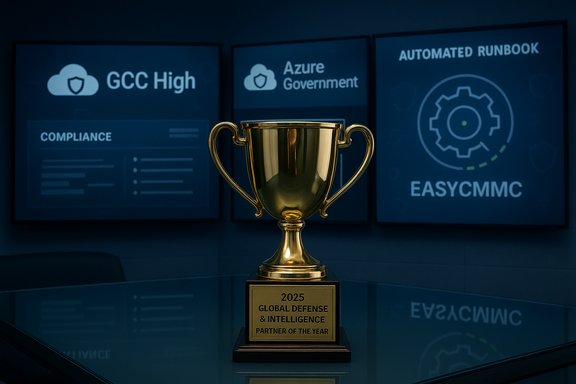 Background / Overview
Microsoft’s annual Partner of the Year Awards are a high‑visibility endorsement for partners that deliver measurable outcomes on Microsoft Cloud and AI platforms. The 2025 cycle drew more than 4,600 nominations across 100+ countries, and winners were published in the run‑up to Microsoft Ignite. The Partner of the Year “Defense & Intelligence” category highlights vendors that demonstrate mission‑grade security, operational repeatability, and alignment with Microsoft’s government cloud tooling. CloudFit’s press release frames the award as recognition of long-running, mission‑oriented work and explicitly ties the accolade to the commercial rollout of easyCMMC — a turnkey offering CloudFit says is built on Microsoft GCC High and Azure Government to accelerate CMMC Level 2 readiness across primes and subcontractors in the Defense Industrial Base (DIB). That announcement was distributed via PR Newswire and widely syndicated. Why the timing matters: the DoD’s 48 CFR CMMC Acquisition Rule was published in the Federal Register in September 2025 and becomes enforceable 60 days after publication — on November 10, 2025 — allowing contracting officers to include CMMC requirements in new solicitations. This regulatory milestone turns vendor claims about CMMC readiness from marketing advantages into immediate procurement differentiators for many DoD contracts. What Microsoft’s award actually signals
What a Partner of the Year win means in practice
- Market validation and visibility. Winners gain prioritized visibility in Microsoft partner listings and field channels; the accolade often speeds co‑sell introductions and shortlists in procurement workflows.
- Proof of repeatability. Judging typically rewards scalable, repeatable customer outcomes — not one‑off proofs‑of‑concept — so a win signals credible delivery processes and documented customer impact.
- Product/engineering alignment. Microsoft tends to award partners that show deep technical alignment with its product direction (in this case, government‑tenanted services such as GCC High and Azure Government).
What the award does not guarantee
- It is not a compliance attestation. Awards do not substitute for audited reports (SOC 2, FedRAMP authority to operate) or for a CMMC certificate issued under the relevant accreditation rules. Buyers should still demand evidence of independent attestations where the contract requires them.
- It does not define contractual SLAs. Commercial and legal protections must be negotiated directly; an award is a market signal, not a legal guarantee.
CloudFit: capabilities, claims, and verifiable facts
The claim set (what CloudFit says)
- CloudFit was named Microsoft’s 2025 Global Defense & Intelligence Partner of the Year.
- CloudFit markets a product called easyCMMC, described as a turnkey offering built on GCC High and Azure Government to help organizations achieve and maintain CMMC Level 2 readiness.
- CloudFit emphasizes a U.S.‑first workforce, experience operating mission‑grade workloads for DoD, and managed 24×7 operations coupled with compliance automation.
Independent verification of key claims
- Microsoft’s official Partner of the Year winners page lists CloudFit Software, LLC as the winner in the Defense & Intelligence category, confirming the award.
- The CloudFit press release and syndications (PR Newswire and other outlets) state the same facts and quote CEO Carroll Moon. These vendor and syndication pages corroborate the company’s public messaging.
- CloudFit’s historical presence on Microsoft partner shortlists and prior finalist recognition is visible in vendor archives and Microsoft‑hosted materials, supporting the company’s claim of prior program engagement. However, the company’s claim that this is their “first global‑level Microsoft Partner Award” is vendor‑declared and not independently verifiable through public Microsoft archive metadata beyond the winners listing itself; procurement teams should treat that as a marketing statement to be validated if important to a selection decision.
Why easyCMMC and GCC High / Azure Government matter now
The technical foundation: GCC High and Azure Government
- GCC High and Azure Government provide tenancy, contractual controls, and compliance baselines that many DoD and federal workloads require: segmented tenancy, government‑only datacenters, and contractual commitments around data handling that differ from commercial Azure regions.
- For organizations handling Controlled Unclassified Information (CUI) or other regulated data, tenancy in GCC High or Azure Government is often a baseline requirement across federal solicitations and many prime‑level flow‑downs.
Policy tailwind: CMMC enforcement begins November 10, 2025
- With the 48 CFR rule taking effect on November 10, 2025, contracting officers can require CMMC status at award. This instantly increases procurement appetite for cloud‑native, vendor‑assisted CMMC readiness, particularly for small to medium subcontractors that lack internal cybersecurity teams.
Market opportunity and buyer pain points
- Many DIB suppliers face compressed timelines: Level 2 (self‑assessment or C3PAO‑validated depending on solicitation) readiness can take months to over a year without automation and an existing governance framework. Managed, automated offerings reduce time‑to‑audit readiness.
- The natural buyers are prime contractors helping subcontractors meet flow‑down requirements, SMB subcontractors, and regulated ISVs needing a fast path to demonstrable control operation.
Strengths: why CloudFit’s entry is credible and compelling
- Platform alignment. CloudFit’s focus on GCC High and Azure Government keeps solutions inside Microsoft’s supported government cloud boundary and aligns with procurement expectations for DoD workloads. This reduces an initial integration friction for Azure‑centric federal customers.
- Operational automation and runbooks. CloudFit positions itself as a managed operations provider with compliance automation — automation that, when done well, materially shortens audit readiness cycles and reduces human error in evidence collection.
- Clear GTM timing. Tying easyCMMC’s launch to the enforceable CMMC rule provides a timely product narrative that will resonate with primes and the many subcontractors racing to meet requirements.
- Microsoft co‑sell halo. A Partner of the Year award typically yields practical go‑to‑market advantages inside Microsoft’s field teams, which can accelerate customer introductions and provide early visibility in federal buying channels.
Risks, limits, and what buyers must validate
1) Tenancy vs. assurance: the difference between being hosted in GCC High and being audit‑ready
- Using GCC High / Azure Government is necessary for many defense use cases, but tenancy alone does not equal compliance. Buyers must validate:
- Actual control implementations (patching, configuration baselines, key management).
- Logging, retention, and evidence export formats.
- Identity architectures and cross‑tenant access flows.
- Require named reference customers and sample evidence artifacts during procurement to validate practical implementation.
2) Certification path and assessor independence
- Phase 1 of the CMMC rollout allows many Level 2 self‑assessments, but third‑party C3PAO assessments are required for a subset of contracts and for later phases. EasyCMMC can accelerate readiness, but certification still requires assessor involvement where the solicitation demands it.
- Procurement teams should clarify whether easyCMMC includes or only prepares for a C3PAO assessment and whether the vendor will support the external audit phase (artifact handover, assessor coordination).
3) Operational lock‑in and exit portability
- Managed, opinionated automation is a double‑edged sword: it speeds onboarding but can create switching friction if configuration artifacts, IaC templates, and system images are not exportable.
- Contracts should require exportable configurations, runbooks, and data egress procedures with clearly defined timelines and formats.
4) Personnel and supply‑chain assurances
- CloudFit emphasizes a U.S.‑first workforce and clearance‑friendly staff as differentiators for defense work. Buyers should ask for evidence and constraints (e.g., are cleared personnel available across time zones, what is the proportion of cleared staff, what supply‑chain protections are in place).
- Claims about cleared workforces are operational facts that vendors should substantiate in the contract or via named references.
5) Pricing, FinOps, and total cost of ownership
- Tenancy and consumption in GCC High / Azure Government can cost materially more than commercial Azure. Buyers must model steady‑state costs, audit evidence maintenance costs, and the cost of periodic re‑assessment support.
- Require clear cost modeling and FinOps guardrails as part of procurement.
Practical procurement checklist for IT and security teams
- Request Microsoft winners confirmation and cross‑check independent vendor press release claims. (CloudFit’s win is listed on Microsoft’s winners page and corroborated by vendor PR; still request nomination documentation if award status materially affects selection.
- Ask for named production references in DoD or DIB contexts that match your required control boundary (CUI vs. FCI).
- Require exportable artifacts: IaC templates, images, SSP/SSP extracts, evidence bundles, and runbooks in machine‑readable formats.
- Define assessor support: clarify whether the offering includes readiness only, or also C3PAO coordination and audit support.
- Negotiate SLAs for incident response, evidence availability, access to logs, and escape/egress timelines.
- Insist on third‑party attestations (FedRAMP, SOC 2, or relevant audits) where the contract requires them.
- Model long‑term costs with a FinOps plan and agree on visibility metrics (monthly consumption, retention costs, and anomaly alerts).
How easyCMMC can fit into defense supply‑chain modernization (practical scenarios)
- Small subcontractor readiness: For SMBs lacking in‑house security teams, a tenant‑based managed package with automated evidence collection and baseline configurations can be the fastest path to being eligible for solicitations that include CMMC clauses.
- Prime contractor supply‑chain programs: Primes can use easyCMMC as a repeatable offering to accelerate vendor onboarding and to reduce administrative burden when validating subcontractor readiness prior to award.
- Joint modernization programs: Agencies and integrators that need to combine cloud modernization with continuous compliance can adopt managed offerings to maintain evidence posture while scaling workloads across GCC High regions.
Points of healthy skepticism
- Vendor narratives in award cycles commonly mix validated outcomes with marketing claims. While the Microsoft winners list is authoritative for award status, operational claims about time‑to‑certify, number of customers ready, or specific audit outcomes are vendor statements that require named references and audit evidence to verify. Treat the award as a signal to start deeper technical diligence, not as a procurement shortcut.
- Some partners will position automation as a silver bullet for CMMC readiness. Automation helps materially, but missing governance or poor identity controls will still fail an assessor’s scrutiny. Insist on end‑to‑end evidence flow and assessor‑friendly artifact packaging.
Strategic implications for Azure, Microsoft, and the DIB ecosystem
- Microsoft’s Partner of the Year recognition of a specialist like CloudFit underlines a continued Microsoft strategy: cultivate trusted partners that operationalize government‑tenant capabilities and rapidly move supply‑chain customers from proof‑of‑concept to audit‑ready production.
- For Microsoft, enabling partners who can operate GCC High and Azure Government workloads at scale is an ecosystem play: it increases enterprise lock‑in of mission workloads on Azure while reducing direct engineering burden on Microsoft product teams.
- For the DIB, this dynamic means more packaged options for compliance, but also a renewed need for procurement literacy: awards will narrow shortlists faster, but they will not replace contract‑level technical verification.
Technical verification and cross‑checks performed
- Award verification: CloudFit is listed as the 2025 winner for the Microsoft Partner of the Year Defense & Intelligence category on Microsoft’s official winners page.
- Press confirmation: CloudFit’s announcement is published via PR Newswire and syndicated across multiple outlets, which match the official award claim and provide the vendor’s quote and product positioning.
- Policy timing: The 48 CFR CMMC acquisition rule was published and is enforceable effective November 10, 2025, creating immediate procurement relevance for CMMC readiness offerings. This was confirmed by multiple industry trackers and legal/advisory summaries.
- CloudFit product foundation: CloudFit’s site and the vendor press material both state easyCMMC is built on GCC High and Azure Government; these are the tenants commonly used for DoD/controlled workloads. Buyers should still validate control implementations beyond tenancy claims.
Conclusion
CloudFit’s recognition as Microsoft’s 2025 Global Defense & Intelligence Partner of the Year is a meaningful commercial credential that materially improves the company’s GTM visibility inside Microsoft channels at a moment when DoD acquisition policy has made CMMC readiness a live procurement factor. The combination of an award halo, a GCC High/Azure Government technical foundation, and a packaged offering named easyCMMC creates a compelling, time‑sensitive option for primes and subcontractors that must demonstrate CMMC Level 2 readiness quickly. That said, awards do not replace technical vetting. For any organization considering easyCMMC or similar managed offerings, the immediate next steps are practical and procedural: demand named references, require exportable evidence artifacts and runbooks, confirm third‑party attestations where required, and include assessor support in the statement of work. When combined with careful contractual protections and real‑world references, CloudFit’s offering — now carrying Microsoft’s Partner of the Year signal — may legitimately accelerate compliance and reduce program risk for many members of the Defense Industrial Base.Source: The AI Journal CloudFit Software Named 2025 Microsoft Global Defense & Intelligence Partner Award Winner | The AI Journal
