

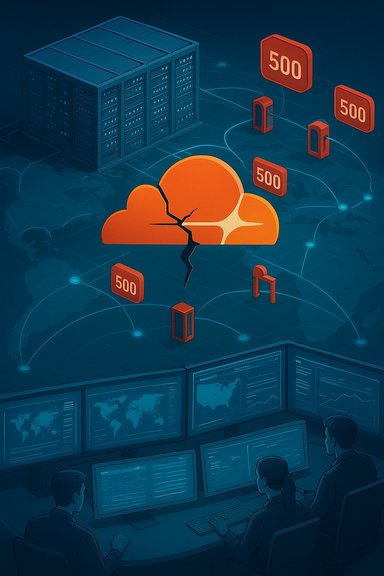
A single internal configuration change at Cloudflare briefly knocked large parts of the public web offline on November 18, 2025, exposing how concentrated and brittle modern internet edge infrastructure has become.
Cloudflare is one of the internet’s largest edge and content-delivery providers, delivering CDN, DNS, bot mitigation, Turnstile/human-verification, WAF and proxy services for millions of sites and applications. That positioning makes it a performance and security multiplier for customers but also a single choke point for traffic that traverses its global edge fabric. Multiple contemporaneous reports estimated Cloudflare handles roughly one-fifth of public web traffic, a factor that explains why a localized failure inside its control plane produced visible outages for big-name services. This is not an abstract risk: in 2025 several high-profile infrastructure incidents — from hyperscale cloud control-plane failures to misapplied edge configurations — created cascades in which apparently unrelated consumer services went dark because they shared a common provider. The November 18 Cloudflare event arrived on the heels of other outages that had already sharpened concern about single-vendor dependencies.
The November 18 outage is another data point in a pattern seen throughout 2025: a small change, bug, or misconfiguration inside a core provider can cascade and produce outsized global outages. Past incidents at hyperscalers and large cloud providers have repeatedly demonstrated the same architecture risk: convenience and scale trade off against single-point-of-failure exposure.
This is the technical and governance reality that IT leaders must now negotiate: edge platforms are essential utilities, but they are also high-leverage failure points that deserve the same operational scrutiny and contingency planning typically reserved for on-prem critical systems.
For IT leaders, the message is simple and practical: assume that major third-party providers will fail, and design your public-facing systems so that a single edge provider’s slip cannot take your core product, payments or authentication completely offline. For the wider internet community, the incident underscores an urgent debate about how much resilience we want from centralized utilities versus the operational cost of decentralizing them — and how governance, procurement and engineering must evolve together to protect the digital economy.
Source: CBC https://www.cbc.ca/news/canada/lond...ernet-blew-up-this-week-temporarily-9.6987955
 Background
Cloudflare is one of the internet’s largest edge and content-delivery providers, delivering CDN, DNS, bot mitigation, Turnstile/human-verification, WAF and proxy services for millions of sites and applications. That positioning makes it a performance and security multiplier for customers but also a single choke point for traffic that traverses its global edge fabric. Multiple contemporaneous reports estimated Cloudflare handles roughly one-fifth of public web traffic, a factor that explains why a localized failure inside its control plane produced visible outages for big-name services. This is not an abstract risk: in 2025 several high-profile infrastructure incidents — from hyperscale cloud control-plane failures to misapplied edge configurations — created cascades in which apparently unrelated consumer services went dark because they shared a common provider. The November 18 Cloudflare event arrived on the heels of other outages that had already sharpened concern about single-vendor dependencies.What happened — concise summary
- The incident began on 18 November 2025 at about 11:20 UTC, when Cloudflare’s monitoring and customer reports showed a sudden spike in HTTP 5xx errors and challenge/Turnstile failures across its network.
- The immediate symptom for end users was twofold: generic 500/5xx error pages served by Cloudflare’s proxy, and the now-familiar message asking browsers to “Please unblock challenges.cloudflare.com to proceed” when challenge validation failed. Those messages blocked legitimate sessions until the edge verification path recovered.
- Cloudflare’s public post‑mortem identified the proximate cause as a change in database permissions that caused a metadata query to produce duplicate rows, which in turn generated a “feature file” for Bot Management that doubled in size and exceeded a hard safety limit on the edge software. That oversized file was then propagated across Cloudflare’s fleet and triggered crashes in the core proxy’s bot-management handler. The company said the incident was not caused by malicious activity.
- Engineers stopped propagation, replaced the bad feature file with a good version, applied mitigations, and restarted affected services; normal traffic flow largely returned after a rollback and staged recovery steps, but residual recovery and backlog effects lasted longer.
Timeline and symptoms — a closer look
Early detection and public signals
Cloudflare received a rapid increase in error reports and observable 5xx rates beginning around 11:20 UTC, followed by successive status updates as the company investigated, identified the fault, and implemented remediation. Outage trackers and social platforms showed sharp spikes in reports for ChatGPT/OpenAI, X (formerly Twitter), Canva, Spotify and dozens of other services that fronted their public traffic through Cloudflare.Why front-line security checks turned into outages
Cloudflare’s Turnstile and Bot Management systems are intentionally conservative: when validation cannot be completed, the edge denies or challenges traffic rather than allowing risky requests through. In this incident the control plane that generated configuration for the bot-management model began producing a corrupt/oversized feature file every few minutes (a consequence of the database query change), and because that file is read by edge proxies to make per-request decisions, the result was a fail‑closed behavior at scale: legitimate sessions were blocked or returned 5xx errors by the intermediary before ever reaching origin servers.Fluctuations and the runaway file
Cloudflare engineers observed an unusual oscillation where the feature file would sometimes be good and sometimes bad, depending on which database shard produced the result — the query was scheduled to run and update the file periodically. That intermittent generation meant the failure pattern could appear to recover and fail again, complicating diagnosis and giving an initial appearance consistent with an attack. Once the pattern was understood, the team prevented further bad file generation, injected a known-good file, and restarted the core proxy to clear the panic state.The technical root cause — explained for operators
Cloudflare’s engineering blog provided a concise technical root cause: a permissions change in a ClickHouse database query that returned duplicate metadata rows, which produced a feature configuration file larger than the proxy code expected. The bot-management module has runtime safety limits (e.g., pre-allocated structures and feature-count caps) and exceeded those limits when the file doubled. The precondition (a seemingly innocuous metadata/permissions update) and the architecture (rapid distribution of configuration to every edge node) combined to produce a globally propagated failure. Two cross-checked technical details are especially important and were confirmed by Cloudflare and independent reporting:- The feature file was regenerated and propagated every few minutes; intermittent generation meant edge nodes could flip between good and bad configurations, producing the observed oscillation in errors.
- The failure mode was internal (software/configuration) rather than an external DDoS or compromise; Cloudflare explicitly denied a cyberattack and the propagation mechanics fit a data-generation and distribution problem.
Who was affected and how bad was the impact?
The outage’s visible impact was broad and heterogeneous:- High-profile consumer-facing platforms that route public ingress through Cloudflare (including conversational AI web front ends, social apps, streaming and design tools) saw intermittent failures and 5xx responses for many users. ChatGPT/OpenAI, X, Canva, Spotify and game-matching services were widely reported as affected.
- Thousands of smaller websites that rely on Cloudflare for DNS, TLS and bot mitigation displayed 500 errors or unreachable pages; the aggregate effect pushed outage-tracker counts sharply upward during the incident window.
- Payment flows, transit portals and other critical public-facing services that had their front ends proxied through Cloudflare saw partial or regional disruption where the edge verification failed. That translated into short-term business interruption, lost conversions, and customer-support surges for affected operators.
Why this mattered: centralization at the edge
Cloudflare’s global footprint and comprehensive product stack (CDN, DNS, WAF, bot mitigation, Turnstile) make it functionally essential for many organizations. That concentration delivers huge operational benefits — simplified TLS, global caching, centralized bot rules and DDoS protection — but it also creates a systemic risk when that provider’s control plane or configuration pipeline misbehaves.The November 18 outage is another data point in a pattern seen throughout 2025: a small change, bug, or misconfiguration inside a core provider can cascade and produce outsized global outages. Past incidents at hyperscalers and large cloud providers have repeatedly demonstrated the same architecture risk: convenience and scale trade off against single-point-of-failure exposure.
This is the technical and governance reality that IT leaders must now negotiate: edge platforms are essential utilities, but they are also high-leverage failure points that deserve the same operational scrutiny and contingency planning typically reserved for on-prem critical systems.
The corporate and operational response
Cloudflare’s response followed a standard incident lifecycle: detection → triage → mitigation → rollback → staged recovery. The company published an initial blog post summarizing the technical cause, acknowledged the outage’s severity (saying it was the worst since 2019 for some core traffic), and committed to a formal post-incident report with remediation steps and longer-term safeguards. Independent coverage confirmed that the company’s fixes — stopping bad file generation, injecting a good file, and restarting the core proxy — were effective at restoring normal traffic. Journalists and operators noted that the oscillating nature of the failure made broad, immediate remediation tricky and emphasized the importance of testable, incremental configuration rollouts. From a business and investor perspective, incidents of this scale produce short-term reputational and market effects, and they typically prompt customers to demand improved SLAs, stronger change-management controls and more transparent post-incident analysis. Expect Cloudflare to publish detailed mitigations (code and configuration guardrails, additional validation checks on generated files, improved propagation controls) as part of its remediation roadmap.Practical resilience lessons for IT operators and power users
This outage carries immediate, actionable lessons for any team that depends on shared internet infrastructure.For architects and platform engineers
- Design for multi-path ingress. Avoid a single CDN/edge provider for mission-critical public endpoints. Use multi-CDN strategies, DNS-based failovers, or provider-neutral traffic managers to reduce blast radius.
- Maintain direct-origin bypasses. Keep origin endpoints and authentication paths that can be enabled quickly in emergency modes to allow core operations to continue if the edge fails.
- Limit control-plane coupling. Wherever possible, avoid design patterns that require frequent full-cluster propagation of large configuration files; prefer incremental, regionally-scoped rollouts and strong validation rules before distribution.
- Exercise incident runbooks. Test failover procedures for authentication, payments, and critical APIs. Practice recovery drills that simulate edge failures and ensure operational playbooks exist for degraded delivery modes.
- Negotiate operational SLAs. Ensure contracts and incident-reporting obligations are clear and include transparency on propagation mechanics and change-management processes.
For application owners and product teams
- Keep cached, static landing pages that can be served directly from origin or non-affected CDNs to preserve customer communication during an outage.
- Publish clear outage status updates independently from your edge provider status to prevent customer confusion when the provider’s own status page is affected.
- Maintain alternative sign-in paths or emergency-support accounts that do not rely on a single third-party edge policy.
For individual users
- Understand that some cloud outages can temporarily block access to services you use; maintain alternative productivity tools or secondary accounts for mission-critical tasks.
- Keep a local backup of essential data (photos, documents) rather than assuming cloud-only storage is sufficient for short-term reliability.
Wider policy and market implications
The Cloudflare outage will likely stimulate three parallel responses:- Enterprise buyers will push for diversifying their edge stack and building operational resilience into procurement decisions.
- Regulators and public-sector buyers may look more closely at systemic dependencies and consider classification or oversight frameworks for firms that function as essential digital infrastructure.
- Providers will be incentivized to redesign propagation and control-plane patterns to limit blast radius from a single misconfiguration (for example, regionally isolated configuration, transactional validation, or staged global rollouts with circuit breakers).
Where reporting remains provisional
A few aspects of the narrative remain subject to further technical nuance and verification:- The exact internal query change that produced duplicate rows in ClickHouse and the surrounding permission adjustments will only be fully describable with Cloudflare’s raw telemetry and an internal timeline; initial public accounts summarize the mechanics but do not (and cannot) publish raw logs. Treat detailed forensics beyond the published blog as provisional until Cloudflare’s complete post-incident report appears.
- Casual social reports naming every affected brand vary in accuracy; vendor status pages remain the definitive account for whether a specific company experienced an outage. Crowd-sourced aggregators are useful for symptom triage but can conflate downstream partner effects with direct outages.
Conclusion
The November 18 Cloudflare disruption was short but stark: a routine maintenance-like change in database permissions cascaded through an automated configuration pipeline, created a bloated bot‑management feature file, and briefly turned a security/defense layer into an inadvertent denial-of-service mechanism. The event is a reminder that the internet’s modern convenience is built on shared, opaque control planes that require rigorous change management, staged propagation, and multi-provider resilience planning.For IT leaders, the message is simple and practical: assume that major third-party providers will fail, and design your public-facing systems so that a single edge provider’s slip cannot take your core product, payments or authentication completely offline. For the wider internet community, the incident underscores an urgent debate about how much resilience we want from centralized utilities versus the operational cost of decentralizing them — and how governance, procurement and engineering must evolve together to protect the digital economy.
Source: CBC https://www.cbc.ca/news/canada/lond...ernet-blew-up-this-week-temporarily-9.6987955
