

Britain’s competition watchdog is preparing to put Microsoft at the center of its newest digital markets test, and the implications could reach far beyond licensing footnotes and procurement paperwork. The Competition and Markets Authority has signaled that it will open a Strategic Market Status investigation into Microsoft’s business software ecosystem in May, focusing on products such as Windows, Word, Excel, Teams and Copilot, according to the report that triggered the latest debate. If the CMA ultimately designates Microsoft with SMS, it could impose conduct requirements or other pro-competition interventions on one of the most deeply embedded technology stacks in the UK public and private sectors.
The significance of this move is not just that the CMA is looking at another large U.S. technology company. It is that the regulator is using a brand-new regime to examine the connective tissue of modern work: productivity software, cloud dependence, AI assistants and the commercial rules that bind them together. The CMA’s digital markets powers were built to address precisely this kind of ecosystem-level influence, where market power can be felt not only in one product but in how several products reinforce one another.
That matters because the UK is not approaching this as a purely abstract antitrust exercise. The CMA’s cloud services market investigation already concluded that competition in cloud infrastructure was not working as well as it could, and it singled out Microsoft and AWS as the two largest providers, each with up to 40% of UK customer spend. The same investigation also pointed to Microsoft’s software licensing practices as a concern affecting cloud competition, which helps explain why the watchdog is now widening its lens from cloud infrastructure to the broader software ecosystem.
The broader context is equally important: AI is no longer a sidecar feature. Microsoft has been steadily embedding Copilot and other agentic capabilities across Microsoft 365, and it has publicly described a future in which AI agents coordinate work across apps and systems at enterprise scale. The CMA appears to be asking a simple but consequential question: when AI is layered on top of a dominant productivity suite, does the bundle become more useful for customers, or more difficult to leave?
This is why the probe has attracted immediate attention from businesses, public bodies and rivals alike. In sectors such as education, healthcare and local government, Microsoft software is not merely popular; it is deeply operational. That gives any future conduct remedy, however targeted, potential knock-on effects across procurement, interoperability, pricing and innovation. The regulator’s challenge is to distinguish between genuine product integration and market power that has become self-reinforcing.
The cloud investigation laid much of the groundwork. In its provisional and final work, the CMA said competition in UK cloud services was not working as well as it should, and it highlighted switching costs, technical barriers and licensing practices as recurring issues. In particular, the inquiry group said potential interventions might include measures to encourage technical standardisation, reduce data transfer charges and ensure fair licensing of software. That line of reasoning is now central to the Microsoft software probe.
The watchdog has already indicated that this issue persisted even after the cloud market investigation closed. The report cited in the current coverage says Microsoft made no material progress on licensing concerns after July 2025, which appears to have influenced the shift toward SMS scrutiny. That sequence is telling: the regulator seems to believe that warning signals, market findings and softer pressure were not enough to change behavior.
There is also a political and institutional backdrop. The CMA has been trying to show that its new powers can have practical force, not just theoretical importance. It has already used the regime to investigate Apple and Google’s mobile ecosystems and has signaled a willingness to move quickly where it sees entrenched market power. Microsoft, unlike some newer AI players, sits at the intersection of legacy enterprise software, cloud infrastructure and emerging AI tooling, which makes it an especially consequential test case.
The CMA’s interest appears to reflect the idea that when a firm controls several layers of a stack, it can shape behavior in ways that individual product markets do not reveal. A company might technically be able to choose another collaboration app or AI assistant, but if the incumbent is integrated into authentication, file formats, admin tools, procurement and training, the switching cost becomes much more than a sticker price. That is the sort of structural issue SMS is designed to address.
That interdependence can benefit customers. A unified stack can reduce integration costs, simplify support and make AI rollout easier for large organizations. But the same structure can also amplify the gatekeeping power of the incumbent, especially if customers feel that moving one component means disrupting the entire environment. In competition terms, that is where convenience can become dependency.
The CMA seems to be asking whether Microsoft’s ecosystem advantages are still chiefly the result of better products, or whether they now include entrenched commercial leverage. That distinction is central because the regulator is not trying to punish success as such. It is trying to decide whether the market remains contestable enough that rivals can compete on merit rather than on whether they can survive the incumbent’s licensing architecture.
From a competition standpoint, that matters because AI assistants can deepen platform lock-in. If a user’s prompts, documents, calendar, identity, security permissions and workflow automation all live inside one vendor’s ecosystem, the AI layer becomes more valuable precisely because it has access to more proprietary context. That is a competitive advantage, but it can also make the platform more difficult to replace once customers become dependent on it.
The CMA’s concern is likely not that Microsoft offers AI in workplace tools. It is that the arrival of AI could turn existing market power into something more potent. If Copilot becomes the default layer through which employees draft, search, summarize and automate work, then the software suite itself becomes even more central to productivity than it already was. In that sense, AI may not create the market power; it may magnify it.
There is also a broader policy question. The UK government has argued that AI can deliver major productivity gains, and public-sector trials of Microsoft 365 Copilot have reported time savings in the NHS and civil service. Those gains are real and politically attractive, but they also make regulators less willing to accept that AI integration is automatically benign. When a tool becomes essential to public-sector efficiency, the terms on which it is sold become a matter of national economic interest.
That matters because the new regime is intentionally flexible. In prior digital markets cases, the CMA has signaled that remedies can range from clearer user choice and interoperability obligations to restrictions on unfair terms or practices that limit switching. In the cloud context, the watchdog has already pointed to fair licensing, reduced transfer charges and technical standardisation as plausible interventions.
The CMA also has to be careful about proportionality. If it overreaches, it could chill investment or push firms to delay new product launches in the UK. If it underreaches, the SMS regime risks looking toothless. The regulator’s own messaging suggests it wants to avoid both extremes by focusing on targeted measures rather than broad, symbolic ones.
One reason this regime is attracting global attention is that it gives regulators a middle path between doing nothing and pursuing drawn-out litigation. Instead of waiting for a case-by-case abuse finding, the CMA can intervene earlier when market structure itself is the problem. That is exactly why other regulators are watching the UK approach so closely.
That could be a meaningful shift for public buyers in particular. The UK public sector has been leaning on Microsoft 365 Copilot and related tools to improve productivity, but any future remedy that lowers switching barriers could also make it easier for departments to mix providers. That would not necessarily reduce adoption of Microsoft tools; it might simply make adoption less coercive.
The risk, however, is that short-term compliance costs get passed through in subtle ways. Vendors may reduce discounting, narrow support concessions or change packaging to preserve margins. In that case, the market could become more transparent without becoming materially cheaper. Competition policy often creates second-order effects that take time to surface.
For IT leaders, the practical takeaway is that the cost of inertia may now include regulatory as well as operational risk. If Microsoft’s ecosystem is forced to open up more, organizations that have postponed exit planning may find that rivals become more viable. If it is not, the very act of investigation may still reshape vendor conversations around renewal terms and cross-cloud portability.
The public sector is where the stakes may be most tangible. The UK government has already highlighted productivity gains from generative AI tools like Microsoft 365 Copilot, but those gains depend on a procurement environment that is healthy, contestable and cost-effective. If licensing or ecosystem constraints force public bodies into a single vendor path, the policy goal of digital transformation can become harder to sustain.
There is also a democratic angle. Public institutions increasingly rely on software whose terms are set privately and globally. When those terms affect interoperability, data portability and access to AI features, the consequences are no longer just commercial. They shape the practical autonomy of schools, councils, hospitals and ministries. That is why the CMA’s framing is as much about productivity and competitiveness as it is about competition law.
If the investigation leads to more open software markets, consumers may benefit indirectly through lower service costs, better public services and more choice in the apps and workflows that sit on top of Microsoft tools. If it does not, the UK may still have a stronger record of documenting the costs of digital dependence. Either way, the case will reverberate well beyond the boardroom.
This matters for Microsoft because cross-border consistency is increasingly valuable in digital regulation. If the company faces comparable expectations in multiple jurisdictions, it may have to adapt licensing, interoperability and AI packaging on a broader basis rather than building country-specific exceptions. For global vendors, that can be costly, but it can also reduce fragmentation if regulators align on principles.
The international angle also increases pressure on Microsoft to present its own narrative as modernization rather than lock-in. The company is likely to argue that AI integration, cloud connectivity and unified admin tools are responses to customer demand. Regulators will answer that customer demand does not excuse terms that make exit materially harder than entry. The tension between those two positions is where this case will be fought.
That battle is bigger than one firm. It will influence how other enterprise software and AI vendors design bundles, how they disclose licensing terms and how they describe interoperability. In practice, Microsoft’s case could become a benchmark for whether ecosystem power is the next major frontier in digital competition policy.
The opportunity is broader than punishment or restraint. A well-designed SMS outcome could improve portability, make procurement more transparent and support a more competitive market for enterprise software and AI tools. It could also encourage rivals to innovate around interoperability rather than around lock-in. In a market this important, those are structural gains, not small ones.
Another risk is implementation drift. A designation can be swift; remedies can take longer and become watered down in consultation, appeal or compliance. There is also the danger that Microsoft responds by changing packaging in ways that technically satisfy the rules while leaving the underlying dependency intact. That kind of regulatory arbitrage is common in digital markets.
The broader market will be watching for three signals in particular. First, whether the CMA treats AI integration as a standalone issue or as part of a wider ecosystem problem. Second, whether it prioritizes licensing and interoperability remedies over heavy-handed structural measures. Third, whether Microsoft responds with concessions, technical changes or a vigorous defense of its bundle-led model. Those choices will shape how other firms design their own enterprise AI offerings.
Source: investing.com UK watchdog to probe Microsoft software dominance, AI integration By Investing.com
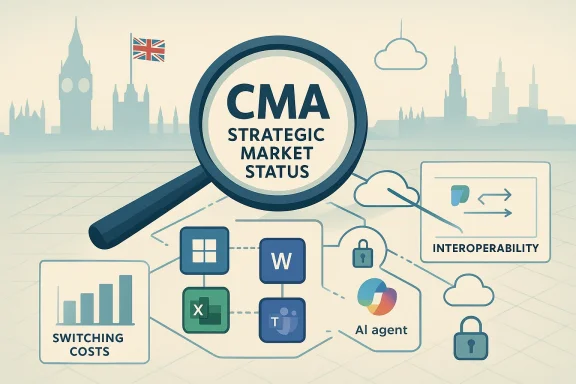 Overview
The significance of this move is not just that the CMA is looking at another large U.S. technology company. It is that the regulator is using a brand-new regime to examine the connective tissue of modern work: productivity software, cloud dependence, AI assistants and the commercial rules that bind them together. The CMA’s digital markets powers were built to address precisely this kind of ecosystem-level influence, where market power can be felt not only in one product but in how several products reinforce one another.That matters because the UK is not approaching this as a purely abstract antitrust exercise. The CMA’s cloud services market investigation already concluded that competition in cloud infrastructure was not working as well as it could, and it singled out Microsoft and AWS as the two largest providers, each with up to 40% of UK customer spend. The same investigation also pointed to Microsoft’s software licensing practices as a concern affecting cloud competition, which helps explain why the watchdog is now widening its lens from cloud infrastructure to the broader software ecosystem.
The broader context is equally important: AI is no longer a sidecar feature. Microsoft has been steadily embedding Copilot and other agentic capabilities across Microsoft 365, and it has publicly described a future in which AI agents coordinate work across apps and systems at enterprise scale. The CMA appears to be asking a simple but consequential question: when AI is layered on top of a dominant productivity suite, does the bundle become more useful for customers, or more difficult to leave?
This is why the probe has attracted immediate attention from businesses, public bodies and rivals alike. In sectors such as education, healthcare and local government, Microsoft software is not merely popular; it is deeply operational. That gives any future conduct remedy, however targeted, potential knock-on effects across procurement, interoperability, pricing and innovation. The regulator’s challenge is to distinguish between genuine product integration and market power that has become self-reinforcing.
Background
The CMA’s current stance did not appear overnight. For several years, UK regulators have been expanding their scrutiny of large digital platforms, first through conventional market studies and then through the newer digital markets regime. The Digital Markets, Competition and Consumers Act 2024 created the SMS framework, which allows the CMA to designate a firm with entrenched power in a particular digital activity and then consider conduct requirements or pro-competition interventions tailored to that market.The cloud investigation laid much of the groundwork. In its provisional and final work, the CMA said competition in UK cloud services was not working as well as it should, and it highlighted switching costs, technical barriers and licensing practices as recurring issues. In particular, the inquiry group said potential interventions might include measures to encourage technical standardisation, reduce data transfer charges and ensure fair licensing of software. That line of reasoning is now central to the Microsoft software probe.
Why software licensing became a competition issue
Microsoft’s software licensing has been controversial because the licensing terms can affect not only how customers buy productivity software, but also how they deploy workloads across competing cloud providers. If a business wants to use familiar Microsoft tools while moving some infrastructure elsewhere, licensing rules can determine whether that migration is easy, costly or commercially unattractive. The CMA’s concern is not simply about price; it is about whether commercial terms create friction that locks customers in.The watchdog has already indicated that this issue persisted even after the cloud market investigation closed. The report cited in the current coverage says Microsoft made no material progress on licensing concerns after July 2025, which appears to have influenced the shift toward SMS scrutiny. That sequence is telling: the regulator seems to believe that warning signals, market findings and softer pressure were not enough to change behavior.
There is also a political and institutional backdrop. The CMA has been trying to show that its new powers can have practical force, not just theoretical importance. It has already used the regime to investigate Apple and Google’s mobile ecosystems and has signaled a willingness to move quickly where it sees entrenched market power. Microsoft, unlike some newer AI players, sits at the intersection of legacy enterprise software, cloud infrastructure and emerging AI tooling, which makes it an especially consequential test case.
Why Microsoft Is in the Frame
Microsoft’s position in the workplace software market is unusually durable. Windows is the default operating system in many corporate environments, while Word, Excel, PowerPoint and Teams remain embedded in daily workflows across industries. That makes Microsoft not just a software supplier, but a kind of productivity substrate for the modern office.The CMA’s interest appears to reflect the idea that when a firm controls several layers of a stack, it can shape behavior in ways that individual product markets do not reveal. A company might technically be able to choose another collaboration app or AI assistant, but if the incumbent is integrated into authentication, file formats, admin tools, procurement and training, the switching cost becomes much more than a sticker price. That is the sort of structural issue SMS is designed to address.
The ecosystem problem
What makes Microsoft especially complex is that the company’s offerings are increasingly interdependent. Copilot sits on top of Microsoft 365; Microsoft 365 depends on data, identity and security layers; and those layers are often linked to Azure and enterprise agreements. The result is an ecosystem where one commercial decision can reverberate across software, cloud and AI purchasing.That interdependence can benefit customers. A unified stack can reduce integration costs, simplify support and make AI rollout easier for large organizations. But the same structure can also amplify the gatekeeping power of the incumbent, especially if customers feel that moving one component means disrupting the entire environment. In competition terms, that is where convenience can become dependency.
The CMA seems to be asking whether Microsoft’s ecosystem advantages are still chiefly the result of better products, or whether they now include entrenched commercial leverage. That distinction is central because the regulator is not trying to punish success as such. It is trying to decide whether the market remains contestable enough that rivals can compete on merit rather than on whether they can survive the incumbent’s licensing architecture.
- Microsoft’s control spans software, cloud and AI layers.
- Switching costs may be driven by commercial terms, not only technology.
- Integrated bundles can be efficient, but also hard to unbundle.
- The CMA’s focus is on whether the market is still contestable.
- AI integration may increase the value of the incumbent’s default position.
The Role of AI and Copilot
The AI angle is what makes this investigation feel newly urgent rather than merely repetitive. Microsoft has been talking publicly about Copilot, agents and “Frontier” transformation as the next phase of work software, and it has been rolling out new capabilities across Microsoft 365 at a rapid pace. In other words, the company is not defending a static legacy stack; it is actively redefining the stack around AI.From a competition standpoint, that matters because AI assistants can deepen platform lock-in. If a user’s prompts, documents, calendar, identity, security permissions and workflow automation all live inside one vendor’s ecosystem, the AI layer becomes more valuable precisely because it has access to more proprietary context. That is a competitive advantage, but it can also make the platform more difficult to replace once customers become dependent on it.
Agentic tools and market power
Microsoft’s recent messaging has emphasized agentic AI, where software does more than answer prompts and instead coordinates actions across apps and systems. The company has described products like Agent 365 and Copilot Studio as tools that help organizations govern and secure multiple agents operating across the enterprise. That is attractive to large buyers, but it also concentrates value in the incumbent’s control plane.The CMA’s concern is likely not that Microsoft offers AI in workplace tools. It is that the arrival of AI could turn existing market power into something more potent. If Copilot becomes the default layer through which employees draft, search, summarize and automate work, then the software suite itself becomes even more central to productivity than it already was. In that sense, AI may not create the market power; it may magnify it.
There is also a broader policy question. The UK government has argued that AI can deliver major productivity gains, and public-sector trials of Microsoft 365 Copilot have reported time savings in the NHS and civil service. Those gains are real and politically attractive, but they also make regulators less willing to accept that AI integration is automatically benign. When a tool becomes essential to public-sector efficiency, the terms on which it is sold become a matter of national economic interest.
- Copilot is becoming a core productivity layer.
- Agentic AI increases the value of integrated ecosystems.
- Better workflow automation can coexist with greater lock-in.
- Public-sector adoption raises the stakes for procurement fairness.
- The challenge is separating innovation gains from market foreclosure.
What the CMA Can Do
If the CMA designates Microsoft with Strategic Market Status, it does not mean the company has done anything unlawful. The SMS label is a regulatory gateway, not a finding of abuse. But it would give the watchdog the ability to impose conduct requirements or pro-competition interventions designed to address specific harms in the market.That matters because the new regime is intentionally flexible. In prior digital markets cases, the CMA has signaled that remedies can range from clearer user choice and interoperability obligations to restrictions on unfair terms or practices that limit switching. In the cloud context, the watchdog has already pointed to fair licensing, reduced transfer charges and technical standardisation as plausible interventions.
Potential remedy paths
The likely regulatory question is not whether Microsoft should be broken up. It is whether specific commercial practices should be constrained so customers can move, interoperate and compete more freely. That could include licensing transparency, portability requirements, clearer pricing structures or obligations that reduce the commercial penalty for using rival cloud infrastructure alongside Microsoft software.The CMA also has to be careful about proportionality. If it overreaches, it could chill investment or push firms to delay new product launches in the UK. If it underreaches, the SMS regime risks looking toothless. The regulator’s own messaging suggests it wants to avoid both extremes by focusing on targeted measures rather than broad, symbolic ones.
One reason this regime is attracting global attention is that it gives regulators a middle path between doing nothing and pursuing drawn-out litigation. Instead of waiting for a case-by-case abuse finding, the CMA can intervene earlier when market structure itself is the problem. That is exactly why other regulators are watching the UK approach so closely.
- SMS is a gateway designation, not a penalty.
- Remedies can be targeted and market-specific.
- The focus may be on licensing, interoperability and switching.
- The CMA wants practical changes, not symbolic gestures.
- Overreach could create uncertainty for enterprise buyers.
Enterprise Impact
For large organizations, especially those in government, healthcare, finance and education, the immediate issue is procurement risk. Many enterprises buy Microsoft as a bundle because the bundle is convenient, discounted and operationally familiar. If the CMA forces more transparency or weaker tying effects, procurement teams may gain more leverage to negotiate and more room to diversify.That could be a meaningful shift for public buyers in particular. The UK public sector has been leaning on Microsoft 365 Copilot and related tools to improve productivity, but any future remedy that lowers switching barriers could also make it easier for departments to mix providers. That would not necessarily reduce adoption of Microsoft tools; it might simply make adoption less coercive.
Procurement and vendor strategy
Enterprise software buyers often care less about headline innovation than about predictability, security and support. If the CMA imposes clearer rules around licensing or interoperability, that could improve the ability of CIOs to architect hybrid environments. It may also weaken the negotiating leverage that incumbent vendors enjoy when one product is so central that changing it is operationally painful.The risk, however, is that short-term compliance costs get passed through in subtle ways. Vendors may reduce discounting, narrow support concessions or change packaging to preserve margins. In that case, the market could become more transparent without becoming materially cheaper. Competition policy often creates second-order effects that take time to surface.
For IT leaders, the practical takeaway is that the cost of inertia may now include regulatory as well as operational risk. If Microsoft’s ecosystem is forced to open up more, organizations that have postponed exit planning may find that rivals become more viable. If it is not, the very act of investigation may still reshape vendor conversations around renewal terms and cross-cloud portability.
- Public procurement could gain more leverage.
- Hybrid and multi-cloud strategies may become easier to justify.
- Licensing terms may become more transparent.
- Vendors may react by reworking bundles or discounts.
- Enterprises will need to reassess switching risk.
Consumer and Public Sector Impact
Consumers may not feel this investigation directly in the same way they would a mobile app ruling or a browser choice-screen mandate. Yet they are still affected through the services they use every day, especially where public bodies, schools and employers shape the software environment around them. If the CMA succeeds, the benefit may be less visible pricing and more freedom of choice in the systems behind the scenes.The public sector is where the stakes may be most tangible. The UK government has already highlighted productivity gains from generative AI tools like Microsoft 365 Copilot, but those gains depend on a procurement environment that is healthy, contestable and cost-effective. If licensing or ecosystem constraints force public bodies into a single vendor path, the policy goal of digital transformation can become harder to sustain.
Why this is more than a corporate story
The danger in focusing only on Microsoft’s size is that the real issue becomes invisible. The CMA is not simply asking whether one company is successful; it is asking whether success in a foundational layer of digital work is now so entrenched that public and private buyers are losing meaningful alternatives. That distinction matters because digital dependency can quietly become a fiscal problem.There is also a democratic angle. Public institutions increasingly rely on software whose terms are set privately and globally. When those terms affect interoperability, data portability and access to AI features, the consequences are no longer just commercial. They shape the practical autonomy of schools, councils, hospitals and ministries. That is why the CMA’s framing is as much about productivity and competitiveness as it is about competition law.
If the investigation leads to more open software markets, consumers may benefit indirectly through lower service costs, better public services and more choice in the apps and workflows that sit on top of Microsoft tools. If it does not, the UK may still have a stronger record of documenting the costs of digital dependence. Either way, the case will reverberate well beyond the boardroom.
- Better procurement could translate into better public services.
- Consumer benefits may appear indirectly through institutions.
- Digital dependency can become a budgetary burden.
- Interoperability affects not just IT teams but service users.
- The public interest in this case is broader than licensing.
International Scrutiny
The UK is not alone in tightening the screws on Microsoft. The CMA itself noted that Brazil’s CADE has opened a parallel investigation into Microsoft’s corporate software and cloud conduct, while Japan’s JFTC is looking at whether Azure restricts customers and rivals from combining services across providers. That suggests regulators are converging on the same underlying concern: integrated cloud and software ecosystems may be difficult to leave.This matters for Microsoft because cross-border consistency is increasingly valuable in digital regulation. If the company faces comparable expectations in multiple jurisdictions, it may have to adapt licensing, interoperability and AI packaging on a broader basis rather than building country-specific exceptions. For global vendors, that can be costly, but it can also reduce fragmentation if regulators align on principles.
Why the UK case may travel
The UK’s regime is notable because it does not require the regulator to wait for a classic abuse-of-dominance case before acting. Instead, it can designate a firm with SMS and then set tailored obligations. That makes the British model a possible template for jurisdictions that want faster, more surgical digital intervention without importing the full rigidity of traditional antitrust litigation.The international angle also increases pressure on Microsoft to present its own narrative as modernization rather than lock-in. The company is likely to argue that AI integration, cloud connectivity and unified admin tools are responses to customer demand. Regulators will answer that customer demand does not excuse terms that make exit materially harder than entry. The tension between those two positions is where this case will be fought.
That battle is bigger than one firm. It will influence how other enterprise software and AI vendors design bundles, how they disclose licensing terms and how they describe interoperability. In practice, Microsoft’s case could become a benchmark for whether ecosystem power is the next major frontier in digital competition policy.
- Brazil and Japan are already examining related issues.
- Cross-border pressure can push vendors toward common standards.
- The UK model may become a template for others.
- Microsoft will likely frame integration as customer demand.
- Regulators will frame it as potential ecosystem lock-in.
Strengths and Opportunities
The CMA’s move has several strengths. It is timely, it is grounded in an existing cloud investigation, and it responds to a real shift in the market as AI becomes embedded in everyday software. Just as importantly, it focuses on the conditions under which competition happens, not just on whether prices look fair on the surface. That makes the intervention more likely to be durable than a one-off enforcement action.The opportunity is broader than punishment or restraint. A well-designed SMS outcome could improve portability, make procurement more transparent and support a more competitive market for enterprise software and AI tools. It could also encourage rivals to innovate around interoperability rather than around lock-in. In a market this important, those are structural gains, not small ones.
- Timely response to AI-driven market change.
- Based on prior findings about cloud and licensing.
- Could improve portability and interoperability.
- May strengthen public and private procurement.
- Could encourage rival innovation on open standards.
- Helps the CMA show its new regime has teeth.
- Aligns competition policy with productivity goals.
Risks and Concerns
There are also obvious risks. The biggest is that the CMA could move too broadly and accidentally penalize legitimate integration that customers value. Microsoft’s software stack is popular partly because it works well together, and not every form of bundling is anti-competitive. The line between efficiency and exclusion is often messy, and the regulator will need to draw it carefully.Another risk is implementation drift. A designation can be swift; remedies can take longer and become watered down in consultation, appeal or compliance. There is also the danger that Microsoft responds by changing packaging in ways that technically satisfy the rules while leaving the underlying dependency intact. That kind of regulatory arbitrage is common in digital markets.
- Risk of overreach into beneficial integration.
- Compliance could become slow or diluted.
- Vendors may repackage products without changing incentives.
- Savings might not fully reach customers.
- Could create uncertainty for enterprise buyers.
- Global divergence may complicate implementation.
- AI regulation may outpace evidence on actual harm.
Looking Ahead
The next phase begins in May, when the CMA is expected to publish the scope of the SMS investigation and invite comment. From there, the central questions will be whether Microsoft has substantial and entrenched market power in the defined digital activity, whether that power harms competition, and whether targeted remedies could unlock more contestable markets without reducing product quality. The procedural details will matter almost as much as the headline.The broader market will be watching for three signals in particular. First, whether the CMA treats AI integration as a standalone issue or as part of a wider ecosystem problem. Second, whether it prioritizes licensing and interoperability remedies over heavy-handed structural measures. Third, whether Microsoft responds with concessions, technical changes or a vigorous defense of its bundle-led model. Those choices will shape how other firms design their own enterprise AI offerings.
- Scope publication in May.
- Evidence on licensing and interoperability.
- Microsoft’s formal response and any concessions.
- Signal to rival vendors on bundle design.
- Possible overlap with cloud and AI scrutiny elsewhere.
Source: investing.com UK watchdog to probe Microsoft software dominance, AI integration By Investing.com
