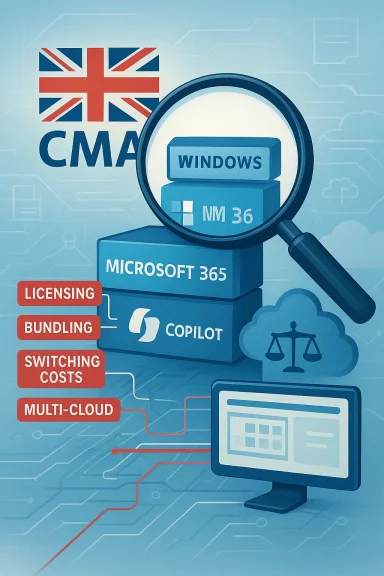
Microsoft’s latest UK antitrust problem is not that regulators are widening their cloud review, but that they are zeroing in on the business software layer that feeds the cloud stack beneath it. The Competition and Markets Authority has now moved toward a strategic market status investigation into Microsoft’s business software ecosystem, a shift that appears designed to tackle cloud licensing and bundling issues through a narrower but more actionable lens. That change matters because the CMA has already spent more than two years studying the cloud market and concluded that competition is not working well enough; now it is choosing the path most likely to produce remedies rather than another broad diagnostic report.
The UK cloud probe did not begin with Microsoft alone, but Microsoft quickly became one of its central targets. The CMA’s cloud-services market investigation grew out of earlier Ofcom work and focused on the structure of the public-cloud market, where Microsoft Azure and Amazon Web Services dominate spending and where switching costs, egress fees and software licensing practices have long troubled customers and rivals. By July 2025, the CMA’s final decision had landed on a familiar but still forceful conclusion: competition in UK cloud services was not functioning as well as it should.
That final decision was notable not because it produced immediate remedies, but because it pushed the CMA toward a more modern set of powers under the Digital Markets, Competition and Consumers Act 2024. Rather than trying to fix cloud competition with a single market-investigation remedy package, the regulator recommended strategic market status investigations into the largest providers. The logic was simple: if the market is structurally tilted, the CMA’s digital-markets toolkit may be more effective than a conventional competition review.
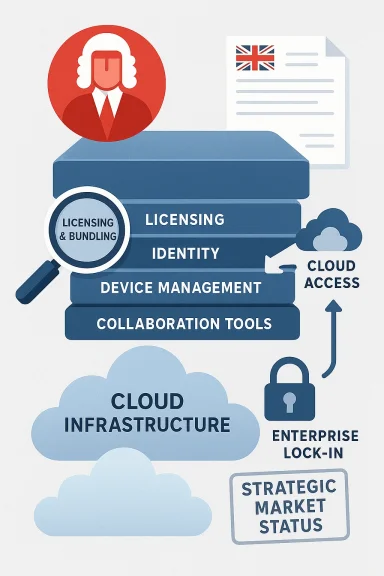
Microsoft’s role has always been broader than a single cloud product. The company’s software stack spans productivity software, identity services, device management, collaboration tools, developer tooling and cloud infrastructure. That gives it unusual leverage because a business can buy software from Microsoft, authenticate users through Microsoft, manage devices through Microsoft and then deploy workloads on Azure. In practice, the cloud market is not just about infrastructure capacity; it is also about how software licensing and ecosystem design shape where customers feel they are allowed to run their workloads.
The new investigation track reflects a regulatory realization that cloud scrutiny alone may be too blunt. If the real leverage point is business software licensing, then the cloud inquiry needs to flow through that gateway. That is why the CMA’s reported decision to narrow its focus looks less like a retreat and more like a tactical recalibration. It is a shift from surveying the whole battlefield to targeting the terrain where Microsoft’s power is most likely to distort downstream competition.
This matters because cloud competition rarely fails in just one place. Sometimes the headline price of compute looks competitive, but the surrounding ecosystem makes migration costly. Customers can face higher charges, more restrictions or more operational friction when they try to run Microsoft software on a non-Microsoft cloud. The CMA’s past work suggested that those frictions were not incidental; they were part of the market structure it was trying to address.
The practical significance is easy to miss unless you run enterprise IT at scale. A software license that seems minor in isolation can become decisive when multiplied across thousands of users, workloads and compliance obligations. In that setting, small pricing asymmetries can alter architecture decisions, cloud-provider selection and long-term migration plans. The CMA’s focus suggests it sees exactly that kind of cumulative effect.
Key implications include:
This is also more politically durable. A broad cloud-market remedy package could be contested as overreach or as too difficult to administer across many providers. A targeted Microsoft SMS investigation, by contrast, can be framed as a focused response to identifiable conduct with measurable effects. That makes the process more likely to survive both legal challenge and industry pushback.
In regulatory terms, that means the most important outcome may not be a formal finding of wrongdoing. It may be the opening of a legal pathway that lets the CMA impose guardrails on how Microsoft packages, prices and interoperates across its ecosystem. For a company with such a sprawling enterprise footprint, that is potentially more consequential than a one-off fine.
The MLex description is especially revealing in suggesting that regulators expect “noise” over AI’s role in the cloud ecosystem and the UK economy. That is not surprising. AI workloads intensify demand for compute, storage, data transfer and enterprise integration, which makes the cloud provider question more strategic than ever. In that context, a business-software probe is not just about licensing; it is about who gets to shape the next generation of digital infrastructure.
It also makes regulator behavior more urgent. If AI-related enterprise adoption becomes tightly bound to one ecosystem, the downside is not just higher costs. It can mean less portability, less bargaining power and fewer chances for smaller providers to compete on merit. The CMA appears to be testing whether Microsoft’s ecosystem is becoming one of those bottlenecks.
That is why the CMA repeatedly links this work to productivity and value for money across the private and public sector. The regulator’s concern is not simply that Microsoft is dominant. It is that dominance in software can spill over into cloud, and that cloud can in turn shape overall enterprise costs, resilience and innovation capacity. Those effects accumulate quietly over years, which is why competition agencies are often slower than technology markets themselves.
At a practical level, enterprise buyers should expect more attention to:
That distinction matters because it may influence future remedies. AWS’s issues are likely to revolve more around cloud market concentration, while Microsoft’s may revolve around whether enterprise software terms improperly steer demand toward Azure or disadvantage rival clouds. If so, the regulator may end up writing two different competition narratives for two cloud giants operating in the same market.
But the regulatory map is also more complicated than simply “help the underdogs.” If the CMA intervenes too aggressively, it could create uncertainty about legitimate bundling, security integration and product support. That is why the regulator’s targeted approach matters: it suggests an attempt to separate harmful lock-in from ordinary product integration.
That framing is important because cloud infrastructure is now seen as national economic plumbing. If the software ecosystem controlling cloud usage is distorted, the effects are not confined to a single corporate balance sheet. They spread through startups, government IT contracts, public procurement, AI adoption and the broader cost structure of digital transformation. That is why this investigation has the potential to become one of the CMA’s most consequential digital-markets tests.
That sequence is not accidental. It reflects a regulator trying to build precedent, credibility and procedural discipline around a brand-new regime. The Microsoft probe will therefore be watched not just for what it says about cloud licensing, but for how the CMA operationalizes its broader digital-markets powers.
Expect the debate to intensify around AI, too. The UK’s regulatory community is increasingly aware that control over enterprise software and cloud infrastructure may become a proxy battle for influence over AI distribution and commercial adoption. If Microsoft’s ecosystem is found to create friction for rival cloud use, the implications will extend well beyond cloud procurement and into the architecture of the AI economy itself.
Source: MLex Microsoft software probe sees UK competition regulator narrow its cloud scrutiny | MLex | Specialist news and analysis on legal risk and regulation
 Background
The UK cloud probe did not begin with Microsoft alone, but Microsoft quickly became one of its central targets. The CMA’s cloud-services market investigation grew out of earlier Ofcom work and focused on the structure of the public-cloud market, where Microsoft Azure and Amazon Web Services dominate spending and where switching costs, egress fees and software licensing practices have long troubled customers and rivals. By July 2025, the CMA’s final decision had landed on a familiar but still forceful conclusion: competition in UK cloud services was not functioning as well as it should.That final decision was notable not because it produced immediate remedies, but because it pushed the CMA toward a more modern set of powers under the Digital Markets, Competition and Consumers Act 2024. Rather than trying to fix cloud competition with a single market-investigation remedy package, the regulator recommended strategic market status investigations into the largest providers. The logic was simple: if the market is structurally tilted, the CMA’s digital-markets toolkit may be more effective than a conventional competition review.
Microsoft’s role has always been broader than a single cloud product. The company’s software stack spans productivity software, identity services, device management, collaboration tools, developer tooling and cloud infrastructure. That gives it unusual leverage because a business can buy software from Microsoft, authenticate users through Microsoft, manage devices through Microsoft and then deploy workloads on Azure. In practice, the cloud market is not just about infrastructure capacity; it is also about how software licensing and ecosystem design shape where customers feel they are allowed to run their workloads.
The new investigation track reflects a regulatory realization that cloud scrutiny alone may be too blunt. If the real leverage point is business software licensing, then the cloud inquiry needs to flow through that gateway. That is why the CMA’s reported decision to narrow its focus looks less like a retreat and more like a tactical recalibration. It is a shift from surveying the whole battlefield to targeting the terrain where Microsoft’s power is most likely to distort downstream competition.
Why the timeline matters
The timing is especially important because the CMA’s new regime only came into force in 2025, and the regulator has been building a portfolio of designated digital giants. Google has already been confirmed with strategic market status in search services, and Apple and Google were both designated in mobile platforms after separate SMS investigations. That gives the CMA a practical blueprint for how a Microsoft probe could unfold: designate first, then consult on conduct requirements and pro-competition interventions later.Why Microsoft’s business software matters more than the cloud label
The phrase “business software ecosystem” sounds broader, and that is the point. Microsoft is not merely being examined as a cloud vendor; it is being examined as a platform owner whose software choices can tilt customer behavior toward or away from Azure and away from competing clouds. That ecosystem includes licensing terms, interoperability choices and product packaging decisions that may make rival clouds more expensive or less attractive to use.This matters because cloud competition rarely fails in just one place. Sometimes the headline price of compute looks competitive, but the surrounding ecosystem makes migration costly. Customers can face higher charges, more restrictions or more operational friction when they try to run Microsoft software on a non-Microsoft cloud. The CMA’s past work suggested that those frictions were not incidental; they were part of the market structure it was trying to address.
Licensing as leverage
Microsoft’s licensing practices have been the central recurring complaint. Rival providers and customers have argued that Microsoft makes it less attractive to use Microsoft software on competing infrastructure than on Azure, creating an artificial advantage for its own cloud. That is a classic competition-law concern: not just that a firm is big, but that its commercial terms shape the terms of rivalry itself.The practical significance is easy to miss unless you run enterprise IT at scale. A software license that seems minor in isolation can become decisive when multiplied across thousands of users, workloads and compliance obligations. In that setting, small pricing asymmetries can alter architecture decisions, cloud-provider selection and long-term migration plans. The CMA’s focus suggests it sees exactly that kind of cumulative effect.
Key implications include:
- Licensing terms can function like a hidden switching cost.
- Bundled software ecosystems can make a rival cloud less usable.
- Enterprise procurement teams may face fewer genuine choices than price sheets suggest.
- Public-sector buyers may be especially exposed because of legacy Microsoft dependence.
- Regulatory scrutiny can now target conduct, not just market concentration.
The CMA’s narrower lens is also a stronger enforcement lens
The move from a market investigation to a strategic-market-status probe is not just procedural. It changes the regulator’s posture from diagnosing structural issues to potentially imposing targeted obligations on a designated firm. That is why the new cloud scrutiny looks narrower even as it becomes more intense. The CMA is effectively saying it already knows where the problem lives; now it wants the legal tools to operate on that exact point.This is also more politically durable. A broad cloud-market remedy package could be contested as overreach or as too difficult to administer across many providers. A targeted Microsoft SMS investigation, by contrast, can be framed as a focused response to identifiable conduct with measurable effects. That makes the process more likely to survive both legal challenge and industry pushback.
From market study to conduct regulation
The CMA’s own material shows a transition in policy architecture. Its cloud investigation concluded with a recommendation to use digital-markets powers, and the regulator said in June 2025 that it expected the board to consider further designation options in early 2026. That is exactly the kind of sequencing that would lead to a business-software probe as a precursor to conduct rules on licensing or interoperability.In regulatory terms, that means the most important outcome may not be a formal finding of wrongdoing. It may be the opening of a legal pathway that lets the CMA impose guardrails on how Microsoft packages, prices and interoperates across its ecosystem. For a company with such a sprawling enterprise footprint, that is potentially more consequential than a one-off fine.
AI is now part of the cloud competition story
It would be a mistake to read this as an old-fashioned licensing case with some cloud jargon attached. AI has become a central reason regulators are paying closer attention to the cloud stack, because modern AI services sit on top of cloud infrastructure, enterprise software, identity systems and developer tools all at once. If Microsoft’s ecosystem controls access to that stack, then AI competition can be affected indirectly even before a model is trained or a chatbot is launched.The MLex description is especially revealing in suggesting that regulators expect “noise” over AI’s role in the cloud ecosystem and the UK economy. That is not surprising. AI workloads intensify demand for compute, storage, data transfer and enterprise integration, which makes the cloud provider question more strategic than ever. In that context, a business-software probe is not just about licensing; it is about who gets to shape the next generation of digital infrastructure.
Why AI amplifies cloud power
AI increases the value of platform integration. A vendor that already controls productivity tools, identity, hosting and developer tooling can more easily package AI features into daily workflows, and customers may find it difficult to disentangle one layer from another. That creates a networked advantage that is harder to unwind than a simple market-share problem.It also makes regulator behavior more urgent. If AI-related enterprise adoption becomes tightly bound to one ecosystem, the downside is not just higher costs. It can mean less portability, less bargaining power and fewer chances for smaller providers to compete on merit. The CMA appears to be testing whether Microsoft’s ecosystem is becoming one of those bottlenecks.
Enterprise customers are the real audience of this probe
For consumers, this is an abstract competition case about technology giants and market structure. For enterprises, it is much more concrete. UK businesses often build their IT estates around Microsoft identities, Microsoft licensing, Microsoft endpoint management and Microsoft collaboration tools; if those decisions lock them into a preferred cloud path, then procurement flexibility is already compromised before cloud negotiations begin.That is why the CMA repeatedly links this work to productivity and value for money across the private and public sector. The regulator’s concern is not simply that Microsoft is dominant. It is that dominance in software can spill over into cloud, and that cloud can in turn shape overall enterprise costs, resilience and innovation capacity. Those effects accumulate quietly over years, which is why competition agencies are often slower than technology markets themselves.
Enterprise pain points to watch
The most likely flashpoints are not flashy consumer issues but dull, expensive ones. Licensing discounts, migration penalties, identity dependencies and cross-platform support terms are the kind of issues that can trap an IT department even when no one individual contract looks abusive. The CMA’s narrowed scrutiny suggests that these small frictions are exactly what it wants to test.At a practical level, enterprise buyers should expect more attention to:
- Hybrid-cloud portability
- Licensing parity across clouds
- Identity and management interoperability
- Discount structures tied to bundled commitments
- Migration costs and exit friction
- Procurement transparency in public and private sectors
The competitive consequences for AWS and Google are not symmetrical
A Microsoft-focused probe does not automatically mean AWS escapes scrutiny in a broader sense, but it does suggest the CMA believes Microsoft’s software ecosystem creates a distinct kind of competitive issue. AWS has been part of the cloud investigation and remains relevant to the market’s concentration, yet Microsoft’s leverage comes from a different source: software ownership that touches the operating environment itself.That distinction matters because it may influence future remedies. AWS’s issues are likely to revolve more around cloud market concentration, while Microsoft’s may revolve around whether enterprise software terms improperly steer demand toward Azure or disadvantage rival clouds. If so, the regulator may end up writing two different competition narratives for two cloud giants operating in the same market.
A more precise remedy map
For rivals, the upside is obvious: clearer rules could reduce the burden of competing against a vertically integrated incumbent. If Microsoft cannot use software licensing to tilt cloud demand, the market could become more contestable and pricing pressure could improve. That would be especially helpful for smaller infrastructure providers and managed-service vendors trying to win enterprise workloads.But the regulatory map is also more complicated than simply “help the underdogs.” If the CMA intervenes too aggressively, it could create uncertainty about legitimate bundling, security integration and product support. That is why the regulator’s targeted approach matters: it suggests an attempt to separate harmful lock-in from ordinary product integration.
The political economy of the probe is just as important as the law
The UK government has made growth, investment and productivity central to its industrial agenda, and the CMA has been operating under a stronger political expectation that competition enforcement should support economic dynamism. That does not mean regulators will go easy on Microsoft; it means they will likely try to frame interventions as pro-growth rather than anti-business.That framing is important because cloud infrastructure is now seen as national economic plumbing. If the software ecosystem controlling cloud usage is distorted, the effects are not confined to a single corporate balance sheet. They spread through startups, government IT contracts, public procurement, AI adoption and the broader cost structure of digital transformation. That is why this investigation has the potential to become one of the CMA’s most consequential digital-markets tests.
A regulator learning to use its new tools
The CMA’s recent actions show a pattern. It has designated Google with SMS in search, designated Apple and Google in mobile platforms, and used consultation-heavy roadmaps to explain how interventions might follow. Microsoft now appears to be next in line, but in a different domain where the conduct concerns are less about apps and more about enterprise software economics.That sequence is not accidental. It reflects a regulator trying to build precedent, credibility and procedural discipline around a brand-new regime. The Microsoft probe will therefore be watched not just for what it says about cloud licensing, but for how the CMA operationalizes its broader digital-markets powers.
Strengths and Opportunities
The strongest argument for the CMA’s narrower Microsoft scrutiny is that it aligns regulatory effort with the market’s actual bottleneck. If software licensing is the lever that distorts cloud competition, then targeting that lever is more efficient than pursuing a generic cloud fix. That is why the investigation could produce remedies with more real-world impact than a broader but fuzzier inquiry. The chance to improve portability, lower switching costs and strengthen buyer leverage is significant.- More precise enforcement than a broad market study
- Potential relief for enterprise customers facing hidden lock-in
- Better cloud portability if licensing parity improves
- Stronger competition for rival infrastructure providers
- Clearer rules for software-cloud bundling
- A useful precedent for the CMA’s digital-markets regime
- Possible benefits for AI competition through less ecosystem friction
Risks and Concerns
The biggest risk is that the probe overshoots and treats integration itself as anti-competitive. Microsoft’s ecosystem is powerful partly because it is deeply connected, and some of that integration delivers real security, manageability and user-value benefits. If the CMA draws the line too broadly, it could chill legitimate product design or create compliance complexity that hurts customers as much as incumbents. The challenge will be distinguishing harmful lock-in from ordinary platform coherence.- Overbroad remedies could disrupt legitimate bundling
- Legal challenge may slow or narrow any interventions
- Uncertainty for enterprise procurement during the probe
- Compliance burden for Microsoft and possibly partners
- Risk of unintended effects on security and interoperability
- Potential duplication with EU or other international actions
- Regulatory fatigue if multiple overlapping probes emerge
Looking Ahead
The next phase will likely determine whether this becomes a landmark conduct case or just another expensive investigation. Much will depend on whether the CMA can translate its cloud findings into concrete questions about Microsoft’s business software terms, rather than drifting into a generalized critique of size and success. If it succeeds, the case could reshape how licensing, interoperability and cloud access are governed in the UK for years to come.Expect the debate to intensify around AI, too. The UK’s regulatory community is increasingly aware that control over enterprise software and cloud infrastructure may become a proxy battle for influence over AI distribution and commercial adoption. If Microsoft’s ecosystem is found to create friction for rival cloud use, the implications will extend well beyond cloud procurement and into the architecture of the AI economy itself.
- The SMS investigation launch date and scope definition
- Whether licensing is formally singled out as a competition concern
- Any consultation on conduct requirements or pro-competition interventions
- Responses from enterprise customers and cloud rivals
- Signs of coordination or contrast with EU and US antitrust thinking
Source: MLex Microsoft software probe sees UK competition regulator narrow its cloud scrutiny | MLex | Specialist news and analysis on legal risk and regulation