

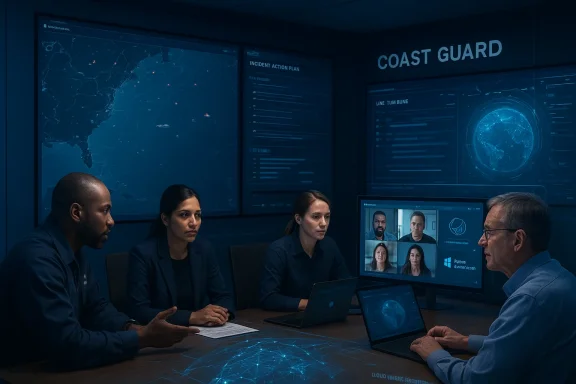
The U.S. Coast Guard has formally chosen PRATUS® as its enterprise incident management platform, a decision that signals a major step in the Service’s Force Design 2028 modernization strategy and reshapes how the Coast Guard will coordinate large-scale events and multi-jurisdictional responses. The cloud-native, Microsoft 365–integrated platform will enter service with an Initial Operational Capability (IOC) posture to support the FIFA World Cup 2026™ and other high-profile national events, replacing the legacy Incident Management Software System (IMSS) and promising a single, unified workspace for Incident Action Plan (IAP) development, geospatial situational awareness, and cross-agency coordination.
The Coast Guard’s modernization drive under Force Design 2028 emphasizes speed, agility, and technology-enabled decision advantage. As the Service reorganizes command structures and invests in program executive offices and rapid prototyping, one recurring operational gap has been enterprise-grade incident coordination software that scales across routine, regional, and national responses.
For more than a decade, the Coast Guard relied on IMSS and interim solutions while it explored a long-term replacement. IMSS was formally discontinued as the primary tool when its contract expired in spring 2024, triggering interim measures and local workarounds for Incident Action Plan production. PRATUS has now been selected to fill that role through a phased, operator-informed fielding process that begins with IOC for summer 2026 national events and proceeds toward Full Operational Capability (FOC) as the platform is refined against real-world operational feedback.
Key capabilities highlighted by the platform include:
First, the Coast Guard already operates in a Microsoft-heavy enterprise environment. Leveraging Teams and SharePoint as the user interface lowers the training and adoption barrier by meeting many users where they already work. Native integrations reduce friction in document management, chat-driven coordination, and identity management through existing tenant and directory constructs.
Second, Azure Government provides the compliance and operational posture federal agencies expect: a dedicated, U.S.-siloed cloud with FedRAMP and DoD-relevant accreditations that are designed to support federal authorization processes. Running on Azure Government helps a vendor demonstrate that its platform can meet baseline federal security requirements and makes the path to Agency Authority to Operate (ATO) more tractable than using a commercial, multi-tenant public cloud without those guarantees.
Third, market and procurement realities matter. PRATUS is available through Microsoft commercial channels and government contract vehicles, which helps accelerate acquisition and distribution to units that need a standardized platform quickly for 2026 events.
Planning: PRATUS promises faster IAP production by providing structured templates, versioning, and role-specific editing. For planners, that reduces administrative friction and shortens the time from detection to operationalized plans.
Execution: Integrated situational awareness—maps, asset tracking, and time-stamped decisions—aims to give commanders a shared understanding of the operational space. When multiple jurisdictions and partner agencies are involved, a single shared COP reduces miscommunication risks and the latency of critical updates.
Learning: Exercise management and automated after-action reporting mean lessons captured in training can flow into live operations, and vice versa. This reduces the historic gap between tabletop exercises and how actual events unfold.
These changes are not just incremental; they alter how the Coast Guard can scale a response, hand off responsibilities, and document decision timelines—capabilities that matter during events with high public safety stakes and complex logistics.
Dependency on a single commercial vendor and cloud stack
But operational AI requires three concrete controls:
At the same time, this is a cautionary moment for the broader homeland security and emergency management community. Modern disaster and event management solutions can deliver major efficiency gains, but they also concentrate risk if vendor, cloud, or integration assumptions are left unexamined. The Coast Guard’s phased, operator-informed approach is the right way to balance innovation with operational assurance; success will depend on disciplined governance, robust training, and honest stress-testing.
Yet capability gains are not automatic. The Coast Guard must pair PRATUS’ technical promise with rigorous security controls, explicit AI governance, clear data ownership rules, and resilient continuity plans. If those pieces come together, PRATUS can be a durable enabler of Force Design 2028’s objectives: faster decisions, better integration, and a more ready, capable Coast Guard.
Source: StreetInsider PRATUS® Selected as Official Incident Management Platform for the U.S. Coast Guard
 Background
The Coast Guard’s modernization drive under Force Design 2028 emphasizes speed, agility, and technology-enabled decision advantage. As the Service reorganizes command structures and invests in program executive offices and rapid prototyping, one recurring operational gap has been enterprise-grade incident coordination software that scales across routine, regional, and national responses.For more than a decade, the Coast Guard relied on IMSS and interim solutions while it explored a long-term replacement. IMSS was formally discontinued as the primary tool when its contract expired in spring 2024, triggering interim measures and local workarounds for Incident Action Plan production. PRATUS has now been selected to fill that role through a phased, operator-informed fielding process that begins with IOC for summer 2026 national events and proceeds toward Full Operational Capability (FOC) as the platform is refined against real-world operational feedback.
What PRATUS Brings to the Table
PRATUS is a cloud-first incident management platform built to run on Microsoft Azure Government and integrated deeply with the Microsoft 365 ecosystem, including Microsoft Teams and SharePoint. The product suite advertises a converged “One Pane of Glass®” approach that brings together collaboration, planning, geospatial mapping, resource tracking, and after-action tools in an environment that mirrors operational structures used by emergency managers and incident commanders.Key capabilities highlighted by the platform include:
- Rapid Incident Action Plan (IAP) development aligned with NIMS/ICS formats.
- Role-based incident workspaces mapped to ICS functions (Command, Operations, Planning, Logistics, Finance/Administration).
- Integrated geospatial visualization to provide a shared common operating picture using GIS mapping tools.
- Secure multi-jurisdictional collaboration via Microsoft Teams and tenant-sharing mechanisms.
- Exercise and training management to close the gap between drills and operations.
- AI-augmented decision support and automation to speed routine tasks and surface relevant data.
Why the Coast Guard Chose a Microsoft-Centric Architecture
There are practical and strategic reasons behind selecting a Microsoft 365–native platform built on Azure Government.First, the Coast Guard already operates in a Microsoft-heavy enterprise environment. Leveraging Teams and SharePoint as the user interface lowers the training and adoption barrier by meeting many users where they already work. Native integrations reduce friction in document management, chat-driven coordination, and identity management through existing tenant and directory constructs.
Second, Azure Government provides the compliance and operational posture federal agencies expect: a dedicated, U.S.-siloed cloud with FedRAMP and DoD-relevant accreditations that are designed to support federal authorization processes. Running on Azure Government helps a vendor demonstrate that its platform can meet baseline federal security requirements and makes the path to Agency Authority to Operate (ATO) more tractable than using a commercial, multi-tenant public cloud without those guarantees.
Third, market and procurement realities matter. PRATUS is available through Microsoft commercial channels and government contract vehicles, which helps accelerate acquisition and distribution to units that need a standardized platform quickly for 2026 events.
Operational Implications for Incident Command
Moving from IMSS (and various interim Team-based processes) to a unified commercial product set will change daily operations across three major axes: planning, execution, and learning.Planning: PRATUS promises faster IAP production by providing structured templates, versioning, and role-specific editing. For planners, that reduces administrative friction and shortens the time from detection to operationalized plans.
Execution: Integrated situational awareness—maps, asset tracking, and time-stamped decisions—aims to give commanders a shared understanding of the operational space. When multiple jurisdictions and partner agencies are involved, a single shared COP reduces miscommunication risks and the latency of critical updates.
Learning: Exercise management and automated after-action reporting mean lessons captured in training can flow into live operations, and vice versa. This reduces the historic gap between tabletop exercises and how actual events unfold.
These changes are not just incremental; they alter how the Coast Guard can scale a response, hand off responsibilities, and document decision timelines—capabilities that matter during events with high public safety stakes and complex logistics.
Strengths: What Looks Promising
- Operator-informed, phased fielding. The Coast Guard is implementing PRATUS through an operator-informed rollout that begins with IOC for major events. That approach—measured, iterative, and feedback-driven—reduces risk from day one and embeds end-users into the development lifecycle.
- Enterprise alignment with existing tooling. Tight integration with Microsoft Teams and Microsoft 365 reduces training overhead and makes the product feel like part of the Service’s established digital ecosystem. That lowers the adoption barrier at the tactical edge.
- Scalable cloud infrastructure. Azure Government provides a platform engineered for federal use, including compliance artifacts and specialized support. For mission-critical uptime and disaster recovery planning, that can be materially superior to ad hoc, on-prem solutions.
- GIS-enabled situational awareness. Bringing geospatial displays into the same workspace where plans are authored and tasks are assigned helps maintain a single, authoritative operating picture—particularly valuable for maritime incidents where location, tides, and asset transit times are vital.
- Lifecycle focus—prepare, respond, review. PRATUS’ combined focus on training, live operations, and after-action management promises to turn exercises into operationally useful inputs and accelerate institutional learning.
Risks and Caveats: Where Questions Remain
No platform, however feature-rich, eliminates operational, security, or programmatic risk. The Coast Guard and partner agencies must confront several real concerns during fielding and at scale.Dependency on a single commercial vendor and cloud stack
- Adopting a single-vendor, cloud-native ecosystem increases dependency on the vendor’s road map, support model, and business continuity. If PRATUS or key third-party dependencies (for example, a geospatial provider) experience outages, the Service needs robust failovers and well-tested continuity procedures.
- The platform’s reliance on Microsoft tenant-sharing and cross-tenant Teams collaboration raises complex questions about identity federation, access scoping, and partner onboarding. Interagency responses often require temporary, finely controlled access for non-Coast Guard users. Those controls must be explicit, auditable, and rapidly revocable.
- Incident records, IAPs, and decision logs are mission-critical artifacts and sometimes legal evidence. The Coast Guard must ensure that data retention policies, archiving, and export mechanisms meet regulatory and investigative requirements—especially when migrating data from IMSS archives or local files into the new system.
- PRATUS advertises AI-driven decision support and chat agents. While AI can accelerate routine drafting and data synthesis, the platform must implement guardrails: provenance for AI-suggested content, conservative defaults for machine-generated outputs in operational products, and clear human-in-the-loop checkpoints for mission-critical decisions. Over-reliance on model outputs without verification can introduce risk in time-sensitive scenarios.
- Commercial software brings supply-chain complexity. The Coast Guard must ensure software bill of materials, third-party dependency auditing, and secure development lifecycle practices are in place and continuously monitored for vulnerabilities.
- IMSS and other legacy repositories contain archived cases and institutional memory. Ensuring those archives are accessible, searchable, and contextually integrated into PRATUS will be essential to bridging historical lessons and maintaining legal/regulatory continuity.
- Maritime operations often occur in denied, degraded, or disconnected environments. The platform’s offline capabilities or edge synchronization strategies must be explicit and tested; otherwise, teams risk losing access to critical plans when networks fail.
Security and Compliance: What to Watch For
Azure Government and Microsoft 365 provide the scaffolding for federal compliance, but vendor-level security practices remain the differentiator in mission assurance.- Authorization posture: An enterprise platform must secure an Agency ATO or equivalent authorization, with explicit boundary definitions, data flow diagrams, and system security plans. CIO-level engagement in the ATO process accelerates the path to enterprise-wide acceptance.
- Least privilege and role decomposition: PRATUS’ role-based workspaces must translate directly into enforceable least-privilege policies. Default configurations should favor conservative access, and system administrators should have granular audit trails to trace access changes.
- Auditability and forensics: Time-stamped decisions, file edits, and chat logs are invaluable during investigations. The system must support detailed, immutable audit logs and integrate with the Coast Guard’s security information and event management (SIEM) processes.
- Data residency and handling: Azure Government reduces cross-border exposure, but the Coast Guard must define what constitutes controlled unclassified information versus higher sensitivity categories and enforce handling policies accordingly.
- Red-team and supply-chain assessment: Regular third-party testing, SBOM review, and penetration testing should be part of the acceptance criteria before broad deployments.
AI in Incident Management: Opportunity and Responsibility
PRATUS’ AI features promise speed and a new layer of decision support—synthesizing weather feeds, resource status, and historical lessons in seconds. That capability is compelling for incident commanders facing information overload.But operational AI requires three concrete controls:
- Provenance and explainability. Every AI suggestion used in an IAP or decision product must include provenance—what data fed the inference and why it was surfaced.
- Clear human-in-the-loop policies. No AI output should be permitted to drive an action without an explicitly identified human approver; roles and thresholds for automation must be documented.
- Model governance and update cadence. The Coast Guard must control model retraining, dataset inclusion, and the cadence of updates to avoid unvetted behavior introduced by opaque model changes.
Integration Priorities and Systems of Record
For PRATUS to be effective across the Coast Guard enterprise, it must interoperate with both internal and external systems of record. Key integration priorities include:- Operational databases (e.g., Marine Information for Safety and Law Enforcement systems) to link case metadata and incident history.
- Geospatial systems for ephemeral data such as weather, tides, and AIS tracks; tight coupling with authoritative GIS sources ensures map overlays remain accurate.
- Resource and logistics databases to allow real-time status of cutters, aircraft, and support assets.
- Public reporting channels and NRC/IRIS for environmental and pollution reporting that may initiate or augment Coast Guard incidents.
- After-action and training repositories to close the loop between exercises and operational lessons learned.
Training and Cultural Change Management
Any technical transition of this scale succeeds or fails at the user level. Three human factors will determine PRATUS’ impact:- User-centered training. Short, scenario-based training modules that map the platform to real operational workflows will accelerate adoption. Training must be role-tailored—what a watchstander needs differs substantially from a planning chief or legal officer.
- Playbooks and SOP alignment. Existing Standard Operating Procedures and Incident Command System documents must be updated to reflect system-enabled workflows. Where PRATUS automates or changes a procedure, the SOP must be revised to match.
- Exercise-driven validation. Real-world confidence grows through repetition. The Coast Guard should incorporate PRATUS into a planned exercise cadence well before FOC, stress-testing interagency access, offline modes, and escalation paths.
Procurement, Sustainment, and Vendor Management
Procurement strategy will shape sustainment realities. The Coast Guard should ensure:- Clear performance metrics and SLAs in the contract that cover uptime, data exportability, and incident response for vendor support.
- Capability delivery schedules tied to IOC and FOC milestones, with acceptance tests conducted jointly with operational units.
- Transition and off-ramp clauses that allow migration to an alternative solution if necessary—ensuring that data ownership and portability are contractually enforced.
- Third-party assurance requirements such as SBOM delivery, vulnerability disclosure timelines, and supply chain transparency.
What Success Looks Like (and How to Measure It)
To judge the program’s effectiveness beyond “system up,” the Coast Guard should track a small set of operational and process KPIs:- Time to publish an operational IAP from initial notification (minutes/hours).
- Percentage reduction in duplicated data entry across systems.
- Mean time to share authoritative situational updates with partners.
- Number of exercise-derived lessons implemented in subsequent operations.
- System availability during surge events and time-to-recover metrics for outages.
Recommendations for the Coast Guard and Partner Agencies
- Finalize an Agency Authority to Operate (ATO) with explicit boundary, data flow, and residual risk documentation.
- Institute a model governance board that reviews AI outputs, retraining cadences, and model provenance for any operational AI features.
- Mandate exportable, standardized incident artifacts to ensure legal and investigative needs are met and to preserve institutional memory.
- Require offline/edge workflows and documented failover procedures for degraded communications environments.
- Execute joint interagency exercises using PRATUS well before major events to validate cross-tenant collaboration and revocation procedures.
- Define and enforce SBOM and supply-chain transparency obligations within vendor contracts.
- Incorporate user-centered training with role-based certification for incident planners, commanders, and support staff.
The Broader Significance
Selecting PRATUS is more than a software buy; it is a tactical manifestation of the Coast Guard’s broader transformation under Force Design 2028. The choice reflects a shift toward commercially delivered, cloud-native tools that marry enterprise collaboration platforms with mission-specific overlays—accelerating the Service’s ability to scale responses, standardize planning, and leverage AI where appropriate.At the same time, this is a cautionary moment for the broader homeland security and emergency management community. Modern disaster and event management solutions can deliver major efficiency gains, but they also concentrate risk if vendor, cloud, or integration assumptions are left unexamined. The Coast Guard’s phased, operator-informed approach is the right way to balance innovation with operational assurance; success will depend on disciplined governance, robust training, and honest stress-testing.
Conclusion
PRATUS’ selection as the Coast Guard’s enterprise incident management platform marks a consequential step in operational modernization—one that aligns technology, doctrine, and organizational priorities. The platform’s Microsoft 365 integration, Azure Government backing, geospatial capabilities, and emphasis on operator feedback create a plausible path to faster planning cycles, better situational awareness, and stronger interagency coordination, especially for national-scale events in 2026.Yet capability gains are not automatic. The Coast Guard must pair PRATUS’ technical promise with rigorous security controls, explicit AI governance, clear data ownership rules, and resilient continuity plans. If those pieces come together, PRATUS can be a durable enabler of Force Design 2028’s objectives: faster decisions, better integration, and a more ready, capable Coast Guard.
Source: StreetInsider PRATUS® Selected as Official Incident Management Platform for the U.S. Coast Guard
