

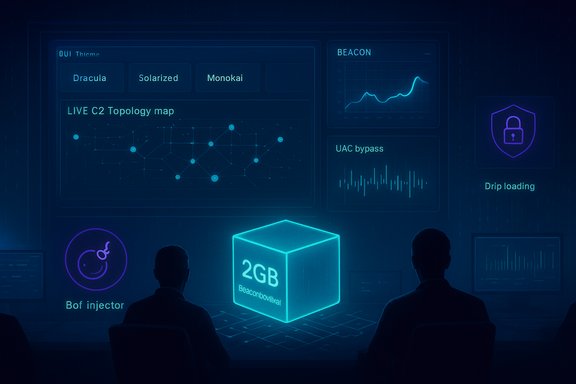
Cobalt Strike 4.12 lands as one of the most consequential updates to the commercial red‑team platform in recent memory, combining major operator‑facing convenience features — a refreshed GUI, theme support and a beta REST API — with a broad set of new offensive capabilities: a user‑defined C2 framework (UDC2), multiple novel process injection primitives, two fresh UAC bypasses, an in‑memory download API for BOFs, and “drip loading” options aimed directly at event‑correlation‑style EDR detections.
The release tightens the product’s developer surface (Java now requires Java 17), expands Beacon’s extension points for BOFs and Sleepmask usage, and explicitly prioritizes operational flexibility — a double‑edged sword for defenders that raises both legitimate red‑team productivity and the risk profile when the same techniques are picked up by abuse actors.
Overview
Cobalt Strike 4.12 is an incremental but strategically important release that addresses three broad goals: operator ergonomics, extensibility, and advanced evasion tradecraft. The official release notes detail:- A modernized GUI with theme options and updated visualizations.
- A beta REST API to script and automate Cobalt Strike workflows in any language.
- User Defined Command and Control (UDC2): a BOF‑based C2 extension model with example ICMP and TCP implementations plus a developer toolkit (UDC2‑VS).
- A process injection overhaul adding four new injection primitives (including an RtlCloneUserProcess variant inspired by DirtyVanity and thread‑pool‑based techniques derived from recent research).
- Two new UAC bypasses (uac‑rpc‑dom and uac‑cmlua) targeting modern Windows 10 → Windows 11 24H2 builds.
- A new BOF API, BeaconDownload, to download in‑memory buffers (up to 2GB) without disk writes.
- Drip loading options for both reflective loaders and process injection, introducing delays and chunked writes to evade event correlation.
- Sleepmask and pivot Beacon improvements, IPv6 SOCKS5 support, expanded BOF dynamic function resolution, and logging enhancements.
These features are described in the vendor announcement and consolidated release notes.
Background: why 4.12 matters now
Cobalt Strike has long occupied an uncomfortable position in modern enterprise security: a legitimate red‑team platform that is simultaneously a favoured tool in real‑world adversary toolkits. The vendor’s ongoing efforts to reduce cracked/distributed copies and to harden the product are part of a larger ecosystem response to that dual use, yet product innovation that lowers the barrier for red‑team operators to build custom C2 channels and stealthy loaders also lowers the barrier for abuse when those techniques leak. Fortra’s recent work on takedowns and the broader reduction of unauthorized copies provides context: legitimate product stewardship is reducing some misuse vectors, but technical features introduced for legitimate research still alter the attacker/defender balance. At the same time, industry telemetry continues to show Cobalt Strike being used alongside bespoke implants and multi‑stage loader chains in high‑value intrusions. One long‑running example is the “server‑centric” campaigns that combine custom backdoors with Cobalt Strike beacons — a reminder that new features in Cobalt Strike can have operational impact beyond the lab.What’s new — feature by feature
A modernized GUI and quality‑of‑life improvements
Cobalt Strike’s client received a cosmetic but practical update: theme support (Dracula, Solarized, Monokai, etc. and refreshed visualizations, including an updated pivot graph. These changes reduce cognitive friction for operators and make complex campaigns easier to manage during long engagements. The change may also improve onboarding for new users and accelerate iterative red‑team work.REST API (beta) — automation and integration
The new REST API unlocks programmatic control of the server and operator workflows from any scripting language. This enables:- CI/CD‑style automation of red‑team artifacts,
- integration with orchestration platforms and external tooling,
- server‑side state storage for longer lived automation,
- potential experimentability with ML/automation-driven playbooks.
User Defined Command and Control (UDC2) — BOF C2 channels
UDC2 is a major extensibility leap: Cobalt Strike payloads can now include a UDC2 BOF that proxies Beacon frames over arbitrary custom channels. The provided UDC2‑VS toolkit and an open‑sourced ICMP implementation accelerate development and testing of new egress channels. Key implications:- Operators can create native‑feel payloads for exotic egress channels (ICMP, custom tunnels).
- UDC2 avoids ExtC2’s named‑pipe relay complexities by patching BOFs into payloads at build time.
- UDC2 uses a relay server (Python example) to shuttle frames between the BOF client and the UDC2 listener.
Process injection overhaul — four new primitives
4.12 brings a packaged set of injection primitives implemented as BOFs using the process inject kit. The new techniques are intended to complicate EDR detection by avoiding canonical allocate/write/execute patterns:- RtlCloneUserProcess — a clone/fork based injection inspired by “DirtyVanity” techniques. Rather than allocating, writing, and remotely executing in a target, this approach creates a cloned process that already contains the payload context and can execute without the same sequence of primitives. Public research and write‑ups on DirtyVanity and clone/reflection approaches explain the underlying rationale and prior PoCs.
- TpDirect and TpStartRoutineStub — thread‑pool manipulation techniques derived from recent research (often described as “Pool Party” or thread‑pool abuse). These attacks insert or manipulate thread pool structures (TP_TIMER/TP_WORK etc. to achieve remote execution without traditional remote thread creation APIs, which can evade EDRs that monitor those signals. Safebreach’s thread‑pool research provides strong technical alignment with these techniques.
- EarlyCascade — a stealthy manipulation of process initialization (fork/run only) that executes code in early process start to hide activity in process creation timelines.
Two new UAC bypasses
4.12 adds two UAC bypass methods:- uac‑rpc‑dom — an AppInfo ALPC bypass linked to public UACME research.
- uac‑cmlua — an ICMLuaUtil COM interface bypass.
BeaconDownload BOF API — in‑memory exfiltration
The BeaconDownload BOF API enables BOFs to hand off in‑memory buffers to Beacon for transfer back to the operator without touching disk. The official limit is currently 2GB per in‑memory download. This removes a common IOC (temporary disk writes) from many credential‑harvesting and memory‑dump workflows, complicating forensic detection that relies on disk artifact discovery. Organizations should ensure EDR captures relevant process memory and that SIEM rules correlate in‑memory dumps with unusual outbound transfers.Drip loading — tactical evasion for loaders and injection
Drip loading introduces delays and chunked writes into reflective loading and process injection flows. By breaking up allocation/write/execute primitives into smaller, time‑staggered operations, drip loading aims to subvert EDRs that correlate sequences of API calls within tight windows. Operators can configure drip parameters in the Malleable C2 stage/process‑inject blocks. This change forces defenders to consider longer correlation windows and to develop heuristics that tolerate noise while catching low‑and‑slow injection flows.Sleepmask, pivot Beacons, and other operational improvements
Pivot Beacon sleepmasks have been unified and simplified, enabling the same evasive Sleepmask introduced in 4.11 to be used for SMB/TCP pivots. SSH Beacon fixes for newer Mac/Linux distros, expanded BOF dynamic function resolution, improved logging (task_id mapping), and IPv6 SOCKS5 support round out the release. These improvements reduce friction for complex multi‑hop engagements and improve integration with third‑party tooling.Cross‑referencing and technical verification
Key technical claims in the vendor release align with independent public research and vendor blogs:- Thread‑pool process injection approaches trace cleanly to Safebreach’s published research demonstrating how TP structures can be abused to enqueue work items that execute attacker code, with real EDR detection implications. The Cobalt Strike primitives (TpDirect, TpStartRoutineStub) mirror those research directions.
- The clone/reflect injection approach (DirtyVanity lineage) has public writeups and PoCs discussing RtlCloneUserProcess / reflection and process snapshots as an evasive primitive. Cobalt Strike’s RtlCloneUserProcess option is consistent with those documented techniques and prior conference presentations.
- The BeaconDownload API and UDC2 packaging are new vendor features; the release notes explicitly detail the 2GB cap and the UDC2 server + BOF architecture. Those claims are verifiable directly in the official 4.12 announcement and ancillary product documentation.
Caveat: specific detection‑resistance claims — e.g., “evades X vendor’s EDR” — are inherently time‑sensitive. Vendors rapidly respond to disclosed techniques; defenders should not assume permanent undetectability without direct telemetry testing in their environment. Any claim that a technique “bypasses EDR” should be treated as contextual and transient until validated against current endpoint versions and configurations.
Security and operational analysis — strengths and risks
Strengths (for red teams and legitimate testing)
- Extensibility: UDC2 and the REST API let red teams prototype and deploy custom C2 channels faster, improving fidelity for emulating advanced adversaries.
- Modularity: BOFs for injection and Sleepmask expand the “building‑blocks” approach; operators can swap primitives without rebuilding full payloads.
- Operational hygiene for testing: BeaconDownload removes disk writes for in‑memory exfil, which reduces labside contamination and simplifies clean teardown for legitimate test environments.
Risks (for defenders and enterprise security)
- Feature migration to abuse: Anything that makes it easier for red teams to create low‑noise, bespoke egress channels and in‑memory exfiltration can be repurposed by attackers. The availability of UDC2 BOF templates and an open ICMP example lowers the technical cost of deploying covert channels.
- Detection complexity: Drip loading and thread‑pool injection force defenders to rethink EDR correlation windows and expand telemetry capture beyond short‑time windows for allocation/write/execute patterns.
- Privilege escalation standardization: Shipping UAC bypasses as built‑in commands normalizes these flows and makes them easier for attackers to replicate reliably across many targets.
- Operational footprint: The REST API, if enabled without strict access controls, increases the internal attack surface for orchestration abuse or API key theft.
Practical defender implications
- EDR vendors and SOC teams must update detection logic to inspect:
- PSS/Process Snapshot / clone/reflection API usage,
- Abnormal modifications or accesses to TP_* structures,
- Long, low‑velocity memory writes consistent with drip loading,
- In‑memory transfers coupled with unusual outbound connections (UDC2 patterns).
- Network defenders should monitor for nonstandard ICMP, raw packet egress, and unusual patterns to cloud developer platforms — channels that adversaries increasingly use as dead‑drops in real intrusions. The PassiveNeuron style campaigns that mix bespoke implants and Cobalt Strike highlight these vectors.
Guidance for blue teams — pragmatic detection and mitigation
- Harden telemetry capture
- Enable EDR logging that tracks uncommon API calls (process snapshot/reflection, duplication of handles, TP manipulation).
- Collect and centralize Sysmon events for CreateRemoteThread, WriteProcessMemory, ImageLoaded, and advanced memory‑related events.
- Extend correlation windows and anomaly thresholds
- Tune detection rules to catch low‑and‑slow write patterns (drip loading) and to correlate process creation, memory allocation, and outbound connections over longer windows.
- Block and monitor exotic egress
- Apply contextual egress controls; block or closely monitor ICMP tunnelers, raw outbound packet flows, and unexpected requests to developer raw‑blob endpoints.
- Lock down the environment
- Restrict the use of local admin and service accounts; enforce least privilege. Harden LSA and protect LSASS memory with PPL where possible.
- Enforce allow‑listing for tools that can create or manipulate processes at scale.
- Treat in‑memory exfil as real
- Because tools like BeaconDownload remove disk artifacts, forensics must include volatile memory capture and EDR memory scanning to detect credential harvesting and memory dumps in progress.
- Operational controls for enterprise Cobalt Strike
- If running Cobalt Strike for legitimate red‑team work, treat the infrastructure like production: limit network reachability, apply strong API key management for the REST API, and separate test infrastructure from business systems.
What defenders should test now
- Validate your EDR/EDR‑like controls against proof‑of‑concept thread‑pool abuse and clone/reflection techniques in a controlled testbed. Public research and demo code exist for both thread‑pool and clone approaches; use them to validate detection efficacy.
- Simulate drip loading and measure whether your correlation rules pick up the attack chain.
- Hunt for server hosts making odd requests to public raw‑blob services (GitHub/raw developer endpoints) and for oversized or padded DLLs placed in system directories — a hallmark of multi‑stage loader campaigns observed in real intrusions.
Unverifiable or time‑sensitive claims — flagged
- Any claim of permanent EDR bypass is time‑sensitive. EDR vendors iterate rapidly; a technique that evaded detection at disclosure may be detectable after vendor updates. Treat “bypass” claims as testing prompts, not as static truths.
- The operational effectiveness of the UAC bypasses across every enterprise configuration is not absolute; differences in Windows builds, applied mitigations, and security products will change results. Verification is required in lab environments that match production baselines before assuming reliability.
Final analysis — balancing red‑team utility and defensive risk
Cobalt Strike 4.12 is a pragmatic, operator‑centric release that significantly lowers friction for custom C2 development and advanced injection tradecraft. The vendor has packaged techniques that previously lived in research papers and PoCs into out‑of‑the‑box BOFs and templates. For legitimate red teams, this reduces development time and increases the realism of adversary simulations. For defenders, the release is a reminder that publicly available research rapidly becomes commoditized and then productized.The right defensive response is twofold: (1) immediate operational hardening and telemetry improvements that anticipate the new TTPs (thread‑pool abuse, clone/reflection, drip loading, in‑memory exfil), and (2) organizational controls around offensive tooling (segregated infrastructure, strict access controls for any REST APIs, and careful stewardship of red‑team booter kits). The combined effect of these measures will blunt the operational advantage such capabilities provide to malicious actors while preserving legitimate security testing workflows.
Cobalt Strike 4.12 expands the offensive toolkit and compresses the timeline from research to fieldable capability. That is valuable for improving defensive testing — but it also raises the stakes for defenders, who must treat the new primitives as likely to appear in real attacks and adapt detection and incident response accordingly.
Conclusion
Cobalt Strike 4.12 is a consequential release: modern UI and automation meet substantive advances in injection and C2 extensibility. The platform’s new features — UDC2, BeaconDownload, drip loading, REST automation, and the fresh injection primitives — materially change operator workflows and the detection landscape. Organizations that run legitimate red teams will welcome the productivity gains; defenders must move quickly to validate and update telemetry and detection logic to account for these new tradecraft patterns. The release underscores a persistent truth in enterprise security: as offensive tools and research mature, defensive telemetry and response must evolve faster.
Source: Cyber Press https://cyberpress.org/cobalt-strike-4-12-released/
