

Codebridge says it has become a Microsoft partner and launched a dedicated Azure Migration Services practice intended to speed cloud adoption for application, database, identity, and DevOps workloads — a plausible, practical offering that merits both operational interest and procurement-level scrutiny.
Cloud migration remains one of the highest‑priority projects inside enterprise IT organizations: teams want lower infrastructure cost, better scalability for AI and cloud‑native services, and simpler operations. Microsoft has invested heavily in an end‑to‑end partner ecosystem and platform tooling — notably Azure Migrate, Azure Database Migration Service (DMS), and the partner‑focused programs that package funding and deployment assistance — to turn migration from a multiyear effort into a repeatable programmatic pathway. Against that market backdrop, Codebridge’s announcement positions the company as a single‑vendor alternative for customers that need application engineering plus migration delivery. The company’s Azure Migration Services product page describes a full lifecycle service: discovery and dependency mapping, database migrations (MSSQL, PostgreSQL, MySQL, Oracle), Azure Active Directory migration, DevOps and pipeline migration, containerization and IaC scaffolding, staged cutovers to reduce downtime, and post‑migration rightsizing and support. That page explicitly highlights Microsoft‑certified Azure specialists and claims proven, low‑risk outcomes for mid‑market and enterprise customers. At the same time, independent verification of partner credentials and the fine print of delivery models matter: syndicated press releases and marketing pages can overstate or compress timelines, and automated modernization tooling — while powerful for supported workloads — carries preview‑stage caveats and governance demands. Our review combines Codebridge’s public materials with provider‑level and Microsoft partner program context, and it flags the verification steps procurement teams should require before committing mission‑critical workloads.
Codebridge’s market move to emphasize Azure migration services is consistent with the broader vendor trend: software engineering firms packaging migration and managed services to meet rising customer demand for simpler, faster cloud moves. The offering is plausible and potentially valuable — but procurement should pair vendor enthusiasm with Microsoft credential proof and a technically sound pilot before entrusting mission‑critical production migrations.
Source: WNTZ-TV FOX 48 https://www.cenlanow.com/business/p...-services-to-accelerate-cloud-transformation/
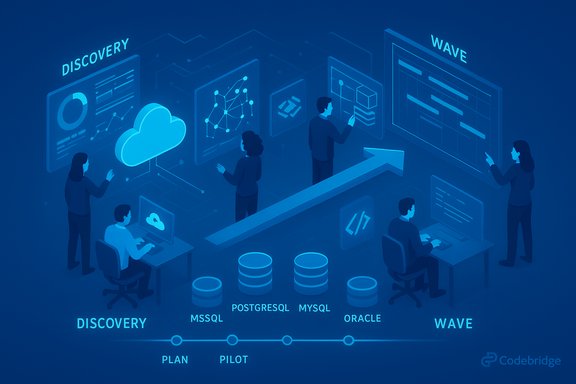 Background / Overview
Cloud migration remains one of the highest‑priority projects inside enterprise IT organizations: teams want lower infrastructure cost, better scalability for AI and cloud‑native services, and simpler operations. Microsoft has invested heavily in an end‑to‑end partner ecosystem and platform tooling — notably Azure Migrate, Azure Database Migration Service (DMS), and the partner‑focused programs that package funding and deployment assistance — to turn migration from a multiyear effort into a repeatable programmatic pathway. Against that market backdrop, Codebridge’s announcement positions the company as a single‑vendor alternative for customers that need application engineering plus migration delivery. The company’s Azure Migration Services product page describes a full lifecycle service: discovery and dependency mapping, database migrations (MSSQL, PostgreSQL, MySQL, Oracle), Azure Active Directory migration, DevOps and pipeline migration, containerization and IaC scaffolding, staged cutovers to reduce downtime, and post‑migration rightsizing and support. That page explicitly highlights Microsoft‑certified Azure specialists and claims proven, low‑risk outcomes for mid‑market and enterprise customers. At the same time, independent verification of partner credentials and the fine print of delivery models matter: syndicated press releases and marketing pages can overstate or compress timelines, and automated modernization tooling — while powerful for supported workloads — carries preview‑stage caveats and governance demands. Our review combines Codebridge’s public materials with provider‑level and Microsoft partner program context, and it flags the verification steps procurement teams should require before committing mission‑critical workloads.What Codebridge is offering: feature breakdown
Codebridge’s Azure Migration Services, as presented in the company materials, follows the typical, industry‑recognized migration playbook but packages it as a vendor productized service. Key features listed by the vendor include:- End‑to‑end migration planning, discovery, and dependency mapping using Azure‑aligned tooling.
- Database migration support for SQL Server, PostgreSQL, MySQL, and Oracle (online and offline migration options using DMS patterns).
- Identity consolidation and migration to Azure Active Directory and Azure AD Domain Services.
- DevOps and pipeline migration (Azure DevOps / GitHub integrations), containerization (AKS) and IaC scaffolding (Terraform/ARM/GitHub Actions).
- Phased, near‑zero‑downtime cutovers with replication and rollback plans.
- Post‑migration optimization: rightsizing, autoscaling, cost management, monitoring and managed operations options.
- Access to certified Azure engineers and optional 24/7 support tiers.
How credible are the claims? Verification and evidence
What we confirmed
- Codebridge publishes a detailed Azure Migration Services page and lists migration experience, tooling alignment, and Microsoft‑certified staff on its site. The service page is explicit about using Azure Migrate and Database Migration Service patterns for discovery and database conversion.
- Microsoft’s partner and migration programs (Azure Migrate, Azure Accelerate, Cloud Accelerate Factory, and GitHub Copilot app modernization features) provide an established, partner‑driven framework that partners like Codebridge can leverage to reduce delivery friction and, where applicable, access credits or deployment assistance. Those platform programs are publicly documented and designed to help partners deliver migration work at scale.
- The migration playbook Codebridge advertises — discovery → assessment → pilot → wave migrations → post‑migration optimization — is the industry standard and aligns with Microsoft guidance for partner‑led migrations. The timeline samples and the set of tools claimed are plausible for many mid‑market migration engagements.
What remains to be proven (caution flags)
- A definitive, procurement‑grade confirmation that Codebridge has an active and specific Microsoft partner designation (for example, a Solutions Partner designation, Advanced Specialization, or Azure Expert MSP status) was not verifiably surfaced during our review. Marketing assets and partner imagery on a vendor website are useful signals, but the most authoritative evidence is a Partner Center entry or an official Microsoft partner directory record. Buyers should request Partner Center confirmation or a Microsoft‑issued verification screenshot before contract award.
- Concrete examples of large, complex migrations (named case studies with metrics) that demonstrate the vendor’s ability to execute “zero downtime” migrations for highly stateful, highly integrated systems were not independently available in the materials we reviewed. The zero‑downtime claim is technically achievable in many scenarios but depends heavily on environment complexity, replication strategies, network topology, and rollback disciplines. Treat such timeline and downtime guarantees as conditional on the actual discovery output.
- Use of agentic automation (Copilot app modernization features, automated code transforms) is powerful but carries preview‑stage caveats for certain languages and templates. When automation is used to modify code or IaC at scale, robust CI/CD gating, human review, and regression testing are mandatory to avoid introducing functional regressions. Microsoft documents that some of these agentic workflows are new and in preview for specific project types, which limits universal applicability.
Practical implications for Windows and Azure customers
Strengths and why Codebridge’s positioning matters
- Single‑vendor accountability: For customers that want both application engineering and migration services, a partner that bridges both reduces cross‑vendor handoffs and coordination overhead.
- Azure‑native tooling alignment: Using Azure Migrate, DMS, and Azure AD migration patterns simplifies long‑term operations, monitoring (Azure Monitor), and ongoing security posture management. This tends to lower support costs and reduces surprises in the post‑migration operations phase.
- Faster assessment → action loop: Modern discovery and dependency mapping reduce the unknowns that typically lengthen migration planning cycles, which can compress pilot and wave schedules when the estate is well‑documented.
- Commercial levers available: If a partner can tap into Microsoft programs such as Azure Accelerate or Cloud Accelerate Factory, customers may benefit from funded assessments, Azure credits, and co‑engineered deployment assistance that materially lower upfront cost and risk.
Risks and operational caveats
- Partner credential verification: Always require Partner Center evidence for any Microsoft badge or specialization the vendor claims. A website logo is not procurement evidence. Ask for Partner Center screenshots or a direct Microsoft verification.
- Scope creep for complex estates: “Zero downtime” promises are highly contextual. Complex integrations, bespoke middleware, or heavy transactional databases typically require longer pilot and wave schedules. Budget for integration testing, performance tuning, and extended cutover rehearsals.
- Automation governance: When agentic or automated remediation tools are used, insist on human‑in‑the‑loop approvals, automated tests, and staged rollout gates. Automation can accelerate work for supported project patterns (notably Java and .NET templates), but it is not a substitute for architecture and QA discipline.
- Data protection and compliance: For regulated data, validate residency, encryption, key management (customer‑managed keys), and the partner’s incident response and data handling practices before any cutover. Use private networking patterns (Azure Private Link) and ensure telemetry collectors are configured to avoid sending sensitive metadata to uncontrolled endpoints.
A sample, pragmatic migration roadmap (operational template)
This is a short, realistic migration roadmap aligned to Codebridge’s advertised offering and to Azure best practice. Timelines are illustrative and will vary with complexity.- Discovery & Inventory (2–4 weeks)
- Run agentless/agent discovery; capture VM, app, database, and middleware metadata.
- Produce dependency maps and candidate wave lists. Tools: Azure Migrate/partner collectors.
- Assessment & Targeting (1–2 weeks)
- Decide IaaS vs PaaS targets, generate cost models, and set rollback strategies.
- Pilot Migration (2–6 weeks)
- Move a non‑critical but representative workload; validate identity, networking, and monitoring.
- Generate IaC for the pilot landing zone; validate builds in CI.
- Wave Migrations (variable)
- Execute grouped migrations based on dependency mapping; for databases use DMS and validated replication cutovers.
- Post‑Migration Optimization (2–8 weeks)
- Rightsize, enable autoscaling, implement Azure Monitor, and run security posture assessments.
- Handover & Managed Operations
- Deliver runbooks, knowledge transfer, and optional managed services for long‑term operations.
How to vet a migration partner: procurement checklist
When evaluating Codebridge or any migration partner, require the following before awarding production migration work:- Partner Center proof: request a Partner Center screenshot or Microsoft confirmation of the specific Solutions Partner badge, Advanced Specialization, or Azure Expert MSP status claimed. Marketing badges alone are insufficient.
- Named references: obtain named references for similar migrations (scope, scale, outcomes, dates). Speak directly to reference customers about downtime, unplanned work, and handover quality.
- Certified engineers: request the names and Microsoft certification IDs for the engineers who will be assigned; validate credentials in Microsoft Learn where possible.
- Pilot agreement: define a bounded, high‑value but low‑risk pilot (one wave) that proves the partner’s approach and automation claims before any large waves are scheduled.
- Automation policy: require a written governance plan for any automated remediation — including human approvals, test coverage thresholds, and rollback procedures.
- Security and compliance evidence: request SOC/ISO attestations, data processing addendums, and evidence of customer‑managed key support if required.
- Program leverage: if partner funding, Azure credits, or Microsoft deployment assistance is claimed, require documentation showing eligibility and program nomination paths.
Competitive context: where Codebridge fits
Codebridge’s offering sits in a crowded field of systems integrators, boutique cloud consultancies, and platform‑first ISVs. Buyers should consider three buyer profiles when selecting a partner:- For lift‑and‑shift scale moves where time to move is critical and minimal refactoring is required, prioritize partners with demonstrable Azure Migrate and DMS volume experience.
- For app modernization tradeoffs (moving to PaaS, AKS, or replatforming), prioritize partners with deep engineering and architecture skill and named modernization case studies; automation helps but architects must guide replatforming decisions.
- For regulated or high‑risk workloads, prioritize partners with Azure Expert MSP certification or equivalent managed services proof and robust compliance evidence.
Technical deep dives and limitations
Databases and stateful workloads
Database migration is frequently the riskiest element. Azure Database Migration Service supports many engine conversions, but extension compatibility (PostgreSQL extensions, Oracle features) and transaction cutover complexity require thorough testing. For very large datasets, replication‑based cutovers and blackout windows must be negotiated and tested. Automated tooling reduces manual effort but does not eliminate the need for schema reconciliation and post‑migration performance tuning.Identity and directory migration
Migrating on‑prem AD to Azure AD (Entra ID) or hybrid AD designs requires careful handling of authentication flows, federation, and legacy service accounts. Partners should demonstrate experience with staged synchronization, seamless SSO tests, and rollback paths for authentication failures. Identity migrations can halt business operations if mismanaged.Agentic automation and code modernization
GitHub Copilot’s app modernization features and automated transformations are valuable for supported templates (notably Java and .NET). However, agentic automation is often delivered in preview for some workflows; teams must be prepared to treat these transforms as proposals that require code review, build validation, and regression tests. Expect exceptions for bespoke frameworks and nonstandard build pipelines.Final assessment and recommendation
Codebridge’s announcement and public materials describe a credible, Azure‑aligned migration offering that packages discovery, migration, and optimization services behind a certified‑engineer narrative. The vendor’s service page is aligned with Microsoft’s recommended migration tooling and the migration playbook many customers use in practice. However, the most important buyer protections remain simple and non‑negotiable:- Verify partner credentials in Microsoft Partner Center or obtain Microsoft confirmation for any partner badge claimed. Marketing imagery is not substitute evidence.
- Run a bounded pilot that proves the partner’s automation claims and cutover playbooks against one representative workload before committing to broad waves.
- Insist on automation governance: require explicit human‑in‑the‑loop approval steps, regression test thresholds, and rollback plans for any automated code or IaC changes.
Quick takeaways (what every CIO and IT lead should remember)
- Codebridge advertises an end‑to‑end Azure Migration Services offering that aligns with Azure Migrate, DMS, and AAD migration patterns; the vendor emphasizes certified engineers and practical timelines.
- Microsoft’s partner programs (Azure Accelerate, Cloud Accelerate Factory) create helpful commercial and delivery levers partners can use — validate whether those levers will apply to your engagement.
- Always require Partner Center proof and a measurable pilot before accepting timeline or downtime guarantees; automation accelerates work but must be governed and tested.
Codebridge’s market move to emphasize Azure migration services is consistent with the broader vendor trend: software engineering firms packaging migration and managed services to meet rising customer demand for simpler, faster cloud moves. The offering is plausible and potentially valuable — but procurement should pair vendor enthusiasm with Microsoft credential proof and a technically sound pilot before entrusting mission‑critical production migrations.
Source: WNTZ-TV FOX 48 https://www.cenlanow.com/business/p...-services-to-accelerate-cloud-transformation/
