

Cognizant is attempting a blunt, high-stakes pivot: from a legacy, labor‑intensive outsourcing model toward an AI‑native, cloud‑first services platform built around productized vertical offerings, hyperscaler partnerships, and governed generative‑AI deployments — a strategy the company says will solve the “last‑mile” problem of moving pilots into production.
For two decades Cognizant was emblematic of the large‑scale, delivery‑center model that built modern global IT services: skilled teams, long contracts, and a focus on application maintenance, systems integration, and business process outsourcing. That model still produces a large slice of revenue, but enterprise buyers today increasingly demand repeatable, cloud‑native solutions, pre‑built vertical platforms, and measurable, outcome‑based engagements — not just bodies and billable hours. Cognizant’s public roadmap compresses that shift into three strategic pillars: generative AI (Neuro® AI), cloud modernization (with an Azure focus), and industry‑specific digital platforms.
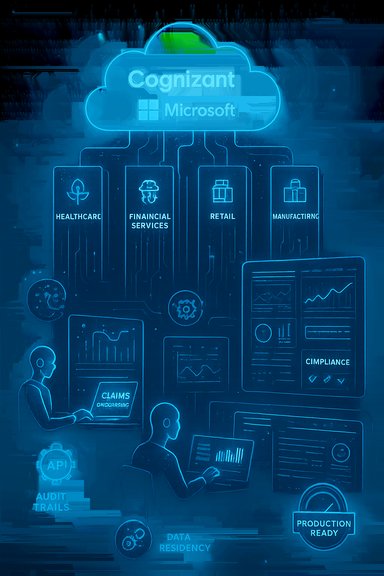
Two concrete 2025 moves crystallize the strategy and its urgency. First, Cognizant announced a multi‑year strategic partnership with Microsoft on December 18, 2025 to co‑build Copilot‑embedded, industry‑grade AI solutions and pursue large joint deals across Financial Services, Healthcare & Life Sciences, Retail and Manufacturing. The press release frames the partnership as an effort to create “AI‑powered Frontier Firms” by embedding Microsoft’s Copilot and intelligence layers (Work IQ, Fabric IQ, Foundry IQ) into Cognizant’s vertical platforms and Neuro® AI offerings. Second, Cognizant agreed to acquire 3Cloud — an Azure‑focused engineering firm — in a deal announced November 13, 2025, which the company says will materially expand its Azure engineering bench and shorten time‑to‑production for Azure‑native AI workloads. Public filings and partner communications emphasize the twin logic: deepen hyperscaler engineering credentials and accelerate enterprise‑grade AI rollouts. These announcements are the operational face of a broader repositioning: package industry IP into reusable platforms, industrialize cloud migrations and modernization, and wrap generative AI into governed, domain‑aware accelerators instead of chasing yet another proprietary foundation model in isolation.
Cognizant’s bet is therefore straightforward: don’t out‑flash the market with marketing‑first AI narratives; out‑deliver it with domain‑tuned, governed, and repeatable solutions that turn Copilot and agentic AI into measurable business outcomes. The company has added the right pieces — Azure engineering scale, partner muscle with Microsoft, and a packaged approach to vertical platforms — but the scoreboard will be written in live customer metrics, not in product names.
Source: AD HOC NEWS Cognizant Technology: How a Legacy IT Giant Is Rebuilding Its Future in the GenAI Era
 Background / Overview
For two decades Cognizant was emblematic of the large‑scale, delivery‑center model that built modern global IT services: skilled teams, long contracts, and a focus on application maintenance, systems integration, and business process outsourcing. That model still produces a large slice of revenue, but enterprise buyers today increasingly demand repeatable, cloud‑native solutions, pre‑built vertical platforms, and measurable, outcome‑based engagements — not just bodies and billable hours. Cognizant’s public roadmap compresses that shift into three strategic pillars: generative AI (Neuro® AI), cloud modernization (with an Azure focus), and industry‑specific digital platforms.Two concrete 2025 moves crystallize the strategy and its urgency. First, Cognizant announced a multi‑year strategic partnership with Microsoft on December 18, 2025 to co‑build Copilot‑embedded, industry‑grade AI solutions and pursue large joint deals across Financial Services, Healthcare & Life Sciences, Retail and Manufacturing. The press release frames the partnership as an effort to create “AI‑powered Frontier Firms” by embedding Microsoft’s Copilot and intelligence layers (Work IQ, Fabric IQ, Foundry IQ) into Cognizant’s vertical platforms and Neuro® AI offerings. Second, Cognizant agreed to acquire 3Cloud — an Azure‑focused engineering firm — in a deal announced November 13, 2025, which the company says will materially expand its Azure engineering bench and shorten time‑to‑production for Azure‑native AI workloads. Public filings and partner communications emphasize the twin logic: deepen hyperscaler engineering credentials and accelerate enterprise‑grade AI rollouts. These announcements are the operational face of a broader repositioning: package industry IP into reusable platforms, industrialize cloud migrations and modernization, and wrap generative AI into governed, domain‑aware accelerators instead of chasing yet another proprietary foundation model in isolation.
What Cognizant Is Building: The Pillars Explained
Neuro® AI — an adoption framework, not a single model
Cognizant’s Neuro® AI is positioned as an enterprise adoption framework made up of use‑case libraries, pre‑built copilots (for claims processing, customer support, engineering productivity, knowledge management), and a responsible‑AI overlay for governance, bias mitigation, model lineage, and data‑residency controls. The company’s public narrative is explicit: assemble hyperscaler and third‑party models inside enterprise controls rather than compete by building a giant proprietary foundation model. That reduces R&D capital intensity and places value on integration, data engineering, and domain context.- Key Neuro® AI elements Cognizant highlights:
- Use‑case libraries mapped to vertical workflows (banking onboarding, claims adjudication, clinical trial operations).
- Pre‑built copilots for function‑level automation (customer support, claims, development productivity).
- Responsible AI features: audit trails, model lineage, and in‑country processing options for regulated workloads.
Cloud modernization and Azure engineering
Cognizant’s cloud play is industrialized migration factories, containerization and microservices accelerators, and observability/FinOps tooling to control costs and performance. The recent decision to acquire 3Cloud — a recognized Azure specialist — binds Cognizant more tightly to Microsoft Azure, Databricks/Fabric patterns and Azure engineering best practices, while preserving multi‑hyperscaler delivery where clients require AWS or Google Cloud. The stated rationale: shorten the runway from pilot to production for Azure‑centric AI workloads by adding certified engineers and Azure‑native accelerators.Industry platforms: productizing vertical IP
Cognizant is packaging decades of vertical experience into reusable platforms aimed at healthcare (payer/provider claims, member engagement, analytics), life sciences (pharmacovigilance, clinical data), and financial services (digital banking, risk and compliance workflows). The approach shifts the company away from bespoke, one‑off implementations toward configurable productized suites that promise faster deployment, predictable economics, and improved margins. This productization underpins the company’s claim to be more of a strategic partner than a traditional low‑cost implementer.Engineering services, IoT and edge scenarios
Beyond enterprise software, Cognizant is investing in engineering and IoT services — digital twins, embedded software, and predictive maintenance use cases. These offerings pair hardware, edge compute and AI to create industrial outcomes (smart factories, predictive maintenance) and extend the platform narrative into physical product lifecycles. Those plays are logical given the ecosystem of connected devices and the commercial value of operational AI.How This Stacks Up Against the Big Three: Accenture, TCS, Infosys
Cognizant is not alone in pursuing a platform + AI strategy. The field is crowded and differentiated by brand, platform depth and go‑to‑market approach.- Accenture: a premium transformation narrative with branded platforms like myNav (cloud assessment/simulation) and SynOps (human‑machine operating engine), and a heavy consulting overlay that emphasizes strategy, multi‑year transformations and change programs. Accenture leans into a high‑touch, high‑margin model aimed at boardroom transformation.
- TCS: historically platform‑oriented in banking with TCS BaNCS and a growing AI/cloud portfolio; TCS increasingly pitches platform‑first models that embed core systems and banking flows, now extending AI features and agentic tooling into BaNCS. That product depth in core banking systems is a structural advantage in financial services.
- Infosys: pushes the Infosys Cobalt cloud portfolio and Topaz Topaz/Topaz Fabric AI offerings (a composable stack of agents, models and services). Infosys emphasizes open, composable AI fabrics and broad agent libraries — a clear competitor to Cognizant’s industry copilots, but with a more visible marketing cadence and earlier product branding.
The Competitive Edge: Why Cognizant Can Win
Cognizant’s case rests on five interlocking advantages:- Industry‑first focus, not AI‑first for its own sake. By starting with workflow outcomes (claims, onboarding, clinical ops) and then mapping AI and platform pieces to those workflows, Cognizant reduces the chance of endless pilots with no production endpoint.
- Productized, reusable solutions. Packaging real, configurable modules in healthcare and financial services shortens procurement cycles and yields more predictable delivery timelines — essential for risk‑averse CIOs.
- Hyperscaler ecosystem depth (Azure lead). The 3Cloud acquisition plus a formalized Microsoft co‑build/co‑sell pact accelerates Azure‑native production paths and gives Cognizant scale inside Microsoft’s partner ecosystem. That alignment can materially shorten model‑to‑production cycles on Azure.
- Cost‑effective, AI‑enhanced delivery. Cognizant still has a large global delivery footprint; embedding automation (auto‑testing, code generation, operations analytics) into delivery can improve productivity and margin profile on legacy work while enabling higher‑margin platform services.
- North American client intimacy. Deep penetration in the U.S. market — particularly in healthcare and financial services — makes Cognizant’s vertical platforms more immediately relevant to U.S. regulatory and operational realities than some more generic global offerings.
Material Risks and What Could Go Wrong
No transformation of this scale is risk‑free. The principal failure modes to watch are:- Execution risk on activation and integration
- A partnership announcement and an acquisition close the intent gap, but the real test is integration: will 3Cloud talent, patterns and certifications be retained and operationalized inside Cognizant quickly enough to influence FY26 bookings? Past integrator M&A shows cultural, tooling and retention frictions can slow delivery.
- Hyperscaler dependence and vendor lock‑in
- Deep alignment with Microsoft Azure (Copilot, Fabric, Foundry) accelerates go‑to‑market for Azure clients but concentrates technical and commercial dependency. Enterprises must still weigh portability and portability clauses; vendors aligned too tightly with a single hyperscaler can face pricing pressure and regulatory constraints in geographies demanding sovereignty.
- Governance, compliance and agentic‑AI safety
- Embedding agentic assistants into mission‑critical workflows raises auditability, data residency and explainability requirements. Regulatory regimes (e.g., EU AI Act and other national rules) will increasingly require demonstrable model governance; failure to build robust guardrails will create legal and commercial risk. Independent audits and customer‑facing SLA language must be available early to convert large regulated customers.
- Pilot fatigue and commercial proof
- Enterprise buyers face “pilot fatigue” from multiple POCs that never reach production. Cognizant’s productization reduces that risk, but the company still needs live, independently audited case studies that demonstrate persistent ROI to break procurement inertia. Vendor claims about seat counts or performance should be validated against customer activation metrics.
- Margin and valuation pressure
- Moving from labor arbitrage to platformized, higher‑margin services is rhetorically attractive, but it requires scaling platform licensing, repeatable deployments and tighter margins on consulting. If revenue mix shifts slowly, investors’ patience will be tested and margin expansion may lag expectations. Market reactions to execution missteps can be quick.
The Microsoft Tie: Opportunity and a Test Case
Cognizant’s December 18, 2025 pact with Microsoft is a strategic accelerator: it commits both firms to co‑build Copilot and agentic AI solutions, co‑sell globally, and scale Copilot seat adoption across Cognizant’s delivery teams. Microsoft frames these partnerships as creating “Frontier Firms” and has publicly signaled big ambitions for Copilot scale with partners. Independent press reports and Microsoft partner comms have echoed seat‑scale numbers across several large systems integrators, but those license‑count figures (for example, the claim that partners will deploy tens of thousands of Copilot seats) are declarative commercial intentions and should be treated as such until activation metrics are published. This partnership becomes a test of Cognizant’s “last‑mile” promise: can joint engineering, certified Azure talent (boosted by 3Cloud), and pre‑built vertical copilots move large, compliance‑sensitive customers from pilots into sustained production? The answer will be visible in the next 6–18 months in published case studies, consumption metrics, and joint‑customer dashboards — not in press releases alone.Validation: What Independent Data Shows Today
- The Microsoft–Cognizant partnership was announced by Cognizant on December 18, 2025. The company’s press materials and investor pages describe co‑build and co‑sell commitments, Copilot embedding, and a vertical focus on Financial Services, Healthcare & Life Sciences, Retail and Manufacturing.
- Cognizant’s acquisition of Azure specialist 3Cloud was announced November 13, 2025; multiple press releases and PR Newswire items confirm the deal and the expected Q1 2026 close, noting that 3Cloud brings Azure engineering depth and Databricks/Fabric patterns.
- Cognizant has publicly promoted its Neuro® AI platform and NVIDIA collaboration (announced March 25, 2025), which positions NVIDIA AI and NeMo/NIM primitives inside Cognizant’s multi‑agent and industry LLM ambitions. That announcement corroborates the vendor’s stated strategy of leveraging hyperscaler and accelerator ecosystems instead of exclusively building proprietary models.
- On market performance, public market feeds in late December 2025 show Cognizant’s shares trading in the mid‑to‑upper double digits (for example, closing near $84 on Dec. 30, 2025 in one market update), reflecting investor perception of a steady services company undergoing gradual transformation rather than a hypergrowth software multiple. Short‑term price movements will continue to track bookings, digital/cloud bookings, and incremental proof of large AI platform deals.
Practical Advice for CIOs, Procurement and Investors
- For CIOs evaluating Cognizant: require evidence of at least one live production deployment (per target vertical) with audit‑grade KPIs before committing to large‑scale rollouts. Insist on contractual rights to logs, model artifacts, and portability clauses that protect future options.
- For procurement teams: structure early engagements as outcome‑based pilots with binding, measurable success criteria (time saved, error rate reduction, FTE reallocation). Account for consumption economics — API and inference costs can erode projected savings if not modeled up front.
- For investors: watch bookings cadence in cloud & AI, margin progression in digital/platform revenue, and the cadence of published case studies proving economic outcomes. Integration of 3Cloud talent and retention metrics will be early indicators of execution success or friction.
Bottom Line: Is This a Reinvention or Rebranding?
Cognizant’s strategy is credible and, in many ways, sensible: productize what you know, align with hyperscalers to reduce infrastructure risk, and put governance and domain expertise front and center to win regulated customers. The Microsoft partnership and 3Cloud acquisition are tangible moves that materially strengthen the engineering and distribution elements of that strategy. But credibility in enterprise IT is earned by outcomes, not press releases. The most important near‑term validations will be:- demonstrable, audited customer deployments that move beyond POC to sustained production;
- retention and integration of acquired Azure engineering talent and accelerators; and
- measurable margin expansion tied to platformized revenue rather than labor arbitrage.
Cognizant’s bet is therefore straightforward: don’t out‑flash the market with marketing‑first AI narratives; out‑deliver it with domain‑tuned, governed, and repeatable solutions that turn Copilot and agentic AI into measurable business outcomes. The company has added the right pieces — Azure engineering scale, partner muscle with Microsoft, and a packaged approach to vertical platforms — but the scoreboard will be written in live customer metrics, not in product names.
Source: AD HOC NEWS Cognizant Technology: How a Legacy IT Giant Is Rebuilding Its Future in the GenAI Era
