

Cognizant’s agreement to buy 3Cloud is a decisive, strategic play to bulk up Azure engineering muscle and accelerate enterprise AI delivery for large customers, folding a tightly focused Azure‑native consultancy into one of the world’s largest systems integrators and creating one of the most credentialed Microsoft Azure partner footprints in the market.
3Cloud, founded by former Microsoft executives and headquartered in Chicago, has positioned itself as a pure‑play Microsoft Azure services firm with deep expertise across modern data platforms, cloud‑native application development, advanced analytics and managed Azure operations. The company has repeatedly earned Microsoft partner awards and holds Elite Databricks partner status — credentials that matter for enterprise AI work that combines Azure infrastructure with lakehouse and analytics platforms. Cognizant announced on November 13, 2025 that it has entered into a definitive agreement to acquire 3Cloud; the deal is expected to close in Q1 2026, subject to regulatory approvals. Public statements from the buyer, seller (private equity owner Gryphon Investors) and partner Microsoft provide the core facts disclosed so far — headline employee and credential counts, timing, and the strategic rationale — while leaving financial terms and detailed integration plans undisclosed. Microsoft’s recent financial results showed a rapid acceleration in Azure and cloud services growth — roughly 39–40% year‑over‑year in the quarter cited by the companies — a backdrop the parties use to justify the timing of the acquisition. Independent reporting has corroborated the scale of Azure’s growth and the broader market dynamics driving vendor consolidation.
However, the ultimate value hinges on execution. The most material near‑term risks are talent attrition, integration slippage, and failure to productize bespoke engineering into high‑leverage managed services. Customers and investors should therefore treat the announcement as a strategic signal, not an operational guarantee, and demand measurable commitments from Cognizant around retention, integration milestones and demonstrable product launches.
Source: CNBC TV18 Cognizant to acquire 3Cloud, creating one of the largest global Azure and enterprise AI partners - CNBC TV18
 Background
3Cloud, founded by former Microsoft executives and headquartered in Chicago, has positioned itself as a pure‑play Microsoft Azure services firm with deep expertise across modern data platforms, cloud‑native application development, advanced analytics and managed Azure operations. The company has repeatedly earned Microsoft partner awards and holds Elite Databricks partner status — credentials that matter for enterprise AI work that combines Azure infrastructure with lakehouse and analytics platforms. Cognizant announced on November 13, 2025 that it has entered into a definitive agreement to acquire 3Cloud; the deal is expected to close in Q1 2026, subject to regulatory approvals. Public statements from the buyer, seller (private equity owner Gryphon Investors) and partner Microsoft provide the core facts disclosed so far — headline employee and credential counts, timing, and the strategic rationale — while leaving financial terms and detailed integration plans undisclosed. Microsoft’s recent financial results showed a rapid acceleration in Azure and cloud services growth — roughly 39–40% year‑over‑year in the quarter cited by the companies — a backdrop the parties use to justify the timing of the acquisition. Independent reporting has corroborated the scale of Azure’s growth and the broader market dynamics driving vendor consolidation. What the deal actually includes (the verifiable facts)
- Agreement type and timing: A definitive agreement announced November 13, 2025; expected close in Q1 2026, subject to regulatory approvals.
- Personnel and credential claims disclosed by the parties:
- Approximately 1,200 3Cloud employees will join Cognizant, with around 700 based in the United States.
- The transaction will add 1,000+ Azure experts and 1,500+ Microsoft certifications to Cognizant’s Azure practice, contributing to a combined pool the companies describe as 21,000+ Azure‑certified specialists.
- Strategic positioning: Cognizant says the acquisition advances its AI builder strategy — an effort to help enterprise clients build, deploy and scale AI on modern cloud infrastructure — by bringing 3Cloud’s Azure‑centric IP, tooling and delivery teams under Cognizant’s global delivery umbrella.
- Seller and transaction context: Gryphon Investors, which invested in 3Cloud in 2020, is the selling party; financial terms were not disclosed.
Why Cognizant is making the move: a strategic analysis
1) Immediate access to Azure engineering scale and IP
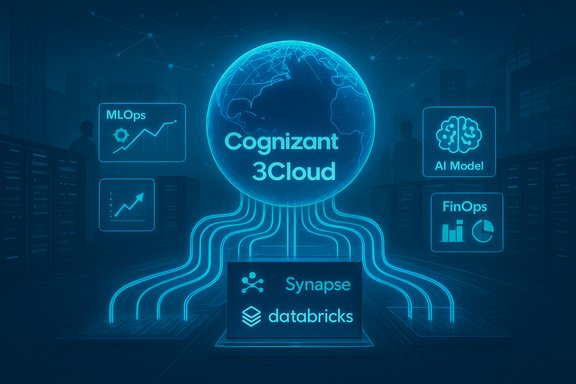
Enterprises pushing AI beyond pilots need converged expertise across cloud infrastructure, data engineering, MLOps and application modernization — not isolated vendor pieces. 3Cloud’s specialization in Azure‑native architectures, modern data engineering (lakehouse patterns, Synapse/Databricks), Azure OpenAI integrations and managed services offers Cognizant a productized and engineering‑intensive bench it would otherwise take years to build organically. Acquiring that bench enables faster time‑to‑market for large, regulated customers that demand production‑grade AI delivery.2) Co‑sell leverage and partner economics with Microsoft
Microsoft’s partner ecosystem rewards scale and measurable influence on Azure consumption. By aggregating credentials, technical bench strength, and Microsoft awards under Cognizant’s global GTM, the combined firm will be positioned to win more joint Microsoft‑co‑sell opportunities and participate more deeply in Azure consumption economics. That matters because Microsoft’s Q1 FY26 results indicate a step‑change in Azure consumption appetite — a market tailwind for partners who can execute at scale.3) Verticalized, repeatable industry playbooks
3Cloud’s enterprise client footprint in banking, healthcare, technology and consumer verticals complements Cognizant’s industry playbooks. The upside for Cognizant is the ability to productize 3Cloud’s accelerators and delivery patterns into industry‑specific, repeatable offerings — for example, governed Copilot programs for finance, clinical data platforms for health systems, and fraud/AML accelerators for banking. Productization reduces customer‑by‑customer bespoke work and improves margin leverage across scale.What 3Cloud brings technically — a closer look
3Cloud’s technical strengths are concentrated in areas that map directly to enterprise AI production problems:- Modern data engineering and lakehouse architectures (Synapse, Databricks, Azure storage).
- Databricks and Azure Fabric expertise, with Elite Databricks partner recognition.
- MLOps and operationalization patterns for LLMs and other models (CI/CD, monitoring, drift detection).
- Cloud‑native app modernization using AKS, microservices, containerized model serving and managed inference patterns.
- Managed services competencies: runbooks, FinOps for inference costs, Entra identity integration and enterprise networking at scale.
Risks, execution challenges, and what to watch
The strategic rationale is convincing on paper, but the real value of this acquisition will be determined in execution. Key risks and issues to monitor include:- Talent retention and attrition: Engineering talent is mobile and in high demand. Acquirers often face immediate attrition after announcements. Retaining delivery leads, architects, and client‑facing engineers will be essential to maintain continuity on projects and preserve customer trust. Contracts and named resource commitments will matter for enterprise customers.
- Integration complexity: Combining two delivery organizations — each with its own tooling, templates, billing practices and HR systems — is nontrivial. Harmonizing delivery playbooks, QA gates, and tooling (DevOps, MLOps pipelines, cost control dashboards) will require a clear integration plan and measurable milestones. Without discipline here, cadence and quality can slip.
- Productization vs bespoke work: 3Cloud’s strength is deep engineering; Cognizant’s scale multiplies it. However, converting bespoke engineering engagements into repeatable, packaged products (for managed Copilots, Fabric analytics, or inference platforms) is a cultural and operational shift that requires sales, presales, delivery, and product teams to align on pricing, SLAs and support models. Failure to productize will limit scalability and margin upside.
- Customer continuity and contractual treatment: Enterprise clients want clarity: will SLAs and named delivery teams stay intact? Will existing statements of work be honored? Customers should insist on written transition plans, named retention commitments for key staff, and transparent escalation paths.
- Vendor lock‑in and multi‑cloud tradeoffs: The acquisition clearly consolidates Azure‑centric capabilities. For enterprises with multi‑cloud strategies, there is a trade‑off between single‑vendor accountability and potential deeper dependence on a specific hyperscaler. Customers must weigh the benefits of simplified vendor management against the strategic risk of tighter Azure lock‑in.
Customer playbook: practical steps for enterprise IT teams
- Request a written transition and continuity plan that includes named delivery leads, SLAs and change‑management steps for ongoing projects.
- Negotiate explicit FinOps transparency for inference and model hosting costs; require reporting cadence and cost‑control guardrails.
- Ask for evidence of productized offerings and references showing successful migration of pilots into production under the combined team.
- Include substitution acceptance clauses in contracts so any personnel replacements are mutually agreed and certified.
- Monitor integration milestones publicly announced by Cognizant (retention rates, product launches, go‑to‑market activities) and demand quarterly updates on any changes to delivery models.
Investor and market implications
From an investor lens, the acquisition has the potential to accelerate Cognizant’s share of higher‑margin AI and managed‑services work — if the integration preserves billable utilization, converts bespoke engagements into repeatable managed‑service offerings, and captures Microsoft co‑sell momentum. However, there are short‑term margin pressures typical of acquisitions: retention bonuses, systems harmonization, and possible headcount rationalization. Analysts will watch for:- Any SEC or investor relations disclosures quantifying purchase price and expected synergies.
- Evidence of revenue acceleration in Azure‑tied services and managed AI revenues in subsequent quarters.
- Retention metrics for key technical personnel and client‑facing leaders.
- Margin trajectory shifts as integration costs normalize.
Microsoft and partner ecosystem implications
Microsoft publicly welcomed the deal, framing Azure as the platform of choice for AI transformation and endorsing the creation of a highly credentialed, globally scaled partner. Larger systems integrators acquiring Azure‑native specialists is consistent with a consolidation trend inside the Microsoft partner ecosystem: Microsoft gains fewer, more capable partners who can drive larger, end‑to‑end customer commitments; partners gain scale, distribution and co‑sell advantages. The net effect for customers may be faster delivery and reduced vendor handoffs — but also less choice among specialized boutiques for niche problems.How credible are the headline numbers?
The parties have made several numerically specific claims (employee counts, certification tallies, Azure experts added, and the “21,000+ Azure‑certified specialists” post‑close figure). Those claims originate in corporate press releases and partner statements; they are credible in context but should be treated as company‑reported metrics until corroborated by independent filings, partner program attestations, or subsequent regulatory disclosures. The absence of purchase price or valuation multiples is a material gap that prevents immediate assessment of expected financial returns. Independent press coverage and filings (Gryphon’s press release, Cognizant’s investor release and mainstream reporting) corroborate the timing and high‑level scale, but external verification of certification tallies and internal utilization will require downstream reporting.Where this fits in the broader cloud‑AI consolidation trend
This transaction is emblematic of a larger industry movement in 2024–2025: hyperscaler‑focused SIs and consultancies are buying specialist engineering firms to assemble end‑to‑end capabilities for enterprise AI programs. The drivers are clear:- Hyperscaler cloud consumption is surging, partly as a direct result of enterprise AI projects that demand large compute, integrated data platforms and sustained operational support. Microsoft’s Azure growth near 40% in the cited quarter underscores this.
- Customers increasingly prefer single‑accountability partners that can deliver platform, data and application outcomes.
- Partners benefit from aggregated credentials and co‑sell economics that reward demonstrable influence on hyperscaler consumption.
Verdict: measured optimism with strict conditions
Cognizant’s acquisition of 3Cloud is a strategically sensible and timely move that addresses tangible market demand: Azure‑native engineering talent and repeatable delivery IP for enterprise AI at scale. The combination strengthens Cognizant’s Microsoft credentials and creates compelling co‑sell and execution opportunities across regulated verticals.However, the ultimate value hinges on execution. The most material near‑term risks are talent attrition, integration slippage, and failure to productize bespoke engineering into high‑leverage managed services. Customers and investors should therefore treat the announcement as a strategic signal, not an operational guarantee, and demand measurable commitments from Cognizant around retention, integration milestones and demonstrable product launches.
What to watch next (timeline and checkpoints)
- Q1 2026 — closing milestone: confirmation of deal close and any regulatory conditions.
- Post‑close 30/60/90 day updates — retention rates for key engineers and named delivery leads.
- Next earnings cycle — management commentary on Azure‑tied revenue growth, expected synergies, and margin impact.
- Productization announcements — packaged AI offerings, managed Copilot services, or industry playbooks formally launched under the Cognizant brand.
- Microsoft partner attestations or program updates that reflect the new credential or co‑sell positioning of the combined organization.
Final takeaway
This acquisition is a clear signal that the market for Azure‑centric AI services is consolidating and professionalizing. For enterprises, the upside is faster, more integrated paths from pilot to production for AI initiatives, provided the combined vendor demonstrates retention of technical talent, transparent FinOps and repeatable delivery models. For Cognizant, the upside is meaningful — if the company successfully converts 3Cloud’s specialized engineering DNA into scaled, productized offerings and captures co‑sell momentum with Microsoft. Investors and customers should expect a period of intense operational focus as the two firms integrate; the difference between a successful strategic bolt‑on and a missed opportunity will be measured in retention metrics, published customer case studies and the speed with which pilots become production services.Source: CNBC TV18 Cognizant to acquire 3Cloud, creating one of the largest global Azure and enterprise AI partners - CNBC TV18
