

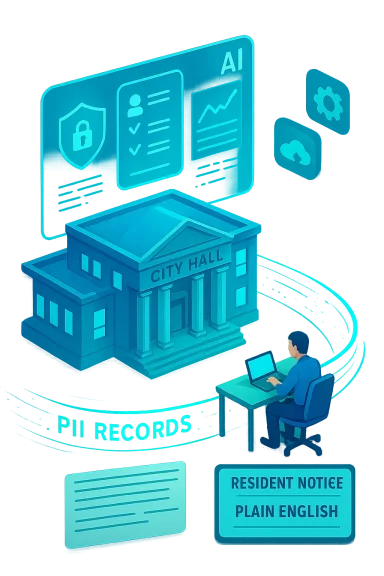
The City of Cold Lake has moved from deliberation to action: on Jan. 27 council unanimously approved a new Artificial Intelligence (AI) policy that aims to let municipal staff use AI where it delivers efficiency, while erecting clear guardrails to protect personal and organizational information. The document does not ban or endorse particular vendor products; instead it creates a decision-making framework for staff, lists permitted and non‑permitted uses, and narrows a recently debated prohibition on image generation so that it applies specifically to images of people. This is a cautious, governance-forward approach that aligns with what many other small and mid‑sized municipalities are doing as generative AI becomes embedded in everyday productivity apps.
Cold Lake’s policy was developed by administration in response to the rapid expansion of generative AI features inside common workplace platforms—examples cited by staff include Microsoft, Adobe, and contemporary web search tools. The policy is described as a principles-based, risk‑tiered framework: rather than hard‑coding a list of allowed apps, it asks employees to run a short decision checklist before using AI for municipal work and identifies several non‑permitted categories (most prominently, processing personally identifiable or confidential information and generating images of people). Staff training on privacy and data protection is already established at the City, and a dedicated AI training rollout for the new policy is being prepared. Local reporting of the council decision quotes Corporate Services leadership and elected officials emphasizing that the intent is to enable productivity while protecting resident data and public trust.
Experienced municipal playbooks therefore emphasize four practical pillars for municipal AI governance:
Practical implications and caveats:
Municipal analyses that have followed similar pathways underscore the same implementation trinity: tenant audits, procurement clauses, and mandatory training—none of which can be deferred indefinitely. Where cities succeed, they also publish a short, plain‑English resident notice explaining where AI is used and create KPIs (time saved, incident counts, prompts retained/rte measurable progress and preserve social licence.
Similarly, Adobe has positioned Firefly and other generative features with curated training data and commercial use licenses that limit vendor training on customer content in many enterprise configurations, though product capabilities and restrictions have evolved rapidly and must be checked against the specific subscription tier and contract language.
Finally, major search vendors have integrated generative overlays into web search and productivity tools (Google’s Gemini/AI Mode is an active part of search experiences), which makes “AI in the browser” an unavoidable governance consideration for councils whose staff use Google search for research. Those integrations mean policies must address web‑grounding behaviours as well as app‑level copilots. (exaalgia.com)
But the policy’s value will be measured in execution. The City must rapidly convert guidance into operational controls: tenant audits, enforceable procurement clauses, automated DLP and endpoint rules, conditional licence issuance tied to role‑based training, and a records/retention scheme for prompts and outputs. Without those concrete actions, the policy’s protective language risks being merely aspirational. Conversely, implemented with technical rigour and public transparency, Cold Lake can capture real productivity gains—faster service delivery, better knowledge retrieval and improved staff capacity—while keeping resident data and democratic accountability intact.
Source: LakelandToday.ca City of Cold Lake council approves new artificial intelligence policy for municipal staff
 Background / Overview
Cold Lake’s policy was developed by administration in response to the rapid expansion of generative AI features inside common workplace platforms—examples cited by staff include Microsoft, Adobe, and contemporary web search tools. The policy is described as a principles-based, risk‑tiered framework: rather than hard‑coding a list of allowed apps, it asks employees to run a short decision checklist before using AI for municipal work and identifies several non‑permitted categories (most prominently, processing personally identifiable or confidential information and generating images of people). Staff training on privacy and data protection is already established at the City, and a dedicated AI training rollout for the new policy is being prepared. Local reporting of the council decision quotes Corporate Services leadership and elected officials emphasizing that the intent is to enable productivity while protecting resident data and public trust.What the Cold Lake policy actually says (plain summary)
- The policy establishes principles staff must consider before using AI: protect privacy, preserve records obligations, require human verification of outputs, and avoid relinquishing decision authority to automated systems.
- It distinguishes permitted activities (low‑risk drafting, internal summarization, retrieval/knowledge assistance where no PII is exposed) from non‑permitted activities (submitting confidential/PII to models, automated profiling or decisions that materially affect residents).
- It explicitly narrows an image‑generation prohibition to “generating photos, images or videos of people” rather than a blanket ban on image generation—intended to avoid unnecessarily blocking legitimate uses like diagrams, maps, or building renders.
- The City will deliver mandatory training on the policy and on existing privacy rules; initial training materials were said to be under development and rolling out in the weeks after approval.
- Council approved the policy unanimously, signaling political consensus for a measured, enterprise‑first posture rather than prohibition or unfettered adoption.
Why this matters: the municipal governance context
Municipal governments occupy an unusual intersection of opportunity and risk with generative AI. On one hand, assistants and retrieval‑grounded tools can reduce clerical load, speed responses to public enquiries, and make institutional knowledge accessible. On the other, municipal work often involves protected personal information, statutory records obligations, and democratic accountability—areas where AI‑assisted errors, data leakage, or opaque automation can quickly create legal and reputational harm.Experienced municipal playbooks therefore emphasize four practical pillars for municipal AI governance:
- Enterprise-first tool posture (favour tenant‑scoped, contract‑bound products over consumer chatbots).
- Human‑in‑the‑loop rules (no AI output becomes official without named human verification).
- Procurement and contract safeguards (non‑training guarantees, deletion/export/audit rights).
- Operational controls (DLP, logging/retention, role‑based access, and endpoint restrictions).
- Principles‑first, not technology ban.
By framing the policy around decision principles rather than a fixed whitelist/blacklist of products, Cold Lake reduces the chance the policy will be obsolete as vendors change features or new entrants appear. This flexibility is a practical strength for small municipalities with limited procurement cycles. Municipal governance reviews recommend this stance because it allows controlled pilots and staged adoption while retaining the ability to tighten controls. - Targeted prohibition on images of peope non‑permitted image use to people rather than all image generation strikes a pragmatic balance: it prevents problematic, potentially identifiable synthetic portraits while preserving legitimate uses of generative imagery such as diagrams, maps, or facility mockups. That specificity reduces collateral disruption to services that can reasonably use synthetic imagery for non‑personal purposes. The change itself shows the City listened to operational feedback during the committee process.
- Explicit emphasis on training and human verification.
Cold Lake’s leaders tied the policy to mandatory training and to existing privacy obligations for staff—an essential operational point. Policies without training become paper exercises; attaching training and requiring attendant stewardship helps translate rules into day‑to‑day decisions. Municipal advisory documents consistently flag training and conditional licence issuance as central to success. - Political clarity and unanimous approval.
A unanimous the odds of abrupt reversals that could leave staff uncertain. It also creates a visible governance mandate for the administration to act quickly on operational steps (training, tenant audits, procurement review). - Awareness of embedded AI.
The document acknowledges that AI is already embedded across platforms (Microsoft CoPilot/Copilot features, Adobe AI, and AI‑assisted search results). Recognizing embedded AI rather than pretending it’s absent helps avoid governance gaps where staff unknowingly use AI features without guidance.
Where Cold Lake’s policy is likely to face operational pressure (risks & gaps)
The policy represents sound intent, but policy language alone is not enough. The real test is operational enforcement and procurement detail. Based on analyses of comparable municipal policies and common failure modes, three risk areas require rapid attention:- Technical enforcement vs. behavioral reality (shadow AI).
Staff will often reach for convenient consumer tools or personal devices if sanctioned tools are slow or missing important functionality. Without endpoint/network blocking of public AI endpoints and a usable, sanctioned alternative, the municipality risks shadow AI use that undermines governance and increases leakage risk. Technical controls like DLP rules, network filtering for known public model endpoints, and short‑lived privilege models are necessary complements to policy. - Procurement detail: vendor promises vs. contractual guarantees.
Microsoft aish strong enterprise privacy commitments, but municipal risk is only properly mitigated when contractual guarantees are in place—non‑training clauses, deletion and egress rights, audit access, and breach notification timelines. Vendor marketing language alone is insufficient because vendor operations, product definitions, and contractual terms can change across license renewals. Municipal procurement practice recommends explicit DPA addenda and audit provisions as non‑negotiable. - Records, discoverability and FOI implications.
AI prompts, intermediate outputs, and human editsnder public‑records regimes. The policy must clarify retention rules for prompt logs, how redaction will be performed, and which artifacts count as official records. Without these rules, the City risks costly disclosure or FOI missteps when AI‑assisted drafts or prompt logs are requested. Several municipal policy analyses highlight this “records paradox” and urge explicit retention and redaction policies.
Technical realities the policy must convert into action
Cold Lake’s policy is sound as a governance instrument only if it is paired with a short checklist of technical actions. Municipal implementers should prioritize the following operational controls within 30–90 days of policy approval:- Conduct a tenant audit (if using Microsoft 365 or similar): confirm Purview, DLP rules, connector settings, telemetry and prompt logging are configured to enforce the non‑PII requirement. Microsoft’s enterprise Copilot products include commercial data‑protection features and explicit non‑training commitments when deployed within an organizational tenant, but those protections depend on correct configuration and contract terms.
- Implement endpoint and network controls to block or limit uploads to public model endpoints when they carry classified or PII‑bearing content. Pair these with an easy‑to‑use, sanctioned alternative so staff do not resort to consumer tools.
- Make access conditional: require completion of role‑based training and stewardship sign‑off before issuing licencer sanctioned tools. Issue short‑lived or least‑privilege credentials for agentic automation features and keep an inventory of who can use which AI connectors.
- Insert procurement clauses now: require non‑training guarantees, data deletion/egress rights, audit access, and breach noti any AI vendor the City engages. Vendor commitments should be demonstrable in written contract language rather than marketing statements.
- Define prompt/output retention and redaction policy: treat prompt logs as potentially sensitive records and decide what is retained, for how long, and how redaction is autes. Create a metadata standard (user, timestamp, connector, model version) to support audits and incident response.
The image‑generation restriction: sensible guardrail, but watch the edge cases
Cold Lake’s decision to prohibit generation of images of people is pragmatic: it targets one of the most ethically fraught uses of generative imagery (synthetic person images that could be realistic, identifiable, or used to misrepresent residents or staff). That specificity reduces collateral impact on legitimate use cases (e.g., generating images of equipment, maps, or architectural mockups).Practical implications and caveats:
- The prohibition should explicitly define “people” (living persons? deceased? staff? minors?) and whether the ban includes stylized avatars, likenesses used with consent, or purpose‑built accessibility assets. Vague language invites inconsistent enforcement.
- The City should clarify whether the prohibition covers in‑house generation only or also covers the use of externally obtained images (e.g., stock photos) that depict people. Policy clarity prevents accidental policy violations by staff working with subcontractors.
- Technical controls can help: block image‑generator endpoints (or set DLP rules to flag uploads of photos containing faces) and require documented consent for any synthetic depiction of a named or identifiable individual.
How Cold Lake’s approach compares with municipal best practice
Cold Lake’s policy mirrors the trajectory many councils are taking: governance first, pilot second, human oversight required, and enterprise tools preferred. This approach is visible in municipal playbooks and case studies where councils limited sanctioned AI to tenant‑bound enterprise offerings (notably Microsoft Copilot and other enterprise copiluafeguards, and required explicit human verification before publication.Municipal analyses that have followed similar pathways underscore the same implementation trinity: tenant audits, procurement clauses, and mandatory training—none of which can be deferred indefinitely. Where cities succeed, they also publish a short, plain‑English resident notice explaining where AI is used and create KPIs (time saved, incident counts, prompts retained/rte measurable progress and preserve social licence.
Practical roadmap and near‑term checklist for Cold Lake
To make the policy operational and credible to residents, the City should prioritize this 90‑day action plan:- Technical audit and hardening (days 0–30)
- Map all places where AI features are enabled across Microsoft 365, Adobe, and other SaaS tools; confirm admin controls.
- Apply DLP rules that automatically block or flag prompts containing regulated identifiers.
- Configure tenant logging and retention for prompts/outputs anddiscoverable for FOI requests.
- Procurement and contract review (days 0–60)
- Require Data Processing Addenda with explicit non‑training guarantees, deletion and egress rightsore any expansion of AI licences.
- Record vendor obligations in contracts and obtain written confirmation of data residency and telemetry settings.
- Training and change management (days 7–90)
- Roll out mandatory, role‑based modules: prompt hygiene, PII handling, human verificident reporting.
- Make access to sanctioned AI contingent on completion of training and a signed stewardship acknowledgement.
- Transparency and public notice (days 30–90)
- Publish a one‑page plain-English resident notice explaining where AI is used, what it does, and how residents can or records.
- Commit to an annual AI usage statement with KPIs (time saved, incidents, retention metrics).
- Governance and review cadence (ongoing)
- Establish a cross‑functional AI governance committee (IT/security, legal/records, communications, service leads) to review exceptions and DPIAs for medium/high‑risk uses.
- Schedulsix‑month cadence and publish minutes of governance committee decisions for transparency.
Verifying vendor claims and why the City should insist on written guarantees
Cold Lake’s policy rightly notes that AI features already exist inside Microsoft, Adobe, and search platforms. Those vendors offer enterprise‑grade privacy features—Microsoft, for example, publicly states that prompts and responses processed inside a Microsoft 365 tenant are protected by commercial data protection and are not used to train foundation models absent explicit consent. Those statements are meaningful, but municipal risk is best managed by converting those vendor promises into enforceable contract terms and verifying tenant settings by audit.Similarly, Adobe has positioned Firefly and other generative features with curated training data and commercial use licenses that limit vendor training on customer content in many enterprise configurations, though product capabilities and restrictions have evolved rapidly and must be checked against the specific subscription tier and contract language.
Finally, major search vendors have integrated generative overlays into web search and productivity tools (Google’s Gemini/AI Mode is an active part of search experiences), which makes “AI in the browser” an unavoidable governance consideration for councils whose staff use Google search for research. Those integrations mean policies must address web‑grounding behaviours as well as app‑level copilots. (exaalgia.com)
What Cold Lake should avoid
- Treating the policy as a one‑off memo. AI governance requires ongoinegotiations, and visible metrics.
- Relying on vendor FAQ pages alone to demonstrate compliance. Contracts and tenant audits are the durable protections.
- Rolling out AI access without training or telemetry. That is the fastest path to shadow AI and accidental data leakage.
Conclusion
Cold Lake’s AI policy is a pragmatic, balanced first step that aligns with contemporary municipal best practice: it accepts that AI is already embedded in productivity software, builds a principles‑based decision framework, narrows a contentious image‑generation ban to images of people, and links use to mandatory training. Those are positive first moves that preserve staff agility while signalling a commitment to privacy and public trust.But the policy’s value will be measured in execution. The City must rapidly convert guidance into operational controls: tenant audits, enforceable procurement clauses, automated DLP and endpoint rules, conditional licence issuance tied to role‑based training, and a records/retention scheme for prompts and outputs. Without those concrete actions, the policy’s protective language risks being merely aspirational. Conversely, implemented with technical rigour and public transparency, Cold Lake can capture real productivity gains—faster service delivery, better knowledge retrieval and improved staff capacity—while keeping resident data and democratic accountability intact.
Source: LakelandToday.ca City of Cold Lake council approves new artificial intelligence policy for municipal staff
