

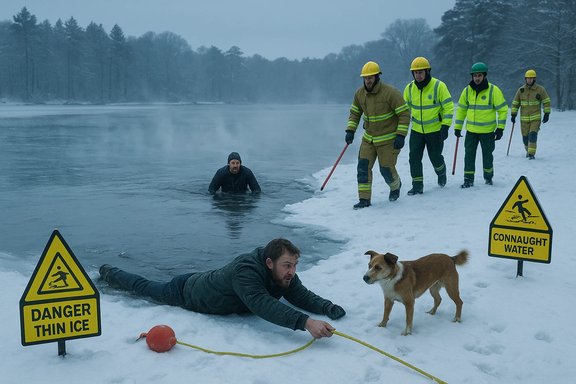
A passerby crawling across a frozen expanse to haul a dog walker and a frightened dog to safety captured a stark human drama at Connaught Water in Epping Forest — and left a clear safety message: frozen water looks stable but can turn deadly in seconds.
Connaught Water, a popular loop within Epping Forest near Rangers Road and Buckhurst Hill, has long been a magnet for walkers and dog owners. On Sunday afternoon, January 4, 2026, the combination of unusually cold weather and thin ice produced a rescue sequence that was filmed by a local witness and posted online, drawing national attention and a swift reminder from emergency services about the dangers of entering cold water. Emergency crews recorded the incident and issued formal safety advice to the public. This article offers a detailed reconstruction of the incident, a technical look at why cold water is so hazardous, an assessment of bystander rescues and their legal and physiological risks, and clear, practical guidance for anyone who encounters a person — or an animal — in trouble on icy water. The narrative draws on eyewitness footage, statements from Essex County Fire and Rescue Service, national water‑safety guidance, and public‑health data on drowning and cold‑water incidents.
Ethically, many will argue it is right to attempt rescue when lives are at stake. But ethics also includes responsibility: the safest way to help can sometimes be by refusing to enter an environment likely to produce additional victims and instead calling specialists equipped to handle cold water and ice. Essex Fire’s message succinctly frames this tension: altruism is admirable, but cold water is uniquely incapacitating — and trained teams exist precisely to handle such hazards.
The safest kind of help is one that preserves the lives of both the victim and the rescuer. During periods of freezing weather, when lakes and ponds are brittle and unpredictable, the best immediate action is to keep a safe distance, call trained professionals, and, where possible, use reach‑and‑throw techniques to help from shore. That combination of courage and restraint is the clearest lesson from Connaught Water: heroism tempered by knowledge saves more lives.
Source: Daily Express https://www.express.co.uk/news/uk/2154333/hero-saves-dog-walker-frozen-lake/
 Background / Overview
Connaught Water, a popular loop within Epping Forest near Rangers Road and Buckhurst Hill, has long been a magnet for walkers and dog owners. On Sunday afternoon, January 4, 2026, the combination of unusually cold weather and thin ice produced a rescue sequence that was filmed by a local witness and posted online, drawing national attention and a swift reminder from emergency services about the dangers of entering cold water. Emergency crews recorded the incident and issued formal safety advice to the public. This article offers a detailed reconstruction of the incident, a technical look at why cold water is so hazardous, an assessment of bystander rescues and their legal and physiological risks, and clear, practical guidance for anyone who encounters a person — or an animal — in trouble on icy water. The narrative draws on eyewitness footage, statements from Essex County Fire and Rescue Service, national water‑safety guidance, and public‑health data on drowning and cold‑water incidents. What happened: timeline and eyewitness account
- Around 14:20 on Sunday, January 4, 2026, a dog wandered onto the frozen surface of Connaught Water and broke through the ice. A dog walker followed the animal onto the ice and himself fell into the icy water. A passerby then attempted to help and also slipped through the ice; both men ended up in the water before bystanders, aided by paramedics and firefighters, pulled them to shore. Both people were treated at the scene and one was later taken to hospital for further assessment. The dog was recovered and reunited with its owners.
- The rescue was filmed by a nearby resident, Ozgur Ontas, who told reporters that the two men were in the water for “between 10 and 15 minutes” before being rescued — a period that underscores how long cold immersion can feel and how quickly the body begins to fail in such conditions. Multiple media outlets replayed the footage and carried the eyewitness’s comments.
- Essex County Fire and Rescue Service confirmed the location as Connaught Water on Rangers Road and reiterated that the safest response to a person or animal in cold water is to maintain visual contact from the bank, call 999, and wait for trained crews to bring specialist equipment. Watch Manager Gary Dyer specifically warned that cold water can overwhelm the body very quickly and urged people to stay out of the water and call professional rescuers.
Why frozen lakes are deceptively hazardous
The physics and biology of ice and cold water
Many people assume that a white, frozen surface equals safety. That assumption is dangerous:- Ice strength varies widely across a single pond or lake. Near shorelines, inflows and outflows, or where debris or vegetation lies beneath the surface, ice can be thin and unstable even if it looks solid from above.
- Temperature stratification and currents under the ice make some sections weaker. A dog running across thin patches can break through and create an irregular hazard for anyone who follows. Multiple eyewitness reports from the Connaught Water incident indicate dogs had already been running onto the ice that day, increasing local risk.
Cold water shock: timeline of harm
Scientific and safety authorities define cold water shock as the body’s rapid, involuntary response to sudden immersion in water below roughly 15°C. The Royal National Lifeboat Institution (RNLI) and related bodies explain that:- The initial gasp reflex and uncontrolled hyperventilation happen within seconds, dramatically increasing the risk of inhaling water.
- Heart rate and blood pressure spike, which can precipitate cardiac events even in healthy people.
- The first minute is the most critical: reflex responses peak and can cause drowning quickly. After about a minute, if a person can control breathing and float, their chances improve — but muscle function and grip strength quickly decline thereafter, making self‑rescue much harder beyond that window.
The human side: why people risk their lives to save animals and strangers
There is a deep, immediate moral impulse that compels many to act. Psychologists call this empathic altruism: people feel the suffering of others as if it were their own, and animals, especially dogs, frequently trigger strong protective responses. Several factors make dog‑related incidents particularly potent:- Dogs are emotionally salient; their distress can provoke an urgent, visceral reaction that bypasses deliberative risk assessment.
- Dog owners are likely to attempt a direct rescue because they are used to being the animal’s constant protector and often feel parental responsibility.
- Bystanders who see a failing animal or owner sometimes react immediately rather than calling for help, particularly when water is visible and help seems close at hand.
Emergency services' response and public safety messaging
Essex County Fire and Rescue Service responded to the Connaught Water incident and used the opportunity to reiterate clear, actionable advice:- Do not enter cold water to attempt a rescue.
- Maintain visual contact and reassure the person from a place of safety.
- Call 999 and ask for the fire service (or the Coastguard at the coast) — trained crews have specialist equipment and training for cold‑water rescue.
- If possible, use a reach‑or‑throw approach: extend a pole, branch, or rope; throw a flotation device or anything that floats.
What could have gone wrong — and why it didn’t, this time
Several failure modes make these rescues lethal:- Rapid onset of cold water shock and drowning during the first minute.
- The rescuer being pulled under by an unconscious victim, causing multiple casualties.
- Hypothermia setting in over minutes to hours, complicating extraction and resuscitation.
- Delays in calling professional rescue teams or incorrect improvised techniques that increase the chance of multiple victims.
Practical, evidence‑based advice for bystanders and dog owners
Below are precise, actionable steps compiled from RNLI guidance, Essex County Fire and Rescue advice, and best‑practice water safety training.If someone else (or an animal) is in trouble on ice
- Stop. Think. Assess for immediate dangers and your ability to help without entering the water.
- Call 999 and ask for the fire service (or Coastguard on the coast). Give a clear location, describe the situation, and indicate if anyone is submerged or unconscious.
- Maintain visual contact and instruct the person to try to float on their back if they are conscious — Float to Live guidance can buy vital time.
- Use a reach or throw technique from the bank:
- Reach: extend a pole, paddle, branch, or even clothing tied into a rope; lie down to distribute weight and avoid falling in.
- Throw: throw a buoyant item (life ring, football, cooler lid) and instruct the person to grab it.
- If no rescue equipment is available, create a line using clothing or a leash; lie low and extend — never stand upright at the edge where ice can break.
If you fall into cold water unexpectedly
- Don’t thrash. The RNLI’s Float to Live method is designed to get you breathing under control: tilt your head back, spread your arms, relax and float until breathing steadies, then plan your next move. This initial minute is critical.
- If you can, swim parallel to the bank to the nearest exit point rather than attempting to swim directly against currents or open water.
- Keep clothing on; it can provide insulation and buoyancy.
- Once out, avoid sudden exertion; seek immediate medical assessment because cold immersion can cause delayed cardiac or respiratory effects.
Equipment and training to keep on hand
- Throw lines or rope bags kept in park kiosks or near popular ponds can be life‑saving.
- Signage that warns about thin ice and gives step‑by‑step emergency instructions.
- Public access defibrillators (PADs) near popular lakes and trails.
- For dog owners: a short, sturdy lead and training to avoid chasing animals onto ice; consider a GPS collar if pets are allowed off‑lead.
The policy angle: what local authorities and parks managers can, and should, do
The Connaught Water incident raises questions about how parks and local authorities manage cold‑weather risks. Practical policy steps include:- Installing and maintaining clear, visible signage at frequently used access points describing the danger of ice and the reach/throw/call emergency sequence.
- Provisioning fixed rescue equipment in high‑use areas (throw lines, poles, ring buoys) and ensuring regular inspection.
- Including frozen lake safety in community education campaigns during cold snaps, coordinated with Met Office warnings and the National Water Safety Forum.
- Considering targeted enforcement or restrictions on off‑lead dog walking in particularly hazardous winter conditions, combined with public outreach rather than punitive measures alone.
Legal and ethical considerations for bystanders
From a legal perspective in the UK, people who attempt rescue are generally protected by the common‑law principle that permits reasonable efforts to save life; there is no specific criminal liability simply for trying to help. However, the practical risk is medical and moral rather than legal: a well‑intentioned rescuer who becomes a second casualty complicates the response and increases the danger for professional rescuers.Ethically, many will argue it is right to attempt rescue when lives are at stake. But ethics also includes responsibility: the safest way to help can sometimes be by refusing to enter an environment likely to produce additional victims and instead calling specialists equipped to handle cold water and ice. Essex Fire’s message succinctly frames this tension: altruism is admirable, but cold water is uniquely incapacitating — and trained teams exist precisely to handle such hazards.
The role of media and viral footage: benefits and risks
The cellphone video of the Connaught Water rescue performed two key public service functions: it raised awareness rapidly and visualized the genuine danger of thin ice. However, viral footage also carries risks:- It may inadvertently normalize risky behavior, as some viewers imitate dramatic rescues without understanding the underlying physiology.
- The bystander who filmed may become a source of public pressure that urges others to intervene rather than call for trained help.
- Conversely, responsibly edited footage accompanied by expert commentary can be a powerful tool for education.
Strengths and weaknesses of the response observed at Connaught Water
Notable strengths
- Rapid public alerting and the presence of multiple bystanders allowed for quick extrication and medical attention.
- The footage and eyewitness accounts prompted immediate public‑safety reminders from Essex Fire, leveraging the incident to educate others.
- The dog’s survival and reunion with its owner demonstrate that not all animal incidents end tragically when help is coordinated quickly.
Potential weaknesses and persistent risks
- A passerby entering the ice — while heroic — created a multi‑victim scenario that could have ended much worse had rescue resources been fewer or delayed.
- The incident highlights a broader pattern: inland waterways are the leading site of accidental drowning in the UK, and many such events involve people who never intended to enter the water. Systematic prevention measures and community training remain insufficient relative to the scale of the hazard.
Concrete recommendations for readers and local communities
- Repeat and internalize the RNLI and fire service messages: don’t enter cold water; call 999; float to live; use reach and throw methods. These are evidence‑based and proven to reduce multiple casualties.
- Dog owners should pre‑plan winter routes away from open water when temperatures drop; use a short lead near lakes; and train pets to avoid thin ice.
- Local councils and park authorities should audit high‑use water sites for signage, rescue equipment, and public education outreach during each winter season.
- Communities should explore community rescue kits (throw bags, long poles) at popular lakes, coupled with public training on reach/throw/call protocols.
Conclusion: bravery must be matched with knowledge
The Connaught Water rescue is a powerful reminder of two truths. First, individual bravery and quick action can save lives — the passerby who entered the ice in Epping Forest contributed directly to a positive outcome for the dog walker and the dog. Second, and equally important, bravery without the right tools and training often multiplies risk. Modern, evidence‑based water safety messaging — from RNLI’s Float to Live to local fire service guidance — exists precisely to channel human compassion into effective, survivable action.The safest kind of help is one that preserves the lives of both the victim and the rescuer. During periods of freezing weather, when lakes and ponds are brittle and unpredictable, the best immediate action is to keep a safe distance, call trained professionals, and, where possible, use reach‑and‑throw techniques to help from shore. That combination of courage and restraint is the clearest lesson from Connaught Water: heroism tempered by knowledge saves more lives.
Source: Daily Express https://www.express.co.uk/news/uk/2154333/hero-saves-dog-walker-frozen-lake/
