

Microsoft’s Copilot appears to be testing a new, deliberately theatrical way to surface analysis: a feature reportedly called Copilot Advisors, which would let users pick two distinct AI personas, assign them opposing stances, and watch or listen as they argue a topic in a structured debate format. The idea is simple and striking — give users a fast way to hear the best arguments on both sides of a question — but its implications cut across product design, trust and safety, legal exposure, and how people use AI to make decisions.
Microsoft has steadily reshaped Copilot from a single-turn assistant into an agentic, multimodal platform that hosts domain-specific agents, voice interactions, and experimental avatar experiences. Recent product work and experiments have emphasized two clear trends: first, specialization — Copilot can run agents tuned for finance, legal, customer service, and other verticals; second, expressive output — voice, animated portraits, and multi-voice audio summaries are moving from experiments into product surfaces. Copilot Advisors would combine those trends: multi-agent specialization + spoken, persona-driven presentation.
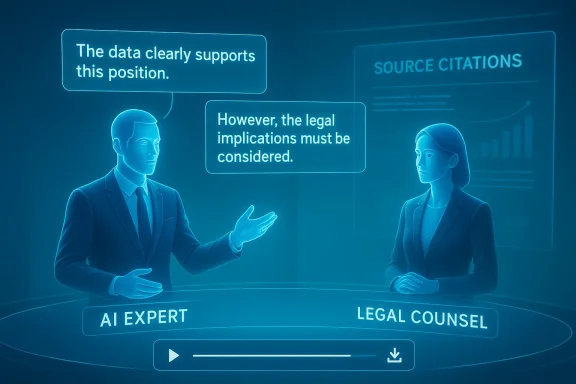
The reported flow is straightforward: a user supplies a prompt describing the topic, picks two agents from a roster that includes AI experts, legal experts, finance experts, artists and other archetypes, assigns one to the affirmative and one to the negative, optionally swaps slots, and then runs the debate. Each agent argues its assigned position (likely in audio), with stylized portraits shown on-screen — possibly animated rather than static — and a back-and-forth debate plays out so the user can hear the strongest case for both sides.
This is not an outlandish experiment. The idea of letting multiple AIs debate or interrogate each other to arrive at better answers has been explored in research and by other companies; Google’s NotebookLM Audio Overviews popularized two-host audio summaries that conversationally interrogate sources, and independent projects and frameworks have shown how structured multi-agent debates can help surface counterarguments and stress-test reasoning. Copilot Advisors would be Microsoft’s attempt to package that capability inside the Copilot ecosystem, with domain-aware personas and the promise of grounded, professional-sounding voices.
But the same traits that make debates compelling also multiply the risks. A convincing audio performance can obscure weak evidence; persona packaging can lend the wrong impression of authority; and voice synthesis raises concrete legal and safety exposures. For Copilot Advisors to be a net positive, the product must be engineered around evidence, transparency, and governance, not just spectacle.
If Microsoft moves forward, the questions to answer are practical: will the debates show their evidence? Can enterprises control persona use and data access? Are synthetic voices clearly labeled and auditable? The answers will determine whether Copilot Advisors is a safe decision-support innovation — or a seductive new way to amplify plausible nonsense.
In short: a debate UI is a powerful idea for sense-making — but it is only as trustworthy as the sources, controls, and guardrails that underpin it.
Source: TestingCatalog Microsoft develops Copilot Advisors to debate on any topic
 Background / Overview
Microsoft has steadily reshaped Copilot from a single-turn assistant into an agentic, multimodal platform that hosts domain-specific agents, voice interactions, and experimental avatar experiences. Recent product work and experiments have emphasized two clear trends: first, specialization — Copilot can run agents tuned for finance, legal, customer service, and other verticals; second, expressive output — voice, animated portraits, and multi-voice audio summaries are moving from experiments into product surfaces. Copilot Advisors would combine those trends: multi-agent specialization + spoken, persona-driven presentation.The reported flow is straightforward: a user supplies a prompt describing the topic, picks two agents from a roster that includes AI experts, legal experts, finance experts, artists and other archetypes, assigns one to the affirmative and one to the negative, optionally swaps slots, and then runs the debate. Each agent argues its assigned position (likely in audio), with stylized portraits shown on-screen — possibly animated rather than static — and a back-and-forth debate plays out so the user can hear the strongest case for both sides.
This is not an outlandish experiment. The idea of letting multiple AIs debate or interrogate each other to arrive at better answers has been explored in research and by other companies; Google’s NotebookLM Audio Overviews popularized two-host audio summaries that conversationally interrogate sources, and independent projects and frameworks have shown how structured multi-agent debates can help surface counterarguments and stress-test reasoning. Copilot Advisors would be Microsoft’s attempt to package that capability inside the Copilot ecosystem, with domain-aware personas and the promise of grounded, professional-sounding voices.
What Copilot Advisors would do — product mechanics
How a session might be configured
- The user describes the topic in natural language, e.g., “Should Company X acquire Company Y?” or “Is this paper’s conclusion justified given the data?”
- The UI presents a curated roster of personas: AI Expert, Legal Counsel, Finance Analyst, Traditional Artist, Skeptical Critic, etc.
- The user assigns personas to the affirmative or negative slot and can toggle them before starting.
- A pair of portraits appears on screen when the debate begins; the session likely plays as audio with the portraits lip-syncing or otherwise animating.
Expected output and controls
- A timed, structured back-and-forth debate with opening statements, rebuttals, and closing remarks.
- Distinct voice styles per persona, possibly using Microsoft’s in-house speech models to create tonal variety.
- Controls to pause, skip to rebuttals, or request a transcript and evidence summary.
- Options to surface the source evidence each persona relied upon (or a note that the persona is drawing on general model knowledge).
Integration points
- Fits into Copilot Chat or Copilot Studio as a solo thinking tool rather than a collaboration workflow.
- Could be made available in voice mode with avatar portraits or as a downloadable audio file for offline listening.
- Persona roster implies a governance and authoring surface for persona definition, tone, and safety constraints.
Why Microsoft would build this (the product rationale)
- Improve decision confidence: Professionals, researchers, students and managers often make choices under uncertainty. Hearing a reasoned case for and against a proposition helps reveal hidden trade-offs and blind spots.
- Leverage Copilot’s agent architecture: Microsoft has been investing in domain-specific agents and multi-model orchestration. A debate feature is a natural extension of that architecture — orchestration plus persona templates.
- Make insights more consumable: Audio plus distinct voices can be faster and more memorable than reading a long analysis, and animated portraits can make AI responses feel more intuitive and approachable.
- Differentiate on experience: Competitors offer audio summaries or single-voice assistants; a multi-persona debate that simulates expert disagreement is a new user experience that can read as more rigorous and trustworthy if implemented correctly.
Strengths and immediate appeal
- Structured adversarial reasoning: Debate forces models (and by extension users) to confront counter-arguments. That dynamic can reduce surface-level consensus and produce more robust conclusions than single-agent summaries.
- Domain-specific credibility: Allowing users to select a legal persona vs a finance persona can make debates feel grounded for specialized decisions, providing context-aware framing and reasoning.
- Better information retention: Audio debates with different voices and personalities are easier to follow and remember than monologues, and the back-and-forth format mimics human deliberation.
- Faster sense-making: For busy professionals, a short audio debate is a quick way to understand both sides of a question without sifting through reams of text.
- Experimentation surface for Copilot: Developers and enterprise admins can learn which personas help users most and tune persona constraints within Copilot Studio.
Key technical and product unknowns (and why they matter)
- Will opinions be evidence-grounded? A feature that presents persuasive-sounding but unsupported arguments invites misuse. The system needs to surface the sources or confidence backing each claim.
- Voice provenance and consent: If generated voices resemble real people, legal exposure arises. Will Microsoft use synthetic voices derived from internal models, licensed actors, or user-supplied voices — and how will consent be handled?
- Degree of persona control: Can organizations author or lock down personas to corporate policy? Who owns the persona templates and their outputs?
- Moderation and safety: How will the feature prevent harmful or illicit debates (e.g., debating how to manufacture illegal substances or how to bypass security controls)?
- Availability and tiering: No timeline or tiering information has been announced; whether this lands in Copilot Free, Copilot Pro, or enterprise plans affects reach and governance.
Comparative context: NotebookLM and the audio-overview trend
Google’s NotebookLM introduced Audio Overviews — two AI hosts that discuss a set of user-supplied sources — and quickly made the idea mainstream: audio-driven, conversational synthesis of evidence. The NotebookLM design showed two important lessons for anyone building multi-voice AI features:- Users like conversational synthesis but are sensitive to accuracy; shortcomings in grounding or hallucinations erode trust.
- Voice matching and production raise consent and impersonation concerns; platform-level safeguards and label/watermarking are important.
Real-world use cases that would benefit
- Legal review: Pair a Legal Counsel persona arguing for compliance risk and a Business Analyst persona arguing for commercial benefit to rapidly surface contractual trade-offs.
- M&A prebriefs: Listen to a Finance Analyst argue acquisition synergies versus a Risk Officer persona arguing integration and due-diligence hazards.
- Academic learning: Students can hear a Methodologist and a Critic debate a paper’s methodology, showing how to interrogate claims.
- Creative critique: A Traditional Artist persona vs a Market Strategist persona could debate the merits of a new design, balancing craft and market fit.
- Decision audits: Teams could preserve debate transcripts as an audit trail showing they considered major counterarguments before acting.
Hard limits and serious risks
Hallucination and false authority
Debates can sound convincing even when based on incorrect premises. If personas produce plausible-sounding but unsupported claims, decision-makers can be misled. A debate format magnifies the risk because two confident voices can mutually reinforce falsehoods.Persuasive deepfakes and voice likeness
Generated voices, especially if they mimic real people or recognizable archetypes, risk impersonation. Without clear labeling and consent mechanisms, produced audio could be misused for fraud or reputation attacks.Confirmation bias and engineered consensus
Users might choose a persona pair that subtly nudges toward a desired outcome (e.g., selecting two "pro" stances packaged differently), turning the debate into a rhetorical performance rather than an objective test. Personas need well-defined stances and constraints to avoid manufactured consensus.Legal exposure and liability
If Copilot Advisors provides decision-influencing output for regulated domains (legal, financial, medical), organizations may face regulatory liability if they act on AI debates that were not properly qualified or if the feature lacks disclaimers and provenance.Moderation and dual-use content
What happens when users ask for debates on malicious topics? A debate interface that presents both sides could inadvertently educate users on harmful methods. Robust content moderation policies and guardrails are essential.Privacy and data governance
If Copilot Advisors uses customer documents or tenant data to ground debates, data access, retention, and non-training guarantees need to be crystal clear to enterprise customers.Design and governance recommendations (what Microsoft should do)
- Evidence-first outputs
- Always surface the evidence and explicit citations that each persona relied upon during the debate.
- Provide easy “jump to source” and downloadable transcripts with time-stamps and source markers.
- Persona transparency
- Clearly label persona training basis and constraints: is Legal Counsel drawing on statutory law, a contract corpus, or general model knowledge?
- Provide a short system note describing persona scope, known limits, and tuning decisions.
- Voice and avatar safeguards
- Use synthetic voices that are non-identical to public figures, and require explicit opt-in if a user or organization uploads a custom voice.
- Apply audible and visual watermarks to generated audio indicating it is synthetic.
- Tiered access and enterprise controls
- Allow enterprise admins to disable debates for certain tenants, to restrict persona rosters, or to lock debates from accessing tenant documents.
- Provide audit logs capturing prompts, persona configuration, and debate outputs.
- Human-in-the-loop and judge mode
- Offer a “Judge” mode where a simpler model or a human reviewer rates the arguments and highlights factual disputes requiring further research.
- Safety filters and prompt hardening
- Block debates about clearly illicit activities or provide safe, high-level ethical discussions instead of operational instructions.
- Use dedicated classifiers to detect potentially dangerous debate topics.
- Explainability and confidence
- For each claim in the debate, show a confidence score and whether the claim is directly grounded in documents or inferred by the model.
Potential deployment models and business questions
- Consumer vs Enterprise: Copilot Advisors’ risks suggest enterprise-first rollout makes sense, with admin controls and governance baked in — but consumer demand for engaging audio could push a simplified version to broader users.
- Monetization: Could be a Pro or enterprise feature; licensing voice packs, persona libraries, and evidence connectors (e.g., legal databases) could produce new revenue streams.
- Persona marketplace: A moderated marketplace for vetted persona templates (legal specialists, tax advisors, certified analysts) could emerge, but requires strong provenance and liability frameworks.
Ethical and legal frontiers
- Voice likeness litigation: As high-fidelity synthetic audio becomes indistinguishable from human speech, lawsuits and regulatory scrutiny will intensify. Platforms will need explicit policies for voice consent and third-party claims.
- Professional reliance and malpractice: If someone accepts AI-advised decisions that cause harm, who is responsible? Clear disclaimers are insufficient without technical controls limiting dangerous reliance in regulated workflows.
- Bias amplification: Personification can amplify biases if persona prompts encode ideological or cultural leanings. Audit and bias testing for persona outputs are necessary.
Short-term outlook and what to watch for
- Product signals: Watch for integrated agent updates, Copilot Studio enhancements for persona authoring, and voice/portrait experiments moving out of labs into previews. Those are strong indicators that a debate feature could be imminent.
- Governance features: If Microsoft adds admin controls for agent behavior and persona provenance in Copilot Studio, that suggests the company is preparing the governance plumbing required for a debate product.
- Third-party reaction: Legal and financial services will either welcome well-governed debate tools as decision aids, or they will require opt-in, auditable, and non-training modes before using them in production.
Final assessment: promising — but only with rigor
Copilot Advisors — as reported in early leaks — is an elegant idea: it maps a human-centric deliberative format (debate) onto AI’s capacity for rapid synthesis and persona-driven explanation. For professionals and students, the feature could be a powerful cognitive tool: fast, memorizable, and oriented to weighing trade-offs.But the same traits that make debates compelling also multiply the risks. A convincing audio performance can obscure weak evidence; persona packaging can lend the wrong impression of authority; and voice synthesis raises concrete legal and safety exposures. For Copilot Advisors to be a net positive, the product must be engineered around evidence, transparency, and governance, not just spectacle.
If Microsoft moves forward, the questions to answer are practical: will the debates show their evidence? Can enterprises control persona use and data access? Are synthetic voices clearly labeled and auditable? The answers will determine whether Copilot Advisors is a safe decision-support innovation — or a seductive new way to amplify plausible nonsense.
In short: a debate UI is a powerful idea for sense-making — but it is only as trustworthy as the sources, controls, and guardrails that underpin it.
Source: TestingCatalog Microsoft develops Copilot Advisors to debate on any topic