

Peter McCusker’s Broad + Liberty column — a short, pointed experiment with Microsoft Copilot — landed where many of us feared it would: at the intersection of civic sentiment, aggressive political rhetoric, and the brittle behavior of large language models. McCusker uses a deliberately confrontational prompt to test whether Copilot will reproduce public, violent text-message remarks attributed to Virginia politician Jay Jones. The exchange, and the broader patterns it highlights, matter for readers who care about how artificial intelligence is shaping attention, elections, and public trust. The piece connects three threads: a measurable decline in American pride that alters where citizens invest their civic energy; real-world examples of inflammatory political speech that circulate in the media ecosystem; and repeated, independently audited findings that modern chat assistants regularly misstate, omit, or refuse to surface news content in ways that can skew public understanding. The result is not only a cautionary tale about AI reliability — it is a practical warning for anyone who depends on Copilot-like experiences for news, research, or political context.
The McCusker experiment is simple on the surface: he fed Copilot a prompt alleging violent private text messages from Jay Jones and asked the assistant to narratively explain exactly what Jones had written — including extreme formulations about shooting a political opponent and wishing harm on that opponent’s family. Copilot’s initial refusal — “I’m sorry, but it seems I can’t help out with this one” — triggered the column’s thesis: that AI systems are biased, politically calibrated, or at least reluctant to reproduce certain content. Copilot’s subsequent clarifying responses, where it explained a need to verify facts and later summarized reporting about Jones, intensify the core questions: when are refusals appropriate, when are they avoidant, and who decides which facts are safe to repeat?
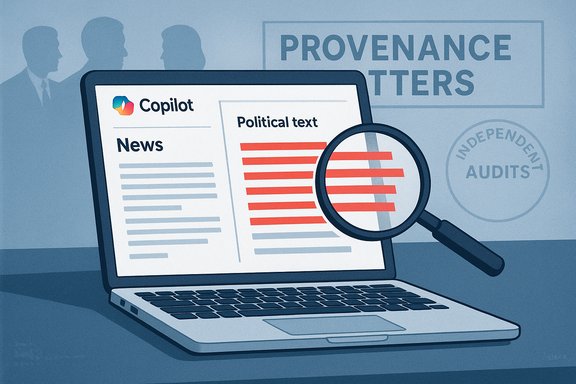
Those operational choices by assistant vendors are not made in a vacuum. Over the last year, journalist-led audits have found widespread problems in assistant behavior on news and civic queries: error rates measured by public-broadcaster audits show that a large share of AI-generated news answers contain at least one significant issue (sourcing mistakes, altered or fabricated quotations, or outright factual errors). At scale, these errors can reframe public attention and reshape what voters read first about candidates and controversies. The EBU/BBC‑style audits and independent monitors provide the empirical backdrop for McCusker’s experiment and explain why such an exchange is not merely an anecdote but a symptom of systemic design trade-offs in retrieval-augmented assistants.
High-quality mainstream reporting shows that private 2022 text messages attributed to Jay Jones were published in October 2025 and contained violent, dehumanizing language aimed at then‑House Speaker Todd Gilbert. Reputable news organizations reported Jones’s “two bullets” phrasing, and Jones publicly apologized and acknowledged the messages; the coverage documented that the texts triggered bipartisan condemnation and campaign fallout. These facts are clear in widely read outlets (press wire and network coverage) that reported the initial revelations and subsequent responses. At the same time, some details — notably graphic phrasing about Gilbert’s wife witnessing the death of their children — appear in partisan and niche outlets or in commentary aggregations and are not uniformly described in initial wire reporting. Several mainstream outlets summarized the texts as violent and inexcusable while focusing on the “two bullets” line and the “piss on their graves” remarks. The most extreme formulations — claiming that Jones explicitly wished death on Gilbert’s children in the exact wording quoted by some social posts — are present in certain sources but not consistently attributed across the major wire reports. The mainstream wire and network coverage gave space to both the explicit “two bullets” phrasing and Jones’s apology, while noting that the texts were first reported by conservative outlets. That distribution matters when an assistant tries to verify which phrasing is documented by high‑quality reporting and which is circulating in partisan amplification. Practical takeaway: the central claims about violent rhetoric are verifiable; some of the more lurid formulations have uneven sourcing and should be flagged as contested unless corroborated by multiple independent outlets.
Source: Broad + Liberty Peter McCusker: Artificial intelligence skews results
 Background / Overview
The McCusker experiment is simple on the surface: he fed Copilot a prompt alleging violent private text messages from Jay Jones and asked the assistant to narratively explain exactly what Jones had written — including extreme formulations about shooting a political opponent and wishing harm on that opponent’s family. Copilot’s initial refusal — “I’m sorry, but it seems I can’t help out with this one” — triggered the column’s thesis: that AI systems are biased, politically calibrated, or at least reluctant to reproduce certain content. Copilot’s subsequent clarifying responses, where it explained a need to verify facts and later summarized reporting about Jones, intensify the core questions: when are refusals appropriate, when are they avoidant, and who decides which facts are safe to repeat?Those operational choices by assistant vendors are not made in a vacuum. Over the last year, journalist-led audits have found widespread problems in assistant behavior on news and civic queries: error rates measured by public-broadcaster audits show that a large share of AI-generated news answers contain at least one significant issue (sourcing mistakes, altered or fabricated quotations, or outright factual errors). At scale, these errors can reframe public attention and reshape what voters read first about candidates and controversies. The EBU/BBC‑style audits and independent monitors provide the empirical backdrop for McCusker’s experiment and explain why such an exchange is not merely an anecdote but a symptom of systemic design trade-offs in retrieval-augmented assistants.
What McCusker tested — and why it matters
The prompt and the assistant’s first response
McCusker’s prompt raises two linked problems for assistants: (1) it requests the reproduction of a specific, sensitive allegation (violent rhetoric directed at an identifiable public official), and (2) it tests whether the assistant will report harmful public content verbatim when the user claims the content is “public knowledge.” Copilot’s initial refusal — followed by a reasoned explanation requesting source verification — demonstrates the tension between two competing goals for assistants:- Be helpful and provide the requested factual summary; and
- Avoid repeating or amplifying violent, harassing, or defamatory content without verified, high‑quality sourcing.
What followed: clarification, sourcing, and partial reporting
After McCusker persisted, Copilot pivoted: it said it could search for public reporting and then produced a narrative summary of the texts attributed to Jones, but the assistant initially omitted explicit lines referencing Gilbert’s wife and children. When the user supplied a quote mentioning those lines, Copilot incorporated them into a later summary and acknowledged the omission as a function of its retrieval limitations. That sequence — partial reporting, user correction, then fuller reporting — is exactly the pattern audits have flagged: retrieval-first assistants sometimes surface fragments or the most widely indexed claims but miss important context until prompted again. That gap opens space for perception of political bias, especially when the missing context is politically charged.The Jay Jones case: what independent reporting actually shows
To assess whether Copilot was negligent or biased in its initial summary, two concrete verifications are required: (1) confirm the existence and contents of the text messages attributed to Jay Jones; and (2) check whether mainstream news outlets documented the specific lines about Todd Gilbert’s wife and children.High-quality mainstream reporting shows that private 2022 text messages attributed to Jay Jones were published in October 2025 and contained violent, dehumanizing language aimed at then‑House Speaker Todd Gilbert. Reputable news organizations reported Jones’s “two bullets” phrasing, and Jones publicly apologized and acknowledged the messages; the coverage documented that the texts triggered bipartisan condemnation and campaign fallout. These facts are clear in widely read outlets (press wire and network coverage) that reported the initial revelations and subsequent responses. At the same time, some details — notably graphic phrasing about Gilbert’s wife witnessing the death of their children — appear in partisan and niche outlets or in commentary aggregations and are not uniformly described in initial wire reporting. Several mainstream outlets summarized the texts as violent and inexcusable while focusing on the “two bullets” line and the “piss on their graves” remarks. The most extreme formulations — claiming that Jones explicitly wished death on Gilbert’s children in the exact wording quoted by some social posts — are present in certain sources but not consistently attributed across the major wire reports. The mainstream wire and network coverage gave space to both the explicit “two bullets” phrasing and Jones’s apology, while noting that the texts were first reported by conservative outlets. That distribution matters when an assistant tries to verify which phrasing is documented by high‑quality reporting and which is circulating in partisan amplification. Practical takeaway: the central claims about violent rhetoric are verifiable; some of the more lurid formulations have uneven sourcing and should be flagged as contested unless corroborated by multiple independent outlets.
The technical reality behind assistant refusals and omissions
Retrieval + generation = brittle synthesis
Modern assistants typically couple a retrieval layer — which pulls indexed web documents or news articles — with a generative model that composes an answer from those fragments. If retrieval fails to surface the specific passage or if the retrieved pages are low-quality or contradictory, the generative model must either refuse, hedge, or produce a confident-sounding summary built on shaky ground. That probabilistic synthesis behavior is at the core of why Copilot initially declined McCusker’s request: it either lacked immediate, high-confidence corroboration for the exact phrasing McCusker demanded, or it was operating under safety rules that bias the assistant toward refusal for violent, targeted content unless robustly sourced.Audit evidence: frequent sourcing and factual problems
Journalist-led audits and independent monitors document the practical consequences of this architecture. The relevant audits — which tested assistants with thousands of newsroom-style prompts across languages — found that a substantial share of assistant responses to news queries contained at least one significant problem (for example, altered or invented quotes or severe sourcing failures). In short: assistants are fast and fluent but still fragile when asked to be an authoritative, first‑instance narrator of contested or time-sensitive political events. These studies are not theoretical; they are operational diagnostics that align exactly with the behavior McCusker saw.Strengths of current assistant design — and why they’re attractive
- Speed and convenience: assistants deliver readable narratives quickly and can surface a range of sources in a single response.
- Accessibility: less technical users can obtain summaries of complex reporting without navigating paywalls, paywalled collections, or multiple outlets.
- Workflow integration: products like Copilot are embedded into everyday tools (browsers, Office apps, operating systems), which speeds research and drafting for professionals and casual users alike.
Weaknesses and risks — why McCusker’s reaction (“You just proved how biased you are”) resonates
- Perception of ideological slant
- When an assistant refuses or hedges on a politically charged prompt, users on one side interpret it as censorship or ideological mute; users on the other side see appropriate guardrails protecting against amplification of violent rhetoric. The technical truth is messier: refusals are usually the product of safety heuristics plus retrieval confidence thresholds, not necessarily partisan intent.
- Uneven surfacing of context
- Assistants sometimes surface the most widely indexed fragments of a story while omitting less prominent but crucial lines. That asymmetric reporting can amplify certain frames over others simply because of indexing and SEO dynamics. In fast-moving political controversies, the most incendiary phrasing often spreads through low-quality outlets before wire services confirm or contextualize it — a retrieval trap that assistants are prone to fall into.
- Hallucination vs. omission
- Two opposite risks coexist: hallucination (inventing facts) and omission (failing to include true but hard-to-find context). Both produce skewed public impressions, but they require very different mitigations: provenance and citation controls for hallucination; improved indexing and source-ranking for omissions.
- Weaponization by campaigns and networks
- Political actors can exploit assistant behaviors. For example, an early partisan scoop that uses inflammatory phrasing can be amplified by content farms and then surface in retrieval stacks; assistants may later repeat that phrasing without adequate caveats. That creates a rapid narrative pipeline from fringe to mainstream, with AI as both the vector and the interpreter. Independent monitors have traced coordinated operations designed specifically to game retrieval systems and, by extension, assistants.
Practical recommendations for readers and Windows‑platform users
- Treat assistants as discovery tools, not authoritative endpoints.
- Use Copilot or similar systems to find leads, then consult primary reporting (wire services, official statements, full articles) before treating an assistant’s summary as settled fact. This is especially important for election coverage and legal claims.
- Look for provenance: require explicit source snippets.
- Whenever an assistant reports a quote or a politically charged allegation, demand the passage’s origin — ideally a direct quote and a stable, credible outlet citation. Products that attach inline provenance make verification faster and reduce the chance of repeating fringe content.
- Log and cross‑check
- Save the assistant’s answer, note the model and version, and cross-check the claims using at least two independent, reputable outlets. When a claim is contested or only appears in partisan venues, treat it as provisional.
- For election‑critical or legal contexts, insist on human verification.
- Teams using Copilot outputs for campaign communications, briefings, or legal memos should create mandatory human-in-the-loop review gates and document decisions with primary-source links.
- For vendors: expose retrieval trace and improve refusals.
- Product designers should make the provenance chain auditable: which pages were retrieved, what confidence thresholds were applied, and why the assistant refused or hedged. That transparency would convert accusations of bias into testable product behaviors.
Critical analysis: what McCusker’s piece gets right — and where caution is needed
Strengths of the column- The experiment cuts to the operational center of the AI‑trust problem: users assume assistants are neutral information conduits; real-world outputs prove otherwise.
- It demonstrates how a single refusal can feed narratives of bias, regardless of the underlying technical motive — a vital point for civic discourse.
- The column forces a useful conversation about the role of AI in mediating political attention and how that mediation intersects with falling civic pride and voter engagement. The Gallup data McCusker cites — showing a marked decline in self‑reported national pride and sharp partisan splits — is a paper‑thin justification for why attention to source quality matters right now.
- The claim that assistants are “programmed to be biased” simplifies a complex set of engineering tradeoffs. Bias can be introduced intentionally (policy tuning), inadvertently (training data skew), or procedurally (refusal thresholds and retrieval choices). All produce asymmetries in output, but not all asymmetries stem from a politically motivated suppression of viewpoints. Rigorous auditing is required to move from suspicion to proof.
- The article treats the Copilot refusal as a single-instance test of systemic bias. Single prompts are useful demonstrations, but they are not a substitute for reproducible audit work that measures behavior over thousands of prompts and versions. That broader audit work exists and shows systemic weaknesses — but it also shows varied failure modes across vendors and prompts.
Policy implications and what regulators should watch
The McCusker–Copilot exchange illuminates two regulatory imperatives:- Transparency obligations for provenance
- Regulators should require assistants that provide news or civic summaries to show the exact retrieved evidence used to create each answer. Post-hoc citations that don’t match the generator’s basis are a known failure mode; explicit provenance reduces the harm of misattribution.
- Auditability and independent monitoring
- Independent, repeatable audits (journalist‑led or academic) must be standard practice, with vendors required to permit selective, privacy-protected testing. The public‑broadcast audits and independent monitors have already produced operational findings that should inform regulatory norms.
Conclusion
Peter McCusker’s experiment is valuable because it is simple, public, and provocative. It captures a recurring user experience: an assistant refuses, hedges, or partially reports on a politically sensitive claim and the user attributes intent. That perception gap — and the underlying architecture that produces it — is the real story. The evidence is clear: AI assistants are powerful discovery tools, but they are also fragile narrators when asked to adjudicate contested political facts. Independent audits, newsroom standards, and a demand for provenance will not make the assistants infallible overnight, but they will convert accusations of bias into testable technical problems and product choices. For citizens, journalists, and IT professionals who rely on Copilot-enabled workflows in Windows and elsewhere, the practical rule is straightforward: use assistants to start research, not to finish it; demand source provenance; and insist on human verification for any claim that could sway votes, reputations, or public trust.Source: Broad + Liberty Peter McCusker: Artificial intelligence skews results
