

Nathan Limm’s 10‑week experiment — asking Microsoft Copilot to act as a running coach and guide him from a 1:55 half‑marathon to a target of 1:40 — reads like a useful case study at the intersection of modern training science and consumer generative AI: humane, encouraging, adaptable and, crucially, limited by the realities of physiology and injury risk.
AI assistants have rapidly migrated from search‑and‑summarize tools into personalized agents that can generate plans, monitor progress and provide on‑demand encouragement. Microsoft positions Copilot explicitly as an assistant that can “personalize” workout plans, track recovery and offer nutrition and motivation tips — the exact capabilities Limm leaned on when he converted a chat‑based Copilot into a running coach.
At the same time, sports science remains conservative about sudden, large performance gains and warns that abrupt spikes in load or unrealistic timelines increase injury risk. The largest recent cohort analysis of recreational runners found that a single‑session spike in distance above about 10% of a runner’s longest run in the prior 30 days substantially increased the risk of overuse injury — a strike‑home reminder that training plans must respect physiological adaptation, not just calendar deadlines.
This article synthesizes Limm’s diary, the capabilities and limits of Copilot as an AI coach, and current training science to explain what worked, what was risky, and what readers should know before handing their preparation to a chatbot.
At the same time, the episode underlines the limits of chat‑only coaching confronting ambitious, short‑fuse goals. Significant performance gains usually require months of progressive, data‑driven work and careful injury mitigation. The science is clear: abrupt spikes (especially in single sessions) raise injury risk; conservative, measurable progress and objective benchmarks are safer and more reliable routes to faster times.
For most readers: use AI as an intelligent training partner, not as a shortcut to extreme improvements. Combine AI plans with objective benchmarks, modest progression rules, sensor data where possible, and a low threshold for human clinical advice when pain persists.
Copilot and other AI coaches represent a meaningful democratization of planning and motivation, and Nathan Limm’s diary demonstrates their immediate practical value: accessible programming, empathetic messaging and on‑demand adjustments. But training is biology in time; fast internet and clever prompts do not accelerate cellular adaptation. Use AI to structure your work, not to outrun the basic laws of training and recovery.
Source: NZ Herald Robot runner: Using AI to plan your half-marathon training
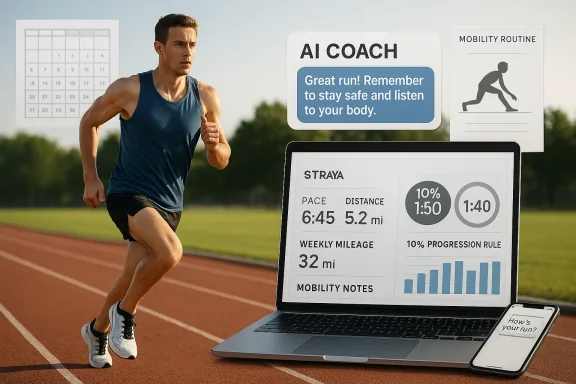 Background
AI assistants have rapidly migrated from search‑and‑summarize tools into personalized agents that can generate plans, monitor progress and provide on‑demand encouragement. Microsoft positions Copilot explicitly as an assistant that can “personalize” workout plans, track recovery and offer nutrition and motivation tips — the exact capabilities Limm leaned on when he converted a chat‑based Copilot into a running coach.At the same time, sports science remains conservative about sudden, large performance gains and warns that abrupt spikes in load or unrealistic timelines increase injury risk. The largest recent cohort analysis of recreational runners found that a single‑session spike in distance above about 10% of a runner’s longest run in the prior 30 days substantially increased the risk of overuse injury — a strike‑home reminder that training plans must respect physiological adaptation, not just calendar deadlines.
This article synthesizes Limm’s diary, the capabilities and limits of Copilot as an AI coach, and current training science to explain what worked, what was risky, and what readers should know before handing their preparation to a chatbot.
Overview of the experiment
The brief and constraints
- Goal: Reduce a baseline half‑marathon time of 1:55 to 1:40 over 10 weeks.
- Tools: Microsoft Copilot (chat), Strava (run tracking).
- No dedicated heart‑rate monitor or GPS racing watch; pacing and perceived effort were the primary intensity measures.
- Health context: full‑time job, social life, and a minor chronic back issue that required mobility work and conservative load management.
Week 1: behaviour and human dynamics
Limm’s week one illustrates two predictable dynamics when a digital coach becomes a relationship: (1) the machine’s tone and responsiveness can generate genuine emotional buy‑in (he felt guilt for “letting down” the coach), and (2) human life — travel, illness, late‑night festival dancing — will sometimes conflict with training prescriptions. Copilot reacted to illness and fatigue by lowering the immediate load and prioritizing recovery; when Limm later reported that he’d gone to a festival and his fatigue spiked, the bot adjusted the plan and emphasized rest. That responsiveness and the nonjudgmental tone are typical strengths of conversational AI.What the AI did well
Personalized intake and iterative adaptation
Copilot’s immediate strength is intake and iteration. By asking for specific details on sleep, soreness, facilities and goals, it can craft a plan that respects individual constraints — a capability Microsoft advertises as a core Copilot use case. The ability to adapt week‑by‑week using user‑reported fatigue and soreness turned a static plan into a dynamic one, and that is valuable for recreational athletes who must balance life and training.Psychological scaffolding and accountability
Limm’s diary makes plain that the AI’s tone matters. The bot’s calm, encouraging replies — “good on you for being honest” — reproduced a coaching voice that reduced stress and encouraged honesty. Research into virtual exercise coaches and virtual presence shows that perceived social presence and immediate feedback improve adherence and motivation, particularly when the interface mimics a supportive coach. Virtual coaches have been effective in feasibility studies for improving walking, maintaining adherence and delivering structured programs.Scalability and cost‑effectiveness
An AI coach like Copilot can be operated without the recurring expense of a human coach, and it will be available 24/7 for plan updates, check‑ins and nutrition suggestions. For many hobby runners, that glidepath to expert‑level planning at a low marginal cost is transformational — especially when the alternative is guessing, copying generic plans, or paying a coach.Scientific and practical limits: where AI struggles
Ambitious goals vs physiological reality
Cutting 15 minutes from a 1:55 half‑marathon (roughly lowering pace from ~5:27/km to ~4:44/km) in 10 weeks demands an extraordinary improvement — about a 13% performance increase. Contemporary training experts recommend setting paces from current fitness (recent race times or benchmark workouts) and expecting modest percentage improvements over one training block; Runner’s World guidance notes typical gains of about 2–3% over 12–16 weeks for many runners when training conservatively and basing paces on current fitness. Translating that to Limm’s case suggests the Copilot target was ambitious and, for many recreational runners, unrealistic without prior consistent training or substantial increases in weekly training volume and targeted speed work.Injury risk from rapid progression
The Garmin‑RUNSAFE cohort analysis published in the British Journal of Sports Medicine identifies single‑session spikes in distance as a primary driver of overuse injuries; when a session exceeds about 10% of the runner’s previous 30‑day longest run, injury risk rises markedly. In plain language: dramatic jumps in distance or intensity to chase an aggressive time goal raise the odds of a training‑ending injury. AI can propose more volume; the human body does not negotiate. Limm’s careful use of mobility work and stepped recovery likely protected his block, but any plan that accelerates load without conservative safeguards is risky.Data limitations: no HR, no form analysis
Copilot’s advice in this experiment was built on self‑report and GPS pace from Strava. That works for basic programming, but it lacks physiological feedback that matters for fine tuning:- No continuous heart‑rate data reduces precision for intensity zones (aerobic vs threshold vs VO2 intervals).
- No power metrics or gait analysis means the AI cannot prescribe form corrections or cadence adjustments that a coach with sensors or video could.
- No direct injury monitoring from wearables (loading patterns, impact metrics) reduces the AI’s ability to pre‑empt overuse patterns.
Hallucination and erroneous medical advice
Generative AIs can produce confident sounding but incorrect guidance. Microsoft has been expanding Copilot’s capabilities (and personality features) while also warning users features are subject to change. Users must be vigilant: an AI is not a licensed clinician, and any persistent pain, neurological symptoms or suspected stress fracture warrants professional medical evaluation. When training is medicalized — e.g., back niggles, recurring joint pain — a human sports clinician should be involved.Cross‑checking the goal: is 1:40 in 10 weeks realistic?
To ground Limm’s target in performance prediction systems, coaches often use calculators based on the Riegel formula or Jack Daniels’ VDOT to estimate attainable times from recent performances. Those tools are useful for setting training paces and estimating realistic goals, but they are sensitive to the input: if your recent performance reflects current fitness, predicted gains over a short block will be modest. Tools and calculators consistently show that very large drops in race time typically reflect either prior under‑training (so a bigger “low‑hanging fruit” improvement is possible) or an extended, structured training history. For a recreational runner starting from 1:55, a 1:40 target inside 10 weeks represents an aggressive jump that would normally require:- a prior base of weekly mileage and consistent aerobic endurance,
- a disciplined block of targeted threshold and interval work,
- careful nutrition and recovery strategies,
- and low susceptibility to injury — a combination few can assemble cleanly in 10 weeks.
What readers should learn from Limm’s week one
1. Intake detail matters
Giving Copilot clear, honest context (sleep, soreness, back pain, equipment) improved the quality of its plan. If you try AI coaching, treat the first chat like a clinical intake.2. AI will — and should — err on the side of conservatism when you report illness
The bot pulled back training when Limm reported a cold and higher fatigue. That’s sensible; premature training after illness increases the risk of poor performance and secondary complications.3. Human behaviour still derails plans
Limm’s festival night and the subsequent spike in fatigue is a reminder that adherence often depends less on algorithms and more on life choices. AI accountability helps, but it can’t eliminate human decision‑making.4. Emotional engagement is real
Even texted encouragement produced guilt and motivation. That effect can boost adherence, but it also means runners may internalize disappointment from missed targets. Good AI design should minimize shame and emphasize short‑term recovery.Practical checklist: how to use an AI coach safely and effectively
- Start with an honest intake
- Recent race times, injury history, weekly availability, sleep patterns, and work commitments.
- Anchor the plan to current fitness, not just the dream goal
- Use a recent race or a benchmark workout to set training paces (VDOT or Riegel tools can help).
- Keep a conservative progression rule for single sessions
- Avoid single‑session distance increases that exceed ~10% of your prior 30‑day longest run to reduce overuse injury risk. Use mobility and cross‑training as buffers.
- Use objective checkpoints
- Schedule tune‑up 5K/10K or benchmark interval sessions every 4–6 weeks to verify progress; that’s more reliable than chasing an arbitrary deadline.
- Don’t skip medical advice for persistent pain
- If pain persists beyond short recovery windows or changes your gait, see a clinician before trusting the bot to “fix” it.
- Add sensors if you can
- A chest strap or wrist heart‑rate monitor, and a GPS watch, supply objective data that meaningfully improves training prescriptions. If you can’t afford those, rely on controlled benchmark workouts and perceived exertion judiciously.
How to prompt an AI coach (practical templates)
Below are tested prompt elements that help an agent like Copilot act as a safer, more practical coach:- “I ran a half‑marathon in 1:55 on [date]. I work 40 hours/week, have a recurring lower‑back niggle that responds to mobility and physiotherapy, and I can train 5 days/week with a maximum 9‑hour weekend block. Create a 10‑week program that prioritizes injury prevention and increases my weekly long run gradualy; explain the benchmarks and give alternate plans if fatigue or illness occurs.”
- “Design a week‑by‑week plan but include: a 4‑weekly benchmark interval (e.g., 6×1km at 5K pace), recommended warm‑ups, mobility sessions for back care, clear rest triggers (e.g., fatigue 4/5), and a 2‑week taper before race day.”
- “If I miss two workouts in a row, suggest an adjusted 2‑week recovery block and outline how the long run and interval sessions should be reintroduced.”
The technology angle: what Copilot can and cannot do
- Copilot’s strength lies in generating structured text plans, nutrition ideas and recovery checklists, and it’s increasingly capable of memory and personalization features that keep user context across sessions. Microsoft’s product messaging and recent feature rollouts show Copilot being positioned explicitly for daily life tasks including workouts.
- Limitations:
- No real‑time gait/form correction without video analysis tools or third‑party integrations.
- No physiological sensing unless coupled with wearables that supply heart‑rate, power or load metrics.
- Potential for confident but incorrect medical advice — Copilot and similar agents vary in how they handle health‑sensitive queries and frequently disclaim that outputs are informational, not clinical. Users must treat AI guidance as a conversation starter, not a definitive medical plan.
- Integration roadmap: the most capable AI coaching systems in research combine chat agents with sensor streams and adaptive learning models; text chat alone is only one layer of a potential multi‑modal coach. Reviews of wearable biosensing indicate that future “artificial coaches” will couple data streams and learning models for stronger prescriptions.
Ethical, privacy and governance considerations
- Memory and data storage: Copilot’s recent updates include memory features and stronger personalization, but any coach that stores health and behavioral data raises questions about privacy, sharing, retention, and potential commercial use. Be proactive: review your AI assistant’s memory settings and remove sensitive history if you prefer not to persist health records in a vendor’s cloud.
- Overtrust: humans can misattribute expertise to polished language models. Treat AI as a tool for planning and motivation — not a licensed exercise physiologist or physiotherapist.
- Equity and access: the promise of democratized coaching is real, but disparities in wearable hardware, mobile connectivity and digital literacy mean AI coaches will not replace human coaching for every population. Research into virtual coaches shows high retention in certain demos but also notes accessibility and diversity gaps.
Verdict: a balanced assessment
AI coaches like Copilot are already useful tools for recreational runners. They excel at intake, plan generation, contingency scripting, accountability nudges and scaling best‑practice templates to individuals. Nathan Limm’s week one shows those strengths clearly: Copilot adjusted intelligently for illness, emphasized mobility for back management, and provided a tone that increased engagement.At the same time, the episode underlines the limits of chat‑only coaching confronting ambitious, short‑fuse goals. Significant performance gains usually require months of progressive, data‑driven work and careful injury mitigation. The science is clear: abrupt spikes (especially in single sessions) raise injury risk; conservative, measurable progress and objective benchmarks are safer and more reliable routes to faster times.
For most readers: use AI as an intelligent training partner, not as a shortcut to extreme improvements. Combine AI plans with objective benchmarks, modest progression rules, sensor data where possible, and a low threshold for human clinical advice when pain persists.
Takeaway guidance — a practical summary
- If you’re curious: try Copilot or another chat coach to build a baseline plan, but anchor it to your most recent race or benchmark workout.
- If you’re ambitious: temper targets with data. Aiming to shave minutes off a half‑marathon in a few weeks is possible for some, but more likely to harm others; build a multi‑block plan and expect modest gains per 8–12 week block.
- If you’re injury‑prone: prioritize mobility, cross‑training and conservative single‑session increases. Avoid runs that leap far above your 30‑day longest session.
- If you’re using only text conversation: set concrete checkpoints (benchmark intervals, 5K/10K tune‑ups) to verify progress objectively.
- If you care about privacy: review AI memory and data settings before sharing health details.
Copilot and other AI coaches represent a meaningful democratization of planning and motivation, and Nathan Limm’s diary demonstrates their immediate practical value: accessible programming, empathetic messaging and on‑demand adjustments. But training is biology in time; fast internet and clever prompts do not accelerate cellular adaptation. Use AI to structure your work, not to outrun the basic laws of training and recovery.
Source: NZ Herald Robot runner: Using AI to plan your half-marathon training
