

Microsoft’s Ignite announcements make a clear, bold claim: Copilot is no longer just a sidebar helper — it is being refactored into a managed, identity‑bound platform of agents that can act inside business systems, convert Dynamics 365 from a “system of record” into a “system of action,” and reshape how enterprises run sales, service, finance, and operational workflows.
Microsoft’s recent messaging centers on a single strategic idea: treat AI agents like first‑class operational workers. That idea bundles several product pillars into one proposition:
Practical advice for leaders is straightforward: pilot deliberately, measure relentlessly, and treat agent deployments as new production services that require lifecycle management, not one‑off experiments. The technology is here in preview form — Agent 365, Sales Development Agent, and expanded MCP servers are available now through Frontier and public previews — but turning these capabilities into reliable business value will be an operational challenge as much as a technical one.
Microsoft’s vision reframes how we think about software products: from passive tools to active, governed collaborators. For enterprises that pair technical discipline with clear governance and adaptation of organizational processes, agents promise outsized returns. For those that don’t, the pace and scale of automation could quickly introduce new risks. The coming months of previews and early pilots will be decisive — they will reveal whether the agentic era is primarily a platform story, a productivity revolution, or a governance headache that demands serious remediation.
Source: Microsoft Microsoft Ignite 2025: Powering Frontier Firms with agentic business applications - Microsoft Dynamics 365 Blog
 Background / Overview
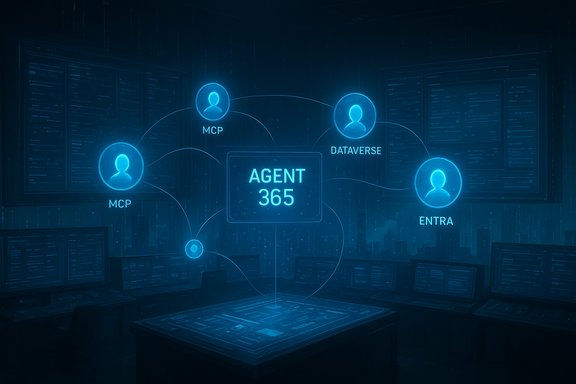
Microsoft’s recent messaging centers on a single strategic idea: treat AI agents like first‑class operational workers. That idea bundles several product pillars into one proposition:- Copilot and Copilot Studio as the authoring and runtime surfaces where agents are designed, tested, and published.
- Model Context Protocol (MCP) servers as standardized bridges between application data and agent runtimes.
- Dataverse, Power Platform, and Dynamics 365 as the state and integration substrate that grounds agents in tenant data and governance.
- Agent 365 as the tenant control plane for discovering, registering, securing, and observing agents at scale.
What Microsoft announced (the essentials)
Sales Development Agent — scaling sales operations
Microsoft introduced the Sales Development Agent (SDA), a first‑party, agentic sales assistant that continuously researches prospects, drafts personalized outreach, and follows up autonomously — handing off to human sellers when escalation is needed. The vendor says SDA will be available through the Frontier Program in December 2025 and will integrate with CRM systems such as Salesforce and Dynamics 365, plus Microsoft 365 apps like Outlook and Teams. Microsoft reports early internal usage produced a 15.1% increase in lead‑to‑opportunity conversion in its own sales organization.- Key SDA capabilities Microsoft highlights:
- Continuous prospect research and personalized outreach.
- Automatic follow‑ups and lead nurturing.
- Intelligent handoff to sellers and integration with seller workflows.
Model Context Protocol (MCP) servers — the integration fabric
Microsoft expanded the MCP footprint across Dynamics 365 and Power Platform:- Dynamics 365 ERP MCP (dynamic) — public preview that exposes a vast set of ERP functions and forms to agents for real‑time, permissioned execution.
- Analytics MCP server — public preview slated for December 2025 to let agents reason over governed ERP analytics and BI definitions.
- Power Apps MCP server — public preview enabling agents to trigger approvals, submit forms, and call app logic.
- Dataverse MCP server — declared generally available, enabling natural‑language answers grounded in Dataverse data.
Agent 365 — the governance and lifecycle control plane
Agent 365 is positioned as the tenant‑level management surface that treats agents like digital employees: inventory, identity (Entra Agent ID), RBAC, telemetry, quarantine controls, and lifecycle operations (enable/disable/kill switch). The platform is being surfaced initially to customers in Microsoft’s Frontier early access program. Major outlets (Reuters, The Verge, Wired) reported Agent 365 as a central Ignite announcement and described its aim to give IT admins the controls they need to deploy agents safely.Partnerships, research and the Frontier Firm initiative
Microsoft is pairing product rollout with executive education and research: a collaboration with Harvard Business School’s Frontier Firm initiative and public Frontier Function Guides for Sales, HR, and IT aim to help leaders operationalize the agentic shift. Harvard’s Digital Data Design Institute materials and Microsoft WorkLab content outline applied research, pilot programs, and upskilling for executives.Why this matters: from helpers to actors
Microsoft’s architecture attempts to address three classic enterprise gaps at once:- Scale — agents can operate 24/7, follow up on large volumes of leads, and surface work to humans only when needed.
- Grounding + governance — MCP + Dataverse + Entra identity aim to ground agent actions in tenant data and existing permission models so actions remain auditable.
- Composability — Power Apps + MCP let organizations expose app functionality as reusable building blocks that agents can call, enabling developers and citizen makers to compose richer agent workflows.
Strengths and practical upsides
Rapid automation of repetitive, high‑volume tasks
Agents like SDA materially reduce time spent on discovery, outreach, and routine triage. For sales organizations facing quota pressure and limited SDR headcount, an agent that can maintain cadence across thousands of touches is an immediately tangible benefit.Reduced integration cost and faster time to value
MCP standardizes a protocol for agent-to-app interactions. This reduces bespoke engineering work for each integration, enabling faster pilots and reusable patterns across ERP, CRM, and Power Apps. Microsoft’s documentation and release notes make this strategic goal explicit and provide preview guidance for implementers.Built‑in governance primitives
Agent 365, Entra Agent ID, and the alignment with existing Purview/Sentinel stacks give enterprises a coherent set of controls — discovery, RBAC, telemetry ingestion, and quarantine — to integrate agents into existing security and compliance workflows. Reuters and The Verge independently reported Agent 365 as Microsoft’s central governance plays.Enterprise readiness for legacy systems
“Computer use” patterns (UI automation) and ERP MCP’s ability to surface tenant customizations make it possible for agents to interact with legacy forms and ISV customizations where APIs were absent — a practical route for real‑world modernization without wholesale rip‑and‑replace. Microsoft’s ERP MCP public preview notes and Learn documentation outline the prerequisites and capabilities.Risks, gaps, and operational realities
1) Performance claims are vendor‑sourced and require replication
The 15.1% lead‑to‑opportunity figure comes from Microsoft’s internal sales data and is presented as aggregate performance for a specific timeframe and total touches. It is a promising signal but not independent proof. Organizations should treat such numbers as hypothesis generators for their own pilots rather than guaranteed outcomes.2) Security and privilege expansion increases attack surface
Agents, by design, will need credentials and permissions to read and write across systems. Every entitlement granted to an agent is a potential vector for misuse, data exfiltration, or misconfiguration. Short‑lived credentials, least‑privilege service identities, conditional access, and tight vetting of allowed MCP clients are mandatory controls. Entra Agent ID and Agent 365 aim to help, but these are new surfaces that will require hardened operational playbooks and constant monitoring.3) Model drift, hallucinations and auditability
Even grounded agents can produce incorrect or non‑actionable results. The new Agent Mode and MCP tooling include “validation stations” and stepwise execution plans, but human review remains essential for high‑impact decisions (financial postings, contract language, legal responses, customer refunds). Treat agents as decision assistants where possible, and as decision actors only when strict validation, thresholds, and rollbacks are in place.4) Governance complexity and organizational change
Treating agents like employees — with identity, licenses, and presence — forces IT, HR, legal, and procurement to collaborate in new ways. Policies for agent onboarding, retention of agent‑generated artifacts, and billing models must be created. Microsoft’s Frontier playbooks and Harvard’s initiative will help with frameworks, but execution requires cross‑functional governance bodies and new skillsets inside teams.5) Cost, telemetry, and compute
Agentic workloads can be compute‑intensive (multimodal reasoning, analytics over large datasets, continuous monitoring). Expect new cost centers (model hosting, Azure Foundry compute, telemetry ingestion). IT must model consumption scenarios, negotiate pricing, and instrument telemetry for ROI tracking before scaling.How to evaluate, pilot, and scale safely (practical guidance)
1. Map candidate workflows (inventory)
- Identify high‑volume, repetitive processes with clear inputs and outputs (lead qualification, invoice intake, case triage).
- Assess data sensitivity and compliance needs (PCI, PHI, PII) to rule in/out automated action.
2. Pilot a single, measurable use case
- Choose a contained domain (inside sales follow‑ups; vendor invoice intake).
- Define success metrics (conversion lift, time saved per ticket, error rate).
- Run the agent in “shadow” mode first (agent produces recommended actions, humans act) to surface accuracy and process gaps.
3. Harden identity and access
- Assign Entra Agent IDs and short‑lived credentials.
- Use Agent 365 to register, monitor, set RBAC and allowed MCP clients.
- Enforce least privilege and access reviews.
4. Require human checkpoints for high‑risk actions
- Implement validation stations and rollbacks in Copilot Studio workflows.
- Define thresholds for when agents can act autonomously vs. when they must escalate.
5. Establish telemetry and audit trails
- Capture action provenance, model routing decisions, context snapshots, and operator overrides.
- Integrate logs into Sentinel and Purview for SIEM and compliance reporting.
6. Measure, learn, iterate
- Track false positive/negative rates, user trust scores, and business KPIs.
- Retune prompts, grounding indices (Dataverse indices), and decision thresholds from telemetry.
Technical and licensing checkpoints (what IT must verify)
- Confirm your tenant is eligible for Frontier preview if you want early access to Agent 365 or Sales Development Agent.
- Review MCP prerequisites for ERP agents: minimum product versions, feature flags, environment tiers (Microsoft Learn outlines specific version and environment requirements).
- Validate which third‑party models (Anthropic, OpenAI) are permitted in your tenant and how model routing is controlled.
- Confirm Dataverse MCP availability in your region and test natural‑language grounding with your sovereign data controls in place.
Where Dynamics 365 and Power Platform fit into an agentic stack
- Dataverse acts as the canonical state store and grounding layer for tenant data, enabling agents to fetch consistent records and audit history.
- Power Apps MCP server exposes app actions as callable tools, turning Power Apps into composable primitives.
- Dynamics 365 ERP MCP lets agents perform ERP tasks with the application’s existing permission model — important for preserving audit and compliance trails.
- Copilot Studio provides the authoring, validation, and publishing pipeline for agents, with templates and observability to iterate in production.
Realistic scenarios and early adopter patterns
- Sales: deploy SDA in a contained inside‑sales unit to automate outreach cadence and triage inbound inquiries; keep high‑value accounts on human‑only paths.
- Finance: pilot invoice intake agents to extract, validate, and route invoices into an approval flow in Power Apps with human validation for exceptions.
- Customer service: use MCP‑connected agents to pre‑populate case summaries and recommended resolutions, then hand to reps for personalization.
- HR: automate candidate pre‑screening and scheduling while preserving human oversight for interviews and offers.
Executive checklist: moving toward the Frontier
- Approve a pilot charter with KPIs, budget, and cross‑functional sponsorship.
- Ensure legal and compliance sign‑off on candidate processes and data retention.
- Provision an Agent 365 sandbox and register the first agents using Entra Agent ID.
- Validate MCP client allowlists and enable feature flags in non‑production environments.
- Start telemetry dashboards (Sentinel, Purview) for agent actions and model decisions.
- Partner with internal change management to train “agent managers” — the emerging role responsible for overseeing fleets of agents.
Final analysis — a powerful platform with operational obligations
Microsoft’s move to formalize agents as tenant‑governed, identity‑bound workers is a strategic reckoning with the realities of enterprise AI adoption. The strength of the approach lies in integrating agents with well‑known enterprise constructs (identity, RBAC, Dataverse, audit trails) and in providing a standard protocol (MCP) that reduces bespoke engineering work. The risk lies in treating agents as plug‑and‑play magic: without disciplined identity hygiene, human checkpoints, telemetry, and measurable ROI criteria, agentic automation can amplify errors and compliance exposures at scale.Practical advice for leaders is straightforward: pilot deliberately, measure relentlessly, and treat agent deployments as new production services that require lifecycle management, not one‑off experiments. The technology is here in preview form — Agent 365, Sales Development Agent, and expanded MCP servers are available now through Frontier and public previews — but turning these capabilities into reliable business value will be an operational challenge as much as a technical one.
Microsoft’s vision reframes how we think about software products: from passive tools to active, governed collaborators. For enterprises that pair technical discipline with clear governance and adaptation of organizational processes, agents promise outsized returns. For those that don’t, the pace and scale of automation could quickly introduce new risks. The coming months of previews and early pilots will be decisive — they will reveal whether the agentic era is primarily a platform story, a productivity revolution, or a governance headache that demands serious remediation.
Source: Microsoft Microsoft Ignite 2025: Powering Frontier Firms with agentic business applications - Microsoft Dynamics 365 Blog
