

Microsoft’s Copilot has moved from assistant to checkout lane: Copilot Checkout lets users discover products and complete purchases inside Copilot conversations without being redirected to merchant websites, and the initial U.S. rollout arrives with major commerce partners—Shopify, PayPal, and Stripe—plus prebuilt retail templates (Brand Agents, catalog enrichment, store‑ops agents) that aim to make “agentic commerce” practical for retailers and IT teams.
Microsoft presented Copilot Checkout as part of a broader retail push at industry events and in partner channels: the feature is rolling out in the United States on Copilot.com and is intended to integrate conversational discovery, product selection, and payment into a single, auditable flow. Microsoft frames this as an “agentic commerce” move—AI that not only recommends but acts—paired with Copilot Studio templates that let merchants deploy Brand Agents and catalog‑enrichment automations. This announcement consolidates several trends observed across the industry: platforms embedding checkout into chat and search, payments vendors exposing delegated/tokenized payment primitives, and merchants seeking tighter, purchase‑ready discovery surfaces. Independent reporting confirms Microsoft’s partners and launch merchants (examples cited include Urban Outfitters, Anthropologie, Ashley Furniture, and some Etsy sellers), and Microsoft emphasizes that merchants remain merchant of record—they own fulfillment, returns, and customer relationships even when the purchase completes inside Copilot.
Key product points Microsoft and partners emphasize:
For retailers and Windows‑focused IT teams, the practical path forward is deliberate piloting: validate conversion metrics, verify SLAs and token flows, harden AgentOps and audit logs, and ensure clear customer consent and refunds workflows exist. If those guardrails are in place, Copilot Checkout could become a high‑value, low‑friction channel that brings conversational commerce from experimental to operational scale. Note: Vendor metrics and conversion claims cited here come from Microsoft and partner materials; merchants should validate these numbers in their own controlled tests.
Source: Windows Report https://windowsreport.com/microsoft-launches-copilot-checkout-for-ai-chat-shopping/
 Background / Overview
Microsoft presented Copilot Checkout as part of a broader retail push at industry events and in partner channels: the feature is rolling out in the United States on Copilot.com and is intended to integrate conversational discovery, product selection, and payment into a single, auditable flow. Microsoft frames this as an “agentic commerce” move—AI that not only recommends but acts—paired with Copilot Studio templates that let merchants deploy Brand Agents and catalog‑enrichment automations. This announcement consolidates several trends observed across the industry: platforms embedding checkout into chat and search, payments vendors exposing delegated/tokenized payment primitives, and merchants seeking tighter, purchase‑ready discovery surfaces. Independent reporting confirms Microsoft’s partners and launch merchants (examples cited include Urban Outfitters, Anthropologie, Ashley Furniture, and some Etsy sellers), and Microsoft emphasizes that merchants remain merchant of record—they own fulfillment, returns, and customer relationships even when the purchase completes inside Copilot. What Copilot Checkout Actually Is
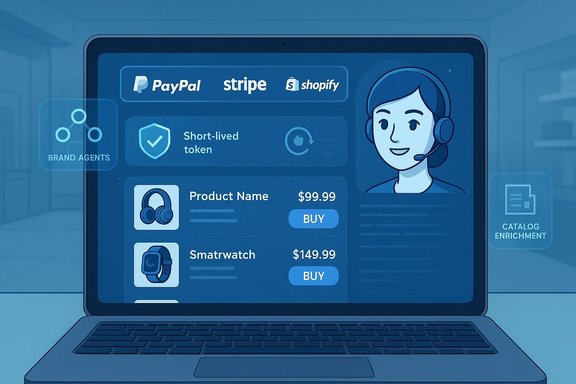
Copilot Checkout is a native, in‑chat checkout widget surfaced when a Copilot conversation reaches a purchase decision. Instead of ending a shopping dialogue with links that send the user to a merchant site, Copilot presents a “Buy” path that opens a short, contextual checkout screen inside the Copilot UI where shoppers confirm shipping, payment, and fulfillment choices.Key product points Microsoft and partners emphasize:
- In‑chat checkout: Full purchase flow inside Copilot (no redirect required on supported merchants).
- Merchant of record retained: Merchants keep control of fulfillment, returns, and customer data.
- Multiple payment partners: Initial payment plumbing is provided by PayPal, Stripe and Shopify (Shopify merchants are slated for automatic enrollment following an opt‑out window).
- Templates for retailers: Copilot Studio ships Brand Agents, catalog enrichment, and store operations templates to shorten deployment time.
How Copilot Checkout Works — Technical Anatomy
At a technical level, Copilot Checkout assembles three coordinated layers that mirror modern agentic commerce architectures:1. Structured catalog ingestion
Agents rely on machine‑readable product feeds—SKU, GTIN, images, inventory levels, shipping metadata—rather than scraping storefront HTML. This canonical product data reduces hallucination risk and ensures provenance for recommendations. Microsoft supplies catalog‑enrichment tooling to normalize and augment feeds where merchants need it.2. Conversational orchestration (Copilot runtime)
The Copilot runtime interprets intent, asks clarifying questions (size, color, delivery window), and maintains provenance linking each suggestion back to an auditable product record. This orchestration layer coordinates multi‑step flows—discovery → clarification → selection → buy—while producing logs necessary for dispute resolution and analytics.3. Delegated, tokenized checkout
When a buyer confirms, Copilot requests a short‑lived checkout session or delegated payment token that hands the transaction to the merchant’s checkout system or a payments partner. Tokenization reduces exposure of raw card data to the conversational surface while enabling merchants and PSPs (payment service providers) to process charging, fraud checks, and settlement. PayPal, Stripe, and Shopify are named as launch partners providing these delegated rails. These primitives—structured feeds, runtime orchestration, and tokenized checkout—are the same building blocks other platforms (OpenAI, Google) have used in previous in‑chat or agentic checkout efforts. Microsoft’s differentiator is distribution (Copilot across Edge, Copilot app, Copilot.com) and prebuilt enterprise governance tooling in Azure/Foundry to manage identity, observability, and AgentOps.Partners, Onboarding, and Merchant Experience
The initial rollout shows a partner‑first strategy:- PayPal: powering inventory surfacing, branded checkout, guest checkout, and multiple funding options; PayPal states buyer and seller protections apply to eligible transactions. PayPal’s press release highlights its store‑sync and agentic commerce capabilities as core enablers.
- Shopify: Shopify merchants will be automatically enrolled after an opt‑out window; Microsoft frames Shopify as allowing “the merchant’s checkout powered by Shopify” to surface inside Copilot. That means Shopify merchants won’t need custom integrations to appear in Copilot Checkout, but they must review opt‑out/terms.
- Stripe: Positioned as infrastructure for delegated payment flows; Stripe executives are quoted as supportive of open protocols that connect agents with merchant backends. Microsoft cites Stripe alongside other card network initiatives (Mastercard Agent Pay, Visa Intelligent Commerce) for future extensibility.
Benefits — Where Value Appears
For merchants and shoppers, Copilot Checkout promises several concrete benefits:- Reduced friction: Eliminating redirects lowers the steps between intent and payment, which should reduce cart abandonment. Early partner materials report strong conversion signals for Copilot journeys.
- Higher intent conversion: Microsoft and PayPal cite metrics (for example: journeys that include Copilot led to 53% more purchases within 30 minutes and were 194% more likely to convert when shopping intent is present). These figures are presented in Microsoft partner materials; merchants should treat them as vendor data points to verify during pilots.
- New distribution surface: Copilot is available across Copilot.com, Edge and other Copilot surfaces; appearing in those results increases discoverability beyond brand channels.
- Brand control: Microsoft explicitly states merchants remain the merchant of record. That preserves merchants’ control over pricing, fulfillment, returns, and customer service. However, operational integration must be confirmed contractually.
Risks, Unknowns, and Governance Concerns
The technology is promising, but several risks must be managed deliberately.- Data and privacy exposure: Centralizing more purchase metadata in Copilot increases the amount of consumer and transaction context held by a platform. Microsoft emphasizes opt‑in controls and governance, but merchants and compliance teams must verify what data is shared, how long it’s retained, and whether consumer consent meets local regulatory requirements (e.g., GDPR, CCPA).
- Dispute resolution and liability boundaries: “Merchant of record” language is important but not dispositive. How disputes, chargebacks, fraud claims, and returns are handled in multi‑party flows (Copilot → PSP → merchant) requires explicit contracts and operational playbooks. Merchants should insist on written SLAs and clear responsibilities for fraud prevention and chargeback costs.
- Catalog and metadata quality: Copilot’s shopping accuracy hinges on high‑quality, machine‑readable product data. Poor feeds will lead to incorrect recommendations, inventory mismatches, and customer dissatisfaction. The catalog enrichment templates help, but they are not a substitute for disciplined product data governance.
- Fraud and payment security: While delegated/tokenized checkout reduces direct exposure of card data to Copilot, merchants still depend on PSP fraud filters and Microsoft’s integration security. Ensure PCI‑DSS responsibilities and token lifecycle policies are well understood.
- Operational complexity and human fallback: Agents can automate many decisions but require human oversight for exceptions. Retailers must design AgentOps playbooks, escalation paths, and audit logs to prevent silent failures or harmful automated decisions.
How This Compares To Competitors
Copilot Checkout joins an expanding field of platforms embedding checkout into AI assistants:- OpenAI launched Instant Checkout with Stripe and Shopify integrations in 2025, enabling ChatGPT purchases for select merchants. Google is experimenting with agentic checkout in Search/Gemini. Microsoft’s strategy is differentiated by distribution (Edge + Windows tie‑ins), prebuilt merchant tooling (Copilot Studio templates), and explicit partner onboarding mechanics.
- Platform incumbents (Amazon, Google) bring different tradeoffs: Amazon has direct seller fulfillment and marketplace economics; Google offers Search intent and Google Pay integration; OpenAI’s approach is model‑centric and protocol oriented. Microsoft’s angle is enterprise governance and merchant retention of records, pitched to retailers concerned about losing customer relationships to platforms.
Practical Checklist for Merchants and IT Teams
For retail IT teams and merchants evaluating Copilot Checkout, here are recommended steps before onboarding:- Confirm onboarding model (Shopify auto‑enroll vs. PayPal/Stripe application) and opt‑out timing.
- Validate product feed integrity: SKUs, GTINs, images, inventory, and shipping metadata must be machine‑readable and regularly synced.
- Review settlement, fees, and chargeback policies with PSPs and Microsoft—get clear SLAs in writing.
- Test delegated checkout flows in a sandbox: token lifecycle, fraud rules, refunds, and end‑to‑end order provenance.
- Implement AgentOps and governance: logging, escalation, human‑in‑the‑loop workflows, and audit trails.
- Define customer support playbooks for returns and disputes originating from Copilot purchases.
- Measure and A/B test conversion, average order value, and post‑purchase NPS against existing channels before scaling.
Governance, Compliance, and Security Notes
- Confirm how customer consent for in‑conversation purchases is obtained and logged; design UIs to surface terms clearly. Microsoft emphasizes opt‑in permission flows, but merchants must verify consent capture meets legal/regulatory requirements in each market.
- Tokenized checkout reduces raw card exposure, but merchants remain accountable for PCI obligations tied to how tokens are exchanged and stored. Validate token revocation policies, replay protections, and PSP fraud tools.
- Auditability is central: ensure Copilot and merchant logs preserve provenance of product recommendations, price shown at confirmation, and the tokenized checkout session. These are crucial for chargebacks and regulatory audits.
What to Watch Next
- Geographic expansion beyond the U.S.: Microsoft’s launch is U.S.‑first; international availability will require localization, payments localizations, and regulatory compliance.
- Wider payment rails: Microsoft and partners referenced Mastercard Agent Pay and Visa Intelligent Commerce as next‑wave integrations—watch for card‑network primitives that standardize agentic checkout.
- Standardization/Interoperability: Protocols like the Agentic Commerce Protocol (ACP) or open standards could determine whether merchant integrations scale across multiple AI assistants or lock merchants into specific platforms. Microsoft signals intent to adopt open protocols, but the details and governance of those standards deserve scrutiny.
- Regulatory attention: As assistants gain transactional capabilities, expect increased regulatory focus on disclosures, liability, and data portability. Retailers and platforms should monitor guidance from consumer protection and payments regulators.
Conclusion
Copilot Checkout is a decisive push by Microsoft to embed commerce into conversational AI and to present Copilot as a full funnel channel: discovery, decision, and payment in one surface. Microsoft’s approach—coupling Copilot’s conversational engine with partner payment rails (PayPal, Shopify, Stripe) and merchant‑focused templates—addresses obvious friction points in the buying journey and gives retailers tools to keep customer relationships intact. The upside is tangible: faster conversion paths, new distribution, and richer discovery experiences. The risks are operational and contractual: feed quality, dispute mechanics, privacy, and the exact division of liability between platform, PSP, and merchant. These are solvable problems but require disciplined engineering, governance, and legal review before handing checkout lanes to autonomous agents.For retailers and Windows‑focused IT teams, the practical path forward is deliberate piloting: validate conversion metrics, verify SLAs and token flows, harden AgentOps and audit logs, and ensure clear customer consent and refunds workflows exist. If those guardrails are in place, Copilot Checkout could become a high‑value, low‑friction channel that brings conversational commerce from experimental to operational scale. Note: Vendor metrics and conversion claims cited here come from Microsoft and partner materials; merchants should validate these numbers in their own controlled tests.
Source: Windows Report https://windowsreport.com/microsoft-launches-copilot-checkout-for-ai-chat-shopping/
