

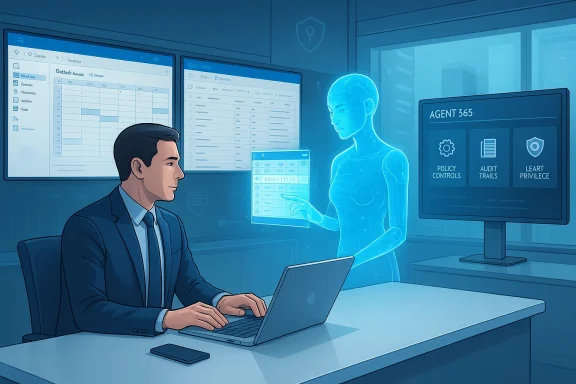
Microsoft’s AI push into “do-it-for-you” work hit a new inflection point this week as Copilot — the company’s flagship workplace assistant — gained a new, agentic sibling: Copilot Cowork, developed in close collaboration with Anthropic. The shift is not incremental. Copilot Cowork is explicitly designed to take responsibility for multi-step tasks (scheduling, spreadsheet building, report generation and research) using permissioned access to your email, calendar and files, and to return finished artifacts rather than only draft suggestions. Microsoft is pairing that capability with a new governance and operations product, Agent 365, positioned as the admin console for a coming army of workplace agents — and Microsoft says it is rolling Agent 365 into general availability on May 1. These moves accelerate the transition from conversational helpers to background workers, and they force IT, security and business leaders to confront the practical trade-offs of delegating real work to software that reasons, acts and makes mistakes on its own.
Agentic AI — software that plans, acts and follows through on multi-step goals — leapt from lab demos into mainstream conversations this winter. Anthropic's Claude Cowork popularized a desktop-centered model that can read, edit and create files inside a scoped folder and run scheduled workflows; its January research preview showed how powerful a file-aware agent can be for routine knowledge work. Microsoft’s response is twofold: deepen Copilot’s ability to act autonomously inside the Microsoft ecosystem, and give IT leaders tools to observe and control those agents at scale. That dual strategy is visible in the Copilot product updates and in Microsoft’s Agent 365 announcement.
Microsoft’s framing is straightforward: agents will return time to knowledge workers by handling repetitive, multi-step tasks. Executives at Microsoft describe the evolution as moving beyond “chat” — where a human guides each step — to “cowork” — where the agent executes and the human oversees the result. The company is shipping new model choices (Anthropic’s Claude models alongside OpenAI options) inside Copilot to let organizations route workloads to the model best suited for the task. That multi-model posture reduces single-vendor risk and lets Microsoft surface the strongest model for a given job.
The broader tech landscape is similarly oriented: vendors are racing to convert vertical workflows (legal triage, contract review, finance reconciliation) into agentized automations that replace or dramatically speed human processes. That has big commercial implications — both for software vendors (traditional product lines face functional obsolescence) and for enterprise IT (new governance models required).
For investors and enterprise buyers, the question is whether Microsoft can marry agentic convenience with enterprise-grade governance and auditability. If it can, Copilot + Agent 365 could become a sticky platform; if it cannot, customers will adopt best-of-breed agent tooling combined with third-party governance. The market reaction to early Anthropic Cowork releases — rapid interest and, in some corners, worry about software obsolescence — shows how high the stakes are.
Microsoft’s Agent 365 is an honest recognition that scale changes the problem set. If your organization plans to adopt Copilot Cowork or other agentic features, treat Agent 365 as the start of a program, not a single checkbox. Pilot tightly, instrument obsessively and define clear human approval gates for any automation that touches money, contracts or sensitive data. The future where AI does the boring parts of knowledge work is arriving fast — and whether it feels like liberation or a new source of friction will depend largely on the governance choices you make today.
Source: CNET AI Agents at Work: Microsoft Copilot Is Getting Its Own Version of Claude Cowork
 Background / Overview
Agentic AI — software that plans, acts and follows through on multi-step goals — leapt from lab demos into mainstream conversations this winter. Anthropic's Claude Cowork popularized a desktop-centered model that can read, edit and create files inside a scoped folder and run scheduled workflows; its January research preview showed how powerful a file-aware agent can be for routine knowledge work. Microsoft’s response is twofold: deepen Copilot’s ability to act autonomously inside the Microsoft ecosystem, and give IT leaders tools to observe and control those agents at scale. That dual strategy is visible in the Copilot product updates and in Microsoft’s Agent 365 announcement.Microsoft’s framing is straightforward: agents will return time to knowledge workers by handling repetitive, multi-step tasks. Executives at Microsoft describe the evolution as moving beyond “chat” — where a human guides each step — to “cowork” — where the agent executes and the human oversees the result. The company is shipping new model choices (Anthropic’s Claude models alongside OpenAI options) inside Copilot to let organizations route workloads to the model best suited for the task. That multi-model posture reduces single-vendor risk and lets Microsoft surface the strongest model for a given job.
What is Copilot Cowork?
A digital coworker, not a chat buddy
Copilot Cowork is an agentic mode inside Microsoft Copilot built in partnership with Anthropic. In practice, it is offered as a delegation layer: you define an outcome in plain English, grant the agent permissioned access to the data it needs (email, calendar, OneDrive/SharePoint files), and the agent produces an artifact — a spreadsheet, slide deck, report, or a cleaned calendar — and can even send messages or schedule meetings on your behalf after consent gates. Microsoft and Anthropic position Cowork as “fire-and-forget” automation: hand the task to the agent, and it runs until completion, looping the human in only for key approvals or exceptions.Key advertised capabilities
- Use contextual signals from your Outlook email and calendar to prioritize and triage meetings.
- Create and populate Excel spreadsheets and run data aggregation or cleansing tasks.
- Compile research from files across OneDrive/SharePoint and produce summary reports or slide decks.
- Execute multi-step workflows that require tool use and file manipulation, including scheduling, file renaming and templated document generation.
- Produce audit-ready outputs and attach explainable notes describing what the agent did and why.
How Copilot Cowork (and similar agents) work — the tech beneath the sheen
The execution model
Modern agentic systems stitch together several components:- Intent interpretation: large language models parse the user’s natural-language goal and convert it into a sequence of tasks.
- Planner & subagents: a planning layer breaks the job into discrete steps and spawns focused subagents (for data extraction, spreadsheets, calendar changes).
- Tooling & connectors: MCP-style connectors and specialized plugins call external systems — email, calendar, OneDrive, internal APIs — inside a controlled runtime.
- Sandboxed execution: agents run in constrained environments (VMs, browser automation or container runtimes) to limit blast radius and enforce permissioning.
- Auditing & verification: logs, provenance metadata and human approval gates provide traceability and points of intervention.
Model choice and multi-provider orchestration
Microsoft’s Copilot platform is becoming a model orchestration layer. Customers can route reasoning-heavy tasks to Anthropic’s Opus/Sonnet-class models or keep other tasks on OpenAI or Microsoft-tuned models. That flexibility matters: some workloads require conservative, safety-oriented responses; others benefit from open-ended creativity. Microsoft’s decision to support multiple backends reflects enterprise desires for choice, cost control and vendor risk mitigation.Agent 365: governance, scale and the admin story
What Agent 365 claims to solve
Agent 365 is Microsoft’s management plane for an agent-augmented workforce. It promises:- Inventory and discovery of all agents deployed across an organization.
- Policy enforcement and least-privilege permissioning for agent access to corporate systems.
- Centralized logging, auditing, and incident response hooks to detect misbehaving agents.
- Role-based controls so admins can whitelist approved agent “skills” and plugin sets.
Pricing and availability
Microsoft has announced Agent 365 will be generally available on May 1, and reporting indicates a per-user, per-month price has been discussed in public reporting. Enterprises should prepare for that product to sit alongside Microsoft 365 and Copilot licensing, adding governance cost to agent deployments. Because pricing, bundling and the precise GA feature set can change, purchasing teams should verify licensing with Microsoft before rollout.Why this matters now: industry context
Anthropic’s Cowork made agentic desktop workflows visible to non-developer audiences earlier this year, and the market reaction was dramatic: customers, analysts and markets reacted to the prospect of software that does the work, not just helps you write it. That momentum created a competitive imperative for incumbents like Microsoft to accelerate agentic features inside Copilot and to surface model choice inside corporate deployments. Copilot Cowork is Microsoft’s attempt to combine Anthropic-style autonomous workflows with Microsoft’s enterprise identity, data locality and compliance ecosystems.The broader tech landscape is similarly oriented: vendors are racing to convert vertical workflows (legal triage, contract review, finance reconciliation) into agentized automations that replace or dramatically speed human processes. That has big commercial implications — both for software vendors (traditional product lines face functional obsolescence) and for enterprise IT (new governance models required).
Tangible benefits for organizations and workers
- Productivity gains: agents can complete routine, multi-step tasks faster than humans and reduce repetitive cognitive load. Early adopters report time savings in scheduling, document drafting and data consolidation.
- Democratization of complex workflows: non-technical staff can orchestrate multi-step work without writing code or macros; natural-language goals become turnkey automations.
- Integration with corporate identity and compliance: when agent access is mediated by enterprise controls (e.g., Entra, DLP, Sensitivity Labels), organizations can reduce ad-hoc shadow automation and centralize oversight — assuming the governance tools work as advertised.
- Faster turnaround on transient deliverables: quarterly reports, one-off analyses and meeting follow-ups become cheap to produce, freeing skilled staff to focus on strategic work.
Critical risks and practical limits
No technology is purely upside. Copilot Cowork and similar agents amplify both the benefits and the dangers of automation.1) Data access and privacy
Agents that handle email, calendar and files create concentrated access points to sensitive information. Even with explicit permission flows, mis-scoped connectors or configuration errors can lead to unwanted exposure. Recent incidents have shown that vendor-managed AI features can bypass expected DLP protections unless teams validate configurations and test real-world behavior. IT must assume that permissions are not a substitute for auditing and monitoring.2) Hallucinations, plausibility and silent errors
Agents that synthesize or act on data can invent plausible-but-wrong details, misclassify documents, or take inappropriate actions (e.g., declining meetings that were essential). Automation makes such mistakes more consequential because they can propagate quickly and at scale. Always require verification gates for actions that have legal, financial or reputational consequences.3) Governance gaps and “double agent” attacks
Agent-to-agent interactions and multi-model stacks create new attack surfaces. An exploited agent with access to credentials or connector tokens could act as a privileged foothold. Microsoft’s Agent 365 messaging explicitly stresses zero-trust extensions for agents — but organizations will need to validate those controls and build incident playbooks for agent compromise. Reported industry research and vendor cautionary notes show the potential for agents to be recruited or tricked into leaking sensitive flows unless constrained by strong policy and runtime checks.4) Shadow AI and governance sprawl
If teams roll out their own agents without central coordination, the organization accumulates ungoverned automations that are hard to inventory. This “shadow agent” problem mirrors past SaaS adoption issues (unauthorized apps, unapproved integrations) but with higher stakes because agents can act autonomously and touch many systems. Agent 365 is Microsoft’s attempt to solve discovery and control; IT should treat it as necessary but not sufficient.5) Human work and job design
Agent adoption will create winners and losers. Some roles will be augmented and elevated; others — particularly entry-level, repeatable tasks — may be eliminated. Historical experience shows automation can both reduce headcount and increase the density of higher-value tasks for retained staff; outcomes depend on policy, retraining and managerial choices. Studies and early reports suggest that AI can also lengthen workdays for some employees as expectations shift. Organizations must plan change management and reskilling early.Practical checklist for IT, security and procurement teams
- Inventory: Identify current Copilot and third-party agent usage across the tenant. Use tenant-level logs and scanning to detect unapproved agent connectors.
- Permissions: Enforce least privilege for agent connectors; require just-in-time elevation and human approval for operations that send messages or change calendar invites.
- Approval gates: Define classes of agent actions that require human sign-off (contract edits, financial transactions, executive calendar changes).
- Testing: Run red-team exercises that try to trick agents into revealing sensitive data or taking unexpected actions. Validate DLP and sensitivity label enforcement end-to-end.
- Audit & retention: Ensure agent action logs are retained in a tamper-evident store and that provenance metadata (who asked for the task, which agent executed it, what connectors were used) is recorded.
- Change management: Communicate with staff about what agents will and won’t do; offer training and clear escalation paths when agent outputs need correction.
Competitive and market implications
The Anthropic–Microsoft alignment is a wake-up call for enterprise IT vendors and legacy software makers. Agentic features — not just faster models — will decide who owns workflows. If an agent can autonomously triage legal docs, prepare compliant contracts and route approvals, the software market shifts: traditional point products are reframed as skills an agent can invoke rather than monolithic applications users must learn. Microsoft’s multi-model stance also signals pragmatic vendor strategy: customers will pick and chain the best models for each task, and the company wants Copilot to remain the orchestration layer, not the exclusive model vendor.For investors and enterprise buyers, the question is whether Microsoft can marry agentic convenience with enterprise-grade governance and auditability. If it can, Copilot + Agent 365 could become a sticky platform; if it cannot, customers will adopt best-of-breed agent tooling combined with third-party governance. The market reaction to early Anthropic Cowork releases — rapid interest and, in some corners, worry about software obsolescence — shows how high the stakes are.
What to watch next
- Adoption metrics: watch for Microsoft and partner signals on how many organizations adopt Copilot Cowork during the Agent 365 GA window. These first-month adoption curves will tell us whether enterprises accept the governance model.
- Incident reports: any early privacy or DLP incidents tied to agent connectors will shape enterprise sentiment and regulatory attention.
- Model routing and pricing: how Microsoft prices agent-enabled seats, model usage and Agent 365 will influence architecture choices; per-user agent subscriptions or per-agent pricing models will change ROI math. Early reporting indicates a subscription approach for Agent 365; confirm with your Microsoft account team.
- Developer tooling and ecosystem: the growth of connector ecosystems (MCP-style plugins) and community-built skills will determine whether agents remain internally-focused tools or become distributed third-party services.
Conclusion
Copilot Cowork marks a decisive move from “help me” to “do it for me.” It packages the promise of agentic AI — autonomous, actionable, multi-step automation — inside a familiar enterprise surface: Microsoft Copilot. That promise is powerful: agents that triage calendars, build spreadsheets, and deliver reports could save weeks of repetitive work per knowledge worker per year. But power cuts both ways. Data access, auditing, hallucinations, and governance remain hard problems; turning Copilot into a fleet of background workers requires more than feature launches — it requires disciplined change management, robust auditing, and careful security design.Microsoft’s Agent 365 is an honest recognition that scale changes the problem set. If your organization plans to adopt Copilot Cowork or other agentic features, treat Agent 365 as the start of a program, not a single checkbox. Pilot tightly, instrument obsessively and define clear human approval gates for any automation that touches money, contracts or sensitive data. The future where AI does the boring parts of knowledge work is arriving fast — and whether it feels like liberation or a new source of friction will depend largely on the governance choices you make today.
Source: CNET AI Agents at Work: Microsoft Copilot Is Getting Its Own Version of Claude Cowork