Microsoft 365 Copilot Researcher Goes Multi-Model: Claude, Critique, and Cowork

  • Thread Author
Microsoft’s latest push to make M365 Copilot Researcher smarter is really a bet on multi-model intelligence—and it may be the clearest sign yet that enterprise AI is moving beyond the single-model era. According to Microsoft’s own recent announcements, the company is now blending OpenAI and Anthropic capabilities inside Microsoft 365 Copilot, with Claude available in mainline Copilot Chat via the Frontier program and with Copilot Cowork bringing long-running, multi-step task execution into the product family. The direction is obvious: Microsoft wants AI that not only answers faster, but also checks itself before it speaks.
The immediate significance is twofold. First, Microsoft is turning Researcher into a more disciplined research workflow by adding a second model layer for critique, validation, and quality control. Second, the company is making a public case that the future of work AI will be built from a portfolio of models, not a single flagship system. That matters because it changes how enterprises think about accuracy, trust, governance, and vendor dependency all at once.
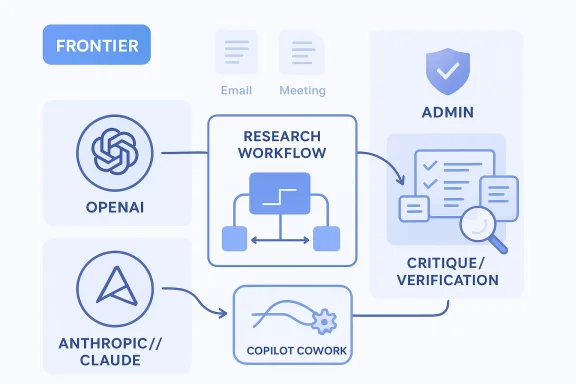
Illustrated workflow diagram connecting OpenAI and Anthropic/Claude to a research process with admin review.Overview​

Microsoft introduced Researcher and Analyst in March 2025 as first-of-their-kind reasoning agents for Microsoft 365 Copilot, designed to work across emails, meetings, files, chats, and the web. In that first version, Researcher combined OpenAI’s deep research model with Microsoft 365 Copilot’s orchestration and search stack, positioning it as an answer engine for more complex, multi-step work. The company’s message then was that AI could move from chatty assistance to actual knowledge work.
What has changed since then is the architecture of trust. Microsoft has spent the last year broadening model choice across Copilot Studio and Microsoft 365 Copilot, while adding Anthropic models to its enterprise stack and emphasizing that the right model should be chosen for the right job. That includes support for Claude in Researcher, model selection in Copilot Studio, and broader “multi-model” language in Microsoft’s newest frontier messaging.
The result is a new competitive framing. Instead of asking whether OpenAI or Anthropic “wins,” Microsoft is asking whether a workflow can be composed from the best parts of each model. That is a subtle but important shift, because enterprise buyers generally care less about brand loyalty in the model layer than they do about quality, security, and operational reliability.
Microsoft’s Frontier program is central to this strategy. Frontier is Microsoft’s early-access space for new AI features in Microsoft 365, letting eligible users try experimental agents before general availability. In practical terms, that gives Microsoft a controlled way to test model behavior, collect feedback, and stage rollouts without forcing every customer into the same pace of change.
The TechRadar report’s framing of “multi-model agents checking each other” fits squarely inside Microsoft’s published roadmap, even if some of the benchmark claims in that article are not directly verifiable from Microsoft’s public material alone. What Microsoft has confirmed is the broader strategy: OpenAI remains foundational, Anthropic is now part of the stack, and Researcher can use Claude in a live session before reverting to the default Microsoft model afterward.

Why this matters now​

The enterprise AI market has spent the last two years debating whether one strong general-purpose model is enough. Microsoft’s answer is increasingly no—at least not for work that requires citation quality, multi-step reasoning, or policy-sensitive outcomes. That is especially important in document-heavy environments, where bad synthesis can be more damaging than a simple factual error.
For Microsoft, the strategic value is that model diversity reduces the risk of overcommitting to any one frontier system. For customers, it creates a chance to pair models with different strengths, but it also raises the bar for governance. The more models that touch a workflow, the more important it becomes to know which one made which decision.

From Single-Model Assistants to Multi-Model Workflows​

Microsoft’s new direction reflects a broader industry realization: complex work is rarely a one-shot prompt. A research agent may need to gather, summarize, cross-check, and refine information before producing something worthy of business use. That makes a chain of responsibility more valuable than a single model speaking with confidence.
The multi-model idea is compelling because it mirrors how human teams operate. One person drafts, another reviews, and a third verifies facts or raises edge cases. In AI terms, Microsoft is trying to encode that same workflow by having one system generate and another critique. That is not just a product feature; it is a design philosophy.

Why orchestration matters​

Orchestration is where enterprise AI becomes operational rather than experimental. Microsoft has repeatedly emphasized that Researcher depends on Copilot’s deep search and task orchestration, while Copilot Studio now supports multiple model families for specialized tasks. In other words, the model is only one part of the system; the workflow design around it is what creates value.
That matters because many AI failures are not “model failures” in a narrow sense. They are workflow failures: wrong source selection, shallow verification, poor context retention, or a lack of quality gates. A critique pass can help catch some of those issues, but only if the system is designed to expose uncertainty rather than hide it. That is the real test.
  • Multi-model orchestration can improve output quality.
  • Critique layers may reduce unsupported claims.
  • Task delegation can lower the burden on users.
  • Governance becomes more complex as workflows span more models.
  • The best system may not be the biggest model, but the best chain.

A more human-like division of labor​

The clearest benefit of this approach is specialization. One model can be optimized for retrieval-heavy synthesis, another for long-context review, and another for final presentation. Microsoft’s product direction suggests it sees the research agent as a team rather than a solo performer.
That aligns with Microsoft’s broader “Frontier” framing, where agents are meant to complete tasks across time rather than merely answer questions in the moment. The company is no longer just selling a copilot; it is selling a layered workflow fabric.

Researcher’s Evolution Inside Microsoft 365 Copilot​

Researcher has always been one of the most ambitious parts of Microsoft 365 Copilot because it reaches beyond casual assistance into serious synthesis. Microsoft originally described it as a reasoning agent that could combine secure access to work data with web research to deliver highly skilled expertise on demand. That positioning was important because it framed Copilot not as a chatbot, but as a work-relevant analyst.
The new step is not simply “better answers.” It is better supervised answers. Microsoft’s documentation now shows Claude available in Researcher sessions, with admins able to control access and with the system reverting to the default model after the session ends. That suggests Microsoft is treating Claude as an opt-in specialist rather than a wholesale replacement.

How the Claude option changes the product​

There is a strategic reason Microsoft chose to expose model choice in Researcher before many other surfaces. Researcher is exactly where accuracy expectations are highest and where a second-pass critique can have the most visible value. If users trust a research agent on difficult questions, they are more likely to trust the rest of the Copilot ecosystem.
There is also a competitive reason. Google, OpenAI, Perplexity, and others are all staking claims in the deep research category, but enterprise buyers care about more than benchmark bragging rights. They want sources, controllability, and fit with existing productivity software. Microsoft’s advantage is that it can surface research, review, and action inside the same Microsoft 365 environment.
  • Researcher is moving from a single-model pattern to a model-choice pattern.
  • Claude is being used as an optional session-level capability.
  • Enterprise admins retain control over model access.
  • The workflow is designed to fit Microsoft 365, not sit beside it.
  • Microsoft is prioritizing trust and orchestration over novelty alone.

The importance of session boundaries​

Microsoft’s session-based Claude support is easy to overlook, but it matters a lot. By reverting to the default model after a session ends, Microsoft limits some of the operational ambiguity that can come from persistent model switching. That makes the feature easier to govern, audit, and explain to IT teams.
This is a classic enterprise compromise. Flexibility is welcome, but only if it doesn’t make the platform harder to secure. Microsoft seems to understand that the winner in enterprise AI may be the vendor that makes advanced model choice feel boringly manageable.

Copilot Cowork and the Move Toward Delegated Work​

If Researcher is about better answers, Copilot Cowork is about better delegation. Microsoft says the feature is built in close collaboration with Anthropic and brings the technology behind Claude Cowork into Microsoft 365 Copilot to support long-running, multi-step tasks. That is a meaningful evolution because it moves the product from “help me think” toward “handle this workflow.”
This shift is important for a simple reason: enterprises do not buy software to chat with it. They buy software to reduce effort. A copilot that can help draft and review is useful; a copilot that can carry a task forward over time is potentially transformative.

From prompts to task execution​

Microsoft has been saying for months that it wants Copilot to do more than answer one-off prompts. Its “Wave 3” messaging focuses on intelligence that understands context of work, while Frontier exposes early access to experimental agents and workflow capabilities. Copilot Cowork fits directly into that narrative.
In practical terms, this may be the more disruptive part of the announcement. Research agents get headlines, but delegated workflow execution is where ROI tends to emerge. If an AI assistant can manage multi-step work with fewer human interventions, organizations can save time in ways that are easier to measure and justify.

What users should expect​

Even so, this is still frontier technology, not a mature autopilot. The benefits depend on the task being well-structured, the data being available, and the approval process being clear. Microsoft’s own Frontier framing signals that the company sees these experiences as experimental and subject to change.
That caution is healthy. In enterprise environments, an agent that is occasionally wrong is one thing; an agent that is wrong and persistent is something else entirely. The more work you hand over, the more important traceability becomes.
  • Better for multi-step, repeated work.
  • More aligned with how business processes actually run.
  • Potentially higher ROI than pure chat features.
  • Requires tighter governance and auditability.
  • Still depends on user oversight and policy controls.

What Microsoft Is Signaling to the Market​

This announcement is about more than product updates. Microsoft is signaling that the AI market should expect composition rather than consolidation. The future, in Microsoft’s view, is not one model to rule them all, but a managed stack of models coordinated by a trusted work platform.
That is a subtle challenge to rivals. OpenAI may still power core capabilities, but Microsoft is no longer behaving like a single-supplier dependent. Anthropic is now a visible part of the Copilot story, and Microsoft has publicly described itself as “model-diverse by design.” That phrase is doing a lot of work.

Competitive implications for OpenAI and Anthropic​

For OpenAI, the upside is continued platform reach inside Microsoft’s enterprise distribution machine. For Anthropic, the upside is broader enterprise exposure and a strong validation point inside one of the world’s most important productivity suites. For both, the downside is that Microsoft is increasingly the orchestrator, not the captive customer.
That could ultimately be good for buyers. Multi-model competition tends to reduce lock-in and push vendors to differentiate on actual strengths. But it also means customers need to think more carefully about data flows, policy boundaries, and how model outputs are routed across systems.

Why benchmarks matter, but only up to a point​

TechRadar highlighted benchmark comparisons such as DRACO, but Microsoft’s public material does not fully expose the testing methodology behind every claim in that report. What Microsoft does have publicly is a growing body of research on deep research systems, citation reliability, and the difficulty of auditing such tools at scale. That research suggests the broader category is still hard to evaluate cleanly.
That is why the market should be careful about treating any single score as destiny. Benchmark wins are useful signals, but enterprise value depends on real workflows, not synthetic leaderboards. The hard part is making intelligence dependable every day.
  • Microsoft is positioning itself as a multi-model platform.
  • OpenAI remains central, but not exclusive.
  • Anthropic gains enterprise legitimacy through Copilot.
  • Competition may improve quality and reduce lock-in.
  • Benchmarks are informative, but workflow reliability matters more.

Accuracy, Critique, and the Problem of Trust​

The most interesting part of the story may be the critique layer itself. AI systems that review other AI systems are a logical response to the problem of hallucinations, but they are not magic. A second model can improve quality, yet it can also inherit blind spots, overconfidence, or shared training assumptions.
Microsoft’s own research on deep-research systems underscores the complexity of evaluation. In its LiveDRBench work, the company argued that deep research should be understood as broad, reasoning-intensive exploration and not merely the generation of long reports. That matters because it suggests the hard part is not prose length but evidence collection and claim formation.

What critique can do well​

A critique pass is strongest when the failure mode is obvious: missing sources, weak logic, incomplete coverage, or factual inconsistency. It can also help standardize style and force a system to revisit weak assumptions before delivering the output. In that sense, critique is a quality-control mechanism more than a source of new intelligence.
It is also a psychologically useful feature. Users are more likely to trust a system that visibly checks itself than one that simply delivers a confident answer. That said, visible self-checking only helps if the checks are meaningful and not just ceremonial. A polished mistake is still a mistake.

Where critique can fail​

The biggest risk is correlated error. If two models draw from similar assumptions, datasets, or retrieval patterns, they may agree for the wrong reasons. In that case, a critique layer becomes a confidence amplifier rather than a truth detector.
Another risk is user overreliance. If the system looks more rigorous, people may stop checking as carefully, especially in high-volume enterprise environments. Microsoft’s governance and admin controls will matter a lot here, because trust must be designed into the workflow rather than assumed from the branding.
  • Critique improves surface quality, but not infallibility.
  • Shared blind spots can survive multi-model review.
  • Users may over-trust polished outputs.
  • Governance controls are essential.
  • The best outcomes still depend on human oversight.

The enterprise trust stack​

Microsoft’s broader agent strategy shows it understands trust as a stack, not a checkbox. Frontier provides early access, admin controls shape rollout, and Agent 365 is being positioned as the control plane for AI agents. That architecture suggests Microsoft knows the hard problem is not model access; it is lifecycle management.
This is also where Microsoft has an advantage over pure-play AI startups. It already owns the productivity layer, the identity layer, and much of the compliance surface area that enterprises care about. If it can make agent governance feel native, that may matter more than any single benchmark gain.

Enterprise vs. Consumer Impact​

For enterprise customers, the new Researcher and Copilot Cowork direction could be genuinely useful, especially in legal, finance, consulting, research, and operations teams. These are environments where the value of AI depends on source quality, workflow consistency, and the ability to reuse existing Microsoft 365 data securely. Microsoft’s own materials repeatedly tie Copilot to emails, files, meetings, chats, and organizational knowledge.
For consumers and smaller teams, the story is slightly different. They are more likely to value speed and simplicity than policy controls and admin governance, but the same multi-model foundation may still improve answer quality. The biggest consumer benefit will likely be better research synthesis and more capable task completion in familiar apps.

The business buyer’s lens​

Enterprise buyers will ask whether the multi-model layer improves outcomes, not just demos. They will care about latency, cost, audit trails, access controls, and whether the agent can consistently cite reliable sources. Those questions will matter more than whether the system sounds smarter in a launch video.
Microsoft is clearly trying to answer those concerns ahead of time by emphasizing phased rollout, admin control, and the Frontier program. That is the right instinct. Enterprise AI adoption usually fails when product ambition outruns operational maturity.

The consumer-quality question​

Consumers, on the other hand, may not notice the model plumbing at all. What they will notice is whether research answers are more complete, whether outputs need fewer edits, and whether the assistant actually helps finish work. In that sense, the success metric is not model diversity itself, but perceived usefulness.
  • Enterprise users need governance and traceability.
  • Consumer users care more about ease and usefulness.
  • Microsoft can differentiate through native Microsoft 365 integration.
  • Multi-model depth may be invisible until something goes wrong.
  • Successful rollout depends on confidence, not just capability.

Strengths and Opportunities​

Microsoft’s approach has several genuine strengths. It is rare to see a major platform company openly embrace model diversity instead of pretending one architecture should serve every need. That gives Microsoft flexibility, makes the platform more resilient, and creates room for specialized quality gains in difficult workflows.
It also gives Microsoft a strong story for regulated and enterprise-heavy markets. By combining Frontier access, admin controls, and session-scoped model choice, the company can argue that it is innovating without abandoning governance. That balance is likely to be attractive to IT teams.
  • Model diversity reduces single-vendor dependency.
  • Critique layers can improve answer quality.
  • Copilot Cowork extends AI from answering to doing.
  • Frontier offers a safe-ish way to test new features.
  • Microsoft 365 integration keeps workflows in one place.
  • Admin controls help with enterprise governance.
  • Anthropic support increases competitive leverage and choice.

A better fit for complex knowledge work​

The biggest opportunity is in work that demands synthesis rather than recall. Research, briefing, analysis, and workflow execution are exactly where Microsoft wants Copilot to live. If it succeeds, it could define the next phase of productivity software.
That is why this is more than a feature update. It is a statement about what modern productivity software should be: less chat, more collaboration; less single-answer prompting, more managed reasoning. That is a meaningful product philosophy.

Risks and Concerns​

The risks are just as real as the opportunities. Multi-model systems can be more accurate, but they can also become more opaque, especially when users do not know which model handled which stage of a task. Once the workflow gets complicated, troubleshooting and accountability get complicated too.
There is also a reputational risk. If Microsoft markets the system as highly reliable and users encounter confident but wrong outputs, trust could erode quickly. In enterprise software, trust is sticky when things work and very fragile when they don’t.
  • Model hallucinations can still slip through critique.
  • Shared blind spots may survive multi-model review.
  • Governance complexity rises with every added model.
  • Admin misconfiguration could limit safe rollout.
  • Overpromising benchmarks can backfire if real-world results lag.
  • Latency and cost may increase with multi-step review.
  • User overreliance could reduce independent checking.

The hidden cost of sophistication​

More sophistication usually means more moving parts. That can be fine in a lab, but at enterprise scale it creates support, audit, and compliance burdens. Microsoft’s architecture may be right, but the operational overhead will still need to be justified by measurable gains.
There is also a market risk that the industry becomes fixated on model choreography while underinvesting in better information grounding. If retrieval is weak, multiple models will simply debate weak evidence faster. That is why Microsoft’s own deep-research research is so important: it points to the underlying problem rather than just the product wrapper.

Looking Ahead​

The next phase will be about proving that this architecture works outside of controlled previews. Microsoft has already signaled that Frontier access, Claude support, and new Wave 3 experiences are rolling out in stages, which means the real test will be customer adoption, not launch-day enthusiasm. If users consistently see better research quality and smoother task completion, the strategy will gain momentum quickly.
What to watch next is whether Microsoft can preserve simplicity while adding power. That is the central tension in enterprise AI right now. Users want better answers and more automation, but they do not want every task to become a model-selection exercise.
  • Frontier expansion beyond early access cohorts
  • Wider Claude availability in Researcher and Copilot Chat
  • More public detail on critique and validation behavior
  • Agent 365 governance adoption by enterprise IT teams
  • Evidence of real workflow gains, not just benchmark wins
The most likely outcome is not a single dramatic leap but a steady normalization of agentic work. Microsoft is building the scaffolding for an AI workplace where model choice, critique, and task delegation become ordinary features rather than headline novelties. If that vision holds, the real winner will not be any one model provider but the enterprise customer who gets more reliable work done with less friction.

Source: TechRadar Microsoft and OpenAI are making AI research tools smarter to answer the trickiest questions
 

Microsoft is pushing Copilot deeper into the realm of work execution, not just work assistance, and that shift matters. With Copilot Cowork now available through the Frontier program, Microsoft is testing an agent that can plan and carry out multi-step tasks across Microsoft 365 while keeping the user in control. At the same time, the company is strengthening Researcher with multi-model evaluation tools like Critique and Model Council, a sign that Microsoft wants enterprise AI to be both more capable and more trustworthy.

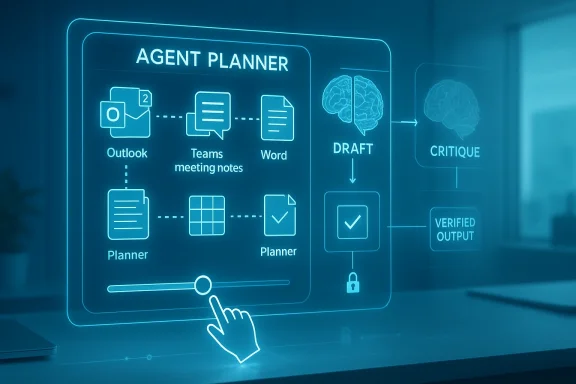
Neon-blue “Agent Planner” UI shows workflow tools like draft, critique, and verified output.Overview​

The current wave of Copilot changes is best understood as Microsoft’s attempt to move from chatbot-style productivity to agentic productivity. Instead of asking Copilot to draft a paragraph or summarize a document, users can now ask it to pursue an outcome, break the job into steps, and work through the task across files, conversations, and apps. That is a big philosophical and practical leap, because it turns AI from a suggestion engine into something closer to a delegated assistant. (microsoft.com)
Microsoft describes Cowork as a way to go “from to dos to done,” and the product language is deliberately expansive. The feature can handle long-running, multi-step work and can be used for recurring workflows, not just one-off prompts. In Microsoft’s own example set, that includes things like inbox organization, meeting prep, event planning, and research tasks, all of which suggest a future where Copilot becomes a layer over routine knowledge work. (learn.microsoft.com)
Just as important, Microsoft is not presenting this as a finished consumer release. Frontier is a preview program, and Microsoft makes clear that availability and capabilities may change over time. That framing matters because it shows the company is still calibrating the balance between usefulness, safety, and enterprise-grade reliability before it scales these features more broadly. (learn.microsoft.com)
The companion story is Researcher, which Microsoft is positioning as a serious deep-research tool rather than a simple summarizer. The new Critique feature uses one model to generate work and another to review it, while Model Council lets users compare multiple model outputs side by side. In other words, Microsoft is making model diversity itself part of the product design, which is a strong signal that the company sees reliability as a multi-model problem rather than a single-model race.

Background​

Microsoft has spent several years building Copilot from a productivity add-on into a platform strategy. Early Copilot features were about writing help, summarization, and assisted content creation, but the company has steadily moved toward task completion and orchestration. The emergence of Wave 3 and Frontier suggests that Microsoft now believes the market is ready for AI that acts, not just AI that answers.
The broader backdrop is the enterprise AI arms race. Microsoft, Google, Anthropic, OpenAI, and others are all racing to define what “work AI” means in practice, but Microsoft has an advantage: it sits directly on top of the workflows people already use every day. Word, Excel, Outlook, Teams, SharePoint, Planner, and Power Platform give Microsoft a distribution channel that startups can only envy. That makes each new Copilot capability more strategically important than it might appear from the outside. (learn.microsoft.com)
A second background thread is trust. Enterprises do not just want smart outputs; they want auditability, security boundaries, and predictable behavior. Microsoft repeatedly emphasizes Work IQ, security, privacy, and compliance in its Frontier materials, and that is not accidental. The company knows that any agent that can send emails, create documents, or execute workflows has to be boxed in carefully or it becomes a liability. (microsoft.com)
The move to multi-model intelligence also reflects a wider industry realization: no single model is best at everything. Microsoft’s Researcher update places OpenAI and Anthropic models into complementary roles, with one drafting and another critiquing. That is a practical response to the very real problem that AI systems can sound convincing while still being incomplete, shallow, or wrong. (microsoft.com)

Why this timing matters​

Microsoft is launching these features at a moment when enterprises are moving from AI experimentation to AI budgeting. That means buyers are asking harder questions about ROI, governance, and adoption friction. By releasing these capabilities in Frontier, Microsoft is effectively inviting customers to help shape the product before broad rollout. (learn.microsoft.com)
  • Frontier gives Microsoft a controlled way to test agent behavior.
  • Preview access creates a feedback loop with real users.
  • Multi-model design helps Microsoft frame AI quality as measurable, not mystical.
  • The company can iterate before these features reach a larger audience.
  • Enterprise trust is becoming a product feature, not a marketing line.

Copilot Cowork and the Rise of Task-Oriented AI​

Copilot Cowork is the headline feature because it pushes beyond conventional assistant behavior. According to Microsoft, users describe the outcome they want, and Cowork plans the steps and takes action across files and conversations while the user stays in control. That is fundamentally different from a passive assistant, because the software is no longer just generating content; it is managing work sequences. (microsoft.com)
The implication is that Copilot is becoming a kind of workflow broker. If the feature works as advertised, it could reduce the friction of switching between apps, copying context, and chasing follow-up actions. That matters most for people whose work is already fragmented across Outlook, Teams, Word, and shared drives, because the value comes from stitching the workflow together rather than merely improving one step. (learn.microsoft.com)
At the same time, the user retains intervention rights. Microsoft says people can adjust or redirect the process at any stage, which is a crucial design choice. The safest agent is not the most autonomous one; it is the one that makes its intentions visible, lets the user intervene, and fails gracefully when the context is ambiguous. That distinction could determine whether Copilot Cowork feels empowering or unnerving. (learn.microsoft.com)

What Cowork actually changes​

The biggest shift is not that Cowork can do more, but that it changes how users frame requests. Instead of asking for a draft, a summary, or a checklist, they can ask for an outcome and let the system reason backward. That saves time, but it also requires trust in the model’s planning abilities and its ability to preserve the user’s intent. (learn.microsoft.com)
Another important detail is recurrence. Microsoft says Cowork can support recurring workflows such as monthly budget reviews, which is where real productivity gains often live. Repetition is where automation creates compound value, and if Microsoft can make recurring tasks reliable, the feature could become sticky very quickly. (learn.microsoft.com)

Practical use cases​

  • Inbox triage and follow-up management.
  • Meeting preparation with document and conversation context.
  • Event planning and coordination.
  • Monthly review or reporting cycles.
  • Research-driven prep work that spans multiple files and threads.
Cowork also reflects a broader design trend in Microsoft 365: the product is becoming less like a suite of separate apps and more like an intelligent workspace. That strategy is especially powerful for enterprise customers because it preserves Microsoft’s core advantage, namely that the work already lives inside its ecosystem. If Copilot can operate natively across that ecosystem, it can reduce the need for employees to jump out to third-party tools for routine coordination.

Researcher and the Multi-Model Turn​

Microsoft’s Researcher update may be less visible than Cowork, but it is arguably just as important. The new Critique feature splits generation from evaluation: one model drafts the answer, and a second model reviews it for quality before delivery. That is a classic reliability pattern in human workflows, and Microsoft is now formalizing it in software. (microsoft.com)
The company says the Critique setup uses a combination of models from frontier labs, including Anthropic and OpenAI, and that it improved Researcher’s performance by 13.8% on the DRACO benchmark. Whether buyers care about the benchmark number or not, the underlying point is clear: Microsoft is trying to prove that multi-model workflows can outperform single-model approaches on demanding research tasks. (microsoft.com)
That is a meaningful competitive move because research tasks expose AI weaknesses quickly. Deep research is where hallucinations, incomplete synthesis, and citation quality become glaringly obvious. By using one model to generate and another to critique, Microsoft is effectively building a second line of defense into the product. That is not a guarantee of correctness, but it is a smart mitigation strategy. (microsoft.com)

Why critique matters​

Critique acknowledges a simple truth about enterprise AI: good output is often the result of structured review, not raw model size alone. Users may not care which model wrote the first draft if the final answer is better validated, clearer, and more grounded. Microsoft is leaning into that reality by making evaluation part of the workflow rather than an afterthought. (microsoft.com)
The company’s language also suggests a future in which model roles become specialized. One model might plan, another might critique, and another might compare alternatives. That is a useful way to think about AI maturity because it mirrors the division of labor in real teams, where no single person is expected to be expert, editor, and auditor all at once. (microsoft.com)
  • Generation and evaluation are now separated.
  • Multi-model output is becoming a product feature.
  • Review stages can reduce obvious errors and improve confidence.
  • Research quality is being measured, not just marketed.
  • Microsoft is pushing toward structured AI collaboration.

Researcher’s broader value​

Researcher’s original promise was to synthesize information across sources and deliver cited answers that users could act on with confidence. The new upgrade extends that promise by making the model process more transparent and more robust. For enterprises, that transparency is valuable because it creates a clearer basis for internal trust and governance. (microsoft.com)
There is also a strategic angle here: Microsoft is normalizing the idea that different models should be used for different sub-tasks, even inside one product. That weakens the notion that one vendor’s model is the sole answer to every problem, and it may make Microsoft’s Copilot stack more durable if market leadership shifts among foundation-model providers over time. Flexibility is becoming a competitive moat.

Model Council and User Choice​

The Model Council feature may sound modest, but it could be one of the more consequential additions. It lets users compare responses from different models side by side, instantly revealing where they agree, where they diverge, and what each model contributes. That is useful not only for quality control, but also for teaching users how to think about model behavior. (microsoft.com)
This is a subtle shift in product philosophy. Instead of hiding model variation, Microsoft is exposing it. That can increase transparency, but it also means users may see disagreements that force them to make judgment calls. In enterprise settings, however, that may be a feature rather than a bug because it gives teams a basis for reasoned review. (microsoft.com)

Transparency as a feature​

Transparency in AI often sounds like a compliance slogan, but in practice it changes how teams work. If users can see how two models handle the same task, they can spot uncertainty, bias, or omissions more quickly. That can lead to better decisions, especially on high-stakes research where confidence should never be confused with correctness. (microsoft.com)
Model Council also gives Microsoft a way to showcase the strengths of its multi-vendor strategy. Rather than pretending that one model wins every comparison, the company can position Copilot as a workspace where the best answer is assembled from several sources. That is a nuanced pitch, and it may resonate with enterprises that already manage mixed-vendor IT environments.
  • Users can compare model output directly.
  • Differences become visible instead of hidden.
  • Better for auditing and decision support.
  • Useful for training teams to evaluate AI critically.
  • Reinforces Microsoft’s multi-model narrative.

The human factor​

There is, however, a risk that comparison features become a crutch. If users rely on side-by-side outputs without understanding model limitations, they may still choose the wrong answer more confidently. The upside is real, but transparency does not eliminate judgment; it simply makes judgment easier to exercise. (microsoft.com)

Wave 3 and Microsoft’s Enterprise AI Strategy​

Microsoft is framing all of this as part of Wave 3 of Microsoft 365 Copilot, and that framing is strategic. Wave 3 is not just about adding features; it is about rebranding AI at work as a trusted execution layer. The company explicitly says this marks a turning point in how AI shows up at work, combining intelligence with trust so AI can scale safely across the workforce. (microsoft.com)
That positioning matters because enterprise buying is increasingly about operational fit, not just model quality. A flashy demo can attract attention, but a durable platform needs governance, controls, audit trails, and workflow integration. Microsoft is trying to own that middle ground by making Copilot the place where AI gets embedded into daily work rather than bolted onto the side. (microsoft.com)

How this differs from consumer AI​

Consumer AI chatbots often optimize for speed, delight, and broad usefulness. Microsoft’s enterprise approach is more constrained, but it aims for repeatability, context, and policy alignment. That difference is why features like Work IQ, Frontier, and critique loops matter so much: they are designed to make AI fit the bureaucracy of real organizations. (microsoft.com)
The strategy also signals where Microsoft thinks value will accrue next. If AI can become a dependable layer over enterprise work, then the company can monetize not just prompting, but execution, orchestration, and governance. That is a more defensible business model than chasing consumer novelty alone.
  • Wave 3 emphasizes execution over experimentation.
  • Trust and compliance are treated as product features.
  • Microsoft is packaging AI as workflow infrastructure.
  • The value proposition is enterprise productivity at scale.
  • Copilot is becoming a platform, not a feature.

Enterprise vs consumer impact​

For enterprises, the immediate appeal is obvious: fewer handoffs, better context, and more automation inside approved tools. For consumers, the value is more limited unless Microsoft eventually broadens access beyond preview channels and premium subscriptions. That split suggests Microsoft is prioritizing commercial adoption first, then consumer polish later. (learn.microsoft.com)

Competitive Implications​

This release puts pressure on nearly every major AI productivity rival. Google, Anthropic, and a long list of startup vendors all want to own the “AI assistant for work” category, but Microsoft’s advantage is distribution and data gravity. When the assistant already lives inside the document, the inbox, and the meeting system, the switching costs become much higher. (microsoft.com)
It also challenges the idea that the future is a single model with a single best answer. Microsoft is implicitly betting that enterprises will value systems that combine models, rather than choose one and hope for the best. That could shift industry emphasis toward orchestration, evaluation, and model routing rather than pure model scale. (microsoft.com)

Rival response scenarios​

One likely reaction is that competitors will add more visible human-in-the-loop review tools of their own. Another is that they will push harder on specialty workflows, such as sales, customer service, or research, where one narrow agent can outperform a general-purpose workplace assistant. The third response, and perhaps the most important, will be price pressure if AI execution features become table stakes.
There is also a subtle competitive message in Microsoft’s model-agnostic posture. By publicly combining OpenAI and Anthropic in one workflow, Microsoft is signaling that it values outcome quality over vendor purity. That makes Copilot harder to box into one foundation-model narrative, which could be an advantage if the market keeps fragmenting. (microsoft.com)
  • Distribution remains Microsoft’s strongest moat.
  • Multi-model orchestration may become an industry norm.
  • Specialized agents could compete on vertical depth.
  • Price and governance will shape buying decisions.
  • Model diversity reduces dependence on any single vendor.

The market signal​

The biggest market signal is that AI productivity tools are moving from “help me write” to “help me finish.” That shift changes how buyers evaluate products, because they now care about task completion reliability, not just output quality. In that sense, Microsoft is helping define the next purchasing checklist for enterprise AI. (learn.microsoft.com)

Security, Privacy, and Governance​

Microsoft repeatedly highlights security, privacy, compliance, and Work IQ in its Frontier materials, and that emphasis is essential to understanding the product. An AI agent that can access files, conversations, and organizational context must be governed carefully, or it risks becoming a compliance headache. The more autonomous the workflow, the more important the controls around it become. (microsoft.com)
Preview status helps here because it limits exposure while Microsoft learns how people actually use the system. But preview does not eliminate risk. If a model misreads context, acts on stale information, or oversteps user intent, the impact could include wasted time, incorrect business decisions, or data-handling mistakes. (learn.microsoft.com)

Governance questions buyers will ask​

Enterprise buyers will want to know what data Cowork can touch, what actions it can take, and how those actions are logged. They will also want clarity on permissions inheritance, approval flows, and whether an admin can scope the feature tightly enough for sensitive departments. Those are not side issues; they are the difference between a pilot and a rollout. (learn.microsoft.com)
Researcher raises slightly different questions. If one model drafts and another critiques, organizations will want to understand how disagreements are resolved, how citations are verified, and whether the review process itself is auditable. The more Microsoft leans into multi-model reasoning, the more important it becomes to explain how those models interact under the hood. (microsoft.com)
  • Access control will determine real-world adoption.
  • Auditability is critical for regulated industries.
  • Model disagreements need clear resolution logic.
  • Preview programs are useful but not sufficient.
  • Security and utility must evolve together.

The trust problem in plain language​

The trust challenge is not whether Copilot can sound competent; it is whether it can be consistently dependable across many contexts. That is a harder standard, and it is why Microsoft is investing so heavily in critique loops and side-by-side comparisons. Better architecture does not guarantee perfection, but it does show the company understands where enterprise trust actually comes from. (microsoft.com)

Strengths and Opportunities​

Microsoft’s latest Copilot move has several clear strengths. It expands the product from conversational help into task execution, while simultaneously adding quality-control mechanisms that make the system more credible for enterprise users. That combination gives Microsoft a chance to own not just the interface to AI, but the workflow layer around it.
  • Cowork turns prompts into multi-step work.
  • Critique improves answer quality through model review.
  • Model Council makes model behavior visible.
  • Frontier allows Microsoft to iterate with real users.
  • Work IQ anchors the experience in business context.
  • Security and compliance remain central to the pitch.
  • The platform strategy could deepen Microsoft 365 lock-in.
There is also an opportunity to win over skeptical organizations that have tested AI but not fully adopted it. If Microsoft can make Copilot feel less like a toy and more like a dependable collaborator, it may accelerate enterprise standardization around its stack. That could be the real prize.

Risks and Concerns​

The same features that make Copilot more ambitious also make it more vulnerable to failure. An agent that can act on behalf of the user can also act on incomplete instructions, and even small mistakes can compound when tasks span multiple steps and apps. Microsoft will need to prove that convenience does not come at the expense of control.
  • Multi-step autonomy increases the blast radius of errors.
  • Preview features may behave inconsistently across tenants.
  • Users may overtrust side-by-side model comparisons.
  • Complex permissions could slow adoption.
  • Benchmark improvements may not translate to every real-world workflow.
  • Model coordination can add latency and operational complexity.
  • Enterprise buyers will scrutinize data handling more than ever.
There is also the risk of feature overload. If Copilot becomes too crowded with agents, critique layers, councils, and preview toggles, some users may find it harder to understand what to use and when. A powerful product still needs simplicity, or adoption will stall at the pilot stage.

Looking Ahead​

The next phase will be about proving that these features work outside carefully framed demos. Microsoft will need to show that Cowork can reliably support real business workflows, that Researcher’s multi-model design improves results beyond benchmarks, and that enterprise admins can govern everything without creating friction. The company has taken a strong first step, but the hard part is turning promise into habit.
The most important question is whether users begin to treat Copilot as a default operating layer for work. If that happens, Microsoft’s value proposition expands dramatically, because the company will not just be selling AI assistance; it will be shaping the default mechanics of digital labor. If not, the features may remain impressive previews that only power users exploit.
  • Watch for broader Frontier access.
  • Watch for enterprise admin controls and policy tooling.
  • Watch for independent validation of benchmark claims.
  • Watch for real-world customer case studies.
  • Watch for whether Cowork expands into more Microsoft 365 apps.
Microsoft’s Copilot roadmap is becoming clearer: fewer isolated AI tricks, more integrated systems that plan, execute, and verify. If the company can keep trust and utility moving in tandem, Copilot may become the most consequential AI layer in mainstream business software. If it cannot, the market will quickly remind Microsoft that agents are only as valuable as the confidence they inspire.

Source: ProPakistani Microsoft Copilot Cowork is Now Available to Windows Users
 

Microsoft Copilot Cowork is no longer just another experimental AI sidebar feature. As of late March 2026, Microsoft has put its new Copilot Cowork workflow into the Frontier program, signaling that the company now wants its AI agents to do more than answer questions: it wants them to plan, execute, and refine multi-step work across the Microsoft 365 stack. The bigger shift is even more important for Windows users watching the AI race unfold: Microsoft’s latest Researcher update adds a Critique mode that compares outputs from OpenAI and Anthropic models in the same workflow, a move that pushes Microsoft’s productivity story from single-model assistance toward multi-model orchestration.
That matters because Microsoft is not simply shipping a new Copilot feature; it is rethinking what a work assistant should be in an enterprise world that increasingly expects AI to handle messy, long-running tasks with context, governance, and auditable outputs. Satya Nadella’s public framing makes that plain: Copilot Cowork is intended to turn a request into a plan and then execute it across apps and files while remaining inside Microsoft 365 security and compliance boundaries. That combination—agentic action, enterprise controls, and model diversity—is where Microsoft now believes the next productivity battle will be won.

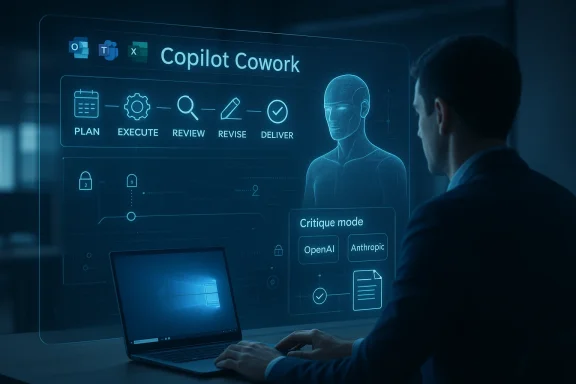
A man uses a laptop with a blue holographic interface showing “Copilot Cowork” and critique mode options.Overview​

Microsoft’s Copilot strategy has been evolving in visible stages. First came chat assistance, then task-oriented capabilities, and now a more ambitious model in which the assistant can operate as a delegated worker inside Microsoft 365. The Cowork concept sits squarely in that third phase, and it aligns with Microsoft’s broader “Frontier” messaging, which is all about AI systems that can take on longer, more autonomous work while still leaving control points in human hands.
The company has also been broadening the model layer underneath Copilot. Microsoft publicly said in September 2025 that it was expanding model choice in Microsoft 365 Copilot with Anthropic Claude support, while still using OpenAI models in key scenarios. That precedent is important because Cowork and Critique are not isolated experiments; they are part of a deliberate product direction in which Microsoft is less concerned with defending one model brand and more focused on delivering the best outcome for the task.
In practical terms, the new Researcher Critique feature is designed to separate generation from evaluation. One model drafts or plans, and a second model reviews and refines before the answer is returned. Microsoft says the result is better deep-research quality, and it ties that claim to a measurable benchmark gain on DRACO. Whether that benchmark advantage translates cleanly into everyday enterprise work is another question, but the architecture reflects a serious attempt to make AI outputs more reliable than single-pass generation.
This is also why the Windows angle matters. While the original report framed the change as “available for Windows users,” Microsoft’s own materials describe Copilot Cowork as a Microsoft 365 feature accessible through the Frontier program rather than a traditional Windows shell feature. In other words, the real story is not that Windows itself gained a new app; it is that Windows remains the primary on-ramp into Microsoft’s expanding AI work layer.

What Copilot Cowork Actually Does​

Copilot Cowork is built around delegation, not just prompting. Instead of asking an AI to answer a question in one shot, the user hands off a task and the agent turns it into a structured plan, executes that plan, and returns a finished result. Microsoft describes it as designed for long-running, multi-step work in Microsoft 365, which immediately puts it in a different category from lightweight chat tools.
That shift is significant because enterprise work is rarely a single prompt. It usually involves gathering context, comparing files, checking a thread in Teams, preparing a PowerPoint deck, and then revising the result after feedback. Copilot Cowork is aimed directly at that reality, and its value proposition is that a user can offload the orchestration while retaining oversight.

From chat to agentic work​

The phrase agentic work gets overused, but in this case it is apt. Microsoft is positioning Cowork as an AI that can reason over workflow rather than merely answer questions about it. That means less “here’s a summary” and more “here is a plan, the work has been done, and here are the checkpoints where you can intervene.”
The real business implication is time compression. When a worker can hand off a multi-step process, the system becomes most useful not for trivial tasks but for the awkward middle layer of knowledge work where humans typically lose time to context switching. That is the layer Microsoft wants to automate without fully removing human supervision.
  • Planning
  • Execution
  • Review
  • Revision
  • Delivery
Those five stages are where Copilot Cowork is trying to create value, and they are also where Microsoft can differentiate its offering from generic consumer chatbots.

Where it works inside Microsoft 365​

Microsoft says Cowork can use the tools available in Outlook, Teams, Excel, PowerPoint, and other Microsoft 365 applications. That matters because the assistant is not operating in a vacuum; it is embedded in the same productivity surfaces employees already use. In enterprise software, that integration is often more valuable than raw model capability.
The company’s Frontier documentation also highlights read-only connectors and research-oriented workflows, which suggests Microsoft is trying to balance agentic power with limited blast radius. That is a smart move. Enterprises may tolerate AI that drafts, analyzes, and recommends far more readily than AI that freely mutates production data without guardrails.

Why Multi-Model Matters​

The headline innovation in this rollout is not just Copilot Cowork itself but the Critique feature in Researcher. Microsoft says the feature uses models from Frontier labs including Anthropic and OpenAI so that one model can generate and another can evaluate. That is a classic quality-control pattern borrowed from human editorial workflows, and it is likely the most interesting technical choice in the announcement.
The reason this matters is simple: single-model systems can be persuasive while still being wrong. Multi-model review does not eliminate errors, but it can reduce blind spots, catch weak reasoning, and improve the final shape of a response. Microsoft’s benchmark claim—that Researcher with Critique scores higher on DRACO—gives the company a concrete narrative for why model diversity is more than a marketing slogan.

Generation and evaluation as separate jobs​

The most mature AI systems in enterprise settings are increasingly being designed as pipelines, not monoliths. Microsoft’s approach reflects that trend by letting one model do the first-pass reasoning and another model act as a reviewer. That architecture is especially useful for research, synthesis, and report generation, where the quality of the answer depends on both breadth and judgment.
It also creates a subtle competitive advantage. If one vendor’s model is better at planning and another is better at critique, Microsoft can route work accordingly without forcing customers to pick a single winner. That flexibility is useful in a market where model leadership changes quickly and where the best model for drafting is not always the best model for verification.

Implications for trust and accuracy​

For enterprise buyers, this is less about novelty and more about trust. A multi-model workflow does not magically make AI authoritative, but it does offer a stronger story for verification than a one-shot answer engine. That should matter to legal, finance, sales, and operations teams that need AI help but cannot afford unchecked hallucinations.
There is also a broader strategic signal here: Microsoft is willing to let its assistant be powered by multiple frontier labs instead of insisting that one model family do everything. That pragmatism may be one of the strongest reasons Microsoft has stayed ahead in the enterprise AI conversation. It is not pretending model purity matters more than outcomes.

The Frontier Program and Limited Access​

Microsoft is currently keeping Copilot Cowork in Research Preview, with access limited to a subset of customers. Broader availability is expected through the Frontier program, and Microsoft has explicitly told organizations to enroll if they want early access. This is a familiar rollout pattern for Microsoft, but the enterprise context makes it especially important.
The Frontier framework is doing more than staging a launch. It is helping Microsoft create a branded path for experimental AI features that are not yet ready for full-scale deployment. That gives Microsoft room to gather feedback, tune behavior, and shape customer expectations without overpromising stability.

Why Microsoft is controlling access​

Microsoft has strong incentives to keep the early rollout tight. Agentic systems can have outsized benefits, but they also introduce risk when they are allowed to act across real documents, emails, and collaborative workspaces. Limiting access lets Microsoft reduce support complexity while testing governance boundaries in real-world environments.
It also helps preserve the perception that Cowork is serious work software, not a consumer toy. That distinction matters for buyers who need to justify security reviews, pilot budgets, and change management efforts. The more Microsoft can frame the launch as a controlled enterprise preview, the easier it becomes to win internal approval.

How this compares to earlier Copilot releases​

Previous Copilot launches often emphasized assistive drafting, summarization, and retrieval. Cowork goes further by treating AI as a task owner, which makes the experience feel more like an employee assistant and less like a smart autocomplete feature. That is a meaningful shift in product philosophy.
The company is effectively asking customers to imagine a workplace where an AI can absorb messy assignments and return finished artifacts. That sounds elegant, but the practical test will be whether users actually trust the system enough to delegate work they once wanted to control themselves.

Enterprise Security and Governance​

Microsoft is careful to say that Copilot Cowork operates within Microsoft 365’s security and governance boundaries. That is not a throwaway line. For enterprise buyers, AI that can touch files, chat threads, calendars, and documents must be constrained by the same permissions, compliance expectations, and auditability rules that govern the rest of the suite.
This is one of Microsoft’s strongest cards against standalone AI startups. Startups may move faster, but Microsoft can offer an integrated trust model that already sits inside a company’s identity and document controls. In regulated industries, that can outweigh a few extra points of benchmark performance.

Security as a product feature​

The best enterprise AI products increasingly sell control as much as capability. Microsoft understands that, and the Cowork messaging is built around helping organizations adopt agents without creating a new compliance mess. The ability to keep the workflow inside Microsoft 365 is therefore not a convenience feature; it is part of the product’s reason for existing.
That said, governance is only as good as implementation. If the agent can pull from too much internal data, or if permissions are overly broad, the company could create new exposure even while claiming a secure design. This is why preview programs matter: they surface the edge cases before the technology becomes routine.

Data provenance and verification​

Microsoft’s broader Frontier messaging repeatedly emphasizes trust, data provenance, and human oversight. That focus is not accidental. The company knows that if agents are going to reshape enterprise work, they need to produce outputs that can be traced back to sources and validated by humans.
In practice, that could become one of the most important differentiators in the market. Consumer AI often wins attention by sounding fluent, but enterprise AI will win adoption by being auditable. Microsoft is betting that companies will pay for confidence, not just cleverness.

Competitive Pressure on OpenAI, Anthropic, and Google​

Copilot Cowork also reveals how Microsoft is navigating its own competitive map. By using models from both OpenAI and Anthropic, Microsoft is no longer presenting the assistant as a single-model showcase; it is presenting itself as an orchestration layer above the model wars. That may be the most strategically important part of the entire announcement.
This approach creates pressure on rivals in two directions. It tells OpenAI that Microsoft will not depend on one model family for enterprise value, and it tells Anthropic that Microsoft can integrate competitors if they outperform a given task. It also puts pressure on Google and other productivity vendors to prove that their own agents can match this blend of capability and governance.

Microsoft as the neutral arbiter​

One way to read this move is that Microsoft wants to become the neutral arbiter of model choice in productivity software. If customers trust Microsoft 365 as the place where multiple models are evaluated and deployed safely, then the company owns the work layer even if the models underneath change. That is a powerful position to occupy.
There is a long-term platform advantage here. The more Microsoft becomes the router for AI labor, the harder it becomes for customers to replace the stack with a competing productivity suite. AI routing can become as sticky as email or file storage once it is embedded in daily workflows.

What rivals may do next​

Competitors are unlikely to sit still. Expect more emphasis on multimodal orchestration, agent review loops, and enterprise-grade policy controls across the broader market. The likely response is not a single feature clone but a wave of “trusted agent” branding across productivity suites.
  • More emphasis on multi-model routing
  • Tighter enterprise governance messaging
  • Better audit trails for AI outputs
  • More human-in-the-loop checkpoints
  • Deeper native app integration
That competitive reaction would confirm Microsoft’s thesis: the winning AI workplace platform is not the flashiest chatbot, but the one that feels safest to delegate real work to.

The Researcher Angle and Better Deep Work​

Researcher is where Microsoft’s new multi-model strategy looks most convincing. The feature already aims to synthesize information across sources and produce cited analysis, and Critique is designed to improve the quality of that process by adding a second evaluation pass. For knowledge workers who live in reports, market analysis, and internal briefings, that is a meaningful step forward.
Microsoft’s benchmark claim is a reminder that this is not just about prettier outputs. The company says the new Critique workflow improves DRACO benchmark performance, which means the system is being measured against research quality criteria rather than simple conversational style. That is the right benchmark family for a product that claims to help people reason.

Why research quality is becoming a battleground​

As AI research assistants multiply, quality is becoming the differentiator. Anyone can build a system that retrieves text; the challenge is building one that can decide what matters, what is missing, and what should be challenged. Microsoft’s Critique design directly targets that challenge.
This is also where enterprise users may feel the most immediate benefit. A better research draft can save time across strategy, sales enablement, procurement, and executive briefing workflows. If the agent can reduce the number of cycles between first draft and final approved version, it can create real operational leverage.

The importance of citations and review​

Microsoft’s emphasis on cited, well-reasoned responses is not cosmetic. In enterprise settings, a strong AI answer is only useful if the user can inspect where it came from and decide whether to trust it. That is why the separation between generation and critique is so important: it makes the process look more like professional editing and less like raw text generation.
Still, users should not assume that two models make an answer correct. They may simply make the answer more polished. That is a meaningful improvement, but it is not the same thing as truth.

The Windows and Microsoft 365 Experience​

Although the announcement is being discussed as something “available for Windows users,” the real beneficiary is the Windows-based Microsoft 365 ecosystem. That distinction matters because the assistant’s value lies in the apps and data it can touch, not in a standalone desktop interface. Windows remains the operating environment, while Microsoft 365 is the actual work surface.
For consumers, this may not feel revolutionary in the short term. For enterprises, however, the prospect of assigning tasks from within familiar Microsoft software could reshape how employees think about productivity. It turns the suite into a place where AI is not just embedded, but operational.

Familiar tools, new behavior​

The novelty is not that users can open Outlook or Excel. It is that those applications can become execution environments for delegated work. That is a subtle but profound change, because it means the software stack is beginning to behave like a managed workforce rather than a set of passive tools.
The long-term effect could be increased lock-in, but also better user adoption. People tend to use AI more when it sits inside the software they already understand. Microsoft knows this, and Cowork is clearly designed to meet users where they already spend time.

Consumer versus enterprise impact​

For consumers, the near-term impact will likely be modest and mostly indirect. Most of the announced capability is centered on organizational workflows, data governance, and research previews rather than a mass-market Windows feature. For enterprises, by contrast, the implications are immediate: if the preview performs well, it could become a new layer of automation inside everyday business processes.
That split matters because many headlines tend to blur consumer AI with enterprise AI. Here the distinction is important. Microsoft is not just trying to delight individual users; it is trying to become the default operating system for AI work in businesses.

The Broader Microsoft AI Stack​

Copilot Cowork does not exist in isolation. It sits alongside Microsoft’s broader AI investments, from the integration of Claude into Copilot to the ongoing expansion of Copilot Studio and agent tooling. The result is a portfolio strategy rather than a single product bet.
That portfolio approach is smart because the AI landscape is changing too quickly for rigid bets. If Microsoft can offer a framework that accepts multiple models, different task types, and different levels of autonomy, it can adapt without rewriting the core story each time the frontier moves.

Why this is bigger than one feature​

The announcement reflects a deeper idea: Microsoft wants to be the place where work AI gets assembled. Models can come from different labs, tasks can be specialized, and workflows can be chained together, but the control plane stays inside Microsoft 365. That is a platform play, not just a feature launch.
That also explains why Microsoft keeps pairing AI announcements with governance language. The company wants to reassure enterprises that new capabilities do not imply reckless openness. In practice, that balance between experimentation and control may determine whether Frontier features become mainstream purchases or stay trapped in preview mode.

A sign of where AI software is headed​

The industry is moving away from isolated prompts and toward systems that can plan, execute, compare, and verify. Microsoft is one of the clearest examples of that shift. If Cowork works as intended, it could become the template for how business software evolves in the next phase of AI adoption.
  • AI as task executor
  • AI as research collaborator
  • AI as cross-app orchestrator
  • AI as reviewable workflow
  • AI as governed assistant
That is a much larger ambition than simple chat integration, and it is where the real market competition is now heading.

Strengths and Opportunities​

Microsoft’s Copilot Cowork push has several clear strengths, especially for organizations already invested in Microsoft 365. The most obvious opportunity is productivity gain through delegated, multi-step work, but the deeper opportunity is that Microsoft can turn AI into a native layer across the apps workers already use. If it lands well, Cowork could become the most practical expression yet of the company’s “AI at work” strategy.
  • Multi-model critique can improve research quality and reduce single-model blind spots.
  • Deep Microsoft 365 integration makes the feature immediately relevant to real workflows.
  • Governance boundaries give enterprises a more comfortable adoption story.
  • Frontier preview access lets customers pilot without full commitment.
  • Agentic task execution could save time in knowledge-intensive teams.
  • Model flexibility reduces dependency on any one frontier lab.
  • Benchmark-driven messaging gives IT buyers a more concrete value proposition.
The strongest opportunity is not just better answers; it is better work completion. Microsoft is trying to move from AI that helps you think to AI that helps you finish. That is a much larger market.

Risks and Concerns​

The same features that make Copilot Cowork compelling also create real risk. Agentic systems can save time, but they can also create confusion, over-reliance, and security exposure if permissions, audit trails, or human oversight are not carefully enforced. Microsoft’s preview status is reassuring, but it does not eliminate the hard problems.
  • Hallucination risk remains even with multi-model critique.
  • Permission sprawl could expose sensitive data if governance is too loose.
  • Over-automation may lead users to trust outputs too quickly.
  • Benchmark gains may not translate perfectly into day-to-day work.
  • Preview-only availability could frustrate organizations eager for deployment.
  • Model complexity may make troubleshooting harder for IT teams.
  • Vendor lock-in could deepen if AI workflows become tightly coupled to Microsoft 365.
There is also a subtler concern: the more polished an AI workflow becomes, the easier it is for users to forget how much human judgment is still required. Useful does not mean correct, and confident does not mean verified. Microsoft will have to keep reminding customers that critique is an aid, not a substitute for accountability.

Looking Ahead​

The key question now is whether Copilot Cowork can move from an impressive preview to a dependable part of daily enterprise operations. Microsoft has the ingredients: model diversity, application integration, governance messaging, and a powerful distribution channel through Microsoft 365. What remains to be proven is whether organizations will actually delegate meaningful work to the agent once it exits the novelty phase.
The next stage will likely revolve around customer evidence rather than launch language. If Microsoft can show that Cowork saves measurable time, improves output quality, and does not create governance headaches, it will have a compelling case for broader rollout. If not, it risks becoming another ambitious preview feature that looked more transformative on stage than in production.
  • Expansion through the Frontier program
  • More customer case studies and workload-specific proofs
  • Further model updates in Researcher and agent workflows
  • Tighter admin controls and governance tooling
  • Possible integration changes as Microsoft refines the experience
For now, the signal is clear: Microsoft believes the future of productivity is not just AI that answers, but AI that works. If that bet pays off, Copilot Cowork could become one of the most important steps yet in the transformation of Windows-era software into a genuinely agentic workplace platform.

Source: Pakistan Connect Microsoft Copilot Cowork now available for Windows users
 

Back
Top