

Microsoft’s Copilot has crossed a new threshold: it no longer waits politely for prompts — it now acts alongside people, taking long-running tasks, coordinating across apps, and carrying work forward without constant prompting. (microsoft.com)
Microsoft unveiled Wave 3 of Microsoft 365 Copilot on March 9, 2026, with the headline innovation branded as Copilot Cowork — a capability set that moves Copilot from a reactive assistant to an agentic collaborator that can run multi-step workflows across Microsoft 365 applications. The announcement explains that Cowork brings long-running, multi-step work into the Copilot experience, backed by Microsoft’s contextual intelligence layer called Work IQ, and governed by a new agent management plane named Agent 365. (microsoft.com)
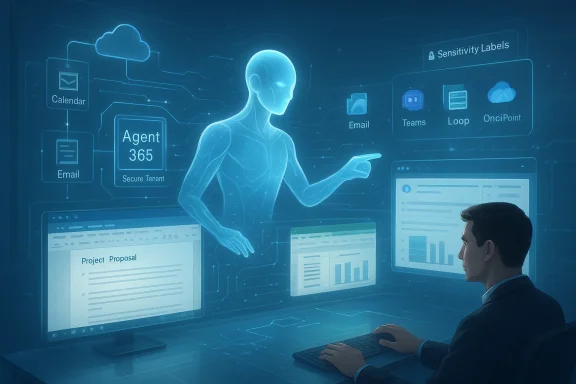
The company positions Cowork as enterprise-first: the service runs inside a customer’s Microsoft 365 tenant, respects permissions and sensitivity labels, saves outputs into OneDrive/SharePoint, and produces auditable actions that IT can monitor and control. Microsoft says Cowork is being piloted with a limited set of customers as a research preview in March, with broader availability through its Frontier program and licensing changes related to a new Microsoft 365 E7 tier arriving May 1. (microsoft.com)
Industry outlets confirmed and expanded on Microsoft’s claims, noting that Cowork is built with help from Anthropic’s agentic models, and that Microsoft is leaning into a multi‑model Copilot which can choose the best model for a given task rather than remaining locked to a single provider. Multiple reporters also highlighted Microsoft’s commercial framing — bundling Copilot and Agent 365 into an enterprise-priced E7 SKU. (venturebeat.com)
Industry reporting corroborated the Anthropic connection and emphasized that Microsoft’s deployment places agentic capabilities inside tenant-scoped, cloud-hosted services — a contrast with some third‑party agent offerings that run locally or outside corporate governance. Reporters also flagged the broader business context: this integration follows a series of Azure compute and partnership moves between Microsoft and Anthropic, and signals model plurality as a competitive advantage. (fortune.com)
Watch the following signals over the coming months:
Conclusion
Copilot Cowork signals a substantial evolution in enterprise productivity software: agents that persist, coordinate across apps, and operate under enterprise governance could materially change how knowledge workers spend their time. Microsoft’s advantage is clear — deep product integration, a context-rich intelligence layer, and an enterprise control plane — but success depends on execution: transparent model use, robust auditability, and sensible governance that prevents errors from spreading. For IT leaders, the immediate task is pragmatic: pilot, measure, and build governance that treats agents with the same operational seriousness as people in the organization. (microsoft.com)
Source: iPhone in Canada Microsoft ‘Copilot Co-work’ Brings Workflow Automation | iPhone in Canada
 Background / Overview
Microsoft unveiled Wave 3 of Microsoft 365 Copilot on March 9, 2026, with the headline innovation branded as Copilot Cowork — a capability set that moves Copilot from a reactive assistant to an agentic collaborator that can run multi-step workflows across Microsoft 365 applications. The announcement explains that Cowork brings long-running, multi-step work into the Copilot experience, backed by Microsoft’s contextual intelligence layer called Work IQ, and governed by a new agent management plane named Agent 365. (microsoft.com)The company positions Cowork as enterprise-first: the service runs inside a customer’s Microsoft 365 tenant, respects permissions and sensitivity labels, saves outputs into OneDrive/SharePoint, and produces auditable actions that IT can monitor and control. Microsoft says Cowork is being piloted with a limited set of customers as a research preview in March, with broader availability through its Frontier program and licensing changes related to a new Microsoft 365 E7 tier arriving May 1. (microsoft.com)
Industry outlets confirmed and expanded on Microsoft’s claims, noting that Cowork is built with help from Anthropic’s agentic models, and that Microsoft is leaning into a multi‑model Copilot which can choose the best model for a given task rather than remaining locked to a single provider. Multiple reporters also highlighted Microsoft’s commercial framing — bundling Copilot and Agent 365 into an enterprise-priced E7 SKU. (venturebeat.com)
What Copilot Cowork actually does
From “ask-and-reply” to sustained execution
Historically, Copilot has been used in a turn-based fashion: a user asks, the model replies. Cowork introduces a different operating model: agents that can break down complex requests into steps, coordinate actions across apps (Word, Excel, Teams, Outlook, Loop), and continue work over minutes or hours with visible progress and checkpoints for human steering. That means a single request can spawn multiple artifacts — drafts, spreadsheets, meeting actions — and the agent will manage the workflow until the task is complete or a human intervenes. (microsoft.com)Deep app integrations and real-time collaboration
Key product behaviors Microsoft demoed and documented include:- Passive observation and context awareness inside Teams, Word, Excel, PowerPoint, and Loop components so the agent can suggest relevant tasks or content without a new prompt. (microsoft.com)
- A “shared cursor” or side-by-side drafting experience in Word where the Copilot agent can edit a separate paragraph concurrently while the human author works, drawing on internal documents and email history to maintain tone and factual consistency. (microsoft.com)
- Meeting-time facilitation in Teams where the agent tracks viewpoints, notes unresolved issues, and — when asked — summarizes consensus or flags open decisions. (microsoft.com)
- Background orchestration: Cowork can assemble a competitive analysis, build an Excel workbook with labeled tabs, generate a research summary, and create a matching slide deck — all as part of a single, coherent workflow. (venturebeat.com)
The tech and partnerships under the hood
Multi‑model strategy and Anthropic collaboration
Microsoft explicitly states Cowork was developed working closely with Anthropic, incorporating the technology that powers Anthropic’s Claude Cowork into Microsoft 365 Copilot. Microsoft frames this as a deliberate multi‑model strategy: Copilot will select the "right model for the job," pulling from OpenAI, Anthropic, and Microsoft’s own model investments as appropriate. This is an important strategic shift; Microsoft is moving from a single-model dependency to an orchestration layer that routes tasks to different models. (microsoft.com)Industry reporting corroborated the Anthropic connection and emphasized that Microsoft’s deployment places agentic capabilities inside tenant-scoped, cloud-hosted services — a contrast with some third‑party agent offerings that run locally or outside corporate governance. Reporters also flagged the broader business context: this integration follows a series of Azure compute and partnership moves between Microsoft and Anthropic, and signals model plurality as a competitive advantage. (fortune.com)
Work IQ and context grounding
Work IQ is Microsoft’s intelligence layer that connects Copilot to work-specific signals: calendar events, files, chats, emails, and relationships. Cowork depends on Work IQ to ground agents’ reasoning in the company’s operational reality so outputs reflect current, relevant materials rather than isolated web knowledge. Microsoft emphasizes that Work IQ plus tenant controls keeps agent actions auditable and aligned with enterprise governance. (microsoft.com)Licensing, pricing, and rollout timing
Microsoft packaged Cowork and the agent ecosystem into a commercial push:- Agent 365: the control plane for agents will be generally available May 1 and is priced at $15 per user per month. Agent 365 gives IT a central console to observe, secure, and govern agents the way they manage users. (microsoft.com)
- Microsoft 365 E7 (Frontier Suite): a new top-tier SKU priced at $99 per user per month, combining Microsoft 365 E5 with Copilot and Agent 365 plus advanced security suites. This SKU becomes purchasable May 1. (microsoft.com)
- Cowork availability: Cowork is being tested with a limited set of customers in a research preview and will be made available via Microsoft’s Frontier program later in March. Broader enterprise availability depends on the Frontier adoption path and E7 licensing. (microsoft.com)
Security, governance and the human-in-the-loop promise
Built within Microsoft’s security stack
Microsoft emphasizes that Cowork operates inside the tenant, enforces Microsoft 365 permissions and sensitivity labels, and persists outputs into OneDrive/SharePoint. The company also says actions are auditable and that existing governance tools (Defender, Entra, Purview, Intune) will extend to agents through Agent 365. That framing is designed to reassure compliance and security teams that agentic AI will not bypass enterprise controls. (microsoft.com)Agent management and the phishing problem
Microsoft’s leadership highlighted a concrete threat vector: agents can be targeted by the same social-engineering techniques used against humans. Jared Spataro and other leaders argue that agents require account-like identity, observability, and protections because once an agent has an email identity it can be phished or tricked into taking unsafe actions. Agent 365 is Microsoft’s answer: treat agents like users and apply the same security controls. (fortune.com)Human oversight and auditability
Microsoft repeatedly framed Cowork as human-in-the-loop: agents can propose, act, and report, but final approval remains with people. Workflows include visible progress and checkpoints so humans can steer, pause, or stop actions. The product design emphasizes transparency and the ability to review outputs and decision traces — important primitives for compliance and incident response. (microsoft.com)Critical analysis: strengths and strategic impulses
Strengths
- Enterprise grounding: Cowork’s tenancy model and Work IQ integration are big strengths for enterprises that reject unmanaged third‑party agents. Running agents inside tenant boundaries reduces surface area for data exfiltration and simplifies compliance audits. (microsoft.com)
- Model choice as differentiation: The multi‑model approach lets Microsoft pick the best model for a given task — improved reasoning for complex workflows, specialized models for code or legal content, and availability trade-offs handled under the hood. This flexibility reduces vendor lock-in risk and allows faster adoption of improved models. (microsoft.com)
- Operational tooling (Agent 365): Exposing a control plane built for IT and security teams is a realistic and necessary step. Enterprises need visibility, policy controls, and audit trails if they’re to adopt agents at scale. Making agent management a purchasable product shows Microsoft understands the operational needs. (microsoft.com)
- End-to-end automation potential: The ability to orchestrate multi‑step workflows across apps promises productivity gains for knowledge workers — from research and competitive analysis to drafting, scheduling, and follow‑ups — shrinking the manual glue work that kills productivity. (venturebeat.com)
Strategic reasoning
Microsoft is using Cowork to lock AI deeper into the productivity layer of organizations. By combining Copilot Cowork, Work IQ, Agent 365, and the E7 SKU, Microsoft is selling a narrative: if you want AI at scale in a governed, enterprise-grade way, use Microsoft’s integrated stack. That is both product strategy and a defensive business play against companies offering stand-alone agents or horizontal automation tools. Reporters noted the timing and partnerships (including Anthropic) reflect Microsoft’s push to maintain leadership in the enterprise AI market. (fortune.com)Risks, unknowns, and areas requiring watchdog attention
Model transparency and selection
A recurring criticism — echoed by academics and industry watchers — is whether Microsoft will disclose which models are used for specific tasks and whether it will transparently surface model choice to customers. There’s a real trade-off between operational simplicity (Microsoft choosing models automatically) and auditing/traceability (customers needing to know which model produced content and under what training constraints). Critics also worry Microsoft might default to older models for certain tasks without clear notice to customers. That concern has real compliance and quality implications. (geekwire.com)Hallucinations and factual drift across workflows
Agentic behavior amplifies the risk from model hallucinations: a single hallucinated assumption can cascade across multiple deliverables (a report, a slide deck, a follow-up email). Even with audit trails, discovering and correcting a propagated error across several artifacts is harder than fixing a single answer in a chat. Organizations will need controls for validation, automated fact-checking, and human verification gates at key milestones. (venturebeat.com)Data governance and compliance edge cases
Microsoft states Cowork respects sensitivity labels and tenant policies, but real-world deployments will surface edge cases: transient data copies in intermediate artifacts, integration with third-party connectors, or external content pulled into workflows. Legal and compliance teams should not assume “everything is safe by default” — they must validate enterprise-level logging, data retention, and processing locations for their specific regulatory requirements. (microsoft.com)Cost and organizational impact
E7 at $99/user/month plus Agent 365 at $15/user/month is a material lift for enterprise budgets. Organizations must assess ROI: which roles and processes will benefit enough to justify migration? Microsoft’s pricing suggests a segmentation of features by SKU that will force procurement decisions about where to deploy agentic capabilities. Expect debate between central IT, security, and line-of-business owners on who gets access and at what scale. (microsoft.com)Practical guidance: what IT and security teams should do now
- Start a tightly scoped pilot: Choose 2–3 workflows with measurable outcomes (e.g., competitive intelligence memos, sales meeting prep, HR onboarding processes). Use the Frontier research preview or request access and document the agent’s actions, errors, and human intervention points. Validate whether Work IQ grounding materially reduces hallucinations compared with external LLM prototypes. (No citation required — guidance based on product behavior.)
- Map policy controls: Inventory sensitivity labels, retention policies, and third-party connectors that touch those workflows. Define explicit policy rules for what Cowork agents may and may not access, and test those rules in a sandbox. (microsoft.com)
- Configure Agent 365 early: If your organization plans to scale agents, build Agent 365 governance playbooks now — enrollment workflows, identity policies for agents, alerting rules for anomalous agent activity, and response procedures for agent compromise. Agent 365 will be generally available May 1; plan procurement and testing around that date. (microsoft.com)
- Educate users and update SOPs: Agents change how work gets done. Train employees on when to trust agent outputs, how to validate critical facts, and how to escalate issues. Clarify that agents can be phished and give teams rules for agent account handling. (fortune.com)
- Economic gating and measurement: Model cost and benefit scenarios for E7 licensing and Agent 365 fees. Run a basic TCO analysis that includes license fees, expected productivity gains, and governance overhead; use pilot metrics to inform any larger rollouts. (microsoft.com)
Real-world adoption considerations
Where Cowork will deliver fastest ROI
- Repetitive knowledge‑work pipelines that are rules‑based and well-scoped (monthly reporting, meeting prep, research aggregation).
- Teams with mature content hygiene (consistent file naming, robust sensitivity labeling) where Work IQ can reliably surface the right materials.
- Functions where speed matters over absolute perfection — e.g., early drafts for cross-functional alignment that will be human‑edited anyway.
Where caution is required
- Legal, regulatory filings, and any function that requires absolute provenance and independently auditable reasoning may need extended human review workflows before adopting Cowork‑generated outputs.
- Highly sensitive customer data or regulated personal data should remain behind stricter access controls until validated by compliance teams that intermediate processing meets jurisdictional requirements. (microsoft.com)
How Copilot Cowork changes the competitive landscape
Microsoft’s move accelerates two industry trends:- The transition from “assistants” to full‑fledged agents that coordinate actions across systems and complete business processes.
- The commercial bundling of AI capabilities with security and governance features to meet enterprise risk tolerances.
Final assessment and what to watch next
Copilot Cowork is a major product pivot: it reframes AI inside Microsoft 365 from a helper to a collaborator capable of doing work across apps and time. The combination of tenant-scoped execution, Work IQ grounding, and an agent control plane addresses many enterprise blockers that have slowed AI adoption. That said, the proof will be in the details: how Microsoft implements model transparency, how reliably Cowork avoids cascading hallucinations, and how well Agent 365 helps security teams detect and remediate agent-targeted attacks. (microsoft.com)Watch the following signals over the coming months:
- The Frontier research preview feedback (late March) — early adopter reports will reveal the most practical failure modes.
- Agent 365 operational maturity as it reaches GA on May 1 — especially how rich the audit trails and alerting controls are. (microsoft.com)
- Pricing and tiering effects — whether organizations accept E7 and Agent 365 pricing at scale, or whether mixed licensing strategies emerge. (geekwire.com)
- Transparency around model choice and provenance — will Microsoft expose model selection per workflow so auditors can verify the source and capabilities used? Industry pressure and regulatory scrutiny will push for clarity here. (geekwire.com)
Conclusion
Copilot Cowork signals a substantial evolution in enterprise productivity software: agents that persist, coordinate across apps, and operate under enterprise governance could materially change how knowledge workers spend their time. Microsoft’s advantage is clear — deep product integration, a context-rich intelligence layer, and an enterprise control plane — but success depends on execution: transparent model use, robust auditability, and sensible governance that prevents errors from spreading. For IT leaders, the immediate task is pragmatic: pilot, measure, and build governance that treats agents with the same operational seriousness as people in the organization. (microsoft.com)
Source: iPhone in Canada Microsoft ‘Copilot Co-work’ Brings Workflow Automation | iPhone in Canada