

Microsoft’s Copilot has moved from clever conversational assistant to an autonomous, cross‑app executor: Copilot Cowork is Microsoft’s newest enterprise offering that promises to translate intent into multi‑step, multi‑app action inside Microsoft 365, using a new intelligence layer called Work IQ and model diversity that now includes Anthropic’s Claude Cowork technology. Launched in a limited Research Preview on March 9, 2026, and slated for broader availability through Microsoft’s Frontier program in March 2026, Copilot Cowork is positioned as a capability for enterprise users who want to delegate real operational tasks—calendar triage, meeting preparation, cross‑functional research, and project coordination—rather than just request drafts and summaries. The feature arrives as part of a broader Microsoft push (Wave 3 of Microsoft 365 Copilot) that also introduces the Microsoft 365 E7 Frontier suite and Agent 365, reorganizing how organizations license, govern, and operate AI agents at scale.
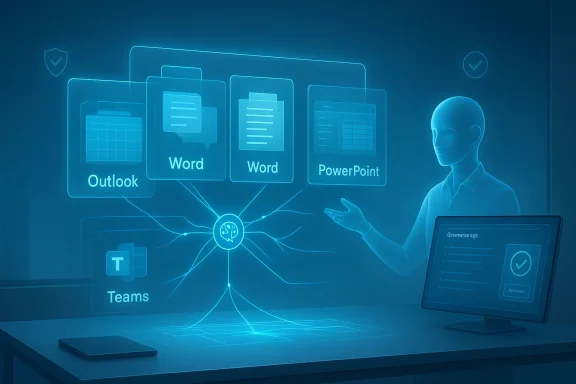
Microsoft’s Copilot journey began with AI assistance—helping users generate text, summarize emails, and draft documents. Over the past three years, the company has layered agentic capabilities onto Copilot: tools that don’t just answer, but can act. Microsoft’s new Work IQ is the intelligence fabric that ties signals from Outlook, Teams, SharePoint, OneDrive, Dynamics 365 and other business systems into a contextual graph of people, projects, documents and events. That context is what Microsoft says allows Copilot Cowork to plan and execute work that plays out over time and across apps while honoring enterprise security, identity and compliance controls.
At the same time, Microsoft has embraced a multi‑model strategy rather than relying on a single supplier. Copilot Cowork is notable for explicitly integrating Anthropic’s Claude Cowork capabilities into Microsoft 365 Copilot—and for running within Microsoft’s governance and sandboxed cloud controls. That mix of in‑house orchestration, an intelligence layer that “knows” your organization, and third‑party model diversity is shaping a new class of productivity tools that go beyond “write a slide” to “run the project.”
For procurement teams, E7 is a consolidation play: it simplifies licensing for organizations planning to adopt Copilot plus agent governance, but it also raises questions about cost vs. blended negotiation of E5 + Copilot + Agent 365 separately. The economics depend heavily on enterprise discounts, usage patterns, and whether third‑party model access incurs additional charges.
Anthropic’s Cowork was developed as a standalone tool optimized for long‑running tasks and code‑adjacent automation; embedding that capability in Copilot gives Microsoft an immediate lift in multi‑step task execution—but it also commits enterprises to vetting cross‑vendor model behavior and lifecycle management.
That promise hinges on two factors. First, the technical delivery: Copilot Cowork must be reliable, auditable, and predictable across the diverse tasks enterprises will ask it to perform. Second, the governance delivery: IT, security and legal teams must be able to see, approve and control agent behavior with sufficient granularity to avoid surprises and regulatory exposure.
For organizations planning to adopt Cowork, practical next steps are clear: run focused pilots, map data flows, lock down connectors with least privilege, instrument observability into SOC tooling, and adopt a phased autonomy plan that scales capability only as confidence grows.
Copilot Cowork signals a maturation of workplace AI: tools that not only explain but execute. The net business value will depend less on the novelty of automation and more on disciplined governance, thorough verification, and thoughtful rollout. If Microsoft’s E7 licensing and Agent 365 control plane deliver the promised operational simplicity, Cowork could become the kind of pragmatic automation that actually changes how knowledge work gets done—so long as organizations don’t outsource their judgement along with their repetitive tasks.
Source: TestingCatalog Microsoft reveals Copilot Cowork for M365 enterprise users
 Background
Microsoft’s Copilot journey began with AI assistance—helping users generate text, summarize emails, and draft documents. Over the past three years, the company has layered agentic capabilities onto Copilot: tools that don’t just answer, but can act. Microsoft’s new Work IQ is the intelligence fabric that ties signals from Outlook, Teams, SharePoint, OneDrive, Dynamics 365 and other business systems into a contextual graph of people, projects, documents and events. That context is what Microsoft says allows Copilot Cowork to plan and execute work that plays out over time and across apps while honoring enterprise security, identity and compliance controls.At the same time, Microsoft has embraced a multi‑model strategy rather than relying on a single supplier. Copilot Cowork is notable for explicitly integrating Anthropic’s Claude Cowork capabilities into Microsoft 365 Copilot—and for running within Microsoft’s governance and sandboxed cloud controls. That mix of in‑house orchestration, an intelligence layer that “knows” your organization, and third‑party model diversity is shaping a new class of productivity tools that go beyond “write a slide” to “run the project.”
What is Copilot Cowork?
A practical digital coworker, not another chat window
Copilot Cowork is an extension of Microsoft 365 Copilot designed to take the manual steps out of common, multi‑step workplace tasks. Unlike the existing Copilot chat and generation features, which are primarily conversational and document‑centric, Cowork is built to:- Interpret a user’s high‑level instruction (for example: “Prepare a briefing and schedule a prep meeting for Q2 product launch”).
- Create an executable plan that maps the work across emails, calendar events, documents, and spreadsheets.
- Execute those steps inside Microsoft 365 apps—updating calendars, compiling and saving documents in SharePoint or OneDrive, assembling slide decks or Excel workbooks, and gathering relevant emails and files.
Built on Work IQ and multi‑model AI
Two foundational elements make Copilot Cowork different:- Work IQ: The contextual intelligence layer that resolves people, projects, and artifacts across structured and unstructured enterprise data. It creates an organizational memory and relationship graph so the agent can reason about who owns what, which files are authoritative, and how actions ripple through business processes.
- Model diversity: Copilot Cowork is model‑agnostic and will select the best available model for a given task. Microsoft explicitly describes integration with Anthropic’s Claude Cowork technology to power longer‑running, action‑oriented workstreams that require more sustained reasoning and automation. This multi‑model approach is intended to combine strengths (for example, OpenAI models for certain tasks and Anthropic models for others) rather than lock customers into a single provider.
Examples Microsoft highlights (practical use cases)
Microsoft and early press coverage outline concrete examples where Copilot Cowork can save time:- Calendar and meeting management: Reviewing calendars, identifying low‑priority meetings, proposing reschedules or declines, and inserting focused work blocks on behalf of the user after approval.
- Meeting preparation: Pulling relevant emails, documents, and past meeting notes to assemble a briefing memo, create an accompanying slide deck, and produce a recommended agenda.
- Research and synthesis: Aggregating internal documents, earnings reports, and public information into a structured research memo and corresponding Excel workbook with extracted data.
- Cross‑functional project coordination: Building rollout plans, assigning owners, creating milestone trackers in Excel or Project and notifying stakeholders through Outlook or Teams.
How Copilot Cowork works in practice
From instruction to plan to execution
- A user delegates a task in plain language (via Copilot chat or a Cowork interface).
- Work IQ contextualizes the request by linking relevant emails, files, calendars, and business entities.
- Copilot Cowork generates a plan—discrete steps mapping to apps (e.g., draft memo in Word, create deck in PowerPoint, schedule meeting in Outlook).
- The system seeks approvals if required by policy, then executes actions inside Microsoft 365 using APIs and connectors, creating or updating files, scheduling events, and posting updates in Teams.
- All actions are logged and auditable through Microsoft’s governance stack and Agent 365 observability tools.
Model selection and multi‑model orchestration
Copilot Cowork doesn’t rely on a single model. Instead, it chooses between models and model variants based on the job: some models are better at long‑context planning and multi‑step execution (Anthropic’s Cowork capabilities are explicitly called out), others excel at rapid drafting or summarization. Microsoft’s Frontier program centralizes this availability so enterprise customers can tap Anthropic, OpenAI, and Microsoft/partner models as needed.Where Work IQ matters
Work IQ is the secret sauce for safe, meaningful action. It:- Aligns unstructured signals (meeting transcripts, emails, documents) with structured business data (Dynamics 365, Dataverse).
- Resolves identities, roles, and organizational relationships so actions (like assigning an owner) use correct, authorized accounts.
- Grounds agents in enterprise context—so a “pricing change” referenced in a meeting can surface the related open opportunities in Dynamics 365 Sales.
Security, compliance and governance: Microsoft’s case—and the questions that remain
Microsoft’s control plane: sandboxing, policies, and audit logs
Copilot Cowork is marketed as operating within Microsoft 365’s enterprise security and compliance frameworks. That means:- Identity and access are enforced through Entra and Microsoft 365 permissions.
- Data handling is governed by sensitivity labels, Purview policies, and tenant‑level controls.
- Agent actions are observable via Agent 365, which Microsoft bills as a control plane for registering, governing and auditing agents.
Critical governance responsibilities for IT
Despite Microsoft’s assurances, organizations must treat agentic automation like any broad platform change. IT and Security teams will need to:- Define which users and roles can delegate tasks to Cowork and which types of tasks require explicit approval.
- Control connectors and data sources Cowork can access—limiting sensitive repositories.
- Audit and review agent actions frequently and implement anomaly detection for agent behavior.
- Set up policy templates, review logs, and integrate agent observability into SOC workflows.
Unverifiable or emerging claims to watch
Microsoft’s high‑level messaging promises enterprise‑grade protections, but several practical questions are still open and should be tested during pilots:- How granular are runtime approvals and prompts for sensitive actions (for example, sending financial Excel attachments externally)?
- What is the exact retention and telemetry footprint of actions executed by Cowork agents?
- When models from third parties (Anthropic/OpenAI) are used, where do temporary runtime traces and intermediate data persist, and how are they subject to customer data controls?
- How will multi‑tenant or delegated scenarios behave inside federated organizations or multi‑cloud deployments?
Enterprise implications: productivity, cost and licencing
Productivity lift—and where it’s real
Copilot Cowork targets time‑consuming coordination tasks that often fall through the cracks: creating meeting artifacts, pulling dispersed information, reconciling calendars and assigning follow ups. In practical terms, companies can expect:- Faster meeting preparation and better structured agendas.
- Reduced administrative friction for cross‑team projects.
- Fewer scheduling conflicts and more intentional focus time for knowledge workers.
The new E7 Frontier suite and pricing context
Microsoft packaged Copilot Cowork messaging alongside the announcement of Microsoft 365 E7: The Frontier Suite, a new SKU that bundles Microsoft 365 E5, Microsoft 365 Copilot, Agent 365, and Entra Suite at a retail price of $99 per user per month, available May 1, 2026. Agent 365—Microsoft’s observability and governance control plane for agents—will be generally available on May 1, and plays a central role in monitoring Cowork and other agent workloads.For procurement teams, E7 is a consolidation play: it simplifies licensing for organizations planning to adopt Copilot plus agent governance, but it also raises questions about cost vs. blended negotiation of E5 + Copilot + Agent 365 separately. The economics depend heavily on enterprise discounts, usage patterns, and whether third‑party model access incurs additional charges.
Risks, limitations and trust considerations
Hallucination, error propagation and auditability
An agent that acts autonomously raises the stakes for model errors. A mistaken calendar change or incorrect assignment can propagate quickly. Microsoft’s audit logs will be essential, but organizations must:- Implement pre‑execution simulated runs or approval gates for high‑risk actions.
- Maintain robust human‑in‑the‑loop controls for decisions that impact compliance, contracts or finance.
- Use model output verification steps—e.g., cross‑checking extracted figures against the source systems before committing changes.
Third‑party model and vendor risk
Bringing Anthropic’s Claude Cowork into Microsoft 365 introduces benefits (specialized long‑running task capabilities) and complexities:- Data residency and subprocessors: Enterprises must ensure that any third‑party model usage meets their regulatory and contractual constraints. Where models execute matters—are transient contexts routed through Microsoft datacenters only, or are Anthropic’s endpoints implicated in any telemetry or inferencing?
- Dependencies on external model updates: Model behavior changes with updates; enterprises need predictable SLAs, testing against model changes, and mechanisms to freeze model versions or roll back when outcomes degrade.
- Supply chain and continuity: Overreliance on a third‑party provider without a robust fallback plan increases operational risk.
Over‑automation and employee trust
Automating meeting declines or schedule changes can be useful but may erode human trust if done poorly. Copilot Cowork must guard against:- Automated actions that surprise colleagues (e.g., cancelling meetings without adequate notice).
- Misalignment between organizational culture and agent behavior.
- Reduced human situational awareness when too many decisions are delegated.
Deployment and governance recommendations for IT teams
1. Start with narrow, high‑value pilots
- Choose a single domain (sales meeting prep, research for executive briefs, or calendar management for a small group).
- Define success metrics: time saved, meeting attendance quality, accuracy of synthesized materials.
- Run strict human‑in‑the‑loop approval thresholds initially.
2. Map data flows and connectors
- Inventory all data sources Cowork will access: mailboxes, SharePoint sites, Dynamics 365 entities, third‑party connectors.
- Use least‑privilege connectors for agents and segment access by tenant, group, or label.
3. Define policy guardrails and approvals
- Configure Purview sensitivity labels and Entra conditional access rules that apply to agent actions.
- Create policy templates in Agent 365 for common risk scenarios and automate alerting to security teams.
4. Instrument observability and logging
- Integrate Agent 365 telemetry with existing SIEM/SOAR tools.
- Establish incident response playbooks for agent misbehavior or data exposure.
5. Train users and set expectations
- Provide clear guidance to employees on what agents can and cannot do.
- Publish an agent action log for teams to see what Cowork executed on their behalf.
Competitive and market context
Copilot Cowork arrives in a fast‑moving market where Anthropic has already been experimenting with Cowork as a desktop and cloud product, and other players (OpenAI, Google, startups) are pushing agentic capabilities. Microsoft’s differentiator is integration: Work IQ plus deep hooks into Microsoft 365, identity, security, and enterprise data. By packaging governance (Agent 365) and a curated multi‑model surface in E7, Microsoft is selling not just capability but a managed operational model for agentic AI.Anthropic’s Cowork was developed as a standalone tool optimized for long‑running tasks and code‑adjacent automation; embedding that capability in Copilot gives Microsoft an immediate lift in multi‑step task execution—but it also commits enterprises to vetting cross‑vendor model behavior and lifecycle management.
Early signals from testers and the broader ecosystem
Press and analyst coverage from March 9, 2026, and earlier previews highlighted positive initial reactions around time saved for routine planning and synthesis tasks. Reported limitations center on:- Platform maturity (approval UX, error handling).
- Enterprise readiness of desktop agents vs. cloud‑first control planes.
- Need for clear documentation on data residency and subprocessor handling when third‑party models are invoked.
Verdict: A step change—if governance keeps pace
Copilot Cowork is a clear product evolution: moving from drafting and summarizing to doing. For organizations that wrestle with time‑sapping coordination tasks, the potential productivity gains are concrete—shorter prep cycles, fewer scheduling headaches, and quicker consolidation of dispersed knowledge. Microsoft’s Work IQ plus Agent 365 create a compelling operational architecture for making agents useful and governable inside the Microsoft 365 estate.That promise hinges on two factors. First, the technical delivery: Copilot Cowork must be reliable, auditable, and predictable across the diverse tasks enterprises will ask it to perform. Second, the governance delivery: IT, security and legal teams must be able to see, approve and control agent behavior with sufficient granularity to avoid surprises and regulatory exposure.
For organizations planning to adopt Cowork, practical next steps are clear: run focused pilots, map data flows, lock down connectors with least privilege, instrument observability into SOC tooling, and adopt a phased autonomy plan that scales capability only as confidence grows.
Copilot Cowork signals a maturation of workplace AI: tools that not only explain but execute. The net business value will depend less on the novelty of automation and more on disciplined governance, thorough verification, and thoughtful rollout. If Microsoft’s E7 licensing and Agent 365 control plane deliver the promised operational simplicity, Cowork could become the kind of pragmatic automation that actually changes how knowledge work gets done—so long as organizations don’t outsource their judgement along with their repetitive tasks.
Quick checklist for IT decision‑makers evaluating Copilot Cowork
- Verify which model providers will be used in your tenant and where inference occurs.
- Confirm data residency and subprocessor policies for third‑party models.
- Define initial pilot scope (team, task type, KPIs).
- Configure least‑privilege connectors and Purview sensitivity enforcement.
- Integrate Agent 365 telemetry into SIEM and SOC workflows.
- Establish explicit human approval gates for high‑risk actions.
- Plan communications and training for users to build trust in agent behavior.
Source: TestingCatalog Microsoft reveals Copilot Cowork for M365 enterprise users