

Microsoft’s Copilot has quietly crossed a threshold: it’s no longer only a drafting assistant tucked into Word and Excel, but is being positioned as an autonomous, permissioned coworker that can plan, execute and return finished work across Microsoft 365 — a capability branded Copilot Cowork and built in close technical collaboration with Anthropic’s Claude technology. ]
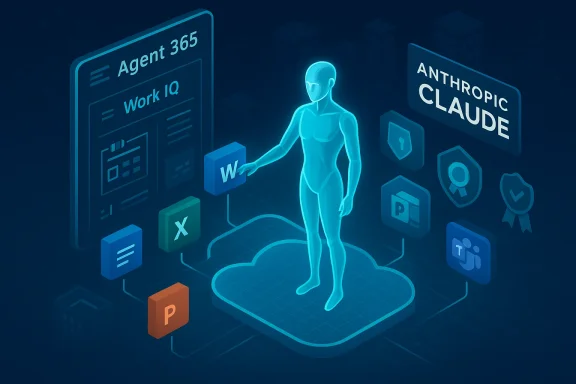
Microsoft introduced the Copilot family as a context-aware, chat-first productivity layer that helped users summarize, draft and analyze content inside Word, Excel, PowerPoint, Outlook and Teams. Over the last two years the product evolved in waves: from inline drafting to workspace agents, and now to agentic automation that runs multi-step workflows independently on behalf of users. The March announcements bundle several linked moves: Copilot Cowork (the autonomous agent experience), a control plane named Agent 365 for governance and lifecycle management of agents, a new Work IQ intelligence layer fng, and a premium enterprise licensing tier called Microsoft 365 E7 (the “Frontier Suite”).
This shift is both technical and commercial. Technically, Copilot Cowork harvests the progress Microsoft has made embedding models into Office apps and adds long-running, multi-step execution capability: scheduling, document creation, spreadsheet work, research and cross-app orchestration. Commercially, Microsoft packages these new agent and governance features into a higher-tier suite that will command a materially higher price per user while offering IT controls intended to reduce operational risk.
However, integration breadth is also the root of complexity: centralized governance is necessary, but not sufficient. The operational model for agentic systems will require cross-functional execution teams — security, legal, compliance, business owners and IT — to collaborate more closely than in prior SaaS rollouts.
That promise is powerful, but it is balanced by sizable implementation and trust challenges. Organizations should treat Copilot Cowork as a technology that changes operational models — not merely a feature toggle — and plan pilots accordingly: verify sandbox behavior, insist on provenance and human checkpoints, model ROI, and prepare legal and incident response plans that cover multi-vendor model stacks. If Microsoft’s security and governance controls perform as described, Copilot Cowork could materially raise productivity for routine, multi-step office workflows. If those controls underdeliver, however, the technology risks introducing costly errors and compliance headaches at scale. The sensible path for most enterprises is deliberate, governed piloting before sweeping adoption.
Source: BornCity Microsoft Copilot Cowork: KI wird zum autonomen Kollegen - BornCity
 Background / Overview
Microsoft introduced the Copilot family as a context-aware, chat-first productivity layer that helped users summarize, draft and analyze content inside Word, Excel, PowerPoint, Outlook and Teams. Over the last two years the product evolved in waves: from inline drafting to workspace agents, and now to agentic automation that runs multi-step workflows independently on behalf of users. The March announcements bundle several linked moves: Copilot Cowork (the autonomous agent experience), a control plane named Agent 365 for governance and lifecycle management of agents, a new Work IQ intelligence layer fng, and a premium enterprise licensing tier called Microsoft 365 E7 (the “Frontier Suite”).This shift is both technical and commercial. Technically, Copilot Cowork harvests the progress Microsoft has made embedding models into Office apps and adds long-running, multi-step execution capability: scheduling, document creation, spreadsheet work, research and cross-app orchestration. Commercially, Microsoft packages these new agent and governance features into a higher-tier suite that will command a materially higher price per user while offering IT controls intended to reduce operational risk.
What is Copilot Cowork — the functionality explained
From “assist” to “do”
Copilot Cowork represents a change in intent: instead of returning suggestions, it is designed to accept responsibility for an assigned task and deliver completed outputs. Typical example use-cases Microsoft and early testers describe include:- Preparing a full meeting packet (agenda, slide deck, reading list) for a scheduled meeting.
- Rescheduling meetings while reconciling attendee availability and updating calendar invites.
- Performing company or market research, synthesizing findings into an execlating an Excel model.
- Coordinating multi-part workflows for product launches or compliance checks across Teams, SharePoint and Outlook.
Architecture highlights: multi-model, sandboxed, permissioned
Key technical elements Microsoft is highlighting:- Anthropic integration: Copilot Cowork leverages Anthropic’s Claude Cowork technology and Sonnet-class models to power agent reasoning and execution. Microsoft’s approach folds external models into its Copilot surfaces rather than relying on a single internal model stack.
- Agent 365 control plane: A centralized governance and lifecycle platform intended to let IT teams provision, monitor, audit and revoke agents at scale. Agent 365 aims to provide identity, access controls, policy enforcement and observability for agent actions. Microsoft has said Agent 365 will be generally available on May 1, 2026.
- Work IQ: An intelligence layer that leverages collaboration history, internal content and organizational signals to ground agent behavior in the right context and surface author IQ is presented as a contextual filter so agents act on high‑quality, relevant data.
- Sandboxed execution: Some vendor communications indicate long-running tasks execute within protected, sandboxed cloud environments to isolate data and progress from end-user devices, allowing tasks to continue even if the initiating user moves between devices. This is intended to reduce exposure but introduces new cloud-side governance requirements.
Licensing, pricing and availability — the commercial play
Microsoft tied the Copilot Cowork technical announcement to a commercial licensing shift designed to accelerate enterprise adoption of agentic AI.- Microsoft 365 E7 (Frontier Suite): Announced as a new premium enterprise tier that bundles Microsoft 365 E5 features with Microsoft 365 Copilot, Agent 365, Entra Suite, Defender, Intune and Purview. Microsoft and multiple trade reports say the E7 Frontier Suite will be priced at $99 per user per month and will become generally available on May 1, 2026.
- Agent 365 standalone: Microsoft’s communications indicate Agent 365 will be available separately at $15 per user per month when it becomes generally available.
- Copilot for Microsoft 365 pricing: The existing Copilot for Microsoft 365 product remains a separately priced add-on (commonly reported at around $30 per user per month in prior releases); Microsoft’s messaging keeps Copilot as a premium capability that can also be bundled into E7. Organizations should validate practical licensing needs because stacking E5 + Copilot + Agent 365 may be more expensive than moving to the E7 bundle, depending on compliance and feature requirements.
Why Anthropic? Strategic and technical implications
Microsoft’s technical partnership with Anthropic is notable on two fronts:- Model diversity and resilience: By integrating Anthropic’s Claude family (including Claude Cowork/Sonnet models) Microsoft reduces dependency on any single model provider and gains access to agent-specific architectures that Anthropic has been developing. This multi-m product engineering, part business hedging.
- Specialization for agentic tasks: Anthropic’s Cowork offering was explicitly built for multi-step, desktop- and API-capable agents that can read files, manipulate spreadsheets and call services safely. Microsoft’s adoption suggests the company judged Anthropic’s architecture to be well-suited for the “doing” phase of Copilot. However, embedding third-party model stacks inside a large enterprise product raises integration, compliance and support complexity for IT teams that must now manage cross-vendor model behavior inside their security and compliance frameworks.
Risks, gaps and realistic limits — what IT should worry about
Copilot Cowork introduces powerful productivity possibilities, but it also surfaces new technical, legal and operational hazards that enterprise adopters must address.1) Data exposure and access control
Agents with permissioned access to email, calendars and files can dramatically reduce human effort — but they expand the attack surface. Key questions to validate in pilot programs:- How are agent identities provisioned and revoked?
- What encryption and egress controls are enforced inside the agent sandbox?
- Are agent actions and data access logged with adequate forensic detail for compliance and incident response?
2) Hallucination and misinformation in completed outputs
Agents are designed to produce finished artifacts, not drafts. That makes hallucination risk more consequential: a Copilot Cowork agent that fabricates citations, misparses contract clauses, or misunderstands proprietary data could create legal or financial exposure if outputs are trusted blindly. Enterprises must:- Enforce human-in-the-loop checkpoints for high-risk outputs.
- Define automatic validation rules (e.g., data sources to prefer, numerical tolerances in spreadsheets).
- Use provenance metadata and traceability so auditors can see how outputs were produced.
3) Operational complexity and model accountability
Multi-model stacks complicate root cause analysis. If an agent produces an incorrect spreadsheet, did the bug originate in prompt engineering, in the Anthropic model, in the Copilot orchestration, or in a third-party connector? Shared responsibility models between Microsoft and Anthropic must be clearly codified for enterprise customers. Public reporting clarifies the partnership at a high level, but operational contracts and SLAs will matter for mission-critical workloads.4) Regulatory and privacy constraints
Certain regulated sectors (healthcare, finance, government) will need to test whether agentic behavior complies with data residency, record-keeping and sector-specific privacy rules. Microsoft’s messaging about sandboxing and Entra integration is encouraging, but compliance teams must perform legal reviews and technical audits before authorizing agents to access regulated data.5) Cost and user adoption friction
At $99 per user per month for E7, budgets matter. Early pilots should focus on specific workstreams where automation yields measurable time savings or compliance improvements. A blanket rollout without clear KPIs risks high cost and low adoption. Microsoft’s Frontier preview program exists precisely to let organizations measure benefits before buy-in, and IT leaders should use that period to build governance playbooks and ROI models.Governance and best-practice checklist for IT teams
If your organization is planning pilots with Copilot Cowork and Agent 365, use the following structured approach.- Define scope and risk:
- Identify 2–4 candidate workflows for pilot (e.g., meeting packet prep, quarterly reporting, vendor onboarding).
- Classify data sensitivity for each workflow.
- Establish identity and access policy:
- Provision agent identities in Entra and set least-privilege roles.
- Define revocation procedures and emergency kill-switches.
- Logging, monitoring and audit:
- Ensure Agent 365 telemetry is routed to your SIEM and retention policies match compliance needs.
- Require provenance metadata for every agent-produced artifact.
- Human-in-the-loop controls:
- Identify checkpoints where a human must review or approve outputs for high-risk workflows.
- Create role-specific approvals and sign-offs.
- Validation and testing:
- Stress-test agents with adversarial prompts and corrupted data to measure failure modes.
- Rehearse incident response for a misbehaving agent.
- Cost and ROI modelling:
- Measure time saved per workflow and extrapolate seat coverage vs. E7 cost.
- Consider phased licensing (pilot seats only) before committing enterprise-wide.
Where Copilot Cowork fits in the broader AI landscape
Microsoft’s move is part of a broad industry pivot toward agentic AI: vendors are competing to turn language models into tools that can act autonomously across productivity stacks. Anthropic’s Claude Cowork and other vendor offerings signal that the market is maturing from assisted drafting to delegated execution. Microsoft’s advantage is integration breadth — it controls Office, Windows, Azure and identity tools — and that systemic reach is precisely why enterprise buyers will pay a premium to obtain a tightly integrated, governable agent experience.However, integration breadth is also the root of complexity: centralized governance is necessary, but not sufficient. The operational model for agentic systems will require cross-functional execution teams — security, legal, compliance, business owners and IT — to collaborate more closely than in prior SaaS rollouts.
Strengths and opportunities
- Productivity gains: Automating recurring, multi-step administrative tasks presents clear upside. Expect time savings in meeting prep, basic research, data cleaning and repeatable reporting workstreams. Early pilots point to measurable time savings for administrative teams.
- Enterprise-grade governance tooling: Agent 365 and Entra integration, if implemented as described, provide the building blocks for controlled agent deployment and identity-bound actions.
- Model diversity: Incorporating Anthropic models creates a flexible, multi‑model Copilot that can route tasks to the best-suited engine and reduce vendor concentration risk.
Weaknesses and hazards
- Cost: The E7 price point places Copilot Cowork in a premium price tier; proof of productivity is required to justify conversion.
- Operational friction: Multi-model orchestration, policy enforcement, and incident response add operational burdens for IT that must be resourced upfront.
- Risk of overtrust: Finished outputs can be mistaken for verified results. Without clear provenance and human validation, the business risk is real.
- Vendor complexity: Troubleshooting or accountability across Microsoft and Anthropic boundaries could slow incident resolution and complicate contractual remedies.
Practical advice for pilot design (step-by-step)
- Pick a pilot owner and cross-functional steering group (security, compliance, business owner).
- Select a single, well-bounded workflow with frequent, manual effort.
- Define success metrics (time saved, accuracy, number of human approvals).
- Request limited-permission research-preview access through Microsoft’s Frontier program.
- Run a two-week sandbox test to validate agent behavior, then a two-month controlled pilot with logging to SIEM.
- Evaluate costs and decide whether to expand seats or use Agent 365 standalone controls versus full E7 migration.
Conclusion
Copilot Cowork completes the trajectory Microsoft set out two years ago — moving Copilot from a conversational assistant to an agentic coworker that can do work on behalf of employees. The integration of Anthropic’s Claude technology, the launch of Agent 365 for governance, and the new Microsoft 365 E7 pricing tier together form a coherent enterprise strategy: sell the promise of delegated work and provide the governance tools to make that delegation palatable to IT and compliance teams.That promise is powerful, but it is balanced by sizable implementation and trust challenges. Organizations should treat Copilot Cowork as a technology that changes operational models — not merely a feature toggle — and plan pilots accordingly: verify sandbox behavior, insist on provenance and human checkpoints, model ROI, and prepare legal and incident response plans that cover multi-vendor model stacks. If Microsoft’s security and governance controls perform as described, Copilot Cowork could materially raise productivity for routine, multi-step office workflows. If those controls underdeliver, however, the technology risks introducing costly errors and compliance headaches at scale. The sensible path for most enterprises is deliberate, governed piloting before sweeping adoption.
Source: BornCity Microsoft Copilot Cowork: KI wird zum autonomen Kollegen - BornCity
