

Microsoft's latest push to move AI from a helpful assistant into a responsible, doing teammate landed this week with the announcement of Copilot Cowork — a research‑preview agent built to execute multi‑step workflows across Microsoft 365, with permissioned access to calendar, mail, files and apps, and designed to return finished outputs rather than just suggestions.
Microsoft has been steadily evolving Copilot from a drafting and summarization tool toward a platform of agentic experiences that can act on behalf of users. Prior moves — embedding Copilot in Teams, SharePoint, OneDrive and Windows, adding document export from chat, and introducing App Builder and Workflows in preview — set the technical and commercial stage for a coworking agent that carries tasks end‑to‑end.
Copilot Cowork was introduced as part of a broader enterprise AI push that includes Agent 365 (a control plane for multi‑agent orchestration), updated governance tooling, and new licensing and tiers aimed at large customers. Microsoft frames Cowork as a “research preview” and emphasizes permissioned access, governance, and a multi‑model architecture that lets organizations choose models and controls appropriate to sensitive workflows.
At the same time, the technology raises acute operational, legal and security risks. Hallucinations, scope creep, insufficient logging, and vendor model risk are not hypothetical; they are real dangers when agents act on live business data. The safe path is deliberate: pilot, instrument, lock down high‑impact paths, and iterate with tight human oversight. Organizations that pair ambition with conservative governance will likely gain the earliest, most durable benefits.
Copilot Cowork is not an instant replacement for disciplined workflows or human judgment. It is, however, a meaningful advance in how enterprise software can bundle comprehension, orchestration and execution into a single agentic experience — and it will be a defining battleground for enterprise productivity and trust in the coming year.
Source: Moneycontrol.com https://www.moneycontrol.com/techno...ks-across-microsoft-365-article-13855155.html
Source: LatestLY Satya Nadella Announces Copilot Cowork To Automate Complex Multi-Step Workflows in Microsoft 365 | LatestLY
Source: Microsoft Copilot Cowork: A new way of getting work done | Microsoft 365 Blog
 Background
Microsoft has been steadily evolving Copilot from a drafting and summarization tool toward a platform of agentic experiences that can act on behalf of users. Prior moves — embedding Copilot in Teams, SharePoint, OneDrive and Windows, adding document export from chat, and introducing App Builder and Workflows in preview — set the technical and commercial stage for a coworking agent that carries tasks end‑to‑end.Copilot Cowork was introduced as part of a broader enterprise AI push that includes Agent 365 (a control plane for multi‑agent orchestration), updated governance tooling, and new licensing and tiers aimed at large customers. Microsoft frames Cowork as a “research preview” and emphasizes permissioned access, governance, and a multi‑model architecture that lets organizations choose models and controls appropriate to sensitive workflows.
What is Copilot Cowork?
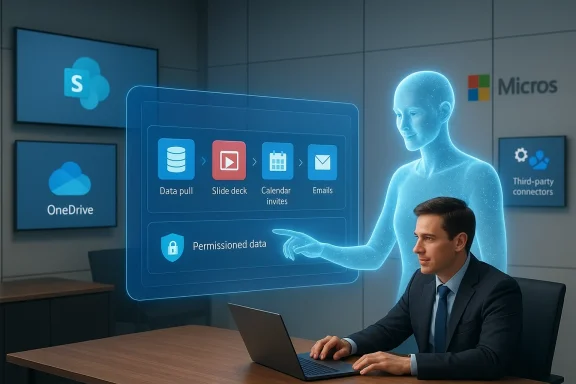
Copilot Cowork is an agentic AI experience that goes beyond single‑turn prompts. Instead of returning a draft or a list of steps, Cowork is intended to:- Accept a high‑level instruction (for example, “prepare a quarterly business review slide deck, schedule the review meeting with stakeholders, and send a follow‑up summary with action items”).
- Plan and execute multiple discrete steps across apps (calendar invites, slide generation in PowerPoint, spreadsheet calculations in Excel, and messages in Outlook or Teams).
- Use permissioned access to the user’s Microsoft 365 data (and potentially connected third‑party services) to complete work and return deliverables.
How Copilot Cowork Works (technical overview)
Multi‑step planning and execution
Copilot Cowork is designed to convert a user’s intent into an ordered plan, then execute that plan using APIs and connectors bound to Microsoft 365 and other permitted services. The system breaks complex requests into sub‑tasks (data gathering, document authoring, scheduling, approvals) and runs them in series or parallel as required. The result is an output — a completed deck, a scheduled meeting, a set of emails — rather than a raw prompt response.Permissioned connectors and data access
A key technical and governance requirement is explicit, auditable permissioning. Cowork can only act on the data the user or organization has granted it access to. Microsoft’s messaging repeatedly emphasizes opt‑in connectors and enterprise controls to reduce inadvertent data exposure. That permission model is a foundational change from broad conversational assistants to agents that may perform actions on behalf of the user.Multi‑model and third‑party collaboration
Microsoft’s Copilot stack is becoming multi‑model. The Cowork research preview was developed with external partners (notably Anthropic in the research preview), and Microsoft plans to offer options that allow customers to choose models and governance levels for different workloads. This multi‑model approach is intended to provide flexibility: organizations can select higher‑assurance models and stricter audit settings for regulated workflows while using more experimental models for low‑risk tasks.Agent 365 control plane
To manage the increasing complexity of autonomous agents, Microsoft introduced an Agent 365 control plane — an orchestration layer for life‑cycle management, policy enforcement, and monitoring of agents across an organization. Agent 365 is presented as the governance backbone that will let IT and compliance teams define what agents can and cannot do, enforce model selection, and retain execution logs for audits.Integration with Microsoft 365 apps
Copilot Cowork is explicitly built to operate across the Microsoft 365 ecosystem. The announcement and surrounding materials describe deep integration points:- Word, Excel, PowerPoint: Cowork can generate or update documents, run calculations, build charts, and produce polished slide decks as final deliverables.
- Outlook and Teams: The agent can read and act on calendar availability, create invites, and send messages or summaries to participants.
- OneDrive and SharePoint: Files used or generated by Cowork are stored, versioned, and accessible according to existing SharePoint/OneDrive permissions.
- Connectors: Optional connectors allow Cowork to reach third‑party services when explicitly configured by the organization.
The business case: Why enterprises will care
Enterprises have three clear incentives to adopt agentic automation like Copilot Cowork:- Productivity uplift: Removing low‑value, repeatable tasks and coordination overhead for knowledge workers can free time for higher‑value thinking and customer work.
- Scale and consistency: Agents can apply standard processes consistently (templates, compliance checks, standardized reporting), reducing human error in operational tasks.
- Competitive acceleration: Faster report generation, meeting prep, and cross‑team coordination can shorten decision cycles and reduce time‑to‑market.
Security, privacy and governance: strengths and gaps
Strengths and positive design choices
- Permissioned data access: Microsoft emphasizes opt‑in connectors and identity‑bound permissioning so agents act only within a scope authorized by the user or admin. This reduces the risk of unchecked data crawling.
- Control plane and auditability: Agent 365 aims to provide centralized policy enforcement, logging and model selection — essential controls for enterprises subject to regulatory oversight.
- Multi‑model options: The ability to choose models with different assurance and safety profiles lets organizations match risk to workload; regulated data can be handled by models vetted for that purpose.
Risks and open questions
Despite these design points, substantial risks remain and must be managed:- Data leakage and scope creep: Even with opt‑in connectors, complex multi‑step workflows increase the chance that an agent will touch sensitive data in ways users don’t expect. Administrators must be able to define and enforce strict scopes to limit data exposure.
- Hallucinations with real‑world effects: When an agent sends an email, creates calendar invites or generates financial figures, any hallucination or factual error can have immediate operational consequences. Systems that enable human‑in‑the‑loop review and require explicit approvals for high‑impact actions are essential.
- Audit trail granularity: Legal and compliance teams will demand detailed, tamper‑resistant logs showing what actions an agent took, which data it read, which prompts or model outputs led to decisions, and who authorized those actions. Agent 365 promises logging, but enterprises should verify retention, immutability and export formats before broad adoption.
- Third‑party model risk: Using a partner model (for example, Anthropic during research preview) introduces another vendor to the trust equation. Contracts, data handling assurances, and model provenance must be clear for regulated industries.
Governance checklist for IT leaders
If your organization evaluates Copilot Cowork, consider this practical checklist before pilot or rollout.- Define risk tiers for tasks (low, medium, high) and map them to allowed agent capabilities and model choices.
- Require explicit opt‑in and RBAC for connectors; default to no external connectors for sensitive groups.
- Enable comprehensive logging and require regular audits of agent activity; ensure logs are tamper‑resistant and exportable.
- Implement human approval gates for high‑impact actions (financial transactions, external communications, legal documents).
- Run initial pilots on non‑critical workflows and build a catalogue of approved templates and agent recipes.
- Train end users and managers on agent behavior, expected outputs, and how to revoke permissions quickly if needed.
- Review vendor contracts for third‑party models and verify data handling, retention, and deletion guarantees.
Practical deployment scenarios and sample workflows
Example 1 — Quarterly business review (low‑to‑medium risk)
- User asks Cowork to assemble latest metrics, create slides, and invite attendees.
- Cowork pulls data from authorized Excel/BI source, generates a deck draft, and proposes a meeting time.
- Human reviews the deck and approves sending invites; Cowork finalizes and distributes materials.
This scenario demonstrates Cowork’s productivity gains while preserving human oversight for the final go‑live step.
Example 2 — Contract redline summary (medium risk)
- Cowork reads a contract in SharePoint, highlights key clauses, and suggests negotiation points.
- It drafts an internal memo and proposes next‑step tasks for legal and procurement.
- Legal must review and approve before any external communication or redlining.
Here, Cowork reduces research and summarization time while keeping attorneys in the decision loop.
Example 3 — Sensitive financial action (high risk)
- Any Cowork task that could authorize payments or change financial records should be disabled by default.
- If enabled, strict approval requirements, multi‑factor attestation, and immutable logs are non‑negotiable.
High‑risk actions underscore the importance of conservative defaults and layered controls.
Legal, compliance and policy implications
Organizations must update internal policies to reflect agentic AI. Key policy changes will include:- Clear ownership and accountability for agent actions: who signs off on deliverables the agent produces?
- Records retention policies that include agent logs and prompts for e‑discovery and compliance audits.
- Contractual addenda for vendors and third‑party models specifying data use, retention, and liability.
- Training and certification for employees who will author “agent recipes” or manage agent permissions.
Human factors: jobs, trust, and adoption
Copilot Cowork will likely accelerate debates about automation and job redesign. Practical realities to consider:- Job redesign, not simply job replacement: early adopters will reassign routine coordination and assembly tasks to agents, allowing staff to focus on judgement, relationships and strategy.
- Trust building: adoption succeeds only when outputs are reliable and auditable; initial pilots should prioritize transparent, visible actions to build user confidence.
- Training and change management: users must learn how to craft instructions, verify outputs, and safely escalate errors — robust training programs will be as important as technology rollout.
Comparative context: how this fits in the market
Copilot Cowork is not the first agentic product, but Microsoft’s advantage is deep application integration, enterprise governance tooling, and partner channels. Competitors are also moving towards embedding agentic features in their productivity stacks; the difference will be in the degree of app integration, data governance, and the enterprise sales and support model. Microsoft’s ecosystem positioning — tying agents to identity and corporate data stores — is its strongest differentiator if governance is robust.Recommendations for IT decision makers
- Start with a narrow pilot on clearly defined, low‑risk workflows and measure time saved, error rate and user satisfaction.
- Insist on auditability: test that logs show inputs, model decisions, data reads, and outputs in an exportable format.
- Apply conservative defaults: disable external connectors and high‑impact actions until risk controls are proven.
- Build an approval process for templates/agent recipes; treat them like privileged automation artifacts.
- Train compliance, legal and security teams to review and sign off on agent capabilities before broader rollout.
- Negotiate data processing and liability terms for third‑party models; insist on clarity in contracts.
Final analysis: promise and prudence
Copilot Cowork represents a consequential step in workplace automation: moving from "suggest and assist" to "plan and do." The productivity promise is real — automating multi‑step workflows could reclaim hours of work from knowledge teams and standardize routine processes across organizations. Microsoft’s push to pair Cowork with Agent 365 governance, permissions, and multi‑model choices shows awareness of the hard questions enterprises face.At the same time, the technology raises acute operational, legal and security risks. Hallucinations, scope creep, insufficient logging, and vendor model risk are not hypothetical; they are real dangers when agents act on live business data. The safe path is deliberate: pilot, instrument, lock down high‑impact paths, and iterate with tight human oversight. Organizations that pair ambition with conservative governance will likely gain the earliest, most durable benefits.
Copilot Cowork is not an instant replacement for disciplined workflows or human judgment. It is, however, a meaningful advance in how enterprise software can bundle comprehension, orchestration and execution into a single agentic experience — and it will be a defining battleground for enterprise productivity and trust in the coming year.
Source: Moneycontrol.com https://www.moneycontrol.com/techno...ks-across-microsoft-365-article-13855155.html
Source: LatestLY Satya Nadella Announces Copilot Cowork To Automate Complex Multi-Step Workflows in Microsoft 365 |
LatestLYSource: Microsoft Copilot Cowork: A new way of getting work done | Microsoft 365 Blog