
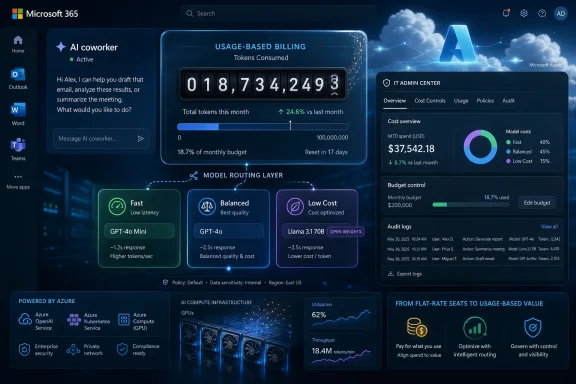
On June 16, 2026, Microsoft made Copilot Cowork generally available and moved the agentic Microsoft 365 assistant toward usage-based billing, after internal testing reportedly showed that unlimited plans could not survive heavy users running hundreds of AI tasks per week. That dry pricing change is really a confession about the economics of agentic AI. The first wave of copilots was sold like software; the second wave behaves more like a metered utility. DeepSeek enters the story not as an exotic outsider, but as the kind of cheaper engine Microsoft and its customers may need if “AI coworker” is to mean more than an expensive demo.
The mythology of enterprise AI has been that productivity gains would swamp the cost of inference. Microsoft’s Copilot story leaned hard into that premise: charge per seat, distribute the assistant across Microsoft 365, and let employees pull AI into Outlook, Word, Teams, Excel, SharePoint, and the surrounding workflow fabric. The logic was familiar because it looked like SaaS.
Copilot Cowork breaks that comfort zone. Unlike a chat assistant that mostly answers when asked, an agentic coworker can spin through multi-step tasks, inspect documents, generate drafts, call tools, revise its plan, and repeat the loop. Each step may look small to the user, but to the provider it is a growing trail of tokens, context windows, retrieval calls, model invocations, and compute-time obligations.
That makes unlimited usage less like Netflix and more like letting every employee run a render farm under a flat monthly license. The average user may be manageable, but the power user can destroy the margin model. In cloud economics, the edge case eventually becomes the invoice.
Microsoft’s apparent retreat from unlimited Cowork usage is therefore not a stumble so much as a collision with physics. AI agents turn enthusiasm into variable cost. If customers love the product enough to use it constantly, the provider must either raise prices, meter usage, swap in cheaper models, or accept that the most engaged users are the least profitable ones.
But adoption is only the first half of the business case. The second half is utilization, and that is where agentic AI becomes harder to subsidize. A traditional Office user who opens Word all day is not asking Microsoft to burn GPU cycles every few seconds; a Cowork user who delegates complex work may be doing exactly that.
This is the paradox of the new Microsoft AI stack. The company wants Copilot to become a persistent layer over work, not a novelty pane in the sidebar. Yet the more Copilot behaves like a real coworker, the more it stops resembling software with near-zero marginal cost.
The phrase “victim of its own success” is overused in technology coverage, but here it is almost literal. If some Cowork users are running hundreds of tasks a week, they are behaving exactly the way Microsoft’s AI marketing encouraged them to behave. The problem is not that customers misunderstood the product; it is that customers may have understood it too well.
Agentic AI bends that model. The marginal cost of “one more task” is not zero, especially when the task requires long context, tool use, retrieval, reasoning, and repeated model calls. A user asking Cowork to synthesize a quarter’s worth of customer feedback, draft a presentation, reconcile spreadsheet discrepancies, and produce follow-up emails is not consuming a symbolic unit of software value. They are consuming compute.
The challenge is magnified by long-context models. A million-token context window sounds like a feature until you remember that context is not just an input field; it is a memory and attention burden. Even with architectural tricks, long context changes cost curves, latency expectations, and infrastructure planning.
That is why the shift to usage-based pricing is less an accounting detail than a product philosophy change. Microsoft is telling customers that AI work has a measurable resource footprint. In doing so, it is also preparing them for a future where prompt discipline, task routing, and model selection become part of enterprise cost management.
DeepSeek V4, released in April 2026 in Pro and Flash variants, gives that strategy a sharper edge. V4-Pro reportedly brings 1.6 trillion total parameters, a mixture-of-experts design with far fewer active parameters per token, a one-million-token context window, and permissive MIT licensing. V4-Flash offers a smaller, cheaper sibling aimed at faster and lower-cost deployment.
For Microsoft, the appeal is obvious. A self-hosted, fine-tuned open-weight model could sit inside Azure, be wrapped in Microsoft’s identity, compliance, monitoring, and data-residency controls, and be presented as an optional engine for cost-sensitive Cowork workloads. The customer sees a Microsoft-managed product; Microsoft sees a path to better inference economics.
This is not the same as replacing OpenAI. It is closer to how hyperscalers treat databases, CPUs, storage tiers, and network fabrics: pick the component that fits the workload. The age of one blessed frontier model powering everything is giving way to a routing layer that asks a colder question: which model is good enough for this job at the lowest acceptable cost?
But open weights change the bargaining position. They give a platform owner more options than simply reselling API calls from a closed-model provider. Microsoft can optimize serving, quantize where appropriate, tune for enterprise tasks, route workloads based on complexity, and keep margin-sensitive tasks away from premium models.
That matters in a world where AI features are being bundled into every enterprise product. If every Teams recap, Excel analysis, Outlook draft, SharePoint search, and Power Platform agent requires a premium closed-model call, the platform owner becomes dependent on a cost structure it does not fully control. That may be tolerable during the land-grab phase; it is dangerous at Fortune 500 scale.
DeepSeek’s permissive approach is also strategically awkward for the incumbent model labs. If a model with strong capability, long context, and low serving costs can be hosted inside a trusted cloud boundary, the value shifts away from the model vendor and toward the platform that controls distribution. In Microsoft’s world, that platform is Microsoft 365 plus Azure.
That distinction matters, but it will not end the debate. In security-sensitive environments, the question is not only where inference runs. It is also how the weights were trained, whether the model has unexpected behavioral characteristics, how fine-tuning changes risk, what telemetry is collected, whether supply-chain review is possible, and whether regulators might later object to the model’s origin.
Still, focusing only on nationality misses the structural point. Enterprises already rely on global supply chains for chips, firmware, open-source libraries, development tools, and cloud infrastructure. The AI model layer is now joining that messy reality. Open-weight models make the supply chain more inspectable in some ways and more complicated in others.
Microsoft’s challenge will be to translate that complexity into procurement language. If DeepSeek becomes an option, customers will want policy controls, audit logs, model-selection restrictions, data-boundary guarantees, and clear documentation of which workloads used which engine. In other words, the model menu must become governable infrastructure, not a novelty dropdown.
The same logic will come to office work. A lightweight email rewrite does not need the same engine as a multi-document legal synthesis. A spreadsheet formula explanation does not need the same context budget as a company-wide compliance review. A meeting recap should be cheap, fast, and reliable; a board presentation built from months of operating data may justify a more expensive model.
Once that distinction is visible, AI stops being a magic button and becomes a tiered service. Users may not think in tokens, but administrators will. Finance teams will ask why one department’s agents consume five times the compute of another. Security teams will ask why a sensitive task used a lower-cost model rather than an approved one.
This is where Microsoft has an advantage. It already sells control planes. Admin centers, policy templates, audit logs, identity rules, sensitivity labels, data-loss prevention, and compliance tooling are dull but decisive. The winner in enterprise AI may not be the company with the most glamorous model; it may be the company that makes a chaotic model market feel administrable.
A salesperson asking Copilot to draft three follow-up notes is not equivalent to an analyst running long, multi-step market scans all day. A developer using an agent to refactor a codebase is not equivalent to a manager asking for a meeting summary. Once agents become useful, usage divergence grows.
That pushes enterprises toward a hybrid cost model. Seats establish access, while tokens or compute credits measure intensity. This will annoy customers who were promised AI transformation and now have to manage AI spend like cloud spend, but it is the only financially coherent direction.
The analogy to cloud is instructive. Early cloud buyers loved the flexibility until they saw the bills. Then came FinOps, reserved instances, tagging strategies, budget alerts, cost dashboards, workload optimization, and long arguments over who owned the spend. Enterprise AI is heading for the same management layer, just faster.
That job will not be simple. AI workloads do not map neatly to traditional endpoint management. A user may invoke an agent from Teams, a document, a browser, a Power Automate flow, or a custom line-of-business app. The actual cost may be incurred by a background chain of tasks the user never sees.
The policy questions will be uncomfortable. Should interns have access to expensive reasoning models? Should finance be allowed to use open-weight models for sensitive forecasts? Should legal tasks be restricted to certain model families? Should departments receive monthly token budgets? Should an agent stop mid-task when it reaches a cost threshold?
These are not theoretical governance puzzles. They are the near-term consequence of moving from chatbots to coworkers. Microsoft’s usage-based turn is a warning that AI administration is about to look much more like cloud administration than software licensing.
The industry initially treated low-cost Chinese models as a pricing event. That was too narrow. The larger threat is architectural and commercial: if competitive models can be built and distributed at lower cost, then the premium model labs must justify their margins with overwhelming capability, trust, tooling, ecosystem, or regulatory advantage.
DeepSeek does not need to win every workload to reshape the market. It only needs to be good enough for a large share of routine enterprise tasks. In a metered AI economy, the “good enough” model can be more disruptive than the best model because it attacks the volume layer where costs accumulate.
That is why Microsoft’s interest is so significant. Microsoft is not a hobbyist trying to run a model on a spare GPU. It is one of the largest enterprise software distributors on Earth, facing real AI cost pressure across products used by hundreds of millions of workers. If Microsoft sees value in a cheaper open-weight engine, the rest of the industry will notice.
That does not make closed models irrelevant. The best closed systems may still lead on frontier reasoning, multimodal performance, safety tooling, reliability, and support. For the highest-value workloads, enterprises will pay. The question is whether they will pay premium rates for every generated summary, rewrite, classification, extraction, and workflow step.
They probably will not. The future looks more like a portfolio. Premium closed models handle the tasks where accuracy, reasoning depth, or vendor indemnity justify the price. Open-weight and self-hosted models absorb high-volume work. Smaller models run at the edge or inside private environments. Routing software decides which is which.
This is the real significance of DeepSeek in the Microsoft story. It is not just a cheaper model. It is evidence that the AI stack is modularizing. Once models become swappable, pricing pressure increases, and platform owners become the brokers of capability rather than mere resellers of intelligence.
This is where mixture-of-experts designs are commercially important. A model can have enormous total parameter count while activating only a fraction for a given token. That does not magically eliminate cost, but it points toward the direction every provider wants: more apparent capability per unit of inference.
Long-context performance is similarly double-edged. A one-million-token window unlocks use cases that were previously awkward or impossible, from analyzing giant codebases to processing lengthy corporate archives. It also tempts users to dump everything into the prompt and let the model sort it out. Without careful retrieval, chunking, and task design, long context can become an expensive substitute for information architecture.
Microsoft’s task is therefore not merely to add DeepSeek or any other model. It must build the orchestration layer that keeps employees from turning every request into a maximum-context reasoning job. The model is only one part of the cost equation; product design determines whether users spend tokens casually or carefully.
That is the correct framing, but it also raises the stakes for transparency. Enterprises will not accept a black box that silently chooses models with different legal, security, and performance profiles. They will want model lineage, usage logs, cost allocation, retention policies, and clear commitments about data use.
Microsoft has spent years telling customers that its cloud is the control plane for modern work. AI will test that claim. If the company can make multi-model AI feel safe, governed, and economically rational, it strengthens Microsoft 365’s moat. If customers feel surprised by costs or confused by routing decisions, Copilot risks becoming another cloud bill nobody wants to own.
The strongest version of Microsoft’s strategy is not “use DeepSeek because it is cheap.” It is “use the right model for the right task under rules your organization controls.” That is a much more defensible enterprise promise.
Anthropic, OpenAI, Google, Salesforce, ServiceNow, Atlassian, Adobe, and countless vertical software vendors all face versions of the same problem. Agentic systems make more model calls than chatbots, and successful customers make more calls than unsuccessful ones. That reverses a lot of SaaS instinct.
The next phase of AI pricing will likely be messy. Vendors will experiment with credits, task classes, premium model add-ons, department budgets, throttles, and “fair use” language that tries to preserve simplicity while limiting abuse. Customers will push back because they were sold transformation, not metering anxiety.
But the direction is hard to avoid. When work becomes computable, work becomes billable by compute. The only question is how much abstraction vendors can place between the user and the meter.
 Microsoft’s AI Coworker Ran Into the Oldest Cloud Problem
The mythology of enterprise AI has been that productivity gains would swamp the cost of inference. Microsoft’s Copilot story leaned hard into that premise: charge per seat, distribute the assistant across Microsoft 365, and let employees pull AI into Outlook, Word, Teams, Excel, SharePoint, and the surrounding workflow fabric. The logic was familiar because it looked like SaaS.Copilot Cowork breaks that comfort zone. Unlike a chat assistant that mostly answers when asked, an agentic coworker can spin through multi-step tasks, inspect documents, generate drafts, call tools, revise its plan, and repeat the loop. Each step may look small to the user, but to the provider it is a growing trail of tokens, context windows, retrieval calls, model invocations, and compute-time obligations.
That makes unlimited usage less like Netflix and more like letting every employee run a render farm under a flat monthly license. The average user may be manageable, but the power user can destroy the margin model. In cloud economics, the edge case eventually becomes the invoice.
Microsoft’s apparent retreat from unlimited Cowork usage is therefore not a stumble so much as a collision with physics. AI agents turn enthusiasm into variable cost. If customers love the product enough to use it constantly, the provider must either raise prices, meter usage, swap in cheaper models, or accept that the most engaged users are the least profitable ones.
Copilot’s Success Created the Bill Microsoft Now Has to Explain
Microsoft has been able to point to impressive adoption metrics. Paid Microsoft 365 Copilot seats reportedly passed 20 million, with 5 million added in a single quarter, and the company has said more than 90 percent of Fortune 500 companies use Copilot in some form. Those numbers matter because they move Copilot from early-adopter curiosity to enterprise default.But adoption is only the first half of the business case. The second half is utilization, and that is where agentic AI becomes harder to subsidize. A traditional Office user who opens Word all day is not asking Microsoft to burn GPU cycles every few seconds; a Cowork user who delegates complex work may be doing exactly that.
This is the paradox of the new Microsoft AI stack. The company wants Copilot to become a persistent layer over work, not a novelty pane in the sidebar. Yet the more Copilot behaves like a real coworker, the more it stops resembling software with near-zero marginal cost.
The phrase “victim of its own success” is overused in technology coverage, but here it is almost literal. If some Cowork users are running hundreds of tasks a week, they are behaving exactly the way Microsoft’s AI marketing encouraged them to behave. The problem is not that customers misunderstood the product; it is that customers may have understood it too well.
The Unlimited Plan Was Always a Bet on Moderation
Flat-rate pricing works beautifully when usage distribution is predictable. Telecom companies built empires on the assumption that not everyone would use peak capacity at once. Gyms rely on members who pay more often than they show up. SaaS companies thrive because an extra click inside a dashboard rarely costs them much.Agentic AI bends that model. The marginal cost of “one more task” is not zero, especially when the task requires long context, tool use, retrieval, reasoning, and repeated model calls. A user asking Cowork to synthesize a quarter’s worth of customer feedback, draft a presentation, reconcile spreadsheet discrepancies, and produce follow-up emails is not consuming a symbolic unit of software value. They are consuming compute.
The challenge is magnified by long-context models. A million-token context window sounds like a feature until you remember that context is not just an input field; it is a memory and attention burden. Even with architectural tricks, long context changes cost curves, latency expectations, and infrastructure planning.
That is why the shift to usage-based pricing is less an accounting detail than a product philosophy change. Microsoft is telling customers that AI work has a measurable resource footprint. In doing so, it is also preparing them for a future where prompt discipline, task routing, and model selection become part of enterprise cost management.
DeepSeek Is Attractive Because the Model Is No Longer the Religion
The most interesting part of Microsoft’s reported DeepSeek interest is not that the company might use a Chinese open-weight model. It is that Microsoft is increasingly acting as though models are interchangeable components in a broader work platform. That is a major change from the first Copilot era, when OpenAI partnership branding did much of the narrative work.DeepSeek V4, released in April 2026 in Pro and Flash variants, gives that strategy a sharper edge. V4-Pro reportedly brings 1.6 trillion total parameters, a mixture-of-experts design with far fewer active parameters per token, a one-million-token context window, and permissive MIT licensing. V4-Flash offers a smaller, cheaper sibling aimed at faster and lower-cost deployment.
For Microsoft, the appeal is obvious. A self-hosted, fine-tuned open-weight model could sit inside Azure, be wrapped in Microsoft’s identity, compliance, monitoring, and data-residency controls, and be presented as an optional engine for cost-sensitive Cowork workloads. The customer sees a Microsoft-managed product; Microsoft sees a path to better inference economics.
This is not the same as replacing OpenAI. It is closer to how hyperscalers treat databases, CPUs, storage tiers, and network fabrics: pick the component that fits the workload. The age of one blessed frontier model powering everything is giving way to a routing layer that asks a colder question: which model is good enough for this job at the lowest acceptable cost?
Open Weights Change the Negotiating Table
Open-weight models are not automatically cheaper in practice. Hosting them well requires hardware, optimization, monitoring, security review, fine-tuning pipelines, and operational discipline. A giant model with a permissive license can still be punishingly expensive if it is deployed naively.But open weights change the bargaining position. They give a platform owner more options than simply reselling API calls from a closed-model provider. Microsoft can optimize serving, quantize where appropriate, tune for enterprise tasks, route workloads based on complexity, and keep margin-sensitive tasks away from premium models.
That matters in a world where AI features are being bundled into every enterprise product. If every Teams recap, Excel analysis, Outlook draft, SharePoint search, and Power Platform agent requires a premium closed-model call, the platform owner becomes dependent on a cost structure it does not fully control. That may be tolerable during the land-grab phase; it is dangerous at Fortune 500 scale.
DeepSeek’s permissive approach is also strategically awkward for the incumbent model labs. If a model with strong capability, long context, and low serving costs can be hosted inside a trusted cloud boundary, the value shifts away from the model vendor and toward the platform that controls distribution. In Microsoft’s world, that platform is Microsoft 365 plus Azure.
The China Factor Is Real, but It Is Not the Whole Story
Any Microsoft move involving DeepSeek would invite scrutiny. DeepSeek is a Chinese AI company, and enterprise customers in regulated sectors will immediately ask about provenance, security review, model behavior, data handling, compliance exposure, and geopolitical risk. Microsoft knows this, which is why the reported posture emphasizes optional use and Azure hosting rather than sending customer data to an external DeepSeek service.That distinction matters, but it will not end the debate. In security-sensitive environments, the question is not only where inference runs. It is also how the weights were trained, whether the model has unexpected behavioral characteristics, how fine-tuning changes risk, what telemetry is collected, whether supply-chain review is possible, and whether regulators might later object to the model’s origin.
Still, focusing only on nationality misses the structural point. Enterprises already rely on global supply chains for chips, firmware, open-source libraries, development tools, and cloud infrastructure. The AI model layer is now joining that messy reality. Open-weight models make the supply chain more inspectable in some ways and more complicated in others.
Microsoft’s challenge will be to translate that complexity into procurement language. If DeepSeek becomes an option, customers will want policy controls, audit logs, model-selection restrictions, data-boundary guarantees, and clear documentation of which workloads used which engine. In other words, the model menu must become governable infrastructure, not a novelty dropdown.
GitHub Copilot Shows Where the Interface Is Going
GitHub Copilot’s model menu is a preview of the broader direction. Developers can increasingly choose among models with different prices, latencies, and strengths, while automatic routing modes try to pick the most cost-effective option for the task. That is not just a user-interface tweak; it is the consumer version of model orchestration.The same logic will come to office work. A lightweight email rewrite does not need the same engine as a multi-document legal synthesis. A spreadsheet formula explanation does not need the same context budget as a company-wide compliance review. A meeting recap should be cheap, fast, and reliable; a board presentation built from months of operating data may justify a more expensive model.
Once that distinction is visible, AI stops being a magic button and becomes a tiered service. Users may not think in tokens, but administrators will. Finance teams will ask why one department’s agents consume five times the compute of another. Security teams will ask why a sensitive task used a lower-cost model rather than an approved one.
This is where Microsoft has an advantage. It already sells control planes. Admin centers, policy templates, audit logs, identity rules, sensitivity labels, data-loss prevention, and compliance tooling are dull but decisive. The winner in enterprise AI may not be the company with the most glamorous model; it may be the company that makes a chaotic model market feel administrable.
Tokens Are Becoming the New Seats
The per-seat license was the great simplifier of enterprise software. It mapped software cost to headcount, which made budgeting understandable even when usage varied. AI breaks that mapping because two employees with the same license can impose wildly different costs.A salesperson asking Copilot to draft three follow-up notes is not equivalent to an analyst running long, multi-step market scans all day. A developer using an agent to refactor a codebase is not equivalent to a manager asking for a meeting summary. Once agents become useful, usage divergence grows.
That pushes enterprises toward a hybrid cost model. Seats establish access, while tokens or compute credits measure intensity. This will annoy customers who were promised AI transformation and now have to manage AI spend like cloud spend, but it is the only financially coherent direction.
The analogy to cloud is instructive. Early cloud buyers loved the flexibility until they saw the bills. Then came FinOps, reserved instances, tagging strategies, budget alerts, cost dashboards, workload optimization, and long arguments over who owned the spend. Enterprise AI is heading for the same management layer, just faster.
Windows and Microsoft 365 Admins Will Inherit the Mess
For WindowsForum readers, the most practical implication is not whether DeepSeek beats OpenAI on a benchmark. It is that AI consumption is becoming another estate to govern. The same admins who already manage Entra ID, Intune, Defender, Purview, Teams policies, Windows update rings, and Microsoft 365 licensing will be asked to manage model access and AI budgets.That job will not be simple. AI workloads do not map neatly to traditional endpoint management. A user may invoke an agent from Teams, a document, a browser, a Power Automate flow, or a custom line-of-business app. The actual cost may be incurred by a background chain of tasks the user never sees.
The policy questions will be uncomfortable. Should interns have access to expensive reasoning models? Should finance be allowed to use open-weight models for sensitive forecasts? Should legal tasks be restricted to certain model families? Should departments receive monthly token budgets? Should an agent stop mid-task when it reaches a cost threshold?
These are not theoretical governance puzzles. They are the near-term consequence of moving from chatbots to coworkers. Microsoft’s usage-based turn is a warning that AI administration is about to look much more like cloud administration than software licensing.
DeepSeek’s Funding Round Makes the Threat More Durable
DeepSeek’s reported external funding round, valued at more than $7.4 billion with a valuation above $50 billion, matters because it suggests the company’s low-cost model strategy is not a one-off shock. Capital gives DeepSeek room to hire, train, optimize, subsidize access, and push its open-weight releases into more enterprise conversations.The industry initially treated low-cost Chinese models as a pricing event. That was too narrow. The larger threat is architectural and commercial: if competitive models can be built and distributed at lower cost, then the premium model labs must justify their margins with overwhelming capability, trust, tooling, ecosystem, or regulatory advantage.
DeepSeek does not need to win every workload to reshape the market. It only needs to be good enough for a large share of routine enterprise tasks. In a metered AI economy, the “good enough” model can be more disruptive than the best model because it attacks the volume layer where costs accumulate.
That is why Microsoft’s interest is so significant. Microsoft is not a hobbyist trying to run a model on a spare GPU. It is one of the largest enterprise software distributors on Earth, facing real AI cost pressure across products used by hundreds of millions of workers. If Microsoft sees value in a cheaper open-weight engine, the rest of the industry will notice.
Open Source Is Becoming a Cost-Control Strategy
The old enterprise open-source pitch was flexibility, transparency, and avoiding vendor lock-in. In AI, a fourth argument has moved to the center: cost control. Open weights give companies a chance to tune the stack around their own economics rather than accept the pricing of a remote API.That does not make closed models irrelevant. The best closed systems may still lead on frontier reasoning, multimodal performance, safety tooling, reliability, and support. For the highest-value workloads, enterprises will pay. The question is whether they will pay premium rates for every generated summary, rewrite, classification, extraction, and workflow step.
They probably will not. The future looks more like a portfolio. Premium closed models handle the tasks where accuracy, reasoning depth, or vendor indemnity justify the price. Open-weight and self-hosted models absorb high-volume work. Smaller models run at the edge or inside private environments. Routing software decides which is which.
This is the real significance of DeepSeek in the Microsoft story. It is not just a cheaper model. It is evidence that the AI stack is modularizing. Once models become swappable, pricing pressure increases, and platform owners become the brokers of capability rather than mere resellers of intelligence.
The Benchmark War Gives Way to the Margin War
AI coverage has spent years obsessing over benchmark wins. That made sense when the central question was whether models could perform. But enterprise deployment has moved the argument from capability to economics. The best model is not always the right model; the right model is the one that satisfies the task, policy, latency, privacy, and cost constraints.This is where mixture-of-experts designs are commercially important. A model can have enormous total parameter count while activating only a fraction for a given token. That does not magically eliminate cost, but it points toward the direction every provider wants: more apparent capability per unit of inference.
Long-context performance is similarly double-edged. A one-million-token window unlocks use cases that were previously awkward or impossible, from analyzing giant codebases to processing lengthy corporate archives. It also tempts users to dump everything into the prompt and let the model sort it out. Without careful retrieval, chunking, and task design, long context can become an expensive substitute for information architecture.
Microsoft’s task is therefore not merely to add DeepSeek or any other model. It must build the orchestration layer that keeps employees from turning every request into a maximum-context reasoning job. The model is only one part of the cost equation; product design determines whether users spend tokens casually or carefully.
The Enterprise Trust Layer Becomes Microsoft’s Real Product
If Microsoft does adopt a self-hosted DeepSeek option for Copilot Cowork, it will likely present the decision less as a model endorsement and more as a trust-boundary story. Customer data stays in Microsoft’s cloud. Admins choose which models are allowed. Enterprise compliance controls apply. The model becomes another managed option inside Azure and Microsoft 365.That is the correct framing, but it also raises the stakes for transparency. Enterprises will not accept a black box that silently chooses models with different legal, security, and performance profiles. They will want model lineage, usage logs, cost allocation, retention policies, and clear commitments about data use.
Microsoft has spent years telling customers that its cloud is the control plane for modern work. AI will test that claim. If the company can make multi-model AI feel safe, governed, and economically rational, it strengthens Microsoft 365’s moat. If customers feel surprised by costs or confused by routing decisions, Copilot risks becoming another cloud bill nobody wants to own.
The strongest version of Microsoft’s strategy is not “use DeepSeek because it is cheap.” It is “use the right model for the right task under rules your organization controls.” That is a much more defensible enterprise promise.
The Cowork Price Shift Is a Preview, Not an Exception
Copilot Cowork is not an isolated product story. It is a preview of what happens as AI agents spread through enterprise software. Every vendor that sells an agent on a flat subscription will face the same pressure once customers use it heavily enough.Anthropic, OpenAI, Google, Salesforce, ServiceNow, Atlassian, Adobe, and countless vertical software vendors all face versions of the same problem. Agentic systems make more model calls than chatbots, and successful customers make more calls than unsuccessful ones. That reverses a lot of SaaS instinct.
The next phase of AI pricing will likely be messy. Vendors will experiment with credits, task classes, premium model add-ons, department budgets, throttles, and “fair use” language that tries to preserve simplicity while limiting abuse. Customers will push back because they were sold transformation, not metering anxiety.
But the direction is hard to avoid. When work becomes computable, work becomes billable by compute. The only question is how much abstraction vendors can place between the user and the meter.
The Meter Finally Reaches the AI Coworker
The most concrete lessons from Microsoft’s Cowork shift are not about hype cycles or geopolitical drama. They are about the operating model now forming around enterprise AI: agents need budgets, models need routing, and administrators need visibility before costs become surprises.- Microsoft’s move toward usage-based billing for Copilot Cowork signals that flat-rate AI plans struggle when agentic workloads become frequent, long-running, and compute-heavy.
- DeepSeek V4’s appeal lies in its combination of open weights, long context, mixture-of-experts efficiency, and licensing flexibility, not simply in its benchmark claims.
- A Microsoft-hosted DeepSeek option would still require serious enterprise governance around model approval, data boundaries, auditing, and regulatory comfort.
- GitHub Copilot’s model menu foreshadows a broader Microsoft strategy in which users and administrators choose or automatically route among models based on cost and capability.
- Windows and Microsoft 365 administrators should expect AI cost management to become part of normal IT operations, much as cloud cost management did after the first wave of infrastructure migration.
References
- Primary source: Pandaily
Published: 2026-06-22T02:43:07.895420
Microsoft Can't Afford Unlimited Token Either — Enter DeepSeek - Pandaily
Microsoft Copilot Cowork shifts to usage-based pricing as costs surge, turning to DeepSeek V4 as a cost-effective open-source alternative.pandaily.com
