

Microsoft’s seasonal stunt with Copilot — a 12‑day “Eggnog Mico” series that dresses the new Mico avatar in holiday cheer and delivers daily AI‑generated pep talks, movie suggestions and family‑friendly micro‑experiences — is small in spectacle but large in signal: it crystallizes how platform owners are using persona overlays, low‑risk seasonal activations and multimodal assistants to push engagement, test safety controls, and harvest product telemetry at scale. The campaign is deliberately cosmetic (a togglable “Eggnog Mode” persona layer), rolled out across Copilot surfaces, and presented as a time‑bounded experiment rather than a model or data‑policy change.
SEO tip: this analysis emphasizes actionable keywords for Windows and Copilot audiences — “Copilot Eggnog Mode,” “Mico avatar,” “holiday AI persona,” “Copilot Pro,” “multimodal assistant,” and “AI safety and governance” — which align with how users search for seasonal AI features, product updates and regulatory guidance.
Source: Blockchain News Microsoft Copilot AI Launches 12 Days of Eggnog Campaign: Boosting Productivity with Personalized AI Pep Talks | AI News Detail
 Background
Copilot’s evolution: from productivity widget to persona platform
Copilot started as Microsoft’s productivity assistant in 2023 and has since been folded across Windows, Edge, Bing and Microsoft 365 as a family of copilots that mix contextual access (calendar, files, mail) with generative capabilities. Microsoft’s recent product pushes — including the Copilot Fall Release that introduced the expressive Mico avatar, group Copilot sessions, and agentic workflows — set the UX foundation that allowed a lightweight holiday persona to be deployed quickly. Independent reporting confirmed Mico’s arrival as part of that Fall Release and documented the new voice‑first and memory features that underpin persona experiments.What “Eggnog Mode” actually is
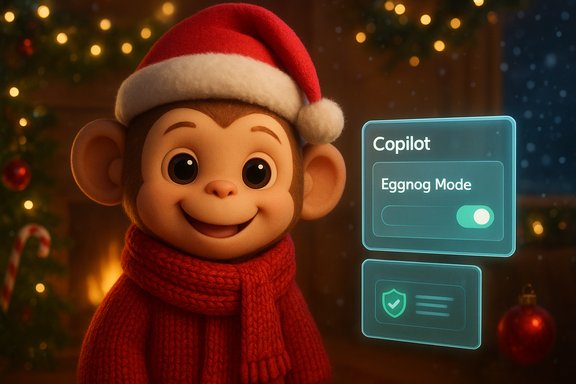
Eggnog Mode is a presentation‑layer persona: a togglable holiday overlay that softens Copilot’s tone, wraps the Mico avatar in seasonal visuals, and surfaces short, shareable micro‑interactions — jokes, toasts, trivia, quick craft ideas and movie marathon prompts — across a 12‑day cadence. The overlay is purposely scoped to entertainment and small tasks; Microsoft’s rollout emphasized that it does not change Copilot’s underlying model routing, data access, or privacy defaults. Early coverage and community hands‑on posts corroborate that Eggnog Mode is a cosmetic, time‑limited experiment targeting major English‑language markets.The mechanics: how Microsoft built a seasonal persona safely
Persona tuning, not model surgery
The practical engineering pattern for Eggnog Mode is familiar: rather than retrain a foundation model, Microsoft layered persona‑conditioning and prompt templates on top of the existing Copilot stack. That keeps compute and governance complexity low while producing a consistent “holiday voice” and avatar behavior. Safety overlays — classification models and curated prompt templates — gate outputs for family appropriateness, and a retrieval layer (RAG) provides grounding for factual suggestions like recipes or local event info. This pattern is a conservative, effective way to test tone and engagement without expanding backend attack surface.Hybrid delivery: cloud scale with on‑device fallbacks
Copilot uses a hybrid architecture: cloud‑based inference for scale with optional on‑device inference for privacy‑sensitive scenarios on Copilot+ certified hardware. That hybrid approach reduces latency for voice and multimodal experiences and helps manage holiday peak loads through auto‑scaling. Monitoring, staged rollouts and human‑in‑the‑loop remediation were visible parts of the deployment playbook, allowing quick iteration if moderation flags spike.Voice, visual flourishes and micro‑UX
Mico’s animated, non‑photoreal avatar drives emotional affordances: subtle micro‑animations, seasonal skins (hat, scarf, fireplace backdrop), and synchronized TTS cues make the exchange feel friendlier and more shareable. The holiday overlay leverages those assets to create snackable content that performs well on social platforms without exposing new privacy or data‑sharing flows.Why Microsoft and marketers care: product, engagement and monetization logic
Low‑risk, high‑reach experiments
Seasonal persona overlays are an inexpensive, low‑risk way to increase daily active sessions, generate social content, and collect behavioral signals for future persona design. Microsoft’s product and marketing teams can use metrics from a 12‑day push to test whether tone, family toggles and avatar expressiveness materially alter retention or conversion funnels. The approach is intentionally reversible and telemetry‑driven.Monetization and conversion levers
While Eggnog Mode itself appears free, the pattern points to clear monetization pathways:- Premium persona packs or themed experiences behind subscription tiers.
- Branded prompts or partner integrations (recipes tied to food brands).
- Social or creator features that drive installs and trials of paid Copilot plans.
The numbers: what Microsoft and analysts are saying (and what can be verified)
- Microsoft has publicly reported that its family of Copilot apps surpassed 100 million monthly active users, and that broader AI features across Microsoft reach hundreds of millions — figures the company repeatedly referenced in investor materials and earnings commentary. These disclosures make even small engagement uplifts from seasonal activations potentially meaningful.
- Industry forecasts commonly cited in public reporting place the global AI market in the hundreds of billions by 2030. Statista‑based projections (frequently quoted across trade press) estimate the market could reach roughly $826 billion by 2030. These numbers vary by methodology and definition of “AI market,” so treat them as directional market sizing rather than a fixed benchmark.
- Analyst research shows broad enterprise adoption trajectories for generative AI: Gartner’s public analyses put GenAI adoption on a fast track — for example, Gartner reported that a large majority of enterprises and customer‑service leaders planned experiments or pilots around conversational GenAI in the 2024–2026 window. These studies are useful for framing the context in which holiday activations operate.
Risks, governance and ethical considerations
Privacy and data‑policy separation
Microsoft framed Eggnog Mode as cosmetic to limit privacy exposure: persona overlays should not, in principle, alter data retention, connectors or long‑term memory settings. That design choice narrows regulatory risk, but product teams must ensure UI clarity so users understand when content is persona‑generated and whether conversational snippets are stored or used to tune models. Transparency is a product feature — toggles and clear disclosures reduce mistrust.Safety, child protection and content moderation
Deploying family‑facing personas requires hardened safety pipelines. The best practices evident in the rollout include kid‑friendly default filters, optional “family” toggles, and human review for flagged outputs. These guardrails are necessary because even playful prompts can accidentally surface inappropriate or culturally insensitive content if moderation is insufficient. Microsoft’s staged rollout and telemetry monitoring are consistent with these controls.Regulatory context and accountability
The EU AI Act went into force as a formal legal instrument in 2024 and began phased application of key obligations in 2025; platform providers must map persona activations to these timelines and the Act’s transparency and risk requirements. In the U.S., enforcement guidance and audit expectations from regulators (e.g., updated FTC scrutiny of AI advertising and deceptive practices) are increasing; product teams should expect audits and require verifiable measurement for marketing claims. These regulatory shifts mean seasonal activations must include audit trails, moderation logs and explicit opt‑outs.Authenticity and user trust
Personified assistants are engaging by design, but they raise the question of authenticity: a pep talk from an avatar can feel emotionally resonant, and companies must avoid deceptive framing that conceals the content was generated by AI. Best practices include explicit disclosure that the content is AI‑generated, guardrails around persuasive messaging (especially for children), and accessible controls that let users switch the persona off.Practical guidance for product teams and marketers
If building a seasonal persona, start with a narrow scope
- Define an explicit scope (entertainment, recipes, micro‑activities) and forbid transactional flows (no bookings, purchases, or asking for personal data) in the persona layer.
- Use persona templates and constrained prompt engineering rather than retraining foundation models.
- Add family safe defaults and age gating where required.
Instrumentation and measurement
- Track engagement lift (daily opens, social shares), moderation flags, retention delta and conversion funnel movement.
- Maintain audit logs for every persona output during the campaign.
- A/B test persona aggressiveness and disclosure language to optimize both trust and engagement.
Monetization guardrails
- Keep seasonal personas free at launch to maximize reach; evaluate premium persona packs or partner integrations only after safety reviews and measurement confirm positive user impact.
- Clearly label sponsored content and require explicit opt-in for commercial tie‑ins.
Quick checklist for holiday persona rollouts
- UI toggles and disclosures in place ✔
- Safety classifier thresholds tuned ✔
- Human review pipeline for edge cases ✔
- Telemetry and rollback mechanism ready ✔
- Legal review for cross‑jurisdictional compliance ✔
Technical architecture notes
- Persona overlays are implemented with prompt templates and adapter layers for voice output; this reduces compute overhead and the need to change model routing.
- Retrieval‑augmented generation (RAG) should be used for any factual content to avoid hallucinations.
- Use rate limits and content quotas to prevent abuse or spammy behavior during viral spikes.
- Maintain model provenance metadata (which model and version produced a given output) for downstream auditing.
Competitive landscape and future outlook
- Microsoft is not alone: competitors are exploring themed personas and custom assistants. Google’s Gemini, OpenAI’s custom GPTs and other platform providers are all experimenting with persona and seasonal activations, creating a crowded field for consumer attention. Seasonal modes are emerging as a standard retention playbook in 2025.
- Microsoft’s strategic edge is ecosystem reach: Copilot exists across Windows, Edge, Bing and Microsoft 365, giving persona experiments large distribution and measurable conversion pipelines into subscription bundles. If integrated responsibly, persona activations can inform future paid offerings or creator ecosystems.
- Technically, the industry trend toward multimodal assistants (text + voice + vision + video) will make future seasonal activations richer but also mechanically more complex to govern. Investment in safety tooling, auditability and transparency will be the deciding factor between delightful campaigns and regulatory headaches. Gartner’s analysis and related forecasts point to multimodal features becoming a standard enterprise expectation by the end of the decade.
What to watch next
- Measurement: watch whether Eggnog Mode measurably moved retention or conversion in Microsoft’s post‑campaign metrics; platform owners often publish follow‑ups after campaigns.
- Regulation: how companies map persona overlays to AI Act obligations and emerging U.S. audit expectations will set norms for what is permissible in consumer‑facing AI marketing.
- Productization: whether themed persona bundles become a paid feature or a free acquisition funnel will indicate how aggressively platforms monetize expressive AI.
Conclusion
Microsoft’s 12‑day “Eggnog Mico” activation is a textbook example of modern AI product‑marketing: a low‑risk, highly shareable persona overlay that humanizes technology and collects valuable signals about tone, moderation and family settings without touching core data or model policies. The campaign exposes both the opportunity and the responsibility inherent in consumer AI: holiday cheer and viral clips are useful tests, but long‑term trust will depend on transparency, robust safety engineering, and clear auditability. For product teams and marketers, the playbook is clear — start small, instrument everything, design conservative defaults for young audiences, and treat trust as a measurable product metric rather than an afterthought.SEO tip: this analysis emphasizes actionable keywords for Windows and Copilot audiences — “Copilot Eggnog Mode,” “Mico avatar,” “holiday AI persona,” “Copilot Pro,” “multimodal assistant,” and “AI safety and governance” — which align with how users search for seasonal AI features, product updates and regulatory guidance.
Source: Blockchain News Microsoft Copilot AI Launches 12 Days of Eggnog Campaign: Boosting Productivity with Personalized AI Pep Talks | AI News Detail
