

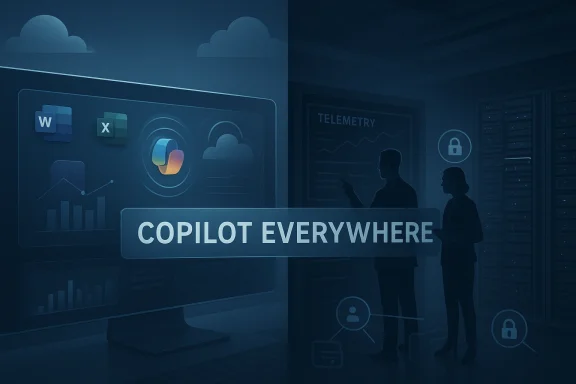
Microsoft’s high‑profile test of “Copilot everywhere” — a staged, headline‑friendly showcase intended to prove that AI could be the next durable revenue and product moat — is running into the messy realities of systems engineering, enterprise procurement, and human expectations. The Barron’s piece that framed this episode as “Microsoft staged AI’s greatest test case” argues that the demo‑heavy rollout may not be working as planned; independent reporting, community testing, and internal signals corroborate the core claim that the story is more complicated than Microsoft’s marketing script.
Microsoft’s Copilot thesis is simple in outline and enormous in scale: embed generative AI into the company’s vast installed base — Windows, Microsoft 365, Edge, Teams, GitHub and Azure — so that customers both pay for premium, seat‑based Copilot features and consume Azure compute for inference. The result, in theory, is a two‑sided revenue engine: license fees and cloud consumption. To back that thesis Microsoft spent heavily on GPU capacity and infrastructure, creating high expectations that product rollouts would quickly translate into measurable revenue lift. Multiple independent summaries of the rollout and the market response underline that this is precisely the bet Microsoft placed — and the bet is now being stress‑tested.
Microsoft’s public narrative has focused on product breadth (Copilot across apps), governance (tenant isolation, agent workspaces), and staged rollouts with opt‑in toggles. But the practical reality described in reporting and hands‑on community tests is more granular: many features behave inconsistently across tasks and hardware tiers; privacy and telemetry questions linger; and enterprise procurement is bumping into integration and pricing complexity. Those operational frictions are important because they directly affect purchase decisions and the path from pilot to scale.
Key elements of the Barron’s narrative, corroborated across other reporting and community analysis, include:
Independent hands‑on testing and community reproductions show real‑world brittleness: image misidentification, inconsistent UI automation, and verbose or slow responses in synchronous workflows. Those symptoms are especially damaging when a feature is positioned as a time‑saver for knowledge workers or as a component in mission‑critical automation.
There are also complex ties to OpenAI: Microsoft’s partnership and large investment created a strategic advantage, but the relationship has its own operational and political friction. Reports of an urgent internal posture at OpenAI (described in some coverage as a “code red”) and changing model roadmaps have downstream implications for Microsoft because of the intertwined engineering and commercial relationships. These dynamics are still evolving and should be treated as reported developments rather than settled facts.
This is not mere noise. Enterprise procurement teams read the same social signals and weigh them alongside vendor references and pilot results. A negative meme economy can slow adoption by increasing perceived risk — making Microsoft’s evangelism task harder and more expensive.
For Microsoft the path forward is salvageable — but it requires humility, targeted engineering, clearer pricing, and an executive willingness to prioritize reliability and integration over headline velocity. For IT leaders and Windows power users, the prudent approach is to treat Copilot as an incrementally valuable tool: pilot narrowly, measure precisely, and harden governance before broad deployment. The march of AI in productivity is real; whether Copilot becomes the durable core of Microsoft’s growth story depends on whether the company can convert staged spectacle into day‑to‑day trust and demonstrable ROI.
Source: Barron's https://www.barrons.com/articles/microsoft-copilot-meta-alphabet-ai-earnings-2e220f19/
 Background
Microsoft’s Copilot thesis is simple in outline and enormous in scale: embed generative AI into the company’s vast installed base — Windows, Microsoft 365, Edge, Teams, GitHub and Azure — so that customers both pay for premium, seat‑based Copilot features and consume Azure compute for inference. The result, in theory, is a two‑sided revenue engine: license fees and cloud consumption. To back that thesis Microsoft spent heavily on GPU capacity and infrastructure, creating high expectations that product rollouts would quickly translate into measurable revenue lift. Multiple independent summaries of the rollout and the market response underline that this is precisely the bet Microsoft placed — and the bet is now being stress‑tested.Microsoft’s public narrative has focused on product breadth (Copilot across apps), governance (tenant isolation, agent workspaces), and staged rollouts with opt‑in toggles. But the practical reality described in reporting and hands‑on community tests is more granular: many features behave inconsistently across tasks and hardware tiers; privacy and telemetry questions linger; and enterprise procurement is bumping into integration and pricing complexity. Those operational frictions are important because they directly affect purchase decisions and the path from pilot to scale.
What Barron’s Said — and Why It Matters
Barron’s framed Microsoft’s recent AI push as a staged test intended to demonstrate that Copilot could be the backbone of a productivity revolution — and suggested that the test may be underperforming. That framing matters because Microsoft’s investor case increasingly ties future growth to AI monetization rather than to the more familiar drivers of Azure infrastructure or Office subscription renewals.Key elements of the Barron’s narrative, corroborated across other reporting and community analysis, include:
- A visible mismatch between marketing demos and real‑world reliability, especially for multimodal features such as Copilot Vision and desktop agents. Users and journalists have documented brittle outcomes in some everyday tasks.
- Evidence of internal recalibration: specific product growth targets and sales expectations for agentic AI offerings were reportedly softened after many sellers failed to hit aggressive quotas. The Information and broader coverage are summarized in industry writeups that report these field adjustments.
- The economics problem: even when Copilot is available, unclear pricing, seat‑based licensing plus consumption billing, and perceived integration overhead complicate buyer math and slow enterprise conversions.
The Technical Reality: Why Demos Diverge from Production
Multimodal brittleness and task variance
One of the clearest technical lessons is that AI capability is highly task‑dependent. Copilot is not a single monolithic product but an umbrella of features — text summarization, spreadsheet reasoning, code completions, image recognition, UI automation, and agentic workflows. Each of these uses different models, prompt engineering, data connectors, and runtime constraints. That means accuracy and reliability vary dramatically by task and context.Independent hands‑on testing and community reproductions show real‑world brittleness: image misidentification, inconsistent UI automation, and verbose or slow responses in synchronous workflows. Those symptoms are especially damaging when a feature is positioned as a time‑saver for knowledge workers or as a component in mission‑critical automation.
Containment, agents, and security design choices
Microsoft’s engineering response has been to design containment into agentic features. Agents are run in separate, low‑privilege Windows accounts with scoped access to known folders, signing and revocation controls, and auditing surfaces for enterprise governance. This model maps to familiar enterprise controls (service accounts, RBAC, Intune policies) and thus reduces some risk vectors. But containment increases complexity: lifecycle management, permission prompts, supply‑chain concerns, and helpdesk overhead all grow.Hardware gating and Copilot+ devices
A complicating factor unique to Windows is hardware heterogeneity. Microsoft has tied richer local inference features to a Copilot+ device tier that uses on‑device NPUs and drivers. That gating means users who install the same OS update may experience very different functionality depending on hardware and OEM software. The two‑tiered reality — base security and fixes for all, advanced AI experiences for certified hardware — makes troubleshooting and adoption more complex across fleets.The Business Impact: Sales, CapEx, and Investor Expectations
A capex‑heavy backdrop
Microsoft’s infrastructure investments to support large‑scale model hosting and agent runtimes have been enormous and visible in financial reporting. Independent reporting summarized by industry analysts indicates capex categories in the tens of billions for recent fiscal periods, underscoring the financial pressure to convert AI capability into predictable revenue. A high capex baseline raises the bar for the speed and scale at which Copilot adoption must mature to create the returns investors expect.Sales target recalibration
Multiple reports and field checks suggest that some Azure sales units reduced product‑level growth targets after many sellers missed ambitious quotas tied to agent and Copilot offerings. Microsoft publicly disputed characterizations that company‑wide quotas were lowered, but the balance of reporting indicates that product‑specific adjustments did occur. Whether framed as a tactical reframing or a meaningful signal, these moves telegraph a slower and more uneven path to monetization than some initial plans anticipated.Pricing, procurement friction, and TCO concerns
Enterprises want predictable total cost of ownership. Copilot’s mix of seat‑based charges and Azure consumption for inference drives procurement anxiety: variable monthly bills tied to GPU‑hours are harder to budget than flat‑fee SaaS seats. Add connectors, integration costs, and governance requirements, and the pilot‑to‑scale probability drops. That’s why many customers remain in pilot mode rather than converting to company‑wide deployments.The Competitive Context: Not Just Microsoft vs. Themselves
Microsoft’s challenges are amplified by the rapid pace of competition. Google’s Gemini and other rivals are advancing multimodal capabilities and user perceptions quickly. Independent market snapshots and internal narratives at AI firms suggest an industry dynamic where first‑mover demo advantage can erode fast if day‑to‑day performance or user sentiment shifts. That means Microsoft’s staging of a big test case must succeed not just technically but on the basis of consistent user value to keep competitive mindshare.There are also complex ties to OpenAI: Microsoft’s partnership and large investment created a strategic advantage, but the relationship has its own operational and political friction. Reports of an urgent internal posture at OpenAI (described in some coverage as a “code red”) and changing model roadmaps have downstream implications for Microsoft because of the intertwined engineering and commercial relationships. These dynamics are still evolving and should be treated as reported developments rather than settled facts.
Governance, Privacy, and Enterprise Risk
Telemetry, consent and admin controls
A persistent theme across reporting and community debugging is data flow uncertainty. When Copilot analyzes a document, a web page, or a set of desktop signals, what is the precise data sent to Microsoft services? How long is it retained? How is it audited and exported? Microsoft publishes controls and admin policies, but many governance knobs remain labeled as preview during early testing — an awkward position for cautious enterprises. Clear, auditable data‑routing controls (local vs cloud inference), retention windows, and robust admin templates are necessary for broad enterprise trust.New attack surfaces and supply chain risk
Agentic capabilities — agents that can read and write files, interact with apps, and call connectors — create a new class of privileged automation. Even with signing and account isolation, a compromised agent binary or an unvetted connector is an attractive vector for exfiltration or privilege escalation. Security teams will need to treat agent identities as first‑class service accounts, with lifecycle policies, RBAC, and telemetry monitoring. The promise of productivity gains must be balanced against operational risk management.Community Reaction: From Skepticism to Strategic Reassessments
Microsoft’s staged rollouts and bold UX experiments provoked an unusually loud community reaction. On enthusiast forums and in enterprise sysadmin channels, the discourse ranges from sharp satire and usability complaints to serious IT reconsideration. Criticisms include regressions in power‑user ergonomics, perceived performance regressions on older hardware, and a sense that headline AI features were prioritized over foundational polish. The social backlash forced public responses from Windows leadership and has become reputational tailwind – or headwind — for adoption.This is not mere noise. Enterprise procurement teams read the same social signals and weigh them alongside vendor references and pilot results. A negative meme economy can slow adoption by increasing perceived risk — making Microsoft’s evangelism task harder and more expensive.
What Works Today: Realistic Use Cases and Where Microsoft Has an Edge
Despite the setbacks and skepticism, not everything is broken. There are targeted scenarios where Copilot‑style assistants add measurable value:- Spreadsheet reasoning and data extraction in narrowly defined templates where input variance is low. Controlled benchmarks sometimes show much higher task‑level accuracy on narrowly scoped problems.
- Developer productivity in GitHub Copilot workflows where code completions are validated by human reviewers and integrated into existing pipelines. Here the feedback loop from devs is faster and easier to operationalize.
- On‑device inference for latency‑sensitive, privacy‑conscious tasks on certified Copilot+ hardware, assuming OEM drivers and local models are mature. This remains a partially realized scenario but has clear promise for specific verticals.
Actionable Guidance: What IT Leaders and Windows Users Should Do Now
- Pilot, don’t plunge. Run Copilot/agent pilots on representative cohorts with defined KPIs (time saved, errors reduced, cycle time). Test the worst‑case failure modes.
- Validate data flows. Use packet captures, telemetry audits, and vendor documentation to confirm what content is sent off‑device and how long it’s retained. Push for contractual SLAs and retention guarantees.
- Treat agents as service accounts. Apply lifecycle policies, least privilege, RBAC, and automated revocation. Monitor agent telemetry closely.
- Budget for integration. Expect additional DevOps, connector engineering, and change‑management costs to move from pilot to production. Include these in your TCO assessments.
- Hardware gate prudently. If you plan on Copilot+ device features, validate performance on the actual models and drivers you will deploy. Don’t assume parity across device SKUs.
Strengths, Risks, and the Likely Path Forward
Notable strengths
- Scale and reach: Microsoft can embed Copilot across the world’s most widely used productivity suite and a major desktop OS, giving it a unique distribution advantage.
- Infrastructure depth: The company’s deep investments in Azure GPU capacity create optionality and control over latency, compliance zones, and model choices.
- Enterprise governance features: The agent containment model and admin surfaces are practical steps toward reconciling automation power with security needs.
Material risks
- Pilot‑to‑scale gap: Integration complexity, procurement friction, and pricing structures threaten to slow adoption and delay the payoff on capex. Field recalibrations of growth targets are evidence of this risk.
- Reputation and trust: Public blowback and social amplification of failures increase the hurdle for corporate buyers who rely on predictable behavior for mission‑critical workflows.
- Supply‑chain and security exposure: Agentic features broaden the threat surface. Even well‑engineered containment needs robust operational practice to be effective.
Where Microsoft can credibly pivot
- Price simplicity: Introduce deterministic, predictable pricing tiers that decouple core seat value from heavy variable compute bills, at least for early enterprise adopters.
- Focused vertical plays: Move aggressively on industry‑specific copilots (finance, legal, healthcare with correct guardrails) where narrow data and high repeatability boost accuracy and ROI.
- Improve the pilot experience: Build turnkey connectors, hardened SDKs, and deployment templates that reduce integration friction and shorten time‑to‑value.
Conclusion
Barron’s characterization that Microsoft staged a grand test that may not be working captures a real and consequential tension: the difference between marketing‑level demos and the gritty, iterative work that makes AI dependable in the enterprise. Independent reporting, community hands‑on tests, and internal signals corroborate that Microsoft’s Copilot strategy is delivering meaningful capabilities but not yet the frictionless, scalable utility many expected.For Microsoft the path forward is salvageable — but it requires humility, targeted engineering, clearer pricing, and an executive willingness to prioritize reliability and integration over headline velocity. For IT leaders and Windows power users, the prudent approach is to treat Copilot as an incrementally valuable tool: pilot narrowly, measure precisely, and harden governance before broad deployment. The march of AI in productivity is real; whether Copilot becomes the durable core of Microsoft’s growth story depends on whether the company can convert staged spectacle into day‑to‑day trust and demonstrable ROI.
Source: Barron's https://www.barrons.com/articles/microsoft-copilot-meta-alphabet-ai-earnings-2e220f19/
