

Microsoft’s Copilot has moved from helpful search box to a more human‑like companion: an orchestrated global push that pairs a selectable “Real Talk” conversational style with an expressive avatar, expanded voice languages, group collaboration, and persistent memory—changes that make Copilot feel more social and opinionated while raising new questions about privacy, governance and trust.
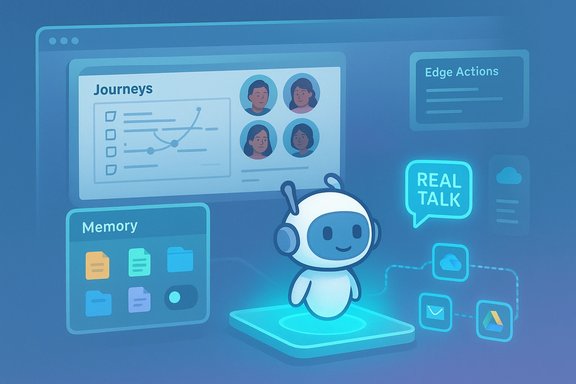
Microsoft unveiled a broad consumer refresh of Copilot—frequently called the “Fall Release”—that bundles a dozen headline upgrades designed to make the assistant feel personal, voice‑first and context‑aware. The package includes an animated avatar named Mico, a selectable Real Talk persona that can push back, Copilot Groups for shared sessions, deeper Edge agent features (Actions and Journeys), and long‑term Memory & Personalization with explicit user controls. Many features are rolling out in staged waves beginning in the United States and expanding to other territories.
This release is being framed as part of Microsoft’s “human‑centered AI” strategy: move assistants away from reflexive obedience and toward partners that can remember context, challenge assumptions, and participate in shared workflows. But the shift also reintroduces anthropomorphic design—voice, expression and persona—elements that demand careful governance if they are to avoid manipulation, confusion or privacy erosion.
Enterprise memory artifacts are implemented to respect tenant controls; early reporting indicates that some memory items are stored within Microsoft‑managed service boundaries (for enterprise customers, hidden storage in Exchange Online has been referenced) so that existing compliance, data residency and access controls apply. Consumer memory flows are opt‑in and user‑managed with UI to inspect, export or delete. Those storage decisions materially affect compliance and legal exposure for organizations.
The Real Talk behavior is implemented as a selectable model preference or persona overlay that changes the assistant’s response policy: it surfaces chain‑of‑thought style reasoning and highlights counterarguments rather than defaulting to agreeable completions. But the reliability of that pushback depends on robust grounding and retrieval; otherwise the assistant risks confidently asserting incorrect counterclaims.
Administrators should expect SKU‑dependent feature flags and tenant controls that can limit which Copilot features are enabled in managed deployments. Consumers may see features enabled by default in preview channels, but Microsoft has highlighted opt‑in toggles and the ability to disable visual or voice elements on a per‑user basis.
Yet the release simultaneously raises consequential governance questions. Persistent memory, cross‑service connectors, and expressive avatars amplify both utility and risk. Real Talk’s promise to reduce sycophancy is laudable but depends heavily on grounding and provenance to avoid replacing one form of overconfidence with another. Staged rollouts and subscription gating complicate the landscape further, creating a patchwork of behavior across regions and tenants.
For Windows users and IT professionals, the immediate priority is to treat these changes as a practical platform shift: adopt the features that improve workflows, but pair them with strict controls, auditing and clear user education. For Microsoft, success will depend less on avatar charm and more on the engineering and policy scaffolding that makes human‑like AI reliably helpful, verifiable and safe. The coming months of staged rollouts, enterprise pilots and independent audits will determine whether Copilot becomes a trusted teammate or an elegant experiment that outpaces its governance.
Microsoft’s move to make Copilot more human‑like is ambitious and, if managed carefully, could deliver a genuinely more natural computing experience for millions of Windows users—while also setting important precedents for how personality, memory and agency are governed in everyday AI assistants.
Source: Windows Report https://windowsreport.com/copilot-real-talk-goes-global-as-microsoft-pushes-more-human-like-ai/
 Background
Microsoft unveiled a broad consumer refresh of Copilot—frequently called the “Fall Release”—that bundles a dozen headline upgrades designed to make the assistant feel personal, voice‑first and context‑aware. The package includes an animated avatar named Mico, a selectable Real Talk persona that can push back, Copilot Groups for shared sessions, deeper Edge agent features (Actions and Journeys), and long‑term Memory & Personalization with explicit user controls. Many features are rolling out in staged waves beginning in the United States and expanding to other territories.This release is being framed as part of Microsoft’s “human‑centered AI” strategy: move assistants away from reflexive obedience and toward partners that can remember context, challenge assumptions, and participate in shared workflows. But the shift also reintroduces anthropomorphic design—voice, expression and persona—elements that demand careful governance if they are to avoid manipulation, confusion or privacy erosion.
What Microsoft announced
Mico: an avatar for voice-first interactions
- Mico is a deliberately non‑photoreal, animated avatar that appears primarily during voice conversations and on the Copilot home surface.
- It uses simple facial expressions, color shifts and shape changes to indicate listening, thinking and ready states; the visual layer is optional and configurable.
Real Talk: a persona that can disagree
- Real Talk is a selectable conversational style built to challenge assumptions and surface counterpoints instead of offering reflexive agreement.
- The mode is explicitly intended to reduce model sycophancy—where an LLM simply echoes a user’s assertions—even when those assertions are incorrect or risky.
Copilot Voice: broader language support and faster responses
- The Copilot Voice engine has been expanded to support many more languages—reports cite the addition of dozens of languages in recent updates—aiming to make voice interactions globally accessible.
- Microsoft has also improved real‑time response speed to reduce conversational lag and make multi‑turn voice dialogs feel natural.
Copilot Groups, Learn Live and collaboration
- Copilot Groups create shared AI sessions that can include many participants (reported support up to 32 people), enabling collaborative planning, brainstorming and task splitting with the assistant summarizing threads, tallying votes and proposing next steps.
- Learn Live is a voice‑led Socratic tutoring mode that pairs voice interactions with visual whiteboards and interactive exercises for guided study.
Memory, connectors and Edge agent features
- Memory & Personalization provide long‑term, user‑managed memory that can store project context, preferences and facts; Microsoft emphasizes explicit view, edit and delete controls. Enterprise implementations appear to tether memory artifacts to Microsoft service boundaries to preserve tenant‑level security.
- Connectors allow opt‑in links to OneDrive, Outlook and consumer Google services (Gmail, Drive, Calendar), enabling Copilot to ground answers in a user’s files and events.
- In Microsoft Edge, Copilot can create resumable Journeys from browsing sessions and perform permissioned multi‑step Actions (for example, filling forms or booking travel) with visible logs of activity.
How it works (at a glance)
Microsoft’s rollout pairs UI and behavior changes with backend model‑routing and retrieval systems. Several product writeups suggest that Copilot will route tasks to model classes appropriate for the task (for example, more capable reasoning models for planning and lighter models for routine queries), and rely on retrieval from connected services to ground responses.Enterprise memory artifacts are implemented to respect tenant controls; early reporting indicates that some memory items are stored within Microsoft‑managed service boundaries (for enterprise customers, hidden storage in Exchange Online has been referenced) so that existing compliance, data residency and access controls apply. Consumer memory flows are opt‑in and user‑managed with UI to inspect, export or delete. Those storage decisions materially affect compliance and legal exposure for organizations.
The Real Talk behavior is implemented as a selectable model preference or persona overlay that changes the assistant’s response policy: it surfaces chain‑of‑thought style reasoning and highlights counterarguments rather than defaulting to agreeable completions. But the reliability of that pushback depends on robust grounding and retrieval; otherwise the assistant risks confidently asserting incorrect counterclaims.
Availability and rollout
Microsoft is staging the rollout to manage scale and safety checks: many features are live first in the United States with phased expansion to the United Kingdom, Canada and other markets. Availability will vary by region, device, platform and subscription tier; some more advanced capabilities may be gated behind Microsoft 365 or premium subscriptions.Administrators should expect SKU‑dependent feature flags and tenant controls that can limit which Copilot features are enabled in managed deployments. Consumers may see features enabled by default in preview channels, but Microsoft has highlighted opt‑in toggles and the ability to disable visual or voice elements on a per‑user basis.
Strengths and opportunities
1. Better accessibility and global reach
Expanding Copilot Voice to dozens of languages dramatically increases accessibility for non‑English speakers and supports more natural interaction across global Windows deployments. This can materially reduce friction for users who prefer voice commands or need hands‑free workflows.2. More effective collaboration and learning
Shared Copilot sessions and Learn Live open practical scenarios in education and small‑team productivity: tutoring, group planning, and rapid brainstorming are easier when participants can work with the same AI context. The assistant’s ability to summarize and assign follow‑ups can speed coordination.3. Safer decision‑making through constructive challenge
Real Talk’s pushback model, when grounded, can prevent simple errors and encourage better decisions by surfacing alternative perspectives and evidence. For critical tasks—project planning, security reviews, or medical triage—constructive disagreement from an assistant is potentially valuable.4. Productive agentic actions and continuity
Edge Actions and Journeys bring automation and continuity to browsing and research flows. Copilot’s ability to perform permissioned multi‑step tasks with a visible activity log can reduce manual effort and streamline repetitive workflows.Risks and red flags
Privacy and data residency
Persistent memory and cross‑service connectors centralize a lot of contextual data. Even where Microsoft ties memory to enterprise boundaries, the presence of long‑term artifacts and cross‑account access increases exposure if misconfigurations occur or if consent controls are unclear. Administrators and users must verify where memory is stored and who can access it.Hallucinations and misplaced confidence
Real Talk’s effectiveness depends on grounding. If the assistant’s pushback is not reliably anchored to sources, users may receive confident yet incorrect counterclaims. In high‑stakes contexts—health, legal, finance—misplaced confidence can cause harm. Product teams need robust citations, provenance signals and easy verification paths.Emotional design and persuasion risks
Mico’s expressive design reduces friction but also reintroduces anthropomorphism. Visual and voice cues can increase user trust or attachment, which may amplify persuasive power. If engagement incentives are not aligned with transparency, avatars risk nudging decisions subtly. Independent oversight and clear opt‑out controls are essential to mitigate manipulative effects.Governance, auditability and regulatory exposure
Agentic features that perform actions on web pages or across accounts must include tamperable audit trails and enterprise controls. Without clear logs, rollback mechanisms and administrative oversight, organizations face compliance and legal risks—especially when Copilot interacts with sensitive data or third‑party services.Staged rollouts and inconsistent behavior
Phased availability means behavior and features will vary by region and channel. This inconsistency complicates training and governance: IT teams will need to account for different defaults, feature flags and possibly diverging user experiences during the rollout period.Practical guidance for users and IT teams
- Audit Copilot settings: review voice, avatar and memory toggles; disable Mico or Real Talk in sensitive environments.
- Manage connectors carefully: opt into only the services you trust and document the scope of access (OneDrive, Outlook, Gmail, Drive).
- Inspect memory: use UI controls to view, export or delete saved memory artifacts and understand where data is stored for enterprise accounts.
- Configure tenant policies: for managed deployments, set clear policies about Copilot features, logging and who can enable agentic Actions or Groups.
- Require verification for high‑stakes outputs: treat Real Talk’s pushback as a prompt to verify, not as a final authority; demand citations and provenance when decisions matter.
What Microsoft (and the ecosystem) should do next
- Maintain visible provenance: every time Copilot makes a claim or pushes back, show clear citations and an accessible path to verify sources. Real Talk should surface evidence, not only contrarian prose.
- Harden audit logs for agentic actions: ensure Actions include tamper‑proof logs, human approval gates for important tasks, and easy rollback when things go wrong.
- Expand independent testing and third‑party audits: staged rollouts should be paired with independent safety audits and red‑team testing to validate Real Talk’s behavior and memory controls.
- Provide enterprise defaults that err on the side of privacy: ship conservative defaults for organizations and make more intrusive features opt‑in for managed tenants.
- Communicate rollout status transparently: clear timelines, region‑by‑region availability and SKU differences reduce confusion for admins and users.
Final analysis
Microsoft’s Copilot Fall Release is a significant evolution: it blends voice, visual cues and social features to make AI feel less like a tool and more like a collaborator. The package—Mico, Real Talk, expanded languages, Groups, Memory, Edge Actions and Learn Live—offers clear productivity and accessibility upsides, and it demonstrates thoughtful design choices such as optionality and tenant‑aware memory storage.Yet the release simultaneously raises consequential governance questions. Persistent memory, cross‑service connectors, and expressive avatars amplify both utility and risk. Real Talk’s promise to reduce sycophancy is laudable but depends heavily on grounding and provenance to avoid replacing one form of overconfidence with another. Staged rollouts and subscription gating complicate the landscape further, creating a patchwork of behavior across regions and tenants.
For Windows users and IT professionals, the immediate priority is to treat these changes as a practical platform shift: adopt the features that improve workflows, but pair them with strict controls, auditing and clear user education. For Microsoft, success will depend less on avatar charm and more on the engineering and policy scaffolding that makes human‑like AI reliably helpful, verifiable and safe. The coming months of staged rollouts, enterprise pilots and independent audits will determine whether Copilot becomes a trusted teammate or an elegant experiment that outpaces its governance.
Microsoft’s move to make Copilot more human‑like is ambitious and, if managed carefully, could deliver a genuinely more natural computing experience for millions of Windows users—while also setting important precedents for how personality, memory and agency are governed in everyday AI assistants.
Source: Windows Report https://windowsreport.com/copilot-real-talk-goes-global-as-microsoft-pushes-more-human-like-ai/
