• Thread Author
Satya Nadella’s short, pointed message to Microsoft’s gaming teams — “For me, we’re long on gaming. We’ll continue to invest, and we’ll always do so.” — landed like both a reassurance and a challenge: reassurance that the company’s commitment to games remains, and a challenge that words must now be matched by results as Xbox enters a period of strategic re‑definition under new leadership.

Xbox console setup glows with AI cloud and Game Pass icons in a futuristic office.Background​

The Xbox business has been one of Microsoft’s most visible and volatile consumer-facing ventures for a quarter century. Under Phil Spencer’s leadership — the public face of Xbox for more than a decade and the architect of several of its most consequential moves — the brand moved from console survival mode into subscription and platform play. Spencer’s tenure brought big, bold bets: rebuilding consumer trust after the Xbox One launch missteps, investing heavily in first‑party studios, expanding Xbox to the PC ecosystem, and placing Game Pass at the center of Xbox’s business model.
Those strategic choices changed both what Xbox is and how Microsoft thinks about gaming. Xbox stopped being only a box that sits under a TV; it became a cross‑device ecosystem of consoles, Windows PC, and cloud streaming tied together by subscription economics. The Activision Blizzard acquisition, closed in October 2023 after an extended regulatory battle, remains the largest seismic event attached to that strategy — a deal meant to provide Microsoft with scale, marquee IP, and leverage in the subscription era.
The recent turbulence around leadership — Phil Spencer’s retirement in February 2026 and the appointment of Asha Sharma, a senior Microsoft AI executive, as CEO of Microsoft Gaming — has intensified questions about Xbox’s future direction. Nadella’s internal Q&A, hosted by Sharma and reported across multiple outlets, was intended to quell doubts inside Microsoft and in the broader gaming ecosystem. His remarks, and Sharma’s public framing of the next-generation console effort called Project Helix, are now the starting points for a revisit of Xbox’s strategic priorities.

What happened: leadership, messaging, and timing​

The leadership shuffle, in brief​

  • Phil Spencer announced his retirement from Microsoft Gaming in mid‑February 2026, wrapping up a career at Microsoft that began in the late 1980s. Reports across the trade press indicated the announcement was publicized between February 20 and February 23, 2026, with Spencer remaining available in an advisory capacity during the transition.
  • Asha Sharma, previously president of Microsoft’s CoreAI product organization, was promoted to CEO of Microsoft Gaming (sometimes reported with effective dates in late February 2026). The shuffle also included other moves within Microsoft Gaming leadership, such as promotions and departures in studio and platform ranks.
  • The changes were rapid and surprising to many observers because Sharma’s profile before the move had been rooted in AI product leadership rather than studio management, console design, or publisher operations.

Nadella’s internal Q&A: the message​

In an internal session that Microsoft allowed to be reported on by major gaming press, Satya Nadella framed gaming as one of Microsoft’s defining identities — alongside platform engineering, developer tools, and productivity software. He reminded staff that gaming historically drove advances the company later leveraged across other businesses: graphics APIs, GPU acceleration, and cloud scale were cited as examples.
His core lines were plain: Microsoft won’t abandon gaming; it is a long‑term investment for the company. Nadella’s phrasing — “we’re long on gaming” and “we’ll always do so” — was deliberately emphatic. The intent was to signal institutional support for both continued investment in AAA games and for broader experimentation that extends the reach of gaming beyond traditional console boundaries.

Why the reassurance matters​

Nadella’s message did not occur in a vacuum. The past 18 months had seen a mixture of moves that created friction among fans, partners, and even some internal stakeholders:
  • Microsoft’s multiplatform posture — releasing titles across console and PC, and using Game Pass as the primary distribution lever — has sometimes frustrated console‑first fans who equate Xbox identity with exclusive, console‑defining franchises.
  • Industry chatter and commentary had raised the specter that Microsoft might deprioritize or rethink console hardware as it channels resources toward cloud services and AI. Those concerns were stoked by the appointment of an AI executive to lead gaming.
  • Project Helix — the internal codename for Microsoft’s next hardware effort — was publicly teased as a device that plays both Xbox and PC titles, prompting conversations about whether Xbox is becoming more of a Windows‑centric device than a distinct console platform.
In that context, Nadella’s promise serves three functions: it calms internal anxiety, it signals to partners and publishers that Microsoft is not stepping away from content and hardware, and it gives Asha Sharma explicit public backing as she begins to make decisions that will define Xbox’s next chapter.

Project Helix: what we know and what we don’t​

The confirmed kernels​

  • Project Helix is the internal codename Microsoft has attached to the next‑generation Xbox hardware effort.
  • Microsoft’s new gaming leadership has publicly stated the system will run both Xbox and PC games and that Microsoft is working to make the Xbox Full Screen Experience for PC feel more like a polished console experience. The messaging implies tighter Xbox‑Windows convergence, not a purely cloud‑native pivot.
Multiple outlets have reported the above points after conversations with Microsoft insiders and company spokespeople. The basic thrust is clear: Helix aims to collapse the historical separation between console and Windows PC gaming, at least at the system level.

Uncertainty and unverifiable claims​

  • Precise technical specifications (CPU/GPU targets, custom silicon, memory bandwidth, or thermal and power profiles) remain undisclosed publicly. Any published “leaks” or predictive specifications should be treated as rumor until Microsoft releases official hardware specs.
  • Release timing has been discussed in analyst commentary and speculation; claims that Helix is the “last chance” for Xbox hardware are opinion, not fact. Analysts’ warnings that hardware failure could end Xbox as a console brand are scenarios, not inevitabilities.
  • Pricing, exclusive launch titles, and retailer partner programs are not confirmed. These are the levers that will determine commercial success and consumer perception.
Given the number of optimistic and alarmist takes circulating online, it’s important to separate company statements from analysts’ interpretations. The existence of Helix and Microsoft’s intent to make it a hybrid Xbox/PC device are verified; detailed performance claims and predictions about its corporate stakes are not.

Strategic analysis: strengths Microsoft can leverage​

  • Scale and cash reserves. Microsoft is one of the world’s most profitable technology companies. The firm’s balance sheet and access to capital reduce the financial risk of hardware development and long‑tail content investment compared with smaller incumbents. This matters when committing to multi‑year console development cycles and expensive AAA production budgets.
  • Cross‑company technology synergies. Microsoft’s work in cloud infrastructure (Azure), AI, and platform engineering can be marshaled to build a hardware/software/service stack that leverages investments already made across the company. Game streaming, smart matchmaking, developer tooling, and AI‑assisted content pipelines are all plausible integrations that could raise Xbox’s value proposition.
  • Owned IP and content breadth. The Activision Blizzard catalog and another decade of Xbox Game Studios investments give the company a deep bench of recognizable franchises and developer teams. When used strategically, that IP can drive subscriptions, hardware attach rates, and cultural momentum.
  • Game Pass as a distribution lever. Game Pass creates a direct billing and discovery channel for Microsoft that rivals other platform models. Even where Game Pass pricing is controversial, the model provides Microsoft leverage to fund content and experiment with release strategies.
  • A refreshed narrative. Nadella’s public commitment — combined with Sharma’s arrival — allows Microsoft to repackage Xbox’s mission for the streaming, AI, and cross‑platform era. That narrative flexibility is a strength if Microsoft executes with clarity.

Strategic risks and red flags​

  • Leadership mismatch perception. Appointing an AI executive to run gaming invites skepticism. Gaming culture, first‑party studio management, and hardware product cycles require domain expertise and a credibility that must be earned. The optics of the move raised immediate questions about priorities and knowledge gaps.
  • Brand identity erosion. Xbox’s identity is anchored in console experiences for many fans. A pivot toward PC parity and multiplatform access risks alienating core console fans who buy hardware to access exclusive experiences.
  • Execution risk on “convergence.” Making a device that genuinely delivers outstanding console and PC experiences simultaneously is technically and commercially difficult. Performance expectations, storefront complexity, anti‑cheat systems, mod support, and platform certification are non‑trivial integration challenges.
  • Economics of hardware. Console hardware is notoriously unprofitable in early lifecycle periods; console makers historically subsidize hardware to build an installed base. If Xbox hardware sales decline while software and services fail to scale as anticipated, Microsoft could be left with an expensive bet and insufficient return.
  • Community trust and communication. Game developers and lifelong Xbox fans have already reacted to changes — sometimes with skepticism and even hostility. Microsoft must rebuild trust through transparent roadmaps, commitments to platform support, and a renewed emphasis on flagship exclusives.
  • Regulatory and antitrust implications. Microsoft’s scale in gaming, following major acquisitions, invites regulatory scrutiny. Continued consolidation or aggressive platform leverage could draw renewed attention from competition authorities.

The content conundrum: exclusives, Game Pass, and developer relations​

Microsoft’s multiplatform approach — adding titles to PC and sometimes non‑Xbox storefronts — was partly a defensive and partly an opportunistic strategy to maximize revenue and reach. But it created friction among fans who equate platform ownership with exclusive content.
Key questions for Microsoft’s content strategy:
  • Will first‑party titles still deliver timed or permanent exclusivity for console owners, or is the company comfortable with wide multiplatform release by default?
  • How will Game Pass economics evolve when balancing day‑one releases, developer revenues, and subscription price sensitivity?
  • Can Microsoft maintain studio morale and creative autonomy while centralizing corporate priorities around subscriptions and platform convergence?
Rebuilding trust with developers and studios will require concrete moves: consistent communications on revenue sharing, long‑term commitments for flagship IP, and demonstrable investments in production quality.

The role of AI: opportunity and caution​

Asha Sharma’s AI background is, in practice, an advantage if applied judiciously. There are realistic, positive use cases for AI across gaming:
  • Faster iteration in content creation (art, animation, voice work) where AI can assist but not replace human craft.
  • Smarter personalization and matchmaking, improving player experiences.
  • Enhanced developer tools to reduce QA cycles and accelerate performance optimization — particularly valuable when targeting dual console/PC experiences.
  • Cloud‑assisted features such as instant in‑game help, dynamic content scaling, and advanced anti‑cheat detection.
But the phrase “AI will save us” risks being hollow if it’s used as a cover for layoffs, content shortcuts, or replacing creative labor with low‑quality automation. New leadership must distinguish between AI as an accelerant for human creativity and AI as a cost‑cutting substitute that dilutes the quality that gamers expect from premium titles.

Financial and market realities to watch​

  • Game Pass metrics: Microsoft’s public disclosures around Game Pass subscribers and revenue have been inconsistent in recent years. Analysts use a mix of public filings, regulatory documents, and third‑party telemetry to estimate scale. Microsoft will need to be clearer about subscriber growth, retention, and ARPU (average revenue per user) if investors and partners are to trust long‑term projections.
  • Hardware attach and unit sales: Xbox hardware sales have lagged competitors in several recent console cycles. Project Helix’s success will depend on competitive performance-per-dollar, an attractive launch lineup, and a price point that doesn’t erode the economics of Microsoft’s broader gaming strategy.
  • Content ROI: The AAA game development cycle can cost upwards of tens to hundreds of millions of dollars per title. Microsoft’s willingness to fund that level of creative investment — and to accept multi‑year timelines for ROI — is central to its ability to sustain a first‑party content pipeline.

What success looks like — a practical playbook for the next 12–36 months​

  • Clarity and consistency in communication. Microsoft must publish a clear roadmap for Project Helix, the cadence of first‑party content, and the future of exclusivity. Ambiguity fuels rumor and distrust.
  • Double down on flagship quality. Microsoft needs at least one or two high‑profile, culturally resonant exclusives that define the generation. Game Pass breadth is valuable, but marquee experiences drive hardware and cultural momentum.
  • Protect the console promise. For many users, a console is more than specifications — it’s a curated experience with stability and plug‑and‑play simplicity. Project Helix must honor that expectation even as it opens the system to PC titles.
  • Use AI to extend, not replace, craft. Prioritize AI tools that speed iteration, improve QA, and enhance player services while publicly committing to human‑led narrative and design work.
  • Transparent metrics and measured price decisions. Be explicit about the relationship between Game Pass pricing, content investments, and studio compensation. Consumers react poorly to unexpected price hikes without clear value propositions.
  • Developer partnership programs. Rebuild trust with indie and mid‑sized studios through favorable revenue splits, marketing support, and technical tooling that makes multiplatform development easier, not harder.

Scenario planning: three plausible futures​

  • Revitalized Xbox hardware + ecosystem success
  • Indicators: Project Helix delivers a compelling console/PC hybrid experience at a competitive price; first‑party exclusives land strongly; Game Pass growth accelerates.
  • Outcome: Xbox retains a distinct console identity while expanding its PC footprint; Microsoft captures higher lifetime revenue per user.
  • Platform‑agnostic, subscription‑first Xbox
  • Indicators: Microsoft emphasizes Game Pass and cloud-first distribution, with newer titles released broadly across platforms; hardware becomes optional or niche.
  • Outcome: Xbox’s brand shifts from console maker to services company; success hinges on subscription economics and cross‑platform partnerships.
  • Gradual retrenchment or repurposing
  • Indicators: Project Helix underperforms; content fails to justify high investment; Microsoft recalibrates to prioritize Azure and AI projects, scaling back consumer hardware.
  • Outcome: Xbox’s consumer identity diminishes over time, even as Microsoft monetizes gaming IP through licensing, mobile, or cloud partnerships.
Which scenario unfolds depends less on a single statement and more on disciplined execution: product quality, pricing discipline, developer relationships, and communication.

What Asha Sharma must prove — a short checklist​

  • That she understands core gamer expectations and can defend the console experience.
  • That AI will be applied to amplify studio productivity, not to shortcut creativity.
  • That Project Helix will be positioned and priced in a way that honors both the console audience and PC gamers.
  • That Game Pass remains a vehicle for value, not simply a discount aggregator that undermines first‑party sales and developer economics.
  • That transparency becomes a core operational habit — clear roadmaps, predictable studio support, and measurable KPIs.

Conclusion​

Satya Nadella’s vow to “always” invest in gaming is an important corporate anchor for a business undergoing a high‑stakes transition. Words are valuable — particularly when they come from the CEO — but they are the beginning, not the end, of the story. The next months will test whether Microsoft can align its unique technological advantages with the cultural, economic, and creative realities of making games that matter.
Project Helix, Asha Sharma’s leadership, and Microsoft’s broader strategy will be judged not by mission statements but by tangible outcomes: the feel of the hardware in gamers’ hands; the emotional resonance of the games shipped; the fairness of the economics for developers; and whether Game Pass continues to represent value rather than just convenience.
Microsoft has the resources and the reasons to stay in gaming. The company now needs the discipline and humility to steward the craft of game development, to protect the console promise even as it experiments with convergence, and to earn back the trust of players through excellence in execution. Only then will Nadella’s commitment be more than a declaration — it will be a demonstrated reality.

Source: Techlusive Satya Nadella says Microsoft will “always continue to invest in gaming”

 

Microsoft’s new Copilot Health sketches a clear ambition: turn the Copilot assistant from a general-purpose research and productivity tool into a personal medical front door that aggregates wearable data, lab results and electronic health records (EHRs) to give consumers tailored insights and appointment-ready summaries — and to do so under rigid privacy and governance promises. This launch, opened to an early waitlist in the United States for adults, brings Microsoft squarely into the consumer‑facing healthcare AI battleground alongside OpenAI, Anthropic and other major cloud vendors — and raises practical, regulatory and clinical questions that will determine whether Copilot Health becomes a useful patient companion or a high‑risk data mashup.

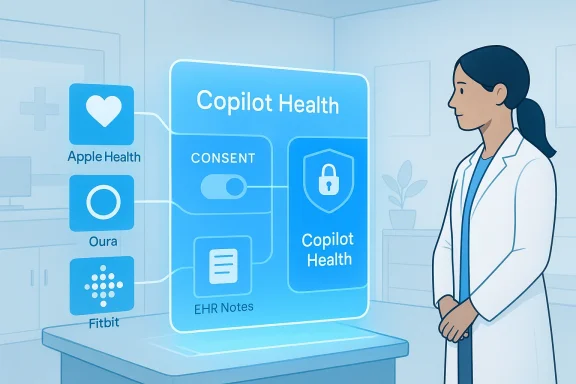
Clinician reviews Copilot Health dashboard linking Apple Health, Oura, and Fitbit with consent.Background and overview​

Copilot Health is presented as a separate, locked‑down space inside Microsoft’s broader Copilot experience. Microsoft says it will let users connect health data from multiple sources — wearable devices, lab test platforms, and health records — and then use AI to summarize history, explain lab values, surface trends across biometrics, and help people prepare for clinical visits. The company positions the offering as a pre‑visit and informational assistant rather than as a tool that diagnoses or replaces clinicians. Microsoft’s consumer pages describe features such as finding providers by specialty, language and insurance coverage, and producing clinician‑friendly summaries and suggested questions for appointments.
Key technical and product claims reported at launch:
  • Support for data from "over 50" wearable device types and direct links to consumer platforms such as Apple Health, Oura and Fitbit.
  • The ability to draw on EHR information from a very large provider footprint — press reports cite connections to records spanning tens of thousands of U.S. provider organizations. Microsoft’s Copilot care navigation connects to real‑time U.S. provider directories and third‑party data sources for provider search and referral context.
  • Lab results ingestion from D2C lab platforms and aggregator services; industry coverage and vendor pages identify companies such as Function (a direct‑to‑consumer lab and health analytics provider) as common data sources for consumer health apps.
  • Privacy and governance controls: health conversations are isolated from general Copilot chat, encrypted in transit and at rest, manageable by the user (disconnect/delete), and — Microsoft says — not used to train the company’s models by default. Microsoft also points to ISO/IEC 42001 compliance across its AI service stack as a governance baseline.
Those technical bullet points are the public face of a much larger Microsoft healthcare strategy that includes enterprise products for providers, payers and life sciences — Azure Health Data Services, Microsoft Foundry for healthcare AI, and clinician‑facing tools such as Microsoft Dragon Copilot that integrate inside clinical workflows and EHRs. Copilot Health is best read as the consumer‑side portal into that broader healthcare ecosystem.

How Copilot Health is built: integrations, data flows and governance​

Data sources and connectors​

Microsoft intends Copilot Health to be a hub: wearable streams for continuous vitals and activity, lab results for discrete biomarker context, and EHR entries for diagnoses, medications and clinical notes. Reported launch details list integrations with Apple Health, Oura and Fitbit for consumer device data, plus ingestion pathways for lab vendors and EHR aggregator services that cover a very large number of U.S. provider organizations. Independent news coverage of the launch confirms the breadth of device and provider coverage Microsoft cited.
From a technical standpoint, delivering these flows requires:
  • Authentication and consent flows that let a user authorize an external account (for example, Apple Health or a lab portal) and grant Copilot Health scoped access to specific record types.
  • Secure FHIR or API‑based connectors for EHR systems or aggregators, along with mapping and normalization to Microsoft’s internal clinical data structures.
  • Linkage and de‑duplication logic so a user’s wearable signals, lab panels and EHR notes can be associated without creating mismatched identities or false longitudinal patterns.
Microsoft’s consumer Copilot pages and support documentation describe provider‑directory connectors and named third‑party sources for provider information. Those pages also point to the broader Microsoft cloud services — Azure Data and Foundry — as the enterprise plumbing that enables these connectors and the model workloads that produce insights. (support.microsoft.com)

Clinical validation and advisory inputs​

Microsoft says Copilot Health was developed with internal clinical teams and informed by an external panel of hundreds of physicians across more than two dozen countries. The company has been explicit that its healthcare roadmap ties into research efforts such as the Microsoft AI Diagnostic Orchestrator (MAI‑DxO) — a multi‑model orchestration research project that Microsoft has published about publicly and that delivered high performance on clinical case benchmarks in research settings. Those research results are significant: MAI‑DxO reached diagnostic accuracy figures in benchmark tests that substantially outperformed a panel of practicing clinicians in controlled case exercises. But Microsoft and outside commentators consistently note that such research is not the same as real‑world clinical validation and that integration into care requires human oversight.

Governance and certification​

Microsoft highlights its adoption of ISO/IEC 42001 (the international standard for AI management systems) and independent audits of parts of its AI stack — notably Azure AI Foundry and Microsoft 365 Copilot components. Those certifications reflect organizational processes for responsible AI governance, risk assessment and compliance; they are not, however, a guarantee that every individual product or integration will be free of error or bias in every use case. Microsoft’s product and privacy pages also describe opt‑outs for model training and controls that keep Copilot Health data separate from general Copilot data flows.

Clinical accuracy, the MAI‑DxO effect, and the “second opinion” question​

Microsoft’s MAI‑DxO research has crystallized a central tension in healthcare AI: models can perform spectacularly on curated benchmarks and case simulations, yet those results do not automatically translate into safe, equitable clinical performance at scale. Microsoft’s published research reports MAI‑DxO accuracies above 80–85% on selected New England Journal of Medicine case vignettes, compared with a roughly 20% correct rate for a small group of generalist physicians tested under the same constraints; the company also reported cost reductions in simulated diagnostic workflows. Multiple independent media outlets and academic write‑ups covered the MAI‑DxO results because they imply a future where AI becomes a routine second opinion.
Why that matters for Copilot Health:
  • Patients and insurers may come to expect AI verification of diagnoses or test interpretations, which could change standard care pathways and create new liability questions.
  • Benchmarks rarely represent the messy, incomplete and socio‑culturally varied data clinicians see in practice; high research accuracy should be treated as promising but not definitive evidence.
  • There is a risk that consumers over‑rely on AI summaries or misinterpret probabilistic outputs as definitive diagnoses; Microsoft’s product messaging explicitly warns against using Copilot Health as a replacement for professional care.
In short: MAI‑DxO and similar research justify careful optimism, but they also make the guardrail conversation more urgent. If patients bring AI‑generated “likely diagnoses” into encounters without clinician context, the dynamics of clinical decision‑making and insurance utilization could shift quickly.

Privacy, model training and data control — what Microsoft promises​

Microsoft’s consumer privacy documentation and Copilot feature pages enumerate several user protections for health data:
  • Conversations and health data in Copilot Health are isolated from general Copilot experiences and are protected with encryption in transit and at rest.
  • Users can view, manage and delete connected sources and conversation history; there are explicit disconnect/delete flows.
  • Microsoft states that certain categories of Copilot data (including some Microsoft 365 Copilot data) are not used to train its generative models, and consumer settings allow users to opt out of training. Microsoft also explains that some enterprise and organizational data is explicitly excluded from public training.
But a few practical questions deserve emphasis:
  • “Not used to train models” is a policy category that requires rigorous implementation and auditability. Microsoft’s ISO/IEC 42001 alignment and third‑party audits address governance but do not eliminate the need for transparent technical attestations (for example, whether derivative embeddings, de‑identified features, or metrics ever leave the health project boundary).
  • Consent and deletion across many connectors (wearable vendors, lab companies, EHR aggregators) depends on each third party’s API and retention rules. Disconnecting Copilot Health does not retroactively force every upstream vendor to delete copies of shared data unless contractually enforced.
Practical takeaway: Microsoft’s privacy architecture and governance posture are strong relative to many consumer AI plays, but real safety depends on operational detail — audit logs, contractual data deletion, independent verification of training exclusions, and user education about what disconnect actually accomplishes.

Regulatory, payer and legal context: why the stakes are high​

State and federal rules are already changing​

Policymakers have moved quickly to restrict high‑risk health applications of AI. Several U.S. states have enacted or advanced laws limiting AI use in mental‑health therapy and requiring human oversight for clinical decisioning. Illinois, for example, has enacted legislation that broadly restricts AI from providing therapy or making autonomous clinical decisions without licensed‑provider supervision — a legal backdrop that product teams must honor with geofencing and feature controls. At the federal level, legislators and regulators are increasingly focused on AI transparency, safety and the special sensitivity of health data.

Payers, prior authorization and utilization management​

Health insurers and government payers are actively experimenting with AI for utilization review, claims processing and prior authorization. That can cut costs and speed adjudication, but it also creates potential conflicts: an AI summarizer that lowers a clinician’s coding or a payer’s AI that flags a service as “unnecessary” could lead to coverage denials or disputes. Policymakers and clinician groups have raised concerns about automated denials or opaque decisioning. The combination of consumer AI that influences patient expectations and payer AI that enforces coverage rules is a recipe for friction unless transparency and appeal mechanisms are robust.

Liability and clinical responsibility​

If Copilot Health suggests actions or highlights likely causes, who bears responsibility when a patient acts on that advice? Microsoft’s repeated framing — Copilot Health is not a replacement for clinical care — is necessary but not sufficient to resolve liability questions. Expect state boards, malpractice insurers and provider contracts to evolve rapidly as AI plays a larger role in pre‑visit preparation and patient self‑management.

Strengths and opportunities​

  • Centralized patient context. For the many patients whose data are scattered across portals, wearables and lab services, a single, well‑designed interface that produces clinically coherent summaries is legitimately useful. Copilot Health aims to reduce administrative friction before visits, which can improve appointment efficiency and shared decision‑making.
  • Enterprise‑grade governance. Microsoft’s adherence to ISO/IEC 42001 across parts of its AI stack, and its enterprise tooling (Azure Health Data Services, Microsoft Foundry, Dragon Copilot) mean Copilot Health will be able to plug into established clinical workflows more easily than many consumer apps, at least for system integrators and health systems that already run Azure.
  • Research traction. The MAI‑DxO research demonstrates a possible path for AI to deliver real clinical value as a decision support tool; integrated properly, such systems can lower diagnostic costs and flag risky patterns earlier. When used as a clinician‑facing second opinion, these systems could materially reduce diagnostic delays.

Risks, blind spots and failure modes​

  • Over‑trust and misinterpretation. Consumers may conflate confidence in an AI summary with clinical certainty. Copilot Health’s interface design and disclaimers must actively guide users to treat outputs as preparatory assistance, not definitive care.
  • Data provenance and residual copies. Disconnecting a connector rarely zaps upstream copies lodged in EHR portals, lab portals or wearable vendor servers. Users need transparent, vendor‑specific deletion paths and clear UI indicators about what “disconnect” actually removes.
  • Bias and representativeness. Clinical AI models reflect the data they were trained on. If clinical models and connectors underrepresent certain demographics or comorbidities, the insights Copilot Health generates will reflect those blind spots. Independent auditing and post‑market surveillance are necessary.
  • Regulatory mismatch across states. Features allowed in one U.S. state may be restricted or illegal in another (for instance, AI therapy prohibitions). Microsoft must implement robust geofencing and compliance filters — a nontrivial engineering burden.
  • Payer arbitrage and care denials. If insurers use AI to justify denials and patients confront AI‑sourced clinical guidance, the mismatch between consumer expectations and payer rules could generate disputes and harm. Transparency and appeals processes will be essential.

What clinicians and health IT teams should watch​

  • Data contracts: Ensure any deployment or data sharing agreement with Microsoft or third‑party connectors contains stringent deletion, access audit and breach notification clauses.
  • Auditability: Demand fine‑grained logs that show which record snippets were used to generate any patient‑facing insight. This is critical if an AI‑assisted note influences clinical decisions.
  • Workflow fit: Evaluate whether summaries and suggested questions from Copilot Health genuinely reduce clinician cognitive load or simply add noise that must be triaged during visits.
  • Clinical governance: Integrate Copilot Health outputs into existing clinical review policies rather than treating them as authoritative. Require clinician sign‑off for any treatment changes suggested by consumer AI.

Recommendations for patients and consumers​

  • Treat Copilot Health as a preparatory tool: use it to clarify questions, organize records and highlight anomalies — but do not treat its outputs as a final diagnosis.
  • Read the consent screens carefully: know which external accounts you authorize and what “disconnect” does in practical terms.
  • If you live in a jurisdiction with specific AI‑in‑healthcare restrictions (for example, some U.S. states), expect feature limitations or different legal protections.

The big picture: competition, consolidation and the patient experience​

Copilot Health is not an isolated product launch; it is Microsoft’s consumer‑side complement to an expansive healthcare play that includes clinician instruments (Dragon Copilot), cloud data services, life‑sciences tooling and enterprise governance frameworks. The market is converging on the same pieces — device connectors, EHR aggregators, lab platforms — and the differentiator will be how well each company stitches them together, governs them, and demonstrates safety and accuracy in live clinical workflows.
Expect three likely outcomes over the next 12–24 months:
  • Constrained, well‑governed rollouts tied to research and clinical partners: conservative but safe adoption paths that prioritize human oversight.
  • Rapid consumer adoption with uneven safety protections: higher short‑term user growth but elevated regulatory and litigation risk.
  • Convergence on interoperability standards and third‑party audits (the regulatory and procurement response): organizations will demand certified compliance and auditable guarantees before buying into health AI platforms.
Microsoft’s scale, enterprise relationships and certifications give it an advantage in the first and third scenarios. But public trust — and the willingness of patients to share sensitive health data — will be the ultimate litmus test.

Conclusion​

Copilot Health crystallizes a central promise of consumer healthcare AI: make a fragmented, confusing wealth of personal health data usable and clinically relevant. Microsoft’s product brings real strengths — enterprise governance, wide connector coverage, and links to powerful clinical AI research — and it raises equally real concerns about privacy, training exclusions, regulatory compliance and the downstream effects of AI‑driven expectations in the clinic and with payers.
If Microsoft can operationalize its governance promises, provide transparent technical attestations about data flows and training exclusions, and embed strict human‑in‑the‑loop safeguards, Copilot Health can be a meaningful step forward for patient empowerment. Without those operational guarantees and independent oversight, the product risks accelerating a messy corner of healthcare where high expectations meet complex, fragmentary data and uneven rules — and where patient safety and trust must be defended, not assumed.

Source: Tech in Asia https://www.techinasia.com/news/microsoft-launches-copilot-health-personal-medical-insights/amp/
 

Microsoft’s Copilot just moved from being a productivity assistant to a personal health concierge: on March 12, 2026 Microsoft unveiled Copilot Health, a U.S.-only preview that promises to ingest electronic health records (EHRs), lab results and continuous biometric streams from consumer wearable devices, then synthesize that data into plain-language summaries, trend detection, and actionable next steps for patients and caregivers. The announcement signals Microsoft’s most aggressive consumer-facing push into health AI yet — a convergence of its enterprise health tools, consumer Copilot surface, and the company’s longstanding cloud and compliance capabilities — but it also brings to the foreground urgent questions about accuracy, privacy, governance and clinical responsibility.

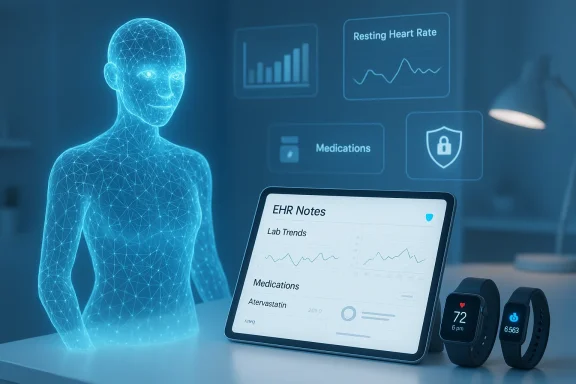
Futuristic scene with a holographic patient, a tablet showing EHR notes, and wearable health devices.Background / Overview​

Microsoft’s Copilot family has been expanding rapidly from desktop and productivity helpers into verticalized copilots for distinct domains. Copilot Health is positioned as a private, privacy-segmented lane inside the consumer Copilot experience where users can connect personal records and device data and then ask the assistant to explain test results, highlight worrisome patterns, prepare notes for a clinician visit, or generate practical care reminders.
In Microsoft’s preview messaging the product is described as able to combine:
  • Electronic health records (EHRs) and clinical notes.
  • Laboratory results and medication lists.
  • Continuous telemetry and snapshot metrics from consumer wearables and fitness trackers.
  • Grounded reference content and evidence sources to reduce unsupported claims.
Microsoft characterized the initial preview with concrete scale figures — for example, the company stated Copilot Health can draw on records from tens of thousands of U.S. health providers and support connections to multiple types of wearable devices — and emphasized that Copilot Health conversations are intended to be kept separate from general Copilot chats and encrypted while under user control. Microsoft executives framed the move as a first step toward a more continuous, personalized health assistant that can synthesize clinical and sensor data in one place.
At the same time, Microsoft’s healthcare product portfolio already includes enterprise-grade offerings — Dragon Copilot for clinical documentation, integrations with health-system partners, and partnerships with evidence publishers — which the company points to as operational experience in working with regulated health data. Copilot Health is the consumer-facing complement to that enterprise work.

What Copilot Health actually does (and claims to do)​

Data inputs and sources​

Copilot Health is designed to combine heterogeneous health information under one conversational interface:
  • EHR ingestion: Users can link personal health records and medical documents so the assistant can read visit notes, problem lists, and lab trends.
  • Labs and medications: Structured lab results and medication lists are intended to be parsed and summarized.
  • Wearable device telemetry: The preview highlights support for data streams from consumer wearables — step counts, heart rate, sleep metrics, activity sessions and similar signals from popular platforms and trackers.
  • Trusted content grounding: Microsoft says Copilot Health will surface guidance grounded in reputable clinical content sources rather than relying solely on unconstrained model output.
These features are being marketed as a convenience and an informational aid: a one‑stop place to turn fragmented medical records and the flood of wearable telemetry into a coherent narrative and practical next steps.

Interface and interaction model​

  • Copilot Health appears as a separate workspace inside Copilot where users explicitly grant access to specific records and device connectors.
  • Conversations and analytics in this workspace are segregated from general Copilot usage and are intended to be encrypted and access‑controlled.
  • The assistant can answer plain‑language questions (“What changed between my last two lipid panels?”), surface trends (“Your resting heart rate has trended up over six weeks”), and produce appointment‑prep summaries for clinical visits.

Scale and auditing claims (what to treat cautiously)​

Microsoft’s public messaging included numeric claims about scale — for example, numbers describing the breadth of provider records potentially accessible and the number of wearable device types supported. Those figures were announced by Microsoft and reported in major outlets at launch. These are corporate claims that are plausible given Microsoft’s cloud reach, healthcare partnerships, and available connectors, but they remain vendor-provided and should be treated as such until independently audited.

Why this matters: strengths and strategic advantages​

1. Tackles a real user problem: fragmented health data​

Most people’s health information is wildly fragmented: different clinics, multiple labs, and a steady stream of wearable telemetry that never quite makes sense in clinical context. Copilot Health’s core value proposition is practical and immediate: synthesize record notes, lab values and device readings into a single timeline with plain-language explanations. That’s a high‑utility use case for patients managing chronic conditions, caregivers coordinating care, and anyone trying to make sense of new test results.

2. Enterprise pedigree and existing health relationships​

Microsoft is not entering healthcare as a fresh startup; it already sells cloud, EHR integrations, and clinician-facing AI tools. Those existing enterprise contracts and compliance tooling (including experience with HIPAA-covered workflows, BAAs, and health system integrations) give Microsoft a pragmatic advantage in building connectors and negotiating data‑use agreements. The company’s prior work with clinical partners and its Dragon/ambient documentation products are relevant experience that can accelerate responsible product design.

3. Grounding and publisher partnerships reduce hallucination risk​

Microsoft has publicly pursued partnerships to ground health answers with licensed medical content, and Copilot Health is being framed to return responses tied to traceable evidence rather than free-form model hallucinations. For consumers, getting guidance anchored to known sources — and shown with provenance — materially increases trustworthiness and auditability.

4. Device and data breadth​

Connecting continuous wearable telemetry to clinical context — for example, aligning a spike in resting heart rate with a change in prescription or a lab abnormality — unlocks new signals. When combined responsibly with clinical records, wearable trends can help surface early warning signs, medication side effects, or lifestyle effects on measured outcomes.

Key risks, limitations, and governance concerns​

1. Accuracy and the illusion of certainty​

AI assistants can sound confident even when wrong. Clinical decision making requires nuance, probabilistic reasoning, and awareness of data quality — things that language models often do not reliably convey. Consumers may mistake a polished summary or recommendation for a definitive medical decision. That gap between polished prose and clinical reliability is especially dangerous for symptom triage, medication advice, and diagnostic conjecture.

2. Quality and provenance of wearable data​

Consumer wearables vary widely in sensor accuracy, sampling cadence, and algorithmic processing. A smartwatch’s heart-rate reading during exercise is not the same as an ECG reading in a clinic. Copilot Health will have to clearly communicate the quality and limitations of any device-derived insight; failing to do so risks spurious alarms, false reassurance, or inappropriate behavior change.

3. Privacy, data flows and future model training​

Microsoft has promised privacy-segmentation and encryption for Copilot Health workspaces, and to require explicit user consent to connect data. But key questions remain operationally critical:
  • Where is the data stored (which regions, what retention policy)?
  • Who can access raw or summarized data inside Microsoft (engineers, auditors)?
  • Does Microsoft ever use de-identified health signals for system improvement, model tuning, or research without a separate opt-in?
  • What contractual protections are available for provider-contributed data and device vendors?
Those are not theoretical. Health data is among the most sensitive categories of personal data, and regulatory frameworks (HIPAA in the U.S., GDPR in the EU, and other national rules) attach both legal risk and reputational impact to mishandled PHI.

4. Regulatory and liability ambiguity​

Consumer health assistants sit in a murky zone between information and medical practice. If an assistant suggests an action that leads to harm, who bears responsibility — the user, the clinician, the device maker, or the platform? Microsoft can mitigate some risk through careful labeling, disclaimers, and by avoiding diagnostic claims, but legal exposure will evolve as regulators and courts grapple with AI-assisted healthcare.

5. Digital divide and equity concerns​

AI health assistants can amplify disparities if they perform worse for underrepresented groups, non-English speakers, or people using older wearable devices. Model training datasets and grounding sources must be audited for demographic bias and coverage gaps to avoid widening existing inequities in care.

Practical guidance: what consumers should know and do​

If you’re considering trying Copilot Health in the preview, here’s a practical checklist to stay safer and get more value:
  • Limit what you connect. Only grant access to records and devices you intend to use together. Avoid bulk ingestion of decades of notes unless you have a specific reason.
  • Read the consent and retention details. Confirm where your data will be stored, how long it will be retained, and whether there’s an option to delete historic records permanently.
  • Keep clinical backup. Use Copilot Health as an informational and organizational tool — not a substitute for clinician judgment. Share generated summaries with your healthcare provider rather than acting on them alone.
  • Check provenance. When the assistant gives a recommendation or explanation, look for the provenance or evidence backing it (what lab result, what guideline, what publisher).
  • Watch for alarm signals. If the assistant recommends urgent care or medication changes, treat that as a prompt to contact a clinician immediately rather than implementing changes unilaterally.
  • Understand device limitations. Know the sensor class of your wearable (PPG heart-rate wrist sensor vs. single-lead ECG patches) and treat readings accordingly.
  • Audit connected apps. Periodically review the list of third-party connectors (apps and devices) you've authorized and revoke any that are no longer needed.

Practical guidance: what health systems and IT teams should ask Microsoft​

For provider organizations, vendor diligence will determine whether and how to use or recommend Copilot Health. The minimum due diligence questions include:
  • Data flow and storage: Where is patient data routed, in which cloud regions, and under what retention policy? Are data flows auditable end-to-end?
  • Business Associate Agreement (BAA): Does Microsoft offer a BAA for this consumer service when providers connect patient records? If not, how should providers manage risk?
  • Clinical validation: What clinical safety testing and validation has Microsoft performed? Are there published performance metrics, failure modes, and mitigation procedures?
  • Model governance: How are updates to underlying models managed? Is there a freeze on using user health data for training? Can providers opt out?
  • Logging and audit trails: Are all assistant responses and data accesses logged with tamper-evident audit trails suitable for forensic review?
  • Incident response: What are Microsoft’s breach notification timelines and responsibilities? How will affected patients be informed?
  • Interoperability standards: Which standards are used for EHR ingestion (e.g., FHIR), and how are mappings and normalization handled?
Health IT teams should treat any consumer health assistant as a new class of interface with regulatory, legal, and clinical repercussions and require detailed contractual commitments.

How Copilot Health compares to the market​

The launch places Microsoft squarely alongside other major tech companies moving into consumer health AI. Key differentiators to watch:
  • Enterprise-to-consumer pipeline: Microsoft’s existing health‑system integrations and enterprise Copilot tools (Dragon Copilot, clinical ambient products) could create tighter handoffs between provider systems and consumer experiences.
  • Provenance and curated content: Licensing and grounding with reputable publishers (a trend across vendors) may help limit hallucinations compared with unconstrained assistants that lack provenance controls.
  • Scale and device connectors: Microsoft’s cloud and platform relationships potentially enable broad device and EHR connectors, but practical coverage depends on negotiated integrations and local provider readiness.
  • Regulatory posture: Microsoft’s large enterprise footprint means it must maintain HIPAA and privacy compliance discipline; other consumer-first vendors may take different approaches that prioritize rapid consumer adoption over enterprise-grade controls.

Technical and safety considerations — an engineer’s checklist​

For engineers and product leads working with or evaluating Copilot Health integrations, focus on these technical controls:
  • Encrypted, customer-managed keys: Where possible, insist on customer-managed encryption keys (CMKs) and region-bound storage to minimize vendor-side exposure.
  • Fine‑grained access control: Implement role-based access and least-privilege access paths for any support or engineering activity that touches PHI.
  • On‑device preprocessing: Where feasible, perform PII scrub and local preprocessing on device or client-side before upload to reduce raw data exposure.
  • Model explainability and confidence: Augment model outputs with confidence estimates and link to the exact data slice (lab value, timestamp, device ID) that generated the inference.
  • Adversarial and safety testing: Test how the assistant responds to noisy inputs, conflicting records, and edge cases (e.g., inconsistent allergy lists, mislabeled labs).
  • Auditability: Ensure all actions are logged with immutable timestamps and that logs are retained per regulatory timelines.

The governance gap: policy, ethics and the law​

Copilot Health arrives during a period of rising regulatory scrutiny. U.S. regulators and policymakers are actively considering how AI intersects with health privacy, medical practice and product safety. Key governance gaps remain:
  • Clear FDA signals: Consumer advice and triage tools sometimes straddle the line where they would be regulated as medical devices. Vendors and regulators need clearer thresholds for when conversational assistants become medical devices that must undergo validation.
  • Liability frameworks: Current laws don’t neatly allocate liability for AI-assisted misadvice in consumer health scenarios. Expect litigation and regulatory clarification in the months and years ahead.
  • Cross-border data controls: Copilot Health’s U.S.-only preview avoids some immediate cross-border complexity, but global rollouts will require region-specific compliance (e.g., GDPR) and likely local data residency.
  • Standards for evidence‑grounding: The industry needs interoperable standards for surfacing provenance, so users and clinicians can quickly evaluate the source and strength of an AI recommendation.

Final assessment: practical optimism with guarded skepticism​

Copilot Health is an ambitious, logical next step for Microsoft’s Copilot strategy: combine the company’s cloud scale, enterprise healthcare relationships, and consumer-facing AI to give people a clearer narrative of their health. When executed with strong provenance, rigorous privacy controls, and transparent limitations, this type of product could reduce confusion, improve patient–clinician communication, and make wearable telemetry clinically usable.
That upside, however, depends entirely on execution. The product must be explicit about data provenance and device accuracy, must not elevate stylistically confident but clinically incorrect statements, and must implement technical and contractual safeguards that match the sensitivity of health data. Regulators, clinicians and patient advocates will rightly scrutinize whether promises about separation, encryption, and non-use of data for training are enforceable — not just aspirational.
For consumers: try Copilot Health for organization and explanation, but keep clinicians in the loop. For health systems and IT teams: demand detailed technical and contractual commitments before recommending or integrating the service. For product and safety engineers: build rigorous test harnesses, provenance metadata, and a culture of clinical humility into every release.
If Microsoft and its partners get these elements right, Copilot Health could be a practical step toward more personal, data-driven health support. If corners are cut, the consequences could be intense: erosion of patient trust, regulatory fines, and real-world harm from incorrect advice. The coming months — as the preview expands, audits are run, and clinicians weigh in — will determine whether Copilot Health is a meaningful help to patients or a cautionary tale about applying conversational AI to the most intimate domain there is: our own bodies.

Source: Neowin Microsoft introduces Copilot Health to analyze your health data from wearable devices
 

Microsoft’s Copilot Health preview asks people to hand the company the hardest, most fragmented parts of their medical lives — clinic notes, lab results, and streams from wearables — and promises to turn that jigsaw into a clear, actionable picture for patients and clinicians. This is not a soft product update: Copilot Health stitches together data from tens of thousands of providers and dozens of device sources, places that data into a privacy‑segmented “health lane,” and offers AI‑generated explanations, citations, and next‑step guidance meant to complement — not replace — clinicians. The move amplifies a central tension in modern health technology: powerful utility versus grave privacy and safety obligations. /www.axios.com/2026/03/12/microsoft-copilot-health)

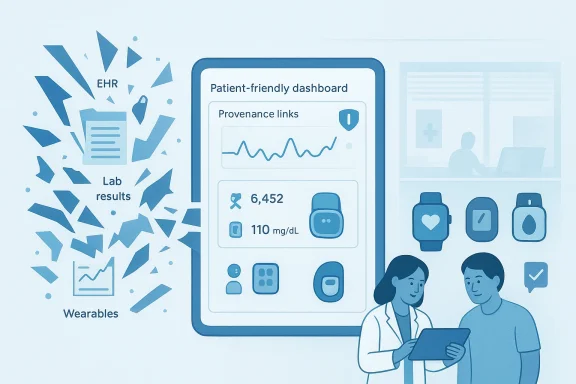
Doctor and patient review a patient-friendly dashboard with lab results and wearables on a tablet.Background​

Microsoft announced Copilot Health in March 2026 as a consumer-facing extension of its Copilot family, marketed as a private Copilot workspace that can ingest electronic health records (EHRs), wearable telemetry, and lab results to generate plain‑language summaries, explainers, and appointment prep for patients. The company frames the product as an assistant that “makes every minute you have with [your doctor] count more,” insisting it will not replace clinicians but will aggregate scattered data to provide context for care. Early messaging highlights a privacy‑segmented architectuage for health conversations.
Why this matters now: consumer use of AI for health questions is already large and growing. Microsoft’s own usage reporting and interviews with company leaders indicate health is a top Copilot topic on mobile, and executives have cited figures indicating tens of millions of health-related queries handled by Microsoft systems. That scale is what makes a dedicated health experience commercially and practically sensible for a company chasing everyday AI engagement — and what makes the stakes so high.

What Copilot Health promises and the technical claims​

Data sources and scope​

  • Microsoft says Copilot Health can connect to records from more than 50,000 U.S. health providers and ingest data from 50+ wearable device types (including Apple Health, Oura, Fitbit), as well as clinical labs and visit summaries. These numbers are being used prominently in Microsoft and press materials to signal breadth and the ability to reduce fragmentation.
  • The product is rolling out as a preview in the United States and is presented as a privacy‑segmented space inside Copilot; the company stresses that conversations and data in Copilot Health are isolated from general Copilot and are encrypted. Microsoft’s messaging emphasizes citations, provenance, and links back to source material for answers generated by the assistant.

Reported usage and user demand​

  • Microsoft’s Copilot Usage Report (2025) and subsequent usage documents show health and wellness as dominant topics on mobile devices. Company representatives quoted in news coverage have said Copilot answers roughly 50 million health queries per day across Microsoft’s systems — a figure used to justify a dedicated health Copilot. Note: that 50 million/day figure has been reported in company interviews and press coverage; the usage reports themselves analyze tens of millions of de‑identified conversations and show health as a leading topic.

How Copilot Health could help — concretese of Copilot Health is easiest to assess in tangible scenarios where data fragmentation and time constraints create real pain:​

  • Pre‑visit preparation: Aggregating clinic notes, meds, and device trends into a single, clinician‑friendly summary for the patient to bring to an appointment — saving time and helping clinicians focus on decisions rather than data collection.
  • Medication reconciliation and error detection: Cross‑checking prescribed medicines, reported side effects, and wearable‑detected vitals to flions or adherence gaps that a clinician might otherwise miss.
  • **Pattern detection across data nds that span devices and labs — for example, falling hemoglobin after a series of clinic notes and correlated symptom descriptions — and offering a plain‑language explanation or suggested questions for your clinician.
  • Access and navigation: Helping users find local specialists who accept their insurance or preparing summaries for second opinions, theoretically expanding access to actionable medical information.
These are realistic, helpful features when implemented carefully. Aggregation and contextualization of fragmented health data are genuine problems clinicians and patients struggle with today.

Security and privacy: the promises, and what they actually mean​

Microsoft repeatedly frames Copilot Health as “Safe and Secure by Design,” highlighting separation of health conversations from general Copilot and the use of encryption. Public communications say the product will include provenance for generated answers and limit use of personal health data for training. Those are important design signals.
But product promises and engineering reality are separate things. To evaluate them we need to ask precise questions:
  • What is the exact threat model? Does “isolated from general Copilot” mean data is never accessible to other Microsoft services, or that it’s logically separated but resident on common infrastructure? Company statements are often brief on these details. Microsoft’s usage and product blog posts reassure users about isolation and encryption, but the granular technical architecture and access controls that define the threat model are not fully public.
  • What are the retention and deletion policies? Can users permanently remove their data? How long will de‑identified derivatives be kept? Public messaging points to encryption and segmentation, but full lifecycle policies will be determinative for risk exposure — especially for long‑lived medical records.
  • Who has legal access under compelled disclosure? Encryption matters, but any cloud vendor operating in the United States can be compelled by lawful process to disclose data, and many enterprise contracts include exceptions. Microsoft’s prior public statements and legal posture matter here; users need explicit contract‑level or policy commitments from health partners and providers about access. Public product posts do not — and cannot — override legal realities without service design elements like customer‑controlled encryption keys, which Microsoft has sometimes offered in other services.
  • How robust are operational controls? Access logging, role‑based controls, zero‑trust architecture, and regular third‑party audits are the practical controls that determine whether an attacker or a malicious insider could get health data. Microsoft cites enterprise security investments and the company’s long health partnerships, but the degree to which Copilot Health will surface to the highest levels of independent auditing and regulatory scrutiny remains to be seen.

Track record matters​

Security promises are judged against a vendor’s history. Independent governmental review of a large Microsoft cloud incident — the Summer 2023 Exchange Online intrusion — produced a critical CSRB report that identified a “cascade of security failures” and urged fundamental security reform inside Microsoft. That report led to public commitments from Microsoft leadership about prioritizing security. These are important context points for anyone deciding whether to entrust extremely sensitive health records to a single vendor.

Regulatory and compliance landscape​

  • In the United States, HIPAA governs covered entities and their business associates. A consumer app that directly ingests an individual’s medical records may or may not be a covered entity or business associate depending on integration points with providers and how data flows. That nuance will matter for legal obligations, breach reporting, and patient rights. Microsoft’s enterprise healthcare products already operate in HIPAA‑covered contexts; a consumer preview sitting between patients and providers raises complex questions about roles and responsibilities.
  • International deployment introduces additional complexity. European data protection law (GDPR) and other national privacy laws treat health data as especially sensitive and impose meaningful restrictions on processing and cross‑border transfers. Microsoft’s initial preview is U.S.-only, which lets the company start where provider‑market complexity is more familiar, but global expansion will create new legal and technical challenges.
  • Independent certification, third‑party audits, and clear contractual obligations around data usage and retention will be critical. Company blog posts are useful, but certifications and independent audits are what large health systems and privacy regulators look for when assessing risk.

Accuracy, safety, and clinical governance​

AI systems that summarize medical records must be measured against clinical standards. Problems that can arise include:
  • Hallucinations and misattributions: Generative models can produce plausible‑sounding but incorrect statements. In a medical context, a wrongly stated allergy, medication dose, or diagnosis is dangerous. Microsoft emphasizes citations and links to source material, but clinicians and patients will need to verify those citations and the model’s interpretation.
  • Context loss: EHR notes contain ambiguity, shorthand, and clinician judgment that doesn’t always translate to a consumer‑facing summary. AI needs to be conservative and flag uncertainty, not assert false confidence. The ability to surface provenance and confidence intervals in generated guidance will be a practical safety measure.
  • Liability and clinical responsibility: Microsoft has stated that Copilot Health doesn’t replace doctors; it aims to prepare patients and clinicians better. But when an AI highlights an actionable next step that a patient follows, the chain of responsibility becomes complicaclinicians, and vendors will need shared governance models, clear disclaimers, and operational pathways for escalation.
Good clinical deployment requires multidisciplinary validation: clinician review, prospective safety studies, and iterative tuning with real‑world feedback. Promising features should be gated behind usability and safety studies, not rushed into broad production without measurable outcomes.

Trust: the company question​

The Windows Central coverage asks a simple but powerful question: would you trust Microsoft with your medical records? That question breaks into two distinct judgments:
  • Do you trust that the AI can provide helpful clinical value?
  • Do you trust Microsoft — as an organization — to protect your data?
On the first question, the technical reasoning is straightforward: the AI can add value in many low‑risk, high‑utility workflows (summaries, prep sheets, navigation assistance) if it is transparent, conservative, and integrates human review. Aggregation of fragmented data is legitimately useful and could materially improve appointment efficiency and patient understanding.
On the second question, history and track record matter. The CSRB’s critical review of the Exchange Online intrusion, and subsequent security scrutiny of Microsoft cloud services, are salient data points when you consider handing highly sensitive health records to a single cloud provider — even one with deep healthcare partnerships. Microsoft has acknowledged past shortcomings and publicly committed to prioritize security; whether that translates to the day‑to‑day operational discipline required for a consumer health product depends on concrete architecture (e.g., encryption key management), robust audits, and transparent policy commitments.

Competitors and the ecosystem​

Copilot Health is not launching into an empty field. Other major players are moving fast:
  • OpenAI launched ChatGPT Health earlier in 2026, with its own framed approach to medical queries and privacy safeguards focused on clinical reliability.
  • Amazon has expanded health chatbot access tied to healthcare services such as One Medical, signaling that large cloud platforms view consumer health as strategically important.
Each platform will be judged on the same axes: data controls, clinical safety, provenance, and regulatory compliance. Market competition could be beneficial if it raises the bar for transparency, certified audits, and interoperable standards for health AI.

Practical advice: what should patients and clinicians ask before using Copilot Health?​

If you are considering adopting Copilot Health (or similar tools), ask vendors and providers these concrete questions:
  • What is your exact data retention policy and can I delete my data permanently?
  • Where is my data stored, and who can access it (including Microsoft employees and third parties)?
  • Are patient records used to train any models, and if so, is that opt‑in only and fully reversible?
  • Do you support customer‑controlled encryption keys so that outside parties (including the vendor) cannot access plaintext without consent?
  • Has the product undergone independent security and privacy audits (SOC 2, HITRUST, or equivalent) and can I see a summary of those results?
  • What governance frameworks, clinical validation studies, and escalation paths exist for safety issues the assistant raises?
  • What happens in the event of a breach — how will patients and providers be notified and supported?
If a vendor cannot provide clear, documented answers to these questions, proceed cautiously.

The major risks — a prioritized view​

  • Data exposure from breaches or misconfigurations. Health data is a high‑value target; cloud services must assume attackers will try and plan accordingly. The CSRB review shows even large vendors can experience oith severe consequences.
  • AI inaccuracies with clinical consequences. Hallucinations or misinterpretations in summaries can lead to missed diagnoses or incorrect patient actions unless human oversight is built into workflows.
  • Regulatory misalignment and liability gaps. Unclear roles between product vendors, providers, and patients create legal ambiguity around breaches, malpractice, and consumer protections.
  • Vendor lock‑in and data portability issues. If a vendor aggregates records but makes it difficult to move or delete data, long‑term patient autonomy is compromised. Portability and standards‑based export are essential.
  • Societal trust erosion. If high‑profile incidents occur, public confidence in AI health tools could collapse, harming beneficial innovation and patient access. The industry needs a strong safety track record to avoid this outcome.

Why some users will still find Copilot Health compelling​

Despite the risks, many patients and clinicians will adopt Copilot Health for pragmatic reasons:
  • Fragmented care is real — patients routinely see multiple providers with no central summary. Copilot Health’s aggregation can save clinician time and reduce information loss.
  • The convenience of plain‑language explanations and curated citations can improve health literacy, medication adherence, and shared decision‑making when paired with clinician oversight.
  • For underserved populations with limited clinician access, an intelligent aggregator that points patients to insurance‑matched doctors or clarifies when urgent care is needed could be valuable — if built with accessibility and privacy front and center.

Recommendations for Microsoft and other vendors​

  • Publish a transparent technical whitepaper. Detail the architecture, threat model, encryption schemes, who has access, and how data is isolated from other services. Consumers and enterprise partners need technical certainty, not marketing language.
  • Independent third‑party audits and certifications. Commit to ongoing independent security, privacy, and clinical safety audits (SOC 2/HITRUST plus prospective clinical validation studies) and publish summaries.
  • User‑controlled keys and strong deletion guarantees. Offer an option where patients or provider organizations control encryption keys to reduce compelled‑access risks. Provide verifiable deletion mechanisms that apply across caches and backups.
  • Clear clinical governance and escalation protocols. Define roles, responsibilities, and liability lines with provider partners; require clinician sign‑off for certain recommendation classes.
  • Conservative default behavior. Default to conservative outputs that flag uncertainty, link to primary sources, and recommend human confirmation for clinical actions. Avoid prescriptive language where the model is uncertain.

Final analysis — balancing utility and distrust​

Copilot Health addresses a genuine, painful progmentation degrades care and wastes clinician time. The product’s technical promises — aggregation across EHRs and wearables, provenance for answers, and a privacy‑segmented workspace — map well to meaningful user needs. If implemented with robust encryption, transparent architecture, independent audits, and conservative clinical guardrails, Copilot Health could be a useful tool for patients and a time‑saving assistant for clinicians.
Yet the company question is unavoidable. Microsoft’s prior security incidents and the CSRB’s pointed review of a major cloud intrusion are not irrelevant background noise; they are a reminder that even large vendors can suffer operational failures with outsized consequences. Trusting Microsoft — or any single cloud giant — with comprehensive medical records demands concrete, auditable guarantees: transparent architecture, customer control over keys and deletion, and ongoing third‑party validation. Without those, the risks remain material.
For patients and clinicians deciding today, my practical advice is straightforward: evaluate Copilot Health on the specific privacy and governance answers Microsoft provides, not on brand statements alone. Ask for architecture details, independent audits, clear deletion and portability guarantees, and clinical validation evidence. Where data sensitivity is highest, demand customer‑controlled keys or equivalent protections. If Microsoft — or other vendors — can meet those conditions, the puzzle of fragmented medical records can be solved in a way that unlocks real patient benefit. If not, the costs of handing over your medical life to a single platform could outweigh the convenience.
In short: the technical utility is real; the trust decision must be earned through verifiable, auditable commitments and concrete engineering guarantees — not only marketing.

Source: Windows Central Would you trust Microsoft with the "puzzle" of your medical records?
 

Microsoft’s Copilot has moved from calendar fixes and document drafting into the most intimate ledger most people own: their medical record, wearable telemetry, and lab results — with the company today previewing Copilot Health, a privacy‑segmented Copilot experience that promises to synthesize electronic health records (EHRs), continuous device data, and laboratory findings into plain‑language insights to help users prepare for clinical visits and better understand personal health trends.

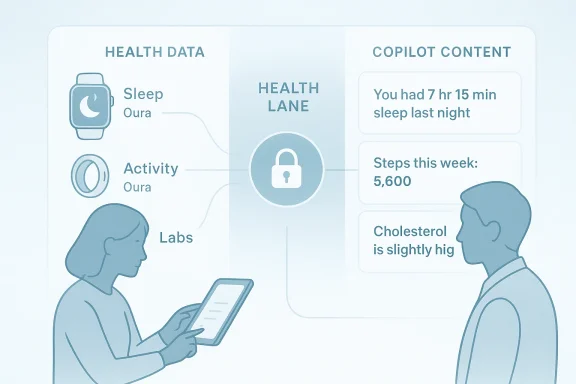
Health data dashboard showing Sleep, Activity, and Labs feeding into a central Health Lane.Background / Overview​

Microsoft’s consumer Copilot strategy has been expanding rapidly across productivity, search, and specialized verticals. Copilot Health represents the company’s clearest move yet into consumer‑facing healthcare: a feature that collects and normalizes data from EHRs, wearable devices, and direct‑to‑consumer lab services, then uses generative and clinical AI tools to describe patterns, highlight anomalies, and produce “appointment prep” briefings and suggested questions for clinicians. Microsoft positions the product as an aid for understanding, not a replacement for professional medical care.
This step is both strategic and predictable. Platforms that become the place users trust to store and query their personal information — calendars, documents, email — are natural candidates to add health as another domain. Microsoft already runs several clinically oriented efforts (for example, Dragon Copilot for clinicians and a slate of healthcare partnerships), and Copilot Health stitches those threads into a consumer‑oriented workspace where wearable telemetry and patient records can be queried conversationally.

What Copilot Health says it does​

Copilot Health’s public preview (U.S. rollout, waitlist model) is built around four core capabilities:
  • Data aggregation: Bring together EHRs, lab results, and wearable streams into a single, personal health profile.
  • Pattern detection and explanation: Use AI to surface trends (sleep, activity, heart rate variability, lab drift) and explain their likely significance in accessible language.
  • Appointment preparation: Generate a concise summary and prioritized questions to take to your clinician.
  • Privacy segmentation and governance: Keep health conversations and stored records in a separate, encrypted “health lane” inside Copilot that Microsoft says will not be used to train its foundation models.
Microsoft and early reporting cite specific integration breadth: Copilot Health can ingest data from more than 50 wearable device types (including Apple Health, Fitbit, and Oura), and connect to medical records from over 50,000 U.S. hospitals and provider organizations via partner services such as HealthEx, while laboratory results can be included through providers like Function. Those headline numbers have been repeated in multiple previews and Microsoft materials.

How the ingestion pipeline is described​

Microsoft’s public materials describe a connector model: device and app integrations (Apple Health, Fitbit APIs, vendor connectors), EHR access through HealthEx‑style record locators and FHIR‑based APIs, and lab feeds from consumer testing platforms. Data is normalized into timelines and contextualized with visit summaries and clinical notes when available, enabling the generative layer to reference both continuous device telemetry and episodic clinical events. Microsoft also indicates the feature draws on its research into clinical AI systems — notably the Microsoft AI Diagnostic Orchestrator (MAI‑DxO) and related research programs — to ground outputs in clinical reasoning patterns rather than free‑form speculation.

Why Microsoft built Copilot Health — the strategic logic​

There are three converging incentives powering Copilot Health:
  • Product differentiation: Health is one of the few deeply personal spaces where an end‑to‑end assistant can add recurring, high‑value interactions (daily telemetry reviews, prep for periodic visits).
  • Data lock‑in and ecosystem expansion: If users aggregate sensitive medical history and device telemetry inside Copilot, Microsoft strengthens the platform’s centrality across devices and subscriptions.
  • Market momentum: Competitors (OpenAI’s health features, Amazon’s health chatbot expansions, and several health‑AI start‑ups) are racing to own patient‑facing interfaces — Microsoft sees Copilot as the most natural consumer front door.
None of these incentives are inherently bad — they explain why a major cloud vendor would pursue consumer health AI — but they also create a strong motivation to encourage users to centralize highly sensitive records in a platform with broad commercial reach. That tradeoff is the central policy and design debate behind consumer health AI today.

Privacy, security, and governance: Microsoft’s promises and limits​

Microsoft emphasizes three privacy controls around Copilot Health:
  • Segregated storage and access controls: Health data and conversations will be stored separately from general Copilot interactions and protected by encryption and fine‑grained access controls. Microsoft’s Copilot privacy documentation reiterates that files and uploaded content are handled with explicit retention and deletion policies and that specific Copilot boundaries exist to limit model training.
  • Not used for model training: Microsoft has repeated that content and conversations in the health lane will not be used to train its foundation models. For enterprise and Microsoft 365 products the company has long published opt‑out controls and contractual commitments; Copilot Health inherits that design principle and the product documentation highlights user controls.
  • Third‑party certification and governance: Microsoft points to ISO/IEC 42001 (AI Management Systems) alignment and related audits as evidence of governance maturity for Copilot services — Microsoft says its Copilot family has attained ISO/IEC 42001 certification at the product level, and the company frames this as a structural safeguard for responsible AI operations.
These are material protections — encryption, access controls, retention policies, and external audits matter — but they are not all the protections critics ask for. Encryption and an ISO certification reduce operational risk but do not, by themselves, eliminate harms that arise when an AI assistant misinterprets clinical data, gives overconfident but incorrect explanations, or when a user acts on AI‑generated suggestions without clinician oversight.

The clinical and safety challenge​

Copilot Health is explicitly designed to support conversations with clinicians, not to replace them. That caveat appears throughout Microsoft’s consumer guidance: the assistant is for education and preparation, not diagnosis or treatment. Yet the technical and social dynamics of consumer health AI complicate that boundary:
  • Wearable data and consumer lab results vary widely in clinical quality. Devices designed for step counting or sleep tracking are useful for trends but are not substitutes for clinical diagnostics. Integrating these starrative requires careful uncertainty calibration and provenance transparency so users understand where signals come from.
  • Generative models can produce plausible but incorrect explanations — the classic hallucination problem — which is especially dangerous in health contexts where confident text can override patient intuition about uncertainty. Microsoft’s use of grounded clinical content and the MAI‑DxO research program seeks to lower this risk, but independent evaluation is necessary.
  • Clinical liability and the clinician‑patient relationship: If Copilot Health produces a list of “urgent” items or a suggested medication question, who is responsible for errors or downstream mismanagement? Microsoft frames outputs as preparatory; the real world makes those outputs part of care conversations, and legal and regulatory frameworks are still catching up.

Triaging accuracy: a practical checklist​

Clinicians, health systems, and informed users should apply a short triage before relying on Copilot Health outputs:
  • Confirm provenance: check whether a flagged lab came from a certified lab or a consumer panel.
  • Assess device accuracy: treat single‑point wearable anomalies cautiously; emphasize trends over isolated readings.
  • Use Copilot outputs as questions for clinicians, not treatment plans.
  • Keep human verification: any recommendation that would change medication, order imaging, or initiate invasive tests should be validated by a licensed clinician.
These simple rules reduce risk and preserve the tool’s core value: improved communication and situational understanding for patients and caregivers.

Interoperability and ecosystem partners — the plumbing that matters​

A headline strength of Microsoft's pitch is that Copilot Health is designed as a connector platform:
  • Device connectors: Apple Health, Fitbit, Oura, and other partner APIs provide continuous telemetry streams that Copilot Health can ingest and summarize. Microsoft’s consumer pages and press reporting list support for dozens of wearable device sources.
  • EHR and provider directory connectivity: Microsoft points to HealthEx and related record‑locator services as the route to provider data across thousands of hospitals and clinics — a pragmatic approach that relies on existing FHIR and TEFCA‑style infrastructures to assemble a patient’s longitudinal record. Healthcare IT reporting shows HealthEx’s ability to surface Epic‑sourced patient records and act as a patient‑directed access layer.
  • Laboratory partners: Consumer lab vendors such as Function (a direct‑to‑consumer testing company) are already providing patient‑facing panels and APIs; Microsoft’s preview materials list lab result ingestion as part of the Copilot Health profile. Function and similar services are a double‑edged sword: they broaden the pool of available data but introduce variability in clinical interpretation and lab standards.
Interoperability is where the product either becomes genuinely useful or merely aggregative window dressing. If Copilot Health successfully stitches FHIR‑standard data with well‑documented device metadata and lab provenance, its summaries will be far more actionable. If instead it treats everything equally and hides provenance, the outputs will be brittle.

Governance, certification, and external oversight​

Microsoft cites ISO/IEC 42001 certification as a governance milestone for Copilot products; this is meaningful because 42001 is the new international standard for AI management systems and offers a framework for risk assessment, lifecycle controls, and accountability. Microsoft’s public compliance materials and community posts indicate that Microsoft 365 Copilot has achieved ISO/IEC 42001 certification and that the company is applying similar governance processes across Copilot experiences. That said, ISO/IEC 42001 is a management‑system standard — it raises the floor on governance controls but does not certify product safety or clinical efficacy in a narrow technical sense.
Two important governance points to track as Copilot Health scales:
  • Independent clinical evaluation: external validation studies that compare Copilot Health’s outputs to clinician review will be essential to quantify accuracy, false positives, and missed findings.
  • Regulatory posture: consumer health tools that remain in the “information” or “education” bucket can avoid medical‑device classification, but that boundary is fragile. If Copilot Health’s outputs begin to recommend specific clinical actions, regulators may require medical‑device level validation. Microsoft’s public guidance currently frames the product as non‑diagnostic, but product changes and feature creep will continuously test that boundary.

User experience and real‑world utility​

In practical terms, Copilot Health’s potential value to typical users is straightforward:
  • Reduce confusion: a patient with fragmented records — a hospitalist note, a telehealth lab, and two months of smartwatch telemetry — currently faces a messy synthesis task. Copilot Health promises to condense these items into a readable timeline with flagged concerns.
  • Improve clinician prep: well‑structured patient summaries and prioritized questions can help clinicians focus visits, possibly making brief appointments more productive.
  • Ongoing monitoring: when configured appropriately, trends (sleep, resting heart rate, activity) might help users and clinicians detect early changes that merit attention.
But usability will depend on how outputs are framed. The best implementations will:
  • Surface provenance and confidence scores,
  • Let users correct errors (link a different provider, fix device attribution), and
  • Provide explicit next‑step pathways (e.g., “Share this summary with your clinician” with a secure export workflow).
If the UI obscures provenance or presents model certainty without caveats, the product will generate both false reassurance and clinician burden.

Risks and open questions​

No product launch eliminates tradeoffs. For Copilot Health, the most important unanswered questions are:
  • How will Microsoft verify and label the clinical quality of consumer lab panels and third‑party device streams?
  • What are the precise retention windows, and how will emergency disclosures (for example, flagged critical lab values) be managed in consumer workflows?
  • How will Microsoft measure and report accuracy, bias, and missed‑event rates in Copilot Health outputs?
  • What legal and regulatory exposures might arise when the assistant’s suggestions affect clinical decisions?
These are not theoretical. Past examples show that even well‑intentioned clinical AI can cause harm when models generalize incorrectly or when poor UI design amplifies rare but serious failures. The right defense is layered: strong governance, transparent provenance, independent evaluation, and clear medicolegal lines for how outputs are used.

How clinicians, health systems, and regulators should respond​

For clinicians and health leaders anticipating Copilot Health adoption among their patients, a pragmatic three‑step approach will reduce risk:
  • Update intake processes: ask patients whether they used consumer AI summaries before visits and include that context in the history‑taking workflow.
  • Define clear verification standards: create protocols for validating consumer lab results and device‑derived signals before acting on them.
  • Advocate for transparency: require vendors to publish evaluation metrics, data‑use policies, and error‑reporting procedures.
Regulators and policy teams should push for public, auditable evaluations of consumer health AI systems and standardized reporting of provenance and confidence metrics. Certification and ISO alignment are helpful, but they must be complemented with domain‑specific evidence of clinical safety.

What to watch next​

As Copilot Health moves from preview to broader availability, watch for the following milestones that will define whether this product is transformative or merely fashionable:
  • Publication of independent evaluations or white papers describing accuracy, false‑positive rates, and clinical concordance. Microsoft has already signaled research outputs will follow; independent peer‑review will matter.
  • Real‑world integration stories from health systems that accept patient‑shared Copilot summaries into workflows, including how clinicians reconcile AI‑generated histories with charted EHR data.
  • Feature changes that move Copilot Health from “explain and prepare” toward “recommend and triage” — the regulatory and safety bar rises dramatically at that point.
  • The transparency of training and governance decisions: Microsoft’s assertion that health lane data won’t be used for model training is meaningful; ongoing audits and clear, user‑accessible opt‑out mechanisms will be a test of trust.

Bottom line​

Copilot Health is a consequential product: it packages wearable telemetry, lab results, and clingle conversational assistant and couples that experience with Microsoft’s broad cloud, identity, and governance infrastructure. That combination could materially improve patient understanding and clinician communication — but only if Microsoft and its partners deliver strong provenance, meaningful independent evaluation, and clear behavioral guards to prevent over‑reliance on imperfect AI outputs.
Microsoft’s promises (segregated storage, no training on health lane data, ISO/IEC 42001 governance) are meaningful steps toward safer consumer health AI, and the company’s scale makes this an influential experiment for the industry. Still, the real measure of success will be whether Copilot Health reduces clinical confusion without adding new vectors for error, whether it proves useful across diverse patient populations and devices, and whether regulators, clinicians, and patients see the transparency and independent evidence they need to trust the results.

Practical guidance for readers today​

If you’re curious to try Copilot Health when the preview expands, keep these pragmatic rules in mind:
  • Treat AI summaries as preparation tools, not diagnoses.
  • Verify provenance on every flagged lab or clinically actionable suggestion.
  • Share Copilot summaries with your clinician as a discussion aid, not as a prescription.
  • Use built‑in privacy controls and understand retention settings before uploading sensitive records.
Microsoft has launched an important experiment in consumer health AI. The company’s combination of scale, governance commitments, and technical research gives Copilot Health a credible platform; the stakes — privacy, clinical safety, and user trust — are high. If Microsoft, its partners, and external evaluators treat those stakes with the seriousness they deserve, Copilot Health could be a useful bridge between fragmented personal data and better, more informed clinical conversations. If not, the product will be another well‑funded attempt that amplifies convenience while leaving critical risks unaddressed.

Source: Digital Watch Observatory AI-powered Copilot Health platform introduced by Microsoft | Digital Watch Observatory
 

Microsoft’s Copilot just moved from productivity and search into the most intimate ledger many users keep: their medical records and wearable telemetry, with a U.S.-only preview called Copilot Health that promises to aggregate electronic health records (EHRs), lab results, prescriptions and continuous biometric streams into a private Copilot workspace that explains findings, highlights trends, and suggests actionable next steps.

Person at a computer reviews HealthEx medical records, lab results, and wearables on a secure dashboard.Background / Overview​

Microsoft has been steadily expanding the Copilot family from productivity assistants into specialized vertical copilots, and Copilot Health represents the company’s clearest push yet into consumer-facing healthcare. The preview — announced in mid‑March 2026 — is positioned as a privacy-segmented lane inside the broader Copilot experience where users can import or connect medical records and wearable data, then ask an AI to summarize results, prepare visit notes, or spot trends across data sources.
This launch is being paired with partner integrations to make the product useful from day one. One of the most notable announcements is Microsoft’s partnership with HealthEx, which will provide a bridge between users’ personal health records and Copilot Health by linking TEFCA-style networks and FHIR-based access to make EHR data and PHRs available to the Copilot workspace. HealthEx’s role is described as a practical interoperability layer to surface patient-authorized records into the Copilot Health environment.
Taken together, the product and partner news signal a strategic ambition: become the consumer “front door” to personalized, AI‑assisted health guidance. That ambition brings clear benefits — convenience, personalization and the potential to translate dense clinical notes into plain language — but it also raises urgent questions about accuracy, provenance, privacy and regulatory compliance. Multiple early previews emphasize Microsoft’s stated design choices: keep health chats separate from general Copilot activity, avoid using consumer health conversations as training data for general models, and surface provenance for clinical claims.

What Copilot Health Claims to Do​

Data types and connectors​

Copilot Health is designed to ingest a range of personal health data types:
  • Electronic health records (EHRs): visit notes, diagnoses, medications, problem lists and imaging/lab reports.
  • Lab results and imaging summaries: clinical test results converted into a timeline and trend analysis.
  • Wearable telemetry: continuous or episodic streams such as heart rate, sleep stages, activity, SpO2 and step counts from consumer devices.
  • Personal health records (PHRs): patient‑held summaries and third‑party PHR services that consolidate records across providers, which HealthEx intends to help integrate.
The product preview emphasizes an ability to synthesize across these streams — for example, correlate an elevated resting heart rate on a wearable with recent lab values or new prescriptions — and to produce short, actionable outputs: plain-language summaries, appointment prep sheets, and “what to ask your clinician” prompts. Microsoft frames these capabilities as patient empowerment tools, not clinician decision-support systems, but the line is functionally thin.

UX: a “privacy-segmented health lane”​

Microsoft has described Copilot Health as a distinct and privacy-segmented experience inside the Copilot ecosystem. That segmentation aims to prevent routine Copilot usage (shopping lists, email drafting) from mixing with sensitive clinical interactions, and Microsoft says health-specific data won’t be used to train the general Copilot models. Early reporting of the preview reiterates that Copilot Health will provide provenance markers and clarify when the assistant is quoting licensed medical content versus summarizing a patient’s record. However — and critically — those promises will require independent verification and ongoing audits to be trusted in practice.

HealthEx partnership: why it matters​

HealthEx’s announced role is practical and strategic. The company says it will help link TEFCA-style interoperability networks and FHIR interfaces into Copilot Health, effectively allowing patient-authorized EHR and PHR records to flow into Microsoft’s consumer-facing assistant. That solves one of the hardest problems for any consumer health product: access to fragmented data sitting across tens of thousands of provider systems. By promising to map TEFCA-like connectivity and FHIR standards onto Copilot Health, the integration could make the product useful for a far larger set of users at launch than a single‑vendor connector approach would allow.
HealthEx’s positioning suggests Microsoft will rely on specialized intermediaries for the plumbing — not unlike how major platforms rely on identity or payments partners. This reduces one engineering burden for Microsoft and concentrates interoperability complexity in a partner that purports to specialize in record access and consent flows.
Caveats:
  • The announced approach depends on wide provider participation in TEFCA-style networks and the willingness of health systems to accept third-party PHR bridging. Adoption remains uneven.
  • FHIR endpoints vary dramatically in completeness and the quality of structured data. HealthEx will need robust mapping, normalization and reconciliation logic to produce clinically useful output rather than noisy, partial summaries.

Clinical accuracy, provenance and the Harvard content angle​

Microsoft has taken steps to shore up clinical accuracy by licensing or pointing to curated medical content to ground Copilot answers. Prior reporting indicates Microsoft has pursued licensing arrangements with recognized medical publishers to provide authoritative consumer health content that Copilot can draw from when answering general medical questions. The goal is to reduce hallucinations and deliver safer, more reliable guidance.
That strategy has merit: combining patient-specific EHR content with vetted clinical guidance offers a two-layer approach — personalized context plus authoritative explanation. But it is not a silver bullet. The practice of blending curated editorial content with generative outputs requires strong provenance signals (what’s patient data vs. what’s publisher guidance) and conservative answer framing when evidence is incomplete. Early previews promise provenance tagging; operationalizing it at scale will be difficult and requires auditing.
Important limitations to flag:
  • Copilot Health is presented as a consumer tool, not a replacement for clinician judgment. Microsoft’s messaging stresses appointment-prep and explanation, not autonomous clinical decision-making. Still, patients may treat AI outputs as medical advice.
  • Licensed publisher content helps with high-level guidance but doesn’t validate inferences drawn by the model from raw clinical notes or ambiguous wearable signals.
  • Independent clinical validation — ideally peer-reviewed or overseen by healthcare organizations — will be necessary before clinicians can meaningfully rely on Copilot outputs in care delivery.

Privacy, security, and regulatory risk matrix​

The stakes for privacy and security are unusually high: medical records are among the most sensitive data types, and wearable telemetry can reveal behavioral patterns that matter for employment and insurance decisions. Microsoft’s preview is explicitly U.S.-only for now, which frames much of the compliance discussion in HIPAA and U.S. state privacy law terms, but global rollout would trigger additional regulatory regimes.
Key security and privacy talking points:
  • Data segmentation promises: Microsoft says health interactions will be kept in a separate Copilot lane and will not be used to train general-purpose models, a central claim for user trust. This needs technical validation (logs, data flows, retention policies) and third-party audits to have credibility.
  • HIPAA and Business Associate concerns: If Microsoft handles PHI (Protected Health Information) in support of Copilot Health for covered entities, multiple contractual and technical obligations apply. The product’s use cases — consumer-managed PHRs and direct-to-consumer wearable ingestion — may reduce some covered-entity obligations, but mixed flows (provider-connected EHRs plus wearables) create complex compliance surfaces that must be spelled out in provider contracts and terms of service.
  • Data breach risk and attack surface: A centralized hub of consolidated medical records and biometric streams becomes a high-value target. Microsoft’s enterprise-grade security posture matters, but attackers disproportionately target user endpoints and credential systems; robust multi-factor authentication, strong session controls, and encrypted-at-rest and in-transit protections are non-negotiable.
  • Consent and revocation mechanics: Practical privacy requires simple, auditable consent flows and the ability to revoke access. HealthEx’s bridge role should simplify the consent orchestration, but it must also provide transparent logs and revocation that are meaningful to users.
Regulatory landscape and enforcement risk:
  • U.S. regulators are already scrutinizing AI in healthcare. Any claims that resemble diagnostic accuracy or treatment advice will invite higher scrutiny from the FDA and state authorities. Microsoft’s consumer framing reduces immediate FDA risk, but ambiguous product messaging or misuse by clinicians could attract enforcement.
  • State privacy laws (e.g., consumer data privacy statutes) and federal HIPAA rules create overlapping obligations. The line between a consumer-directed PHR and a covered health service is not always clear; Microsoft and HealthEx will have to be explicit about roles and liabilities.

Clinical and technical risks: hallucinations, provenance, and data quality​

Generative models are powerful pattern-matchers but they are also prone to confident, incorrect outputs — the well-known hallucination problem. In a health context, hallucinations can be harmful. Microsoft’s strategy of combining patient data with licensed content and of surfacing provenance is important, but not sufficient by itself.
Three interlocking risk categories deserve emphasis:
  • Model inference risk
  • Correlating wearable anomalies with clinical pathology is inherently probabilistic. For example, a transient heart‑rate elevation on a fitness tracker may reflect exercise, anxiety, or device error. Presenting a single, deterministic clinical explanation without uncertainty bounds is dangerous. Copilot must present uncertainties and allow users to escalate to clinician review.
  • Data quality and interoperability risk
  • EHRs are often incomplete, inconsistent and filled with copy‑forward artifacts. FHIR endpoints vary by vendor and health system. HealthEx’s normalization will be crucial, but it cannot invent missing clinical context. Users and clinicians must be reminded of the limitations of incomplete data sources.
  • Provenance and auditability risk
  • Knowing which claim came from which source — a lab result, a note, a device reading, or licensed guidance — matters for trust and liability. Copilot Health’s user interface must make provenance explicit and keep auditable logs suitable for clinical review and legal scrutiny. Early product descriptions promise provenance tagging; real-world usefulness depends on clarity and retrievability.

Practical implications for users, healthcare providers, and payers​

For consumers​

  • Copilot Health could make it easier to understand complex results and to prepare for clinician visits, potentially improving health literacy and shared decision-making.
  • Users should approach outputs as informational rather than authoritative; always confirm interpretation with a clinician, especially for new symptoms or abnormal labs.

For health systems and clinicians​

  • Health systems should evaluate how patient-delivered AI summaries might change workflow. For example, a patient who arrives with a Copilot‑generated prep sheet could save visit time — or could require clinicians to correct AI errors, increasing workload.
  • Institutions will need clear policies around if/when Copilot outputs can be attached to the medical record or used in clinical decision-making.

For payers and employers​

  • Consolidated consumer health records create questions about secondary use. Payers may see opportunity in care management and prevention, but any attempt to use Copilot outputs for underwriting or employment decisions would raise ethical and legal red flags.

Competitive and strategic analysis​

Microsoft’s play is logical from a platform perspective. The company already occupies productivity, identity, cloud and device ecosystems; adding a health layer gives Copilot a potentially sticky, high-value consumer role. Owning the “personal health interface” across devices and EHRs would create a defensible moat if Microsoft can deliver reliable, private and clinically useful assistance. Multiple cloud giants are pursuing adjacent plays, and Microsoft’s combination of enterprise credibility, partnerships with publishers and interoperability intermediaries like HealthEx offers a practical path to scale.
But the strategic win is not guaranteed. Success hinges on:
  • Effective, trustworthy privacy and compliance controls.
  • High-quality interoperability that reduces noise and preserves provenance.
  • Conservative clinical-risk framing and transparent scientific validation.
  • User experience that clearly communicates uncertainty and sources.

What Microsoft, HealthEx and partners must get right​

  • Implement transparent, auditable consent and revocation flows that are understandable to non-technical users.
  • Publish technical documentation and external audit results on data flows, retention, training exclusions and provenance mechanisms. Independent third-party attestations will be essential to build trust.
  • Constrain the product’s language around diagnosis and treatment; use conservative phrasing, uncertainty bands and automatic escalation prompts when the model detects potentially serious findings.
  • Invest in rigorous clinical validation studies, ideally with academic partners, to evaluate the assistant’s accuracy across representative patient cohorts and real-world data.

Practical user checklist: before you add your records​

  • Confirm whether Copilot Health will be covered by a HIPAA business associate agreement for your provider’s connection, and understand which entity holds what data.
  • Review consent prompts carefully; note whether the platform stores data long-term and whether it is shared with third parties (e.g., HealthEx) for interoperability.
  • Use strong authentication (MFA) on accounts that will hold health data and enable device-level encryption where possible.
  • Treat Copilot Health outputs as preparatory materials — bring them to your clinician for confirmation rather than using them as self-diagnosis tools.

Where reporting is thin or claims are currently unverifiable​

Several important claims in early product reporting require independent confirmation:
  • The exact technical architecture for isolating health data from model training pipelines is not yet public; Microsoft’s statements must be backed by technical attestations and logs. If you are evaluating risk, treat training-exclusion promises as claims that need verification.
  • The completeness and quality of FHIR endpoints HealthEx will access (and any normalization rules HealthEx will apply) are not yet transparently documented. Real-world FHIR variability means outputs will vary by provider.
  • Claims about publisher-licensed content integration (e.g., Harvard Health) can reduce hallucination risk, but how models reconcile conflicting sources or handle gaps remains unclear in published previews and should be audited.
Where statements are unverifiable in public previews, we recommend caution and expect Microsoft and its partners to publish technical whitepapers and third-party audit summaries if they want broad clinical and institutional uptake.

Conclusion — a consequential, cautious opportunity​

Copilot Health is a consequential product move: it compresses messy, distributed health data into a single, AI‑assisted place intended to improve understanding and convenience. The HealthEx partnership addresses a core interoperability problem and could materially improve the product’s utility at launch. Together, these announcements mark a strategic push by Microsoft to be the consumer-facing layer for personal health data and insights.
That potential comes with commensurate responsibility. Microsoft and its partners must prove, publicly and technically, that health data is both protected and used responsibly; that model outputs are conservative, auditable and provenance-laden; and that users understand the scope and limits of AI-generated health guidance. Until those proofs exist and are verified by independent auditors and clinicians, Copilot Health will be a powerful convenience tool with real benefits — but also real, non-trivial risks that users and health organizations should treat with healthy skepticism.
If Microsoft delivers on the technical and governance promises it is making in previews — and if HealthEx’s interoperability plumbing proves resilient in the messy world of live EHRs — Copilot Health could raise the bar for consumer health assistants. If not, it risks delivering a high-value target of consolidated sensitive data and confident, yet potentially misleading, medical assertions. The next months of product documentation, third-party audits and clinical validation studies will determine which path this product ultimately follows.

Source: WinBuzzer Microsoft Launches Copilot Health to Link Medical Records and Wearables
Source: HLTH HealthEx and Microsoft Partner to Integrate Personal Health Records into Copilot Health
 

Microsoft’s new Copilot Health preview is a clear, ambitious push to make the Copilot assistant the single, consumer-facing hub for personal medical data: it promises to pull together electronic health records (EHRs), lab results and continuous wearable telemetry into a privacy‑segmented “health lane” inside Copilot that can explain findings in plain language, highlight trends across disparate data sources, and offer appointment‑prep and “next step” guidance — but it also forces a reckoning with accuracy, clinical responsibility, and data governance at a scale that matters.

Doctor and patient review holographic health data on futuristic screens.Background / Overview​

Microsoft unveiled Copilot Health as a U.S.-only preview in mid‑March 2026, opening a waitlist for adults to join the early trial. The feature is positioned not as a replacement for clinicians but as a personal intelligence layer that ingests medical records, lab reports and telemetry from consumer wearables (Apple Health, Fitbit, Oura and similar services) and synthesizes that data with grounded medical guidance.
That framing — personal intelligence, not clinical care — is central to Microsoft’s messaging. The company emphasizes a privacy‑segmented workspace inside Copilot, which it describes as separate from general Copilot training and workflows, and claims the environment will present results in plain language, surface trends, and provide actionable suggestions such as what to bring to a doctor visit or which test results warrant clinical follow‑up.
Copilot Health arrives at a moment when major cloud and AI vendors are racing to become the interface people use to ask medical questions and act on health data. Microsoft’s bet is strategic: if users trust a platform with their health data, that platform becomes a durable hub for services and commerce. But that strategy comes with high stakes: medical safety, privacy, interoperability and regulatory exposure.

What Copilot Health promises to do​

Aggregate fragmented medical histories into one workspace​

One of Copilot Health’s headline capabilities is consolidation. The preview promises to ingest clinic notes, EHR entries, lab reports and prescription records so that a user — or their caregiver — can ask the Copilot to explain what a particular lab value means, follow trends over time, or summarize visit notes ahead of an appointment. Microsoft frames this as turning a fragmented “medical jigsaw” into an intelligible picture.
  • Aggregate EHR entries and clinic notes
  • Pull in laboratory results and explain numeric findings
  • Include prescription and medication histories
  • Provide appointment‑prep summaries and suggested questions

Fuse consumer wearable telemetry with clinical data​

Copilot Health intends to combine continuous streams from consumer wearables — heart rate, sleep metrics, activity levels and similar telemetry — with clinical data. That enables trend detection across different timescales (for example, how resting heart rate drift relates to lab markers or medication changes). Published previews name common wearables and health platforms as sources, explicitly listing Apple Health, Fitbit and Oura among the device ecosystems Microsoft plans to support.

Provide plain‑language explanations and “actionable next steps”​

A core user experience Microsoft showcases is plain‑language summarization. Instead of a dense lab report letterhead, Copilot Health will produce a succinct explanation of what a test result means, whether it is within expected ranges, and potential next steps (e.g., “follow up with your primary care physician” or “retest in X weeks”). This is pitched as a tool to make health data useful for people — especially those who struggle with medical jargon.

Privacy segmentation and data governance​

Microsoft describes Copilot Health as a privacy‑segmented lane inside Copilot. The company says this separates clinically focused interactions from general Copilot usage and insists that clinical data will be handled under stricter governance. Microsoft also highlights partners and technical plumbing intended to ease EHR connectivity and data provenance. Early previews name integrations and partners that will facilitate links to medical records and standardize formats.

Technical plumbing and interoperability: how the system will (likely) work​

Linking EHRs, labs and personal health records​

The practical problem Copilot Health must solve is interoperability. Medical records live in thousands of EHR systems with different export formats and varying degrees of API support. The preview indicates Microsoft will rely on existing standards and partners to bridge those gaps — notably FHIR‑style APIs and third‑party integrators that can pull records on behalf of the user. Microsoft’s previews mention partners and solutions aimed at linking TEFCA/FHIR interoperability promises into a consumer flow. Those mechanisms are crucial to provide accurate, timely clinical data rather than stale PDFs or partial exports.

Wearable integration and continuous telemetry​

To bring wearable data into the same workspace, Copilot Health will tap consumer health platforms (like Apple Health and Fitbit data streams) and normalize telemetry into time series the assistant can analyze. This includes heart rate, activity, sleep, and possibly more advanced signals depending on device capabilities. Continuous telemetry poses distinct technical challenges: large volumes of time‑series data, device‑specific noise and variability, and the need for sensible aggregation and visualization so that the assistant’s summaries remain actionable.

Where the AI reasoning sits — local, cloud, or hybrid?​

Microsoft’s Copilot architecture historically blends local device features with cloud‑hosted models and services. For Copilot Health, the heavy lifting — such as cross‑document synthesis, trend detection across time‑series and grounding of outputs in medical content — will almost certainly run in the cloud due to compute and data access requirements. Microsoft’s messaging about a privacy‑segmented environment suggests the company will apply stricter access controls, audit logs, and possibly encryption and provenance markers for health data. That said, the specifics of what runs locally versus in the cloud and whether on‑device models are used for ephemeral processing have not been fully disclosed in public previews. Treat any operational assumptions here as provisional.

Why this matters: potential benefits​

1. Better patient comprehension and engagement​

Medical results and clinic notes are notoriously difficult for many people to understand. Copilot Health’s promise to translate dense clinical language into plain English and to highlight which values are clinically significant could substantially increase patient comprehension and engagement, improving adherence and the quality of clinic conversations.

2. Trend detection across previously siloed data​

Combining wearables and lab data opens the door to clinically relevant correlations — for example, correlating rising resting heart rates with inflammatory markers or medication changes. That contextual view can help patients and clinicians identify patterns that single data sources miss.

3. Convenience and appointment prep​

A Copilot‑generated appointment summary or “prep sheet” that lists recent abnormal labs, medication changes and suggested questions could make short clinic visits far more efficient and productive. For caregivers managing multiple patients, this could be a tangible time saver.

4. Frees clinicians from basic explanation tasks​

If Copilot Health reliably handles routine explanations and logistics (e.g., what a CBC shows and why a value is abnormal), clinicians could focus on interpretation, decision‑making and treatment rather than rehashing basic educational points. That could improve workflow if implemented thoughtfully and integrated into clinical practice safely.

Concrete risks and unresolved questions​

Accuracy, hallucination and the medical safety problem​

Generative AI systems can produce plausible‑sounding but incorrect statements. In a medical context, even a small rate of incorrect or misleading outputs is consequential. Copilot Health must avoid hallucinated diagnoses, wrong medication advice, or misinterpreted lab results. Early previews stress that Copilot Health is not a replacement for clinicians, but real‑world use will require robust guardrails, verification mechanisms, and clear provenance for every claim the assistant makes. Multiple previews and analyst pieces highlight this central safety concern.

Data provenance and completeness​

If Copilot Health ingests partial records — for instance, an EHR export missing hospital encounter notes or a wearable dataset with gaps — the assistant’s conclusions may be biased or incomplete. Users and clinicians need visibility into what the assistant had access to and what it did not. Previews indicate Microsoft plans provenance markers and visibility, but detailed mechanics (how provenance is shown, whether a clinician can see the underlying documents, and how conflicting data are reconciled) remain unclear.

Privacy, consent and secondary use​

Microsoft’s notion of a privacy‑segmented health lane is a strong design signal, but the company will need to operationalize legal and technical protections for health data. In the U.S., HIPAA governs covered entities and business associates, but consumer applications that the patient directly controls often fall outside HIPAA’s strictest protections. That means the legal and contractual framework surrounding Copilot Health — what Microsoft can do with ingested data, how it is stored, and whether it’s used to improve models — will need to be explicit and auditable. Early reports note Microsoft’s emphasis on privacy segmentation, but users should be cautious and read terms carefully.

Liability and clinical governance​

If Copilot Health suggests an action that leads to harm, who is responsible? Microsoft’s previews stress the assistant is not a replacement for clinicians, but the practical line between helpful guidance and de facto clinical advice will blur in user interactions. Healthcare providers, payers and regulators will focus on governance: what disclaimers are required, whether outputs must be routed through clinicians for certain tasks, and how to handle adverse events. Analysts point to this unresolved liability calculus as one of the trickiest operational problems ahead.

Equity and device access​

Relying on consumer wearables means Copilot Health’s richer features will be more accessible to people who own and sync such devices. That could widen disparities if low‑income patients or older adults lack compatible devices. Microsoft and health system partners will need to plan for equitable access and alternative data sources to avoid creating a two‑tiered experience where only some patients receive advanced insights.

How Microsoft and partners appear to be mitigating risks​

Privacy segmentation and strict governance controls​

Microsoft’s messaging repeatedly emphasizes a separate health workspace and governance model intended to protect clinical data. While details remain thin, the company has signalled stronger access controls, audit trails and a commitment that health data will not be used for general Copilot training workflows — at least in the initial preview framing. Users should still confirm the data handling and retention specifics before enrolling.

Partnered interoperability and standards​

To overcome the fragmentation of records, Microsoft is working with third‑party integrators and adopting standards-based approaches. Previews mention partnerships and the use of FHIR/TEFCA or equivalent connectors to fetch records and ensure provenance, a practical move that can reduce error from manual uploads and screenshots. These integrations also facilitate a closer, auditable chain from provider systems into Copilot.

Clinical grounding and explicit disclaimers​

Microsoft positions Copilot Health as an assistant that grounds its outputs in medical content and explicitly disclaims clinical replacement. That framing is necessary but not sufficient; safe deployment will also require human‑in‑the‑loop mechanisms, clinician review capabilities, and fast‑feedback processes to correct model errors when they surface.

Practical advice for early adopters and administrators​

If you’re considering Copilot Health — either as an individual user or as an administrator evaluating adoption for a patient population — here are practical steps to reduce risk and set correct expectations:
  • Read the privacy and data use terms carefully before uploading records or linking devices. Confirm whether Microsoft will retain, analyze or use the data for model improvement.
  • Treat Copilot Health outputs as preparatory material, not definitive medical advice. Use summaries to inform conversations with clinicians, not to replace them.
  • Check provenance: ask what documents and device streams the assistant consulted when it generated a recommendation. If the interface does not make provenance explicit, do not rely on complex clinical interpretations.
  • Maintain copies of original lab reports and EHR PDFs. If Copilot Health’s interpretation seems inconsistent with source documents, compare outputs with the originals and consult a clinician.
  • Clinicians and health systems should demand audit logs and an option to export the assistant’s underlying evidence so that human reviewers can verify conclusions and correct model errors.

Competitive context and market implications​

Copilot Health situates Microsoft in a crowded race: other major cloud and AI companies are also building consumer and clinician‑facing medical assistants. The strategic value is high: whoever becomes the default interface for personal health queries may gain long‑term engagement and monetization opportunities across devices, services and clinical workflows. Analysts note this contest between cloud giants is not only about technical superiority but also trust, market reach and regulatory compliance. Microsoft’s advantage is existing enterprise relationships with health systems and a broad consumer footprint for Windows and Office; however, consumer trust around medical data will be decisive.

What to watch next​

  • Adoption and waitlist dynamics: The preview is U.S.-only and invite‑based. Monitor who Microsoft admits (patients, caregivers, clinicians) and how quickly it scales beyond the initial cohort. Early user experiences will shape adoption.
  • Regulatory signals: Watch for guidance from U.S. regulators and major health systems on liability, required disclosures and acceptable clinical use cases for consumer‑facing AI assistants.
  • Integration depth: Will Copilot Health support full clinical workflow integrations (e.g., sending clinician‑approved summaries into EHR inboxes) or remain focused on consumer prep and education? The former would be a more intrusive but potentially more useful move.
  • Safety incidents and corrections: The speed at which Microsoft identifies and corrects inaccurate outputs — and whether those corrections are transparent — will be a bellwether for the product’s clinical viability.

Conclusion: a powerful convenience, but not a finished clinical product​

Copilot Health is an important milestone in consumer‑facing medical AI: it brings together EHRs, lab reports and wearable telemetry into a single, AI‑driven workspace that could meaningfully improve patient comprehension, appointment preparation and trend detection. Microsoft’s emphasis on a privacy‑segmented “health lane,” partnerships for interoperability, and plain‑language outputs are all sensible design choices that address core user needs.
That said, the move also crystallizes difficult tradeoffs. Accuracy and hallucination risks, data provenance and completeness, regulatory and liability questions, and equity of access are unresolved problems that will determine whether Copilot Health becomes a trustworthy everyday tool or a high‑profile cautionary tale. Early previews and reporting make clear Microsoft understands these stakes, but the proof will be in implementation: how the company operationalizes governance, how transparently it surfaces provenance and uncertainty, and how it partners with clinicians to keep a human in the loop.
For users tempted to try the preview: Copilot Health can be a powerful assistant for understanding your data, but it should augment — not replace — conversations with qualified clinicians. Treat its outputs as a convenient way to prepare for care, not as clinical directives, and demand clear provenance and the ability to export or verify the underlying records the assistant used.
Microsoft’s Copilot Health will be a vital signal in the larger race to build the consumer interface for personal health. If the company can pair technical competence with transparent governance and rapid, visible error‑correction, Copilot Health could raise the floor for how people understand and manage their health data. If it stumbles on accuracy or privacy execution, it will underscore how badly rigorous guardrails are needed when AI meets medicine.

Source: Moneycontrol.com https://www.moneycontrol.com/techno...records-into-one-ai-hub-article-13859640.html
Source: ManilaShaker Philippines Microsoft Launches Copilot Health With AI-Powered Health Insights
 

Back
Top