

Title: How a 60‑second Copilot-powered film study made the case for Stafford — and revealed how AI is reshaping sports media and sideline operations
By [Your Name], WindowsForum technology correspondent
Date: January 16, 2026
Summary
- A Bleacher Report short — reposted by outlets including Yardbarker — shows Hall‑of‑Famer Ed Reed using Microsoft Copilot to break down film that makes a short, punchy case for Matthew Stafford as an MVP candidate.
- The clip is a useful lens into two simultaneous trends: (1) the NFL’s operational adoption of Copilot tools on the sidelines and inside team workflows; and (2) how Copilot is being embedded into editorial production to speed up and scale short‑form, social‑first sports content.
- The technology offers real, measurable advantages (faster analysis, better fan engagement, new sponsor inventory) — but it also raises technical, editorial and governance questions (hallucination risk, data provenance, privacy and overreliance). I unpack what’s happening, verify the key claims, and explain what teams, publishers and technologists should watch next.
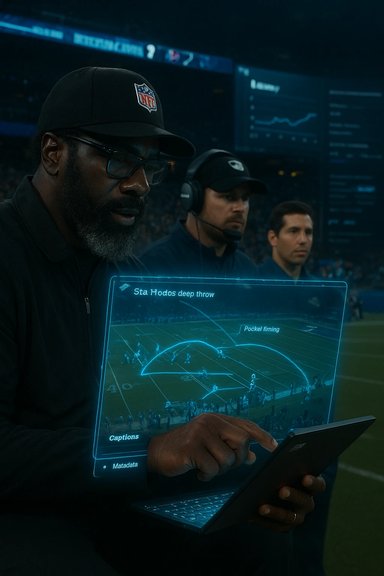
On January 16, 2026 a short-form clip circulating from Bleacher Report — also republished to sites like Yardbarker — features Ed Reed studying a handful of Rams plays and calling out why Matthew Stafford’s 2025 season qualifies as MVP‑level work. The clip is explicitly framed as part of a Copilot‑enabled series of film studies, where on‑screen annotations, play tagging and visual overlays are produced with AI assistance. That framing matters: the short isn’t just a highlight reel. It’s a demonstration of a production workflow in which generative and assistive AI tools (branded Copilot in Microsoft’s portfolio) accelerate clip selection, add synchronized callouts and generate narration/captions and distribution metadata so publishers can turn long film study into social‑ready snippets quickly. These are the exact features Microsoft and media partners have been testing and promoting for sports content. Putting the “MVP” claim in context
Why would a brief film study persuade anyone to call Stafford an MVP candidate? Because the claim is grounded in performance that is easily verified: Stafford finished the 2025 regular season among the NFL leaders in major passing categories — including leading the league with 4,707 passing yards and 46 touchdown passes — statistics that underpin most objective MVP conversations. Reliable stat outlets and season leaderboards report those same totals. The short’s persuasive power comes from two elements:
1) a human expert (Ed Reed) pointing out specific plays where Stafford displayed timing, pocket management, and situational accuracy; and
2) the Copilot‑assisted visualizations that highlight pre‑snap reads, route stems and protection windows so a non‑technical viewer immediately sees why those plays were effective. In short: expert commentary plus synchronized visuals equals rapid comprehension. Why Microsoft is now in every sideline and content studio
The Bleacher Report pieces are best interpreted against a much larger backdrop: by 2025 Microsoft substantially expanded its NFL partnership to put Copilot‑capable Surface devices and AI services into the hands of teams, coaches and media partners. Microsoft’s public descriptions of the program cite upgrades to the Sideline Viewing System, deployment of thousands of Surface Copilot+ PCs, and integration of Copilot‑powered filtering and highlight generation into game‑day tools. Independent reporting of the deal and rollout corroborates those numbers and features. Concretely, that architecture looks like:
- On‑device Copilot+ Surface hardware for low‑latency, privacy‑sensitive tasks (e.g., quick clip filters on the sideline).
- Cloud / Azure inference for heavier aggregation and cross‑game analytics (e.g., pattern detection across a season’s worth of plays).
- Integration with league systems (GSIS / SVS) and broadcast workflows so coaches and broadcasters can share the same annotated footage and metrics.
The Reed film studies reveal several practical production use cases for Copilot beyond on‑field decision support:
- Automated play selection: Copilot can be prompted to find “all third‑down over‑the‑top targets to the slot” and return a short list of relevant clips, saving editors hours.
- Synchronized visual overlays: when Reed points to an inside shoulder, an overlay highlights that shoulder, matching the narration timecode — reducing cognitive load for viewers and increasing retention.
- Derivative content generation: Copilot can draft captions, generate SEO‑friendly headlines, produce multiple social cuts and auto‑caption the final footage. That makes one edit session produce many outputs for TikTok, X, Instagram and editorial pages.
Technical anatomy — what the system is likely doing
The public material and industry coverage let us infer a plausible technical stack behind a Reed Copilot film study:
- Ingest: high‑resolution game footage is ingested into a media processing pipeline (already standard in broadcast workflows).
- Detection & indexing: computer vision models and event detectors (routes, blocks, QB drop, pocket pressure) segment footage into discrete plays and index them by metadata (down/distance, formation, player IDs).
- Retrieval: a Copilot agent accepts a natural‑language prompt (“show me Stafford deep‑ball completions from empty sets after play‑action”) and maps that to a filtered set of indexed plays.
- Render & annotate: overlay generation tools align tickers, bounding boxes and vector callouts to frames, producing a synchronized output for the analyst to narrate.
- Assistive generation: Copilot drafts on‑screen captions, one‑line social copy, and a suggested title/thumbnail variations for A/B testing.
- Human review: an editor/analyst (Ed Reed, in this case) reviews, records voiceover, and approves the final cut.
There are tangible wins:
- Time savings: Copilot reduces the manual search/annotate/caption cycle, letting small editorial teams produce more content without proportionally more staff. That’s powerful for social distribution.
- Sharper storytelling: synchronized visuals make expert analysis more accessible to casual fans; the “aha” moment arrives faster when Reed can point and the viewer sees the same thing instantly.
- Operational impact: teams can use the same tooling to produce coaching artifacts and fan assets; that convergence reduces duplicate effort across front office, coaching and media teams.
- Sponsorship/productization: coproduced, branded short-form segments (e.g., “The Blueprint, powered by Microsoft Copilot”) create premium ad/sponsor slots that are natively integrated with the product.
The demonstration also glosses over hard problems; IT pros and media technologists should pay attention to these.
1) Hallucination and editorial accuracy
Generative agents can produce plausible but incorrect textual summaries, mislabel frames, or overclaim causation (e.g., “Stafford always does X before Y”), and if editors accept those outputs without verification the result degrades trust. Human review is non‑negotiable. Independent reporting on Copilot deployments explicitly emphasizes human‑in‑the‑loop workflows for this reason. 2) Provenance and data lineage
Which model produced a given overlay? Which training data informed a particular inference? For sports analytics used in coaching decisions, teams must preserve provenance and be able to audit outputs; black‑box agents without logs are a governance danger. Industry guidance now recommends model cards and inference logging for operational deployments. 3) Latency, reliability and network assumptions
Sideline systems must work in stadiums with weak connectivity. Microsoft’s playbook — mixing on‑device inference (for low latency) with cloud reasoning (for heavy lifting) — is designed to mitigate this; but proper fallbacks and local acceleration hardware are required for reliability. PYMNTS and Microsoft’s own descriptions note this hybrid architecture. 4) Privacy and competitive leak risks
Game film and pre‑snap tendencies are competitive assets. Any third‑party integration (cloud storage, managed services, social publication) requires strict access controls, encryption-at-rest, and contractual limits on data reuse. Teams and the league must set clear boundaries on what editorial partners can access. PwC and other analysts point out that governance is now the most important operational step in digital‑fan and team AI programs. 5) Overreliance on automation
There’s a subtle cultural risk: if teams or coaches begin to treat Copilot outputs as definitive prescriptions rather than decision support, they risk reducing critical human judgment — especially around adversarial or noisy plays where models can fail. The proper posture is “augmented intelligence” rather than “automated decisioning.” Verifying the important claims (cross‑checks)
Because the Bleacher Report short is both promotional and editorial, I double‑checked three central claims against independent sources:
- Did Stafford lead the NFL in key passing stats (2025)? Yes — league leaderboards and mainstream outlets (ESPN, Sports Illustrated) show Stafford finishing the 2025 regular season with 4,707 passing yards and 46 TD passes. Those topline numbers are the objective foundation for an MVP argument.
- Is Microsoft rolling Copilot into the NFL’s sideline and content workflows at scale? Microsoft’s own Unlocked blog and independent reporting (PYMNTS, industry newswire coverage) confirm a broad rollout of Surface Copilot+ PCs, SVS upgrades and Copilot‑powered analytics to teams and media partners starting in 2025. Numbers and program details are consistent across those sources.
- Are publishers using Copilot to accelerate production (overlays, captions, metadata)? Yes — production‑workflow writeups and insider writeups of coproduced segments note Copilot’s role in generating annotations, captions and social variants, and WindowsForum coverage of the production pipeline shows how these tools lower editorial friction.
If you’re building or buying a Copilot‑powered sports workflow, here’s a practical checklist based on the deployments we’re seeing:
- Human‑in‑the‑loop (HITL) gates: every Copilot output that may be published or used in coaching decisions must be reviewable and editable by a qualified human.
- Provenance & logging: attach model‑id, prompt and confidence scores to every generated overlay and summary, and preserve the index of source frames.
- On‑device fallbacks: ensure essential filters and retrieval tasks run locally if network fails; reserve cloud calls for heavy aggregations.
- Access control: separate editorial access from operational (coaching) access; limit replay/film exports that could leak playbooks.
- Model testing & bias audits: run routine checks that verify detection accuracy across teams, formations and camera angles.
- Transparent sponsor labeling: clearly disclose when a segment is “powered by” or “generated with” Copilot; audiences deserve to know when content is AI‑assisted.
For fans: expect richer, faster explainer content and more micro‑learning moments. A 60‑second, Copilot‑enhanced clip can teach an angle or concept that used to require 10 minutes of watching.
For sports journalists and editors: the marginal cost of producing short form analysis drops, but editorial judgment becomes more valuable. The competitive advantage shifts to outlets that pair strong human experts with the best AI tooling and governance.
For IT and media technologists: the new challenge is reliability and auditability. It’s not enough to spin up Copilot endpoints — you must instrument, log and govern them.
Bottom line
The short Bleacher Report film study starring Ed Reed and framed as “Copilot‑powered” is not just an entertaining clip about Matthew Stafford’s MVP case. It’s an operational proof point: AI agents are already integrated into the workflows that create, filter and distribute the sports content we consume — and into the tools teams use to make game‑day decisions. The benefits are real and measurable: faster analysis, clearer storytelling, and new commercial possibilities. But the rollout also elevates predictable IT questions — provenance, latency, privacy and human oversight — to business‑critical status. As Copilot moves from demo to deployment, the organizations that pair strong governance with skilled analysts will unlock the upside while avoiding the pitfalls. Sources (selected)
- Bleacher Report — Ed Reed film studies and short‑form clips (Bleacher Report’s “film study” series and short clips).
- Microsoft Unlocked — “Powering a better game” blog and details of the Copilot/SVS/NFL partnership (Microsoft).
- PYMNTS — reporting on Microsoft’s Sideline Viewing System upgrades and device counts.
- ESPN player statistics — Matthew Stafford 2025 season totals and career stats.
- Sports Illustrated — 2025 seasonal stat leaders and context for Stafford’s MVP case.
- WindowsForum and production‑tech writeups detailing Copilot in editorial workflows (analysis of annotation, captioning, and metadata generation).
- PwC / industry analysis on digital fan engagement and governance (ethical implications).
- Produce a technical diagram (for internal IT teams) showing a recommended Copilot + SVS architecture, including on‑device vs cloud inference, logging points and access controls.
- Draft a template “AI use policy” for a sports newsroom or team analytics group that covers provenance, review rules and sponsor labeling.
- Break down the Reed short play‑by‑play into the specific events the Copilot pipeline must detect (route, protection, QB read) and suggest candidate off‑the‑shelf CV/analytics models to use.
Source: Yardbarker Watch: This is why Stafford is an MVP candidate @Microsoft.Copilot
