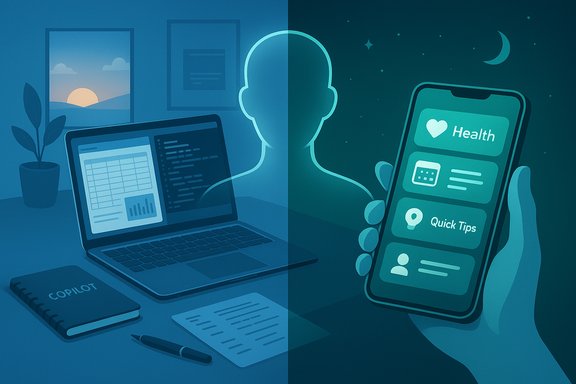
Microsoft’s new Copilot Usage Report makes a blunt, consequential claim: conversational AI has quietly become a “digital confidant,” used differently by device and hour — a productivity engine at the desk and a trusted adviser in the pocket — based on an analysis of roughly 37.5 million de‑identified Copilot conversations collected between January and September 2025.
Microsoft’s research team published a high‑level preprint and companion press material under the heading It’s About Time: The Copilot Usage Report 2025, describing time‑of‑day, device and seasonal rhythms in consumer Copilot usage. The dataset Microsoft cites covers about 37.5 million de‑identified conversations and, according to Microsoft, the analysis pipeline extracted short summaries which were labeled by automated classifiers for both topic (for example, Health and Fitness, Programming, Work and Career) and intent (for example, information‑seeking, advice‑seeking, content creation). Independent coverage from major technology outlets amplifies the same core narrative: on desktops Copilot usage concentrates on work and technical tasks during business hours, while on mobile devices health and personal‑advice queries dominate at all hours. These findings have been reported by outlets including PCWorld and GeekWire, which independently summarized Microsoft’s highlights and product context.
The direction of the trends is credible and supported by Microsoft’s report and multiple independent outlets; however, the limits of the published methodology mean the most consequential next step is verification. Independent audits of the labeling pipeline, disclosure of classifier performance metrics, and privacy assessments would convert the study from an instructive vendor brief into a reproducible piece of science that policymakers and enterprise buyers can rely on.
In sum: Copilot is behaving like two products in one. That dual identity unlocks new user value — and a new set of governance obligations that must be met before the convenience of an always‑available confidant becomes a systemic risk.
Source: Business Today New Microsoft report reveals AI is becoming a digital confidant - BusinessToday
 Background
Microsoft’s research team published a high‑level preprint and companion press material under the heading It’s About Time: The Copilot Usage Report 2025, describing time‑of‑day, device and seasonal rhythms in consumer Copilot usage. The dataset Microsoft cites covers about 37.5 million de‑identified conversations and, according to Microsoft, the analysis pipeline extracted short summaries which were labeled by automated classifiers for both topic (for example, Health and Fitness, Programming, Work and Career) and intent (for example, information‑seeking, advice‑seeking, content creation). Independent coverage from major technology outlets amplifies the same core narrative: on desktops Copilot usage concentrates on work and technical tasks during business hours, while on mobile devices health and personal‑advice queries dominate at all hours. These findings have been reported by outlets including PCWorld and GeekWire, which independently summarized Microsoft’s highlights and product context. What Microsoft found — the headline patterns
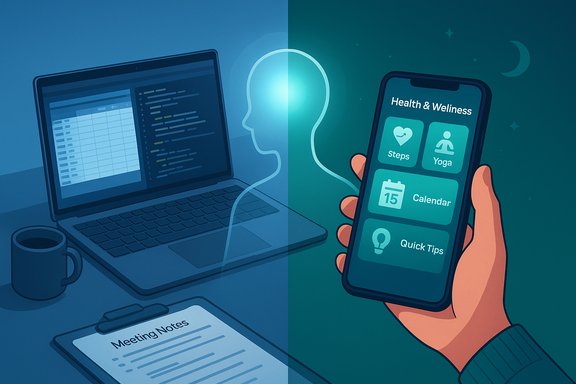
Two distinct dayparts: desktop = work, mobile = confidant
- Desktop sessions skew heavily toward productivity‑oriented tasks: drafting documents, spreadsheets, meeting prep, and programming, with a pronounced peak between roughly 8 a.m. and 5 p.m. local time.
- Mobile sessions are dominated by health and wellness topics: users repeatedly turn to phones for exercise guidance, symptom questions, routine‑planning and other wellness advice. According to Microsoft this mobile health dominance holds every hour, every month across the nine‑month sample window.
Time, week and season shape subject matter
- Weekday rhythms: programming and technical queries rise Monday–Friday; weekends see a clear shift toward gaming and leisure topics.
- Late‑night rhythms: philosophical, religious and introspective questions spike in the early hours, suggesting Copilot is a go‑to for reflection and “big questions.”
- Seasonal effects: short, predictable surges around calendar events — for example, a Valentine’s‑Day bump in relationship‑advice queries in February — demonstrate how Copilot queries sync to the social calendar.
Advice-seeking is rising
Beyond topical shifts, Microsoft reports a steady increase in advice‑seeking intent: users increasingly ask Copilot to weigh tradeoffs, suggest next steps, or assist with life decisions — from career moves to relationship dilemmas. This transition from simple search to advice changes the technical and governance requirements for the product.Methodology and what we can — and cannot — verify
Microsoft provides a useful high‑level description of methods: the company says it excluded enterprise and education accounts from the analysis, de‑identified conversations, and did not retain raw transcripts; instead the analytic pipeline generated summaries which were labeled automatically. Microsoft reports sampling on the order of roughly 144,000 conversations per day across the study window. These methodological choices deliver privacy benefits and scale, but they also leave important verification gaps:- The report does not publish full classifier performance metrics (precision, recall, confusion matrices) nor a public labeled dataset that outside researchers can audit, which limits independent reproduction of fine‑grained claims. This omission is explicitly noted in community analyses and coverage.
- De‑identification plus summarization reduces exposure to raw content, but it does not eliminate all re‑identification risk if summaries retain quasi‑identifiers (medical details, locations or event‑specific data). Microsoft’s public write‑up does not quantify residual re‑identification risk.
Why the patterns matter — product, policy and UX
Product design must be device‑aware
The data argues strongly that Copilot needs two different default experiences:- On desktop: prioritize multi‑file context, document grounding, versioning, and audit trails. Enterprise‑grade evidence and explainability are most important when Copilot assists in workplace tasks.
- On mobile: prioritize empathetic responses, brief guidance, safe‑refusal behaviors in high‑risk domains (health, mental health), and clear escalation/referral paths to qualified professionals when appropriate. Mobile UX should surface provenance and confidence signals prominently.
Governance and enterprise risk
Even though Microsoft excluded corporate and education tenants from this consumer dataset, the report shows strong evidence of work happening on personal devices. That matters for IT teams: unmanaged Copilot usage creates potential shadow IT, data exfiltration risks, and compliance headaches if employees paste sensitive information into consumer Copilot sessions. CISOs and compliance officers must assume dual usage patterns and configure access and connectors conservatively.Safety and privacy risks — a practical breakdown
The Copilot Usage Report’s central claim — people rely on AI for intimate, high‑stakes advice — raises several concrete risks that product teams and IT professionals must address.- Risk: Hallucinations in health or legal advice. A confident, but incorrect, answer about symptoms, medications, or legal steps could lead to harm. Mitigation: conservative refusal defaults for medical/legal queries, explicit provenance, and immediate prompts to consult licensed professionals.
- Risk: Privacy leakage from summaries. Even summarization can preserve identifying detail. Mitigation: independent privacy audits of the summarization pipeline, stronger k‑anonymity or differential‑privacy checks on aggregated outputs, and user‑facing warnings about what gets stored.
- Risk: Emotional overreliance. As Copilot becomes a confidant, vulnerable users (teens, socially isolated people) risk substituting machine counsel for professional help. Mitigation: age‑appropriate guardrails, limits on companion‑style interactions, and built‑in pathways to human support resources.
- Risk: Shadow IT and data sprawl. Employees using consumer Copilot on personal devices for work tasks can create compliance gaps. Mitigation: enterprise policies, per‑user connector approval, and telemetry that distinguishes corporate vs. consumer usage.
How Microsoft has already responded in product terms
Microsoft paired the usage study with deliberate product moves that map to the behaviors the data reveals. The company’s Fall Copilot release added features designed to make Copilot more persistent and social, including:- Long‑term, user‑managed memory (with controls to view and delete stored context).
- Group/shared sessions (Copilot Groups) and social modes for collaborative interactions.
- New conversational styles such as “Real Talk” intended to make reasoning explicit, and an optional animated persona called Mico for voice/expressive interactions. These interface and persona elements make the assistant feel more continuous and human‑like.
What this means for Windows users, IT admins and product teams
For Windows users and consumers
- Treat Copilot responses, especially in health and legal areas, as informational, not prescriptive. Verify with trusted sources and consult professionals for medical or legal decisions.
- Use memory and connector controls actively — review and delete stored context if you share sensitive information.
For IT admins and CISOs
- Audit what Copilot connectors and integrations are allowed in your environment.
- Implement data‑loss prevention (DLP) rules that detect and block PII/PCI being copied into consumer Copilot sessions where possible.
- Educate employees about the risks of pasting proprietary data into third‑party or unsanctioned AI services.
For product managers and UX designers
- Treat device as a primary signal: different affordances require different defaults.
- Add conservative defaults in high‑risk domains, clear provenance/footnotes for claims, and visible controls for memory and data deletion.
- Build monitoring for hallucination rates and user escalation triggers so the product can reflexively route high‑risk queries to human professionals.
Strengths of the report — why it matters
- Scale: A 37.5 million‑conversation sample gives the analysis statistical weight that small lab studies lack and surfaces repeatable daily and seasonal rhythms at population scale.
- Behavioral framing: By focusing on when and where people use AI, Microsoft reframes design questions toward situational affordances rather than one‑size‑fits‑all chat UX. That insight is actionable: product teams can change defaults and safety policies based on time and device.
- Immediate product alignment: Microsoft aligned newly shipped Copilot features (memory, persona, group sessions) with the behavioral signals, demonstrating a rapid translate‑from‑data‑to‑product cycle. That reduces the lag between observed user behavior and product support.
Weaknesses and open questions
- Lack of public auditability: Without published classifier metrics or a released labeled dataset, external researchers cannot validate the labeling accuracy or rule out sampling biases (geography, language, age skew). That limits confidence in granular claims.
- Unquantified residual privacy risk: Summarization and de‑identification are privacy‑preserving in principle, but Microsoft did not publish independent privacy audits or a quantified re‑identification risk assessment. That absence is material given the prominence of health queries in the dataset.
- The causality gap: The report documents what and when people ask, but not why — e.g., whether health queries reflect unmet access to care, simple convenience, curiosity, or a mix of motivations. Disentangling those drivers requires mixed‑methods research (qualitative interviews plus quantitative telemetry).
Practical checklist — immediate actions for technologists
- Add conservative risk thresholds for any assistant action that could materially affect health, finance, legal or contractual outcomes.
- Require human‑in‑the‑loop checks (and multi‑factor approvals) before Copilot initiates agentic actions that change documents, transfer funds, or sign contracts.
- Require provenance footnotes and confidence scores for health‑related answers; route high‑risk queries to verified resources and link to licensed professionals.
- Demand independent privacy and methodology audits for large vendor usage studies that influence public policy or product defaults.
Final analysis — an opportunity and a responsibility
Microsoft’s Copilot Usage Report 2025 is a milestone: it documents at scale that conversational AI is no longer a niche productivity overlay but a persistent presence in people’s daily lives, performing different social roles as the context changes. The evidence that phones are now a primary channel for health and personal advice — at all hours — should concentrate the minds of product teams, regulators and IT leaders. The product opportunity is enormous: better context‑aware agents can meaningfully improve everyday decision‑making and accessibility. The responsibility is equally large: these systems must ship with conservative safety defaults, clear provenance, auditable memories, and robust privacy protections.The direction of the trends is credible and supported by Microsoft’s report and multiple independent outlets; however, the limits of the published methodology mean the most consequential next step is verification. Independent audits of the labeling pipeline, disclosure of classifier performance metrics, and privacy assessments would convert the study from an instructive vendor brief into a reproducible piece of science that policymakers and enterprise buyers can rely on.
In sum: Copilot is behaving like two products in one. That dual identity unlocks new user value — and a new set of governance obligations that must be met before the convenience of an always‑available confidant becomes a systemic risk.
Source: Business Today New Microsoft report reveals AI is becoming a digital confidant - BusinessToday