AI Copilot Bracket Picks: UConn Repeats as Women’s March Madness Champion

  • Thread Author
The AI simulator’s biggest takeaway is clear: chalk still rules women’s March Madness in 2026. According to the USA Today Sports/Copilot exercise, the bracket’s remaining chaos gets tamped down quickly, with all four No. 1 seeds surviving to the Final Four and UConn ultimately crowned champion. That prediction fits the larger shape of this tournament, which was built around a dominant top tier and opened with UConn, UCLA, Texas and South Carolina as the four No. 1 seeds. (apnews.com)

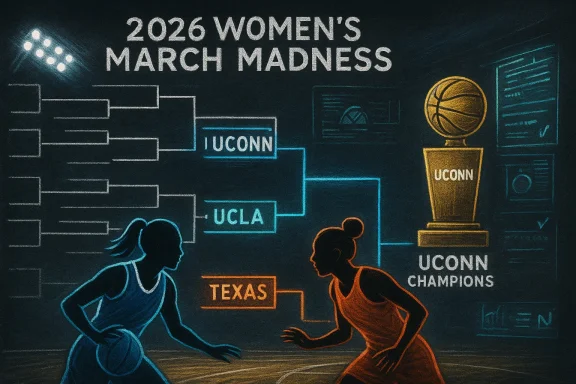
A digital visualization related to the article topic.Background​

Women’s March Madness has always had its own personality, but it has not been defined by the same level of bracket carnage that makes the men’s event famous. That’s part of what makes a simulation article like this interesting: it tests whether a powerful AI model can identify the same structural realities human analysts see, or whether it will manufacture drama where the bracket itself offers little. In 2026, the tournament entered the Sweet 16 with a rare and genuine surprise in No. 10 Virginia, the first First Four team ever to reach that stage, after a double-overtime upset of Iowa in the Round of 32.
The backdrop to all of this is a women’s field heavily dominated by elite programs. UConn entered the tournament unbeaten at 34-0 and was awarded the No. 1 overall seed, with UCLA, Texas and South Carolina rounding out the top line. Those four teams were not just the committee’s favorites; they were the teams the broader market and most bracketologists treated as the clear championship tier. (apnews.com)
That matters because AI bracket simulations are only as smart as the competitive environment they inherit. When the top seeds are this strong, and when the distribution of quality is this concentrated, the “correct” AI answer may look boring to casual fans. But boring can be rational, especially in a tournament where experience, depth, and two-way efficiency usually overpower single-game variance. (apnews.com)
The tournament structure itself reinforces that logic. The Sweet 16 and Elite Eight are split between Fort Worth and Sacramento, with the Final Four scheduled for Phoenix on April 3 and the championship game on April 5. That neutral-site progression reduces some of the volatility you would expect from true home-court chaos and gives the best teams more chances to survive on talent rather than atmosphere. (apnews.com)
At the same time, this is a fascinating moment for Microsoft Copilot specifically. USA Today Sports framed the exercise around a chatbot simulation using roster strengths and weaknesses, traditional and advanced statistics, upset trends, projections and expert analysis. In other words, the exercise was not just “guess a winner”; it was an attempt to blend structured basketball logic with AI inference, which makes the result more revealing than a random prompt-and-response experiment.

Why this bracket looked so top-heavy​

The 2026 women’s bracket entered the Sweet 16 with four programs that many analysts considered national-title worthy before the tournament even tipped off. UConn, UCLA, Texas and South Carolina were all seeded on the top line, and the AP’s bracket coverage described UConn as the reigning champion and the heavy favorite to repeat. That created a tournament in which the most likely AI output was always going to be conservative rather than adventurous. (apnews.com)
Another reason the bracket looks top-heavy is that several No. 2 and No. 3 seeds were clearly strong enough to threaten a Final Four run, but not necessarily strong enough to outmuscle the No. 1s in a neutral-site two-game stretch. That is exactly where Vanderbilt, LSU, Michigan, and TCU sat in the AI’s projected path: credible challengers, but not enough to topple the bluebloods.
  • UConn entered as the No. 1 overall seed.
  • UCLA was the No. 2 overall seed and a clear title threat.
  • Texas arrived with SEC-tournament momentum.
  • South Carolina remained the other powerhouse on the top line.
  • Virginia was the bracket’s true outlier story. (apnews.com)

What makes AI bracket picks useful​

AI bracket picks are not valuable because they are magically prophetic. They are useful because they expose what a machine thinks matters most: seed line, efficiency profile, roster balance, and the relative stability of outcomes. When a model keeps landing on the same teams humans favor, that usually tells you the public consensus is not just lazy punditry; it is often a rational reading of the sport.
They are also useful as a storytelling device. A clean projection from Sweet 16 through the title game gives readers a full tournament narrative in one glance, even if the sport itself usually refuses to cooperate. In 2026, Copilot’s forecast reads less like a bold prophecy and more like an AI endorsement of the obvious contenders.

The Sweet 16 Set the Tone​

The AI’s Sweet 16 picks were almost entirely chalk, and that’s the first signal that the simulation respected the bracket’s power structure. UConn over North Carolina, Vanderbilt over Notre Dame, UCLA over Minnesota, LSU over Duke, Texas over Kentucky, Michigan over Louisville, South Carolina over Oklahoma, and TCU over Virginia formed a bracket that largely rewarded the higher seed. That kind of output is not glamorous, but it is often what strong predictive systems produce when the tournament field is top-heavy.
The single possible eyebrow-raiser is Virginia’s run ending at TCU rather than continuing into the Elite Eight. That is still a fairly conservative call, because it acknowledges the Cavaliers as a credible Cinderella without giving them the kind of sustained momentum that would be needed to keep upsetting better teams. In bracket terms, the AI respected the story while refusing to overfeed it.

The shape of the opening round​

The interesting part of the Sweet 16 forecast is how little room it left for stylistic novelty. The model did not chase a fashionable upset candidate or lean on one hot-shooting profile to blow up the bracket. Instead, it treated the advancing teams as the ones with the deepest, most durable advantages, which is exactly how many human analysts would frame a tournament played over a three-week sprint.
That approach also suggests Copilot was reacting to the same core variables that dominate women’s tournament analysis: defensive consistency, roster top-end talent, and the ability to survive on a neutral floor. The result is a bracket that reads like a seed-based filter, but one that still allows for a little narrative texture around teams like Virginia and Notre Dame.
  • UConn was treated as the safest path through the Fort Worth side.
  • UCLA was projected to control the Sacramento side.
  • Texas was viewed as too physical for Kentucky.
  • South Carolina was expected to blunt Oklahoma’s run.
  • TCU got the nod as the more complete team than Virginia.

What this says about tournament volatility​

The Sweet 16 is usually where March narratives begin to harden, but in this simulation the bracket already started to look predictable. That is a meaningful signal because it means the AI believed the early upsets had already happened and the rest of the event would normalize. In other words, Virginia was the exception that proved the rule.
For fans hoping for chaos, that may feel disappointing. But for observers trying to understand the sport, it underlines something important: the women’s game is increasingly defined by elite program infrastructure, not by bracket roulette. When the best teams are this well-coached and this deep, the tournament tends to reward pedigree more than randomness. (apnews.com)

The Elite Eight Tightened the Squeeze​

Once the AI moved into the Elite Eight, it became even more committed to the idea that the sport’s top four powers would separate from everyone else. UConn over Vanderbilt, UCLA over LSU, Texas over Michigan, and South Carolina over TCU gave the model a Final Four made entirely of No. 1 seeds. That is a highly orderly outcome, but it is also a very plausible one in a year where the seeding hierarchy looked unusually stable.
The most revealing result here may be UCLA over LSU. LSU was one of the more dangerous No. 2 seeds in the bracket, and Kim Mulkey’s teams are notorious for turning tournament games into emotional, high-variance affairs. Still, the AI chose UCLA, which suggests it valued the Bruins’ overall balance and consistency more than LSU’s explosive upside. (apnews.com)

Why the model trusted the favorites​

The Elite Eight is where models often show their true bias. Some systems chase variance and will gladly pick a lower seed if the matchup looks stylistically favorable. This simulation did the opposite, which implies Copilot leaned on aggregate team quality rather than trying to be clever about styles or coaching edges. That is usually the safer route in women’s basketball.
It also mirrors the broader consensus coming out of Selection Sunday. Multiple major outlets framed UConn, UCLA, Texas and South Carolina as the clear championship class, and the title odds reflected that same hierarchy. When the betting market and the committee’s seed line are aligned, an AI model that follows them is not being boring; it is being disciplined. (new.cbssports.com)
  • UConn was projected to handle Vanderbilt in a matchup of elite guards and frontcourt length.
  • UCLA was favored to end LSU’s run.
  • Texas was expected to overpower Michigan’s path.
  • South Carolina was predicted to survive TCU’s toughness.

The value of a No. 1-seed Final Four​

A Final Four made entirely of No. 1 seeds would be a validation of the selection committee’s top line and a strong argument for the reliability of seeding in the women’s game. It would also produce an event where the best teams finally get to settle everything head-to-head, with no mid-major spoiler left to tilt the bracket. That kind of finish can be less chaotic, but it is often more satisfying for purists. (apnews.com)
From a media perspective, it is also ideal. UConn, UCLA, Texas, and South Carolina are not just elite teams; they are national brands, each with a strong coaching story and a distinct identity. That kind of Final Four would maximize attention, ratings, and debate, even if it sacrificed the bracket-busting theatrics some fans crave. (apnews.com)

The Final Four Chose Experience Over Surprise​

Copilot’s Final Four was straightforward: Texas over UCLA and UConn over South Carolina. That pairing creates the tournament’s clearest star-power collision, with two programs that can win in different ways and two coaches who are comfortable playing deep into April. It also produced the one result that feels most debatable in hindsight: Texas over UCLA, which is the type of pick that suggests the model gave extra weight to physicality and matchup control.
The other semifinal, UConn over South Carolina, is where the simulation most emphatically endorsed the Huskies. UConn entered the event unbeaten and was already carrying the aura of a team built for a repeat run. The AI’s choice says as much about the Huskies’ depth and backcourt stability as it does about South Carolina’s standing as a perennial power. (apnews.com)

Why Texas over UCLA is the swing pick​

Texas over UCLA is the only Final Four result in the simulation that feels designed to be a conversation starter. UCLA had the better overall seed line and entered with a long winning streak, but Texas had beaten South Carolina twice in three meetings and had the kind of robust, battle-tested profile that models often love in a one-game setting. That is likely the analytical logic behind the pick. (apnews.com)
It is also the kind of decision that exposes one of AI’s strengths and one of its weaknesses. The strength is pattern recognition: it can see that Texas has already handled elite competition. The weakness is that it may overvalue that prior success without fully accounting for how different a neutral-site semifinal can be from a conference game. That is the eternal bracket problem in machine form.
  • Texas was projected to beat UCLA in a matchup of top-tier balance.
  • UConn was projected to continue its unbeaten march.
  • South Carolina was strong enough to reach Phoenix, but not enough to survive the Huskies.
  • UCLA lost in the semis despite elite season-long numbers. (apnews.com)

The coaching factor still matters​

This is where women’s basketball differs from a lot of algorithmic sports analysis. Coaching is not just a tiebreaker; it is a core variable, because the best programs are often built around system discipline, matchup planning, and in-game adjustment. When an AI predicts Texas, UConn, or South Carolina deep into the bracket, it is also implicitly betting on coaching consistency under pressure. (apnews.com)
That helps explain why the bracket stayed so stable. The deepest teams in the sport are usually also the best-coached, which means the model is not forcing a contradiction between talent and execution. It is simply following the sport’s power hierarchy to its logical conclusion. (apnews.com)

UConn’s Championship Path Reflects the Market’s Faith​

The title game prediction is the simplest part of the whole exercise: UConn beats Texas and wins the national championship. That aligns with the broader market view, where UConn was the heavy favorite and carried the shortest title odds by a wide margin. It also matches the emotional reality of the 2026 tournament, where any bracket that doesn’t feature the Huskies in the last game would feel like a bigger surprise than their inclusion. (new.cbssports.com)
A UConn title would mean more than another trophy. It would confirm that the Huskies have fully re-established themselves as the standard in women’s college basketball and that the post-Paige Bueckers era is no step down at all. With Sarah Strong and Azzi Fudd leading the way, the program has the type of roster balance that translates well to tournament basketball. (apnews.com)

Why the AI liked the Huskies​

Copilot’s choice of UConn suggests it treated the Huskies as the most complete team in the field rather than merely the most famous. That matters because fame alone does not win six tournament games; the actual edge comes from offense-defense balance, shot creation, and defensive reliability. In a single-elimination setting, those traits are the real currency.
The model also seems to have valued UConn’s consistency across the bracket more than Texas’ path-specific strengths. That is a reasonable call. When the question is who survives three weeks of pressure, the team with the fewest obvious weaknesses often deserves the benefit of the doubt. (apnews.com)
  • UConn is the model’s champion.
  • Texas is the runner-up.
  • UCLA and South Carolina are the semifinal losers.
  • The Huskies’ unbeaten record is treated as a feature, not a coincidence.
  • The title pick reflects stability more than surprise. (apnews.com)

The title-game implications​

A UConn-Texas final would be a showcase for two of the sport’s most comprehensive programs. It would also represent the best possible answer to the “AI vs. chaos” question, because both teams have enough size, skill, and coaching structure to justify their presence on the final stage. That is a far cry from a bracket built on randomness. (apnews.com)
For the sport, such a final would likely be beneficial. It would put elite women’s basketball front and center, with a blueblood narrative that casual fans can follow immediately. The downside, of course, is that it leaves less room for a Cinderella to capture the broader public imagination. (apnews.com)

What This Means for AI Bracketology​

This simulation is interesting not because it produced a wild result, but because it did not. Copilot’s bracket tracked the seed structure almost perfectly, and that is a meaningful data point in itself. It suggests that when the field is strong at the top and balanced in the middle, AI may be best used as a probabilistic mirror rather than a source of shock value.
That also speaks to the current state of sports AI more broadly. In March 2025, several outlets argued that chatbots were still struggling to fill out March Madness brackets reliably, especially when asked to reason through women’s tournament complexity. The 2026 Copilot result looks more coherent, but it still behaves like a model trained to optimize plausibility rather than to chase upside.

AI is strongest when the bracket is orderly​

When the tournament is chalky, AI can appear brilliant because its answers line up with the most likely outcomes. But that can be misleading. The real test comes when the field has true parity, when an eight-nine game is a coin flip, and when a hot mid-major can flatten a seeded favorite with matchup advantages the model may not fully capture.
Still, there is value here. A well-run AI simulation can consolidate a lot of disparate basketball knowledge into one clean narrative, which is useful for fans who want a bracket guide without reading 10 separate previews. That’s especially true in a women’s tournament where the best teams often deserve deeper statistical context than a quick headline can provide.
  • Plausibility beats spectacle in top-heavy tournaments.
  • Seed structure remains a powerful predictor.
  • Model outputs can validate human consensus.
  • Upset-prone games remain the hardest to forecast.
  • Women’s bracketology benefits from AI when used carefully.

Why this matters to fans and media​

For fans, AI brackets are part entertainment and part benchmarking exercise. They let you compare your own gut instincts against a machine that has no emotional attachment to any school, conference, or storyline. When the machine is conservative, it can make a human upset pick feel more daring than reckless.
For media organizations, these simulations are also a way to package expertise in a format built for clicks and conversation. The key is transparency: readers should understand that AI is making informed guesses, not projecting certainty. In a tournament as volatile as March Madness, that distinction matters.

Strengths and Opportunities​

The biggest strength of the Copilot simulation is that it mirrors how a seasoned bracket analyst would approach a field dominated by four elite teams. It doesn’t overreact to one Cinderella or try to force drama where the talent gap is obvious. That restraint makes the bracket feel credible, even when it is not especially surprising. (apnews.com)
It also gives fans a practical lens for understanding what tends to win in women’s March Madness: depth, coaching, and top-end star power. Those elements show up repeatedly in the AI’s choices and help explain why it sees UConn, Texas, UCLA and South Carolina as the sport’s true elite. That is a useful teaching tool, not just a prediction engine. (apnews.com)
  • Clear, structured predictions from Sweet 16 to title game.
  • Strong alignment with seeds and odds.
  • Useful as a benchmarking tool for human bracket picks.
  • Highlights elite-team dominance in the women’s game.
  • Creates easy-to-follow storylines for casual readers.
  • Encourages data-driven tournament discussion. (new.cbssports.com)

Risks and Concerns​

The main risk with any AI bracket story is overconfidence. Readers can easily mistake a simulation for a forecast with real predictive authority, when in fact it is only as good as the assumptions fed into it. Even the best model is still vulnerable to bad inputs, stale data, and the sport’s own beautiful randomness.
There is also the problem of false precision. A model that picks every winner can give the impression that the outcome is knowable in a way basketball rarely is. That is especially true in tournament settings where foul trouble, cold shooting, and officiating swings can flip a game in minutes.
  • AI can underweight randomness in one-game elimination.
  • Stale or incomplete data can distort predictions.
  • False certainty may mislead casual readers.
  • Upset potential is harder to quantify than seed strength.
  • Matchup nuance can be flattened into generic logic.
  • Narrative bias can creep into “expert-style” prompts.

Looking Ahead​

The next few days will determine whether the real tournament validates the AI’s conservative logic or exposes its limitations. If the top four seeds keep winning, this simulation will look impressively disciplined. If one or two of those powers fall early, the bracket will quickly remind everyone why March Madness remains one of sports’ least machine-friendly events. (apnews.com)
The stakes are also bigger than one bracket game. A UConn repeat would further cement the program’s status as the standard bearer of the women’s game, while a Texas, UCLA, or South Carolina title would reshape the balance of power and keep the sport’s elite tier from becoming too predictable. Either way, the Final Four in Phoenix should tell us whether 2026 was a year of hierarchy or upheaval. (apnews.com)
  • Watch whether all four No. 1 seeds hold through the regional finals.
  • Track whether Virginia’s run becomes the tournament’s defining surprise.
  • Monitor UConn’s path as the bracket favorite and unbeaten champion-in-waiting.
  • See if LSU or Vanderbilt can disrupt the expected order.
  • Measure whether AI’s chalk-heavy view matches reality.
The most important lesson from this AI simulation is that it understands the tournament as a function of hierarchy, not hype. That makes it less dramatic than a human bracket full of wild guesses, but often more faithful to how women’s March Madness actually behaves. If the coming rounds unfold the way Copilot expects, the machine will have done something subtle and useful: it will have captured the sport’s competitive truth before the final buzzer.

Source: USA Today Predicting every women's March Madness game using AI simulator
 

The 2026 women’s NCAA tournament has reached the Sweet 16 with an unusual mix of storylines: a true bracket shocker in Virginia, four familiar bluebloods still hanging around the top line, and a growing appetite for whether artificial intelligence can actually see a title run before the human bracketologists do. Microsoft Copilot’s simulated forecast for USA TODAY Sports landed on the safe side of the chaos ledger, projecting a nearly all-chalk march to Phoenix and a national championship for UConn. That prediction is not just a bracket pick; it is a useful snapshot of how AI now interprets modern women’s college basketball, where elite depth, efficiency metrics, and seed strength tend to overwhelm romance in the late rounds.

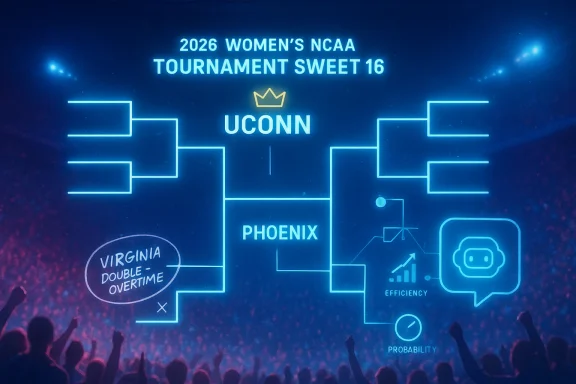
NCAA Women’s Sweet 16 bracket graphic showing UConn vs Phoenix in a neon stadium scene.Overview​

The 2026 women’s tournament arrives at a time when the sport’s top tier is unusually concentrated. The NCAA’s top-16 reveals in early March placed UConn, UCLA, South Carolina, and Texas at the top, setting up the possibility that all four would remain alive deep into the bracket if they simply played to seed. That structure matters because it shapes both human and machine expectations: when the committee’s own early rankings are that stable, a simulator built on seeding, advanced stats, and historical upset rates will naturally tilt toward conservatism.
The official schedule also matters. The Sweet 16 runs March 27-28, the Elite Eight follows March 29-30, and the Final Four is set for Friday, April 3, with the championship game on Sunday, April 5 in Phoenix. That compressed finish gives the favorites fewer chances to be exposed, and it helps explain why AI models often see the women’s bracket as less chaotic than the men’s field. Fewer games, stronger top seeds, and a smaller pool of genuine double-digit threats all push toward chalk.
At the same time, the tournament has already reminded everyone that the women’s bracket can still surprise. Virginia’s run from the First Four to the Sweet 16 via a double-overtime win over Iowa broke the expected script and gave fans a rare Cinderella worth tracking. But the Copilot simulation effectively says that one upset does not necessarily become a wave; in its view, the bracket’s gravitational pull quickly reasserts itself once the field narrows and the elite programs face one another.
Microsoft Copilot itself is now positioned as an everyday AI assistant that can browse, reason, and help with research across devices, with Microsoft describing it as a tool for chat-based assistance and deeper reasoning on complex prompts. That broader capability is exactly why sports outlets are increasingly using it for bracket exercises: the chatbot is not merely guessing, it is attempting to synthesize team strength, form, and historical performance into a forecast. The real question is whether that synthesis is genuinely predictive, or simply very good at formalizing consensus.

What the AI Pick Actually Says​

Copilot’s bracket simulation is striking less for its creativity than for its restraint. It picks all four No. 1 seeds to make the Final Four, then selects UConn over Texas for the national title. That is a model outcome built on the assumption that the highest-seeded teams are still the best teams, and that the 2026 women’s tournament is being driven by depth and efficiency rather than volatility.
The model’s Sweet 16 decisions reinforce that philosophy. It favors UConn, UCLA, Texas, and South Carolina to move on from their regions, and only introduces a modest dose of variation with a few No. 2 seeds advancing into the Elite Eight. Even there, the simulator does not flirt with long-shot chaos; it treats the lower-seeded survivors as respectable contenders, not bracket wreckers.

Why the Sim Is So Conservative​

A conservative simulation often reflects the inputs more than the intelligence of the system itself. If the model is fed current records, ranking strength, and matchup efficiency, then it is effectively capturing the same reality that committee members and serious analysts already recognize: the women’s bracket is front-loaded with elite teams. In that setting, AI does not need to be dramatic to be useful. It needs to be consistent.
That consistency can also be a weakness. Bracket simulations that lean heavily on seeding and statistical priors may underweight the very factors that create memorable March outcomes, such as shooting variance, foul trouble, bench scoring, and matchup-specific disruption. In other words, the model can be right about the broad shape of the bracket while still missing the one game that changes everything. That is the curse of probabilistic prediction.
  • UConn is the AI champion pick.
  • Texas reaches the title game in the model.
  • UCLA and South Carolina round out the Final Four.
  • The simulator sees only limited late-round volatility.
  • The projected finish is a classic chalk bracket.

The Championship Landscape in 2026​

The 2026 women’s field was not seeded by accident. When the NCAA first revealed its top 16, the four No. 1 seeds were already clustered at the top, and the committee’s regional assignments framed the tournament around those teams as the sport’s clearest benchmarks. That is important because AI systems usually favor stable hierarchies, and the women’s bracket has offered one this season.
UConn’s placement as the No. 1 overall seed is especially significant. A perfect or near-perfect regular season, combined with tournament-tested pedigree, creates the kind of profile predictive systems love. The model does not need to assume UConn is unbeatable; it only needs to believe the Huskies are more likely than anyone else to keep winning under pressure.

Why Seeding Matters More Here​

Seeding is not destiny, but it is a strong signal. In women’s college basketball, top programs historically translate regular-season dominance into deep tournament runs more reliably than in many other sports. That does not eliminate the possibility of an upset, but it means the lower-probability outcomes need more than one lucky bounce to become sustained chaos.
The 2026 bracket also reflects a familiar concentration of elite talent at a handful of programs. When the best teams are already separated from the middle tier by several qualitative layers, AI models have fewer reasons to forecast major disruption. That’s a meaningful distinction from a sport where parity is broader and the margin between a No. 2 seed and a No. 10 seed may be much thinner. The women’s bracket is not immune to upsets; it is just less structurally eager to produce them.
  • UConn enters with the strongest résumé.
  • Texas and UCLA represent major title threats.
  • South Carolina remains a natural Final Four candidate.
  • The committee’s early seeding aligned with the AI forecast.
  • Predictive tools tend to prefer stable power structures.

Virginia’s Surprise Run​

Virginia’s presence in the Sweet 16 is the bracket’s most eye-catching anomaly. A No. 10 seed coming out of the First Four and then beating Iowa in double overtime is exactly the sort of outcome that fuels the idea that March is unpredictable. It also serves as a reminder that even the most carefully built model has to leave room for the kind of late-game volatility that no algorithm can fully tame.
But the simulator’s skepticism is not unreasonable. Cinderella stories often depend on a narrow chain of favorable events, and once a team has burned through emotional fuel and late-game luck just to reach the second weekend, the statistical odds usually catch up. AI models are often good at identifying when an upset has already happened and when it is more likely to end than continue.

Can One Upset Become a Trend?​

This is where bracket forecasting gets interesting. Human fans tend to extrapolate from the story in front of them, assuming a stunning win means something bigger is brewing. AI, by contrast, is more likely to ask whether the underlying performance profile justifies that optimism, and Virginia’s model treatment suggests the answer was no.
That distinction matters for the broader tournament conversation. The women’s event can absolutely produce memorable underdog moments, but a single breakthrough does not rewrite the whole bracket landscape. It is one thing to eliminate a favorite; it is another to keep defeating elite, rested, deeply seeded opponents over successive rounds. That’s where most fairy tales run out of plot.
  • Virginia is the bracket’s biggest shock story.
  • The win over Iowa proves the field is not fully chalk.
  • AI still sees the run as a short-lived exception.
  • Double-overtime wins can distort perception of momentum.
  • One upset does not necessarily predict another.

UConn as the AI’s Final Answer​

If there is a single takeaway from the Copilot bracket, it is that UConn remains the model’s favorite to win everything. That choice reflects more than seed line; it reflects a broader belief that the Huskies possess the right mix of balance, tournament experience, and postseason reliability to survive the April pressure cooker in Phoenix.
The appeal of UConn in a simulator is obvious. Strong programs with elite depth tend to rate well across different statistical systems, especially when they defend, rebound, and minimize empty possessions. In bracket modeling, those traits reduce variance, and reduced variance is often the difference between a favorite surviving or getting clipped by a hot-shooting underdog.

Why AI Trusts the Huskies​

A title prediction is rarely about one stat. It is usually the accumulation of many small edges: efficient scoring, rotation stability, veteran poise, and the ability to avoid bad stretches that turn manageable games into coin flips. UConn’s profile, at least as the field stood entering the Sweet 16, checks the boxes a model wants to see.
There is also a historical component. Programs with long postseason pedigrees are often treated as safer bets because they have repeatedly demonstrated an ability to win on the biggest stage. AI does not "remember" the way humans do, but its training patterns absorb those repeated outcomes, and that can make a program like UConn look even more dependable than its raw seed might imply. Experience becomes a statistical asset.
  • UConn is the AI champion pick.
  • The Huskies’ profile fits model-friendly traits.
  • Elite depth tends to translate well in tournament simulations.
  • Championship experience lowers predicted volatility.
  • UConn’s status as top overall seed strengthens the forecast.

Texas, UCLA, and South Carolina in the Model​

The rest of the AI bracket is built around three other No. 1 seeds: Texas, UCLA, and South Carolina. In the simulation, all three handle their Sweet 16 tests and continue to the Final Four, which is exactly what a strong seeding structure would imply in a field without a wide-open middle.
Texas gets the most interesting path in the forecast because it is the team that survives the model’s strongest title-round resistance before falling to UConn. UCLA and South Carolina are also projected to play like elite programs, but the simulator appears to treat Texas as the most direct comparison to the eventual champion. That is a subtle but important distinction: the model likes Texas enough to get to the end, but not enough to beat the most complete team.

The Final Four as a Power-Structure Check​

When all four No. 1 seeds survive to the Final Four, the bracket stops being a story about luck and becomes a referendum on hierarchy. That outcome suggests the season’s best teams really were separated from the rest, at least in the model’s view. It also suggests that the committee’s early assessment of the field was directionally correct.
For fans, that may sound boring. For analysts, it is confirmation that the women’s game remains highly top-heavy at the very top. And for AI, it is validation: if the best teams are actually the best teams, the safest forecast is the one that keeps them alive. Sometimes the least glamorous answer is the most informative one.
  • Texas is the model’s runner-up.
  • UCLA is projected to reach Phoenix.
  • South Carolina stays on the Final Four path.
  • The forecast reinforces top-seed durability.
  • The semifinal round becomes a battle of heavyweights.

What the Forecast Tells Us About AI in Sports​

Copilot’s bracket is less a novelty than a case study. Sports AI is moving from gimmick territory into mainstream editorial use, and bracket prediction is one of the cleanest ways to show what these tools do well and where they still struggle. Microsoft describes Copilot as a broadly capable assistant that can help with reasoning and synthesis, but a bracket is also a reminder that synthesis is not the same as certainty.
The strongest AI forecasts are often the least flashy ones because they are anchored in probability, not narrative. That makes them useful for readers who want a structured view of the tournament, but less satisfying for those hoping the machine will discover a hidden title run before everyone else does. In this case, the model appears to have concluded that the tournament’s most likely outcome is also its most conventional one.

Strength of Model, Strength of Inputs​

A prediction system can only be as creative as its inputs allow. If the top seeds are dominating, the bracket is relatively balanced, and advanced metrics favor the favorites, then even a sophisticated chatbot will usually land on outcomes that look sensible rather than sensational. That is not a failure; it is a sign the model is operating within the bounds of the evidence.
Still, there is an editorial tradeoff here. AI-generated bracket content can be fast, scalable, and statistically grounded, but it can also flatten the human drama that makes March Madness irresistible. The challenge for publishers is to use AI as an analytical tool without letting it erase the unpredictability that gives the tournament its cultural energy. A clean forecast is not the same thing as a great story.
  • AI favors probability over drama.
  • Strong inputs produce conservative outputs.
  • Bracket forecasting is a good stress test for models.
  • Sports storytelling still needs human interpretation.
  • Predictive tools work best when treated as analysis, not prophecy.

The Women’s Game and the Chalk Debate​

The women’s tournament has long been discussed differently from the men’s because its brackets often reward the strongest teams in more predictable ways. That does not mean upsets do not matter; it means the game’s elite programs have historically been more successful at converting regular-season dominance into postseason longevity. The Copilot forecast is a clear expression of that reality.
This is also why the AI result feels both unsurprising and revealing. It suggests that, at least in 2026, the women’s bracket remains highly sensitive to the quality gap at the top. The remaining teams may all be good, but the model is saying that only a small handful are truly championship-grade.

Why Fans Still Want Chaos​

Fans do not love brackets because they are accurate; they love them because they can be wrong in interesting ways. The upset is the emotional currency of March, and a perfectly rational forecast can feel almost rebellious in a tournament built on hope. That tension is part of the attraction of AI predictions: they can illuminate the most likely path while also showing how much human excitement depends on the unlikely one.
In that sense, Virginia’s run is valuable not because it disproves the model, but because it keeps the tournament from becoming entirely deterministic. Every bracket needs at least one team that refuses the script. Without that, the whole exercise becomes a spreadsheet with cheerleaders. And no one tunes in for that.
  • The women’s bracket often rewards strong programs.
  • AI’s chalk-heavy forecast fits that historical pattern.
  • Fans still crave bracket chaos and emotional stakes.
  • Virginia provides the tournament’s counterweight.
  • Predictability and surprise can coexist in the same event.

The Competitive Implications for Rivals​

If Copilot’s bracket proves even partially accurate, the message to everyone outside the top line is blunt: the gap to the true title tier is still significant. That matters for rival programs because it reinforces the importance of roster depth, defensive versatility, and late-season consistency rather than just a hot run in conference play.
For coaches and athletic departments, the implication is equally clear. It is not enough to be good enough to make the tournament; the path to Phoenix increasingly requires the kind of multi-layered roster construction that can survive a four-game run against elite competition. AI models that repeatedly select the top seeds are, in effect, telling the rest of the field what it still has to catch up to.

The Gap Between Good and Great​

In any tournament, there are contenders and there are true threats. The Copilot bracket leans heavily toward the latter, which implies that the middle class of the bracket may be thinner than it appears on paper. That is bad news for teams hoping that matchup luck will substitute for complete roster quality.
It also increases pressure on the top seeds. Once you are the AI favorite, every game becomes a referendum on whether your program looks as strong as your reputation. That can elevate the visibility of the sport, but it also makes the expectation burden heavier for teams like UConn, UCLA, South Carolina, and Texas. The better the profile, the less room there is to surprise people.
  • Rival programs must close the talent gap.
  • Depth matters more than one-off scoring bursts.
  • The middle tier has less margin for error.
  • Top seeds carry both advantage and expectation.
  • Title contenders must prove they can win multiple styles of game.

Strengths and Opportunities​

The biggest strength of this AI forecast is that it provides a disciplined, data-driven baseline in a tournament that often gets overwhelmed by emotion. It also offers a clean way to compare models, human experts, and actual results once the bracket finishes in Phoenix. Perhaps most importantly, it highlights how much the women’s game has clustered around a small set of genuine title contenders.
  • Clear structure: The bracket is easy to follow because the logic is straightforward.
  • Strong alignment with seeds: The model mirrors the committee’s top-tier evaluation.
  • Useful for comparison: Readers can measure forecast accuracy against real outcomes.
  • Highlights elite teams: It focuses attention on the programs most likely to matter.
  • Reduces noise: The simulation filters out overly speculative upset talk.
  • Shows model transparency: The picks make the assumptions obvious.
  • Good for preseason-to-postseason analysis: It helps connect regular-season metrics to tournament outcomes.

Risks and Concerns​

The main concern is overconfidence. A simulator can appear authoritative while still missing the one matchup, injury, or shooting explosion that changes the bracket’s trajectory. There is also a danger that all-chalk AI predictions can unintentionally flatten the excitement of the tournament by treating surprise as an error instead of part of the sport’s identity.
  • Overreliance on seeds: Strong seeding can hide matchup-specific weaknesses.
  • Undervaluing volatility: Basketball is still a high-variance sport in short bursts.
  • Narrative blindness: Models can miss momentum that matters psychologically.
  • Public misreading: Readers may confuse probabilities with certainty.
  • Injury sensitivity: Late-round health changes can break any forecast.
  • Upset underestimation: Double-digit seeds can still win when shot profiles align.
  • Expectation inflation: Top seeds may be judged harshly if they fall short of model projections.

Looking Ahead​

The next few days will tell us whether the Copilot forecast was a brilliant read of the field or simply a polished reflection of conventional wisdom. If the four No. 1 seeds continue to advance, the model will look prescient and the bracket will appear to have been remarkably stable. If one of the top teams falls early, the simulation will still have done something valuable: it will have shown exactly how narrow the path to a chalk finish really was.
The larger lesson may be about the role of AI in sports media. These tools are getting better at organizing evidence, estimating outcomes, and explaining why the favorites remain favorites. What they still cannot do is fully anticipate the human part of tournament basketball: nerves, bursts of confidence, tactical surprises, and the emotional chaos that turns a good bracket into a great story.
  • Sweet 16 outcomes will test whether the chalk holds.
  • UConn’s path will be watched as the model’s central thesis.
  • Virginia’s run remains the clearest upset storyline.
  • AI accuracy can be judged against actual Final Four results.
  • Future bracket models will likely blend more stats with more context.
The most interesting thing about Copilot’s bracket is not that it picked UConn; it is that it picked UConn in a way that feels defensible rather than dramatic. That is where AI sports forecasting is headed: less prediction theater, more probability discipline. Whether that makes March Madness smarter or simply more sober will depend on how often the bracket remembers to embarrass the machines.

Source: AOL.com Predicting every women's March Madness game using AI simulator
 

Microsoft’s Copilot may be the closest thing women’s March Madness has to a machine-bracket oracle, but the 2026 Final Four is still built on the oldest rule in tournament basketball: elite teams, tiny margins, and one bad shooting night can wreck any forecast. In the latest simulation highlighted by USA TODAY, the AI chatbot keeps leaning toward UConn as the most likely national champion, with Texas, UCLA, and South Carolina trailing in various combinations of upset paths. That prediction aligns with the NCAA’s own picture of an all-No. 1-seed Final Four in Phoenix, but it also underlines a larger truth about March: even the smartest model is still reading probabilities, not destiny.

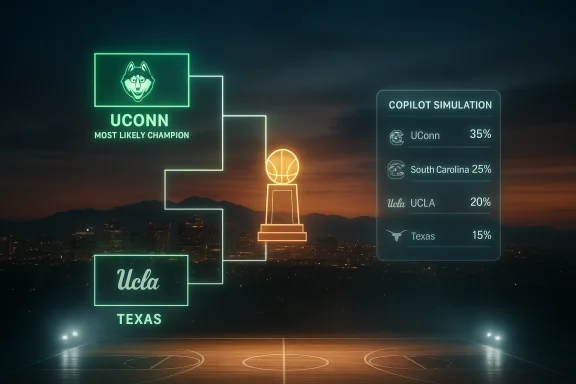
Neon bracket over a city skyline showing UConn as likely champion and a Copilot simulation odds panel.Background​

The 2026 women’s NCAA tournament entered its final weekend with something that immediately sharpened the stakes: every team left standing was a No. 1 seed. That is rare in itself, and the NCAA noted that the Final Four in Phoenix marks only the fifth time in Division I women’s basketball history that all four regional champions were top seeds. The semifinal pairings are UConn vs. South Carolina and UCLA vs. Texas, with the winners meeting for the title on Sunday, April 5.
That context matters because it changes the meaning of an AI bracket prediction. When the field is this compressed, the model is no longer trying to sort through a long tail of Cinderella possibilities. Instead, it is comparing four programs that have already survived the bracket’s most hostile terrain, which makes every underlying assumption about pace, shooting, rebounding, and experience more influential.
USA TODAY’s Copilot experiment is also part of a growing media habit: asking general-purpose AI to simulate a sports event the way a human analyst might handicap it. Microsoft itself has promoted Copilot as a sports and information assistant, and it has also positioned the tool as capable of analyzing real-time sports data in plain language. That does not make the tool clairvoyant; it just means it is better suited than a generic chatbot to turn inputs into probability-weighted output.
What makes this particular prediction interesting is that Copilot did not dramatically revise its stance when the Final Four field became official. The AI reportedly kept UConn on top, even as it acknowledged different “upset champion” paths for Texas and UCLA and treated South Carolina as the longest shot among the four. That continuity is as important as the pick itself, because it suggests the model sees the tournament less as a sequence of coin flips and more as a hierarchy of roster strength, efficiency, and likely matchup edges.
At the same time, this is the kind of forecast that can seduce readers into overconfidence. The language of simulations and current odds has a veneer of precision, but the NCAA tournament has always punished anyone who confuses precision with certainty. The real value of these AI bracket stories is not that they predict the future perfectly; it is that they reveal which teams the model thinks are most insulated from randomness.

Why UConn Keeps Showing Up as the Favorite​

UConn’s status as the AI favorite is not a surprise if you track how the conversation around this tournament has evolved. The NCAA’s March 20 analysis described UConn as the dominant champion pick in the field, and the Huskies had already separated themselves in projection models before the Final Four bracket was complete. In practical terms, that means the simulated path is doing what human analysts do: rewarding a team that combines peak talent, tournament pedigree, and a roster that can win in multiple styles.
For Copilot, the appeal is easy to understand. UConn has the kind of roster profile that tends to survive Monte Carlo-style modeling because it reduces variance. A team that can score efficiently, defend at a high level, and generate enough shot quality to withstand a cold quarter will often be favored in simulated brackets even when the opponent has similar seed strength. That helps explain why the AI keeps giving the Huskies a clear majority of championship paths.

The logic of model-friendly teams​

AI simulations usually reward programs that are stable in the metrics that matter most in one-off games. That means avoiding turnovers, creating efficient half-court offense, and limiting opponent runs that can swing a single elimination contest. UConn’s repeated appearance at the top of predictive conversations suggests the Huskies are doing more than just winning; they are winning in ways that look durable to a model.
There is also a psychological element. UConn is one of the most recognizable brands in women’s basketball, and its tournament history gives any model plenty of signal to digest. That history cannot guarantee future success, but it does affect how people interpret simulated outcomes, because fans and analysts naturally trust repeat contenders more than teams with thinner postseason résumés.
  • UConn’s projection strength reflects both current form and tournament pedigree.
  • The model seems to value low-variance performance.
  • Brand-name programs can appear more “predictable” because they offer more historical data.
  • In a short tournament, stability matters as much as upside.
The caveat, of course, is that models can overvalue reputation when the evidence is close. That is why Copilot’s confidence should be read as a probabilistic judgment, not a verdict. A team can be the favorite in most simulated runs and still lose the game that counts most.

South Carolina vs. UConn: The Semifinal That May Decide the Title​

The first semifinal is the heavyweight matchup of the weekend, and that is probably why the AI’s read on it matters so much. USA TODAY’s report says Copilot gave UConn roughly two-thirds of the simulated wins against South Carolina and even produced a sample result of 78-68. That is not a blowout in the emotional sense, but it is a meaningful edge in a game between teams this good.
South Carolina’s case is still substantial. The Gamecocks are not just a top seed; they are a program with modern championship expectations, elite coaching, and the sort of roster depth that can erase a bad first half. The NCAA’s tournament coverage has repeatedly highlighted South Carolina’s ability to finish games strongly, and that late-game resilience is one of the most dangerous traits in any Final Four setting.

Matchup pressure and late-game execution​

This is where simulations and basketball reality begin to overlap. A model can identify the favorite, but the actual game often comes down to whether one side can survive five to eight minutes of pressure without losing structure. South Carolina’s depth and UConn’s balance make this a matchup where one hot scorer or one foul problem could completely alter the feel of the contest.
A key advantage of AI predictions is that they force attention on game state, not just star power. If the Huskies are favored, it likely means the model thinks they are better equipped to handle the high-leverage possessions late in the fourth quarter. If the Gamecocks win, it will probably be because they imposed enough physical control and bench production to grind the game into their preferred tempo.
  • UConn’s edge appears to come from overall balance.
  • South Carolina’s path likely depends on depth and physicality.
  • The game could turn on foul trouble or late scoring droughts.
  • A small statistical edge can still look enormous in a semifinal.
The broader lesson is that the AI is not claiming certainty. It is saying UConn is the likeliest team to handle a brutal semifinal, and in a bracket with only four teams left, that distinction is everything. In a tournament this deep, the favorite is still vulnerable; it just starts with the best odds.

Texas vs. UCLA: A Coin Flip With Consequences​

If UConn-South Carolina is the tactical collision, Texas-UCLA is the game where the model reportedly sees near parity. USA TODAY’s writeup says Texas advances slightly more often, but only by a narrow margin, and it characterizes the semifinal as “close to a coin flip.” That is exactly the sort of matchup where a single run, a bench burst, or a cold shooting stretch can decide everything.
For a predictive model, a coin-flip semifinal is not a failure of analysis. It is actually a useful outcome, because it reflects the reality that two elite teams can be nearly indistinguishable on paper. The difference between Texas and UCLA may come down to matchup-specific details that are difficult to encode cleanly, especially in a tournament where both teams have already shown they can survive pressure.

Why narrow margins matter​

Texas getting a slight edge suggests the AI sees the Longhorns as marginally more complete or more resilient in the tournament environment. But “slight” is the operative word here. When a model is nearly even, it is effectively saying the game is too close to treat as a true hierarchy, which also means either team winning would be fully consistent with the data.
UCLA’s inclusion as a serious championship contender is equally important. The Bruins’ place among the four top seeds reflects the strength of their season, and in a one-game semifinal, that gives them every chance to upset the path to the title game. AI might favor Texas a bit more, but the margin is too thin to carry much emotional certainty.
  • Texas appears to have a small but real predictive edge.
  • UCLA is not a long shot; it is an equal-status contender.
  • This is the kind of game where shot variance matters enormously.
  • The winner may be the team that handles pressure possessions best.
That is why the semifinal is also a referendum on how much faith readers should place in bracket simulations. A coin-flip result is both honest and unsatisfying, which is precisely what good predictive journalism should sometimes be. The point is not to flatten uncertainty; it is to show where uncertainty is highest.

The Championship Path and Why Texas Still Has a Route​

The more dramatic part of USA TODAY’s report is not the semifinal picks but the championship bracket inside the prediction. In the most likely scenario, Copilot keeps UConn over Texas, with a sample result of 80-70. That gives the Huskies the clearest title path, but it also shows the model is not dismissing Texas as a non-factor.
A simulated UConn-Texas title game is a strong sign that the model views Texas as the team most likely to emerge from the more balanced side of the bracket. In other words, Texas is not just being projected to survive UCLA because it is lucky; it is being treated as a real championship-caliber side that can stress UConn before ultimately falling short in the most probable outcome.

The difference between “likely” and “possible”​

This distinction matters in sports analytics. A team can be less likely to win the title and still be fully capable of doing so if the bracket breaks right or the right players peak at the right time. That is why Copilot’s confidence should be interpreted as probability, not inevitability, especially in a short tournament where a single hot hand can flip the entire logic of the model.
Texas also benefits from the fact that the AI seems to treat South Carolina as the toughest path to the final. If the Longhorns escape UCLA, they may find themselves in a matchup that the model likes them to win more often than not. That is the kind of structure that makes bracket narratives compelling: one side can be slightly favored, but the road still demands enough precision that nothing should be assumed.
  • Texas has a plausible title path even if it is not the strongest favorite.
  • The model seems to like Texas more than UCLA in a direct semifinal.
  • UConn remains the safest simulated champion choice.
  • The title game projection highlights how bracket structure shapes outcomes.
What stands out here is that AI does not flatten the tournament into one favorite and three also-rans. Instead, it creates a hierarchy of paths: UConn as the anchor, Texas as the leading alternative, UCLA as the upset-capable challenger, and South Carolina as the program with the hardest simulated route but still plenty of talent. That layered reading is one reason these projections are more useful than simple winner-pick graphics.

How Much Trust Should Anyone Put in a Copilot Bracket?​

The answer is: enough to make it interesting, not enough to make it authoritative. Microsoft has promoted Copilot as a tool that can summarize sports, pull in live information, and help users reason through data-heavy tasks. But a tournament bracket is not just data-heavy; it is also sensitive to momentum, injuries, officiating, and the emotional volatility that comes with single-elimination basketball.
That means the strongest use of AI in this context is not prediction as prophecy. It is prediction as framing. The model can tell readers which teams have the most robust statistical shape, while humans still have to account for the parts of sports that resist clean quantification. That is the real divide between analysis and entertainment.

Model output vs. basketball reality​

The tension here is simple. AI can approximate probabilities using available inputs, but the Final Four compresses everything into two games and a championship. When the sample size is that small, even a good model becomes fragile, because variance has very few opportunities to smooth itself out.
That fragility is why readers should be skeptical of any language that sounds too definitive. If Copilot says UConn wins in a clear majority of runs, that is useful information. If someone turns that into “UConn will win,” they have already gone one step too far.
  • Treat the model as a probability engine, not a prophecy machine.
  • Read simulated margins as signals, not certainties.
  • Use AI to spot patterns and likely edges.
  • Leave room for human unpredictability.
  • Remember that the Final Four is still just two games from a title.
This is also where media literacy matters. A sports chatbot can sound impressively confident, and because it produces tidy outputs, readers may overestimate its certainty. The best response is to enjoy the bracket forecast as an informed guess, then let the games decide whether the model had the right read.

What the Prediction Means for Fans and the Women’s Game​

For fans, the Copilot forecast adds another layer of conversation to a Final Four that already feels unusually concentrated at the top. When all four No. 1 seeds survive to Phoenix, the bracket becomes less about shock and more about excellence, and AI predictions fit that environment well because they reward the teams that have already done the hardest work.
For the women’s game, it is another sign of mainstream analytic attention. A few years ago, AI bracket simulations would have felt like a novelty. Now they are becoming part of how fans, outlets, and brands explain the sport, which both expands the conversation and raises the bar for accuracy.

Consumer attention and digital engagement​

That shift matters because women’s basketball is now a major content engine, not a side story. The combination of star power, parity among elite programs, and high-stakes postseason drama makes it ideal for AI-assisted explainers. The challenge is to keep that content useful rather than gimmicky, especially when the model is only as good as the data and assumptions behind it.
There is also a healthy competitive upside. Predictive content can keep casual fans engaged between games and give deeper fans a new talking point, even if the forecast is wrong. In a sport where fan bases care deeply about every possession, that extra layer of conversation can be a feature, not a bug.
  • AI forecasts can increase engagement around women’s basketball.
  • They work best when the field is full of elite teams.
  • They should complement, not replace, human analysis.
  • The novelty is fading, but the utility is growing.
The bigger opportunity is that this kind of coverage makes statistical thinking more accessible. Readers do not need to understand every algorithmic detail to appreciate that one team is favored in most runs and another is basically a toss-up. That is a good entry point for a broader audience, especially as women’s sports continue to command more national attention.

Strengths and Opportunities​

The strongest part of the Copilot prediction is that it gives a coherent hierarchy for a field full of elite teams. It does not claim perfection, but it does offer a rational way to think about the Final Four, and that is more valuable than a random hot take. It also creates a useful bridge between casual fandom and advanced analytics.
  • UConn emerges as a credible, data-driven favorite.
  • The model preserves uncertainty where the matchups are truly tight.
  • It helps explain why some teams project better than others.
  • It gives fans a simple way to compare paths to the title.
  • It reinforces the idea that elite women’s basketball is deeply competitive.
  • It can drive more informed bracket discussion.
  • It makes AI feel practical rather than abstract.

Risks and Concerns​

The main risk is that readers may treat a simulation like a guarantee. That is especially dangerous in a tournament where variance is the whole story, and where one cold shooting half can undo weeks of analysis. AI can be helpful, but it can also create false confidence if its probabilities are simplified into certainties.
  • Simulations can be mistaken for predictions with certainty.
  • Models may overweight past reputation or historical pedigree.
  • Small-sample games can produce wildly misleading impressions.
  • Readers may ignore matchup context that a model cannot fully capture.
  • “Current odds” can change quickly and are only a snapshot.
  • Overreliance on AI can flatten the beauty of tournament unpredictability.
  • The wrong lesson would be that human observation no longer matters.

Looking Ahead​

The next step is obvious: the games themselves will either validate or embarrass the simulation. If UConn reaches the title game and wins, the Copilot forecast will look prescient, at least in broad outline. If South Carolina or UCLA breaks through, the story becomes one of the model correctly identifying contenders while still missing the exact path the bracket took.
The more interesting long-term question is not whether one prediction was right. It is whether AI becomes a standard part of how fans consume bracket analysis, especially in women’s sports where the audience has shown a strong appetite for smarter, deeper coverage. If that happens, the best models will be the ones that communicate uncertainty honestly and explain why a team is favored rather than just announcing a winner.
  • Watch whether UConn’s projected edge holds up in a real semifinal.
  • See if Texas or UCLA can exploit the narrow margin in their game.
  • Monitor whether South Carolina’s depth changes the model’s assumptions.
  • Pay attention to how future AI bracket stories handle uncertainty.
  • Track whether sports coverage uses more simulation-based analysis going forward.
The bottom line is that Copilot’s bracket lean toward UConn says more about the structure of this Final Four than it does about any single team’s destiny. In a weekend built entirely around elite programs, the model is identifying the most stable path, not the only one, and that is exactly the right way to read it. The games in Phoenix will still decide the champion, but for now the AI has done what good analytics should do: it has sharpened the debate without pretending to settle it.

Source: USA Today Women's March Madness Final Four AI predictions pick UConn over field
 

Back
Top