

Core Group’s Microsoft Surface reseller programme, discussed in a Business Day Spotlight podcast published on July 1, 2026, expands access for small and mid-sized South African resellers to Surface for Business devices through Core’s authorised distribution channel. The story is not merely that another distributor has opened a partner portal. It is that Microsoft’s PC hardware ambitions in the region are being pushed through the channel at the exact moment Windows PCs are being repositioned around AI, lifecycle management, and business refresh cycles. For resellers, the opportunity is real; for buyers, the promise depends on whether Surface can become more than a premium device badge.
Microsoft Surface has always occupied an awkward place in the Windows ecosystem. It is first-party hardware from a company that built its PC empire by licensing software to other manufacturers, yet it is also a showcase product meant to demonstrate what Windows devices can be when hardware, firmware, accessories, security, and cloud services are treated as one stack.
In South Africa and the wider Sub-Saharan market, that showcase cannot scale on Microsoft branding alone. It needs credit terms, warranties, training, after-sales support, procurement relationships, and the ability to answer a customer’s very ordinary question: who do I call when something breaks?
That is where Core Group’s programme matters. Core is already known in the region as a distributor of premium consumer technology brands, including Apple, Nintendo, and Microsoft. Its Surface reseller programme is aimed at small and mid-sized resellers that want access to Surface for Business devices without navigating an enterprise-only maze of certifications.
John Press, Core Group’s Surface Business Unit Head, frames the model as a practical answer to how hardware still reaches customers in the region. The old supply chain has not disappeared: appointed distributors serve channel partners, those partners serve customers, and value often comes from the relationship as much as the device. The channel may sound old-fashioned next to hyperscale cloud marketplaces, but for business PCs it remains the route through which financing, deployment, and support become real.
The deeper point is that Microsoft is not trying to turn Surface into a direct-sales phenomenon in this market. The Surface business described in the podcast relies completely on the reseller network, which spans thousands of partners across software and hardware channels. That is a very different posture from the consumer electronics fantasy of a customer clicking “buy now” and letting global logistics do the rest.
That sounds modest, but it reflects a strategic shift. Microsoft does not need every reseller to become a Surface evangelist with a laminated badge and a 200-page playbook. It needs enough competent partners to put Surface into more customer conversations, especially among small and medium-sized businesses that may not have dedicated procurement departments or global hardware contracts.
For those resellers, Surface can be a margin story, a services story, or a relationship story. Selling a business laptop is rarely only about the laptop. It can lead to Microsoft 365 licensing, endpoint management, security subscriptions, docking stations, extended warranties, device trade-ins, and support contracts.
The programme’s public-facing material emphasizes exactly that mix: access to Surface hardware, accessories, warranties, training, marketing resources, promotions, demo products, technical support, competitive pricing, and credit terms for qualifying resellers. In plain English, Core is trying to make Surface easier to sell as a business proposition rather than a one-off premium purchase.
That matters because the Surface brand has never been the cheapest way to buy a Windows PC. Its pitch is control, quality, integration, and business readiness. If the reseller cannot explain that pitch in terms a customer understands — security, lifecycle, productivity, repairability, manageability, total cost — then Surface becomes just another expensive laptop on a quote sheet.
That is why the channel expansion arrives at a significant moment. Windows 10 reached end of support on October 14, 2025, and the PC market has been working through the consequences ever since. Many organizations delayed refresh cycles during the pandemic hangover and then confronted a harsher reality: aging devices, stricter security expectations, Windows 11 hardware requirements, and a vendor ecosystem now talking relentlessly about AI PCs.
Microsoft’s Copilot+ PC category sharpened that message. A Copilot+ PC is defined around a neural processing unit capable of more than 40 trillion operations per second, enabling local AI features such as Recall, improved Windows search, Click to Do, and other on-device experiences. Current Surface Pro and Surface Laptop for Business models include Intel Core Ultra Series 2 configurations with NPUs in that performance class.
But the commercial significance is not that every worker suddenly needs an NPU to summarize meetings. The significance is that Microsoft is creating a new baseline for what a modern Windows endpoint is supposed to be. In that world, Surface for Business is less a device family than a demonstration kit for Microsoft’s preferred future.
That future is attractive to some IT teams. Fewer oddball configurations, enterprise-grade firmware, predictable accessory compatibility, Windows Hello, BitLocker, TPM 2.0, Secured-core PC capabilities, and cloud management all speak the language of administrators who are tired of managing fleets assembled through opportunistic purchasing. Surface does not eliminate complexity, but it gives Microsoft a cleaner platform on which to tell the Windows story.
That argument is plausible, but it is not self-executing. Most buyers do not wake up wanting an NPU. They want devices that last longer, run quietly, support Teams calls, protect data, survive travel, and do not trigger help-desk tickets every time Windows updates. AI becomes compelling only when it attaches itself to those mundane outcomes.
This is why reseller enablement matters more than the slogan. A channel partner can turn “Copilot+ PC” into a procurement conversation: which users benefit first, which applications are ready, which devices qualify, what policies govern Recall, how data is handled, and whether the organization should standardize now or wait for another hardware generation. A spec sheet cannot do that on its own.
For Microsoft, the risk is that AI PC messaging outruns buyer readiness. The company has already had to navigate privacy criticism around Recall and uneven enthusiasm for Copilot features across Windows. Business buyers are pragmatic: they may be curious about AI, but they will not rip and replace fleets because a launch video promised a new era of computing.
Core’s reseller programme gives Microsoft a way to localize that conversation. Instead of expecting smaller firms to parse global Microsoft messaging, the programme equips resellers to frame Surface in terms of South African business conditions: budget constraints, support expectations, device availability, compliance needs, and the realities of hybrid work.
Microsoft’s challenge is not merely to make a good device. It must convince resellers that Surface is worth quoting, customers that Surface is worth paying for, and IT teams that Surface is worth standardizing. That requires a distribution model capable of supporting not just sales volume but trust.
Core brings one advantage Microsoft cannot manufacture overnight: familiarity with premium technology distribution in the region. The company’s long association with Apple is relevant not because Surface is an Apple-like product, but because premium hardware depends on more than stock movement. It depends on presentation, service, warranty handling, and partner discipline.
The awkward part is that premium distribution can also feel restrictive. Customers in smaller markets often know what it is like to pay more, wait longer, or depend on limited official channels. If Surface is to grow beyond a niche, the channel must make it easier to buy and support, not simply more formally controlled.
That is the tension at the heart of the programme. Reseller expansion suggests broader access. Authorised status suggests governance. Microsoft and Core have to find the middle ground where the programme feels open enough to recruit meaningful partner breadth but structured enough to protect the business customer experience.
Sub-Saharan Africa is not a monolith, and South Africa’s commercial technology market has its own dynamics. But across the region, many organizations buy through trusted intermediaries. Smaller firms often rely on resellers for advice that larger enterprises would source from internal architecture teams or global systems integrators.
That gives the channel unusual influence. A reseller can decide whether Surface appears as the recommended premium option, an alternative to incumbent PC brands, or not at all. If Microsoft wants Surface to be part of more business conversations, it needs to win the people who assemble those quotes.
This also has implications for Windows itself. Microsoft’s operating system dominance does not automatically translate into first-party hardware adoption. In fact, Windows’ historic strength came from hardware diversity. Surface must therefore justify itself without alienating the broader OEM ecosystem or looking like an indulgent side project.
In markets where procurement is relationship-driven, that justification has to be local. It has to survive currency pressure, supply constraints, warranty concerns, and the fact that a business owner may care more about a reliable reseller than about Microsoft’s global device roadmap.
Legacy channels are not glamorous, but they are excellent at translating technology waves into sellable bundles. They know how to package a laptop with support, how to persuade a finance manager to approve a refresh, how to stage a deployment, and how to calm a customer when a vendor’s marketing promise meets a firmware update.
AI PCs need that translation layer badly. Microsoft can define the Copilot+ PC category, publish technical requirements, and ship Surface hardware. But customers still need someone to answer whether they should buy Intel, Arm, or AMD systems; whether their business apps are compatible; whether 16GB of RAM is enough; whether local AI features are policy-safe; and whether the device will still make sense three years from now.
That is where the old channel becomes the new on-ramp. Resellers are not merely moving boxes; they are being asked to explain a platform transition. The Surface reseller programme is therefore not just a commercial expansion. It is part of Microsoft’s attempt to turn the AI PC from an abstract category into a concrete buying decision.
The danger is that channel partners become responsible for cleaning up overpromising from vendors. If AI features remain uneven, if licensing gets confusing, or if customers discover that their most useful Copilot experiences still depend primarily on cloud services and subscriptions, resellers will be the ones facing the disappointment. Microsoft needs the channel, but the channel will need Microsoft to keep the story honest.
The AI layer can enhance that pitch, but it should not replace it. A Surface Laptop for Business with a capable NPU is still, first and foremost, a business laptop. A Surface Pro is still a hybrid tablet-PC whose value depends on whether the user actually benefits from that form factor. An AI feature that saves seconds is useful; a device that fails to meet everyday work needs is not redeemed by a neural processor.
For IT pros, the more persuasive argument is lifecycle coherence. Standardized devices, predictable firmware, modern security primitives, Windows 11 readiness, and management through Microsoft’s cloud stack are easier to defend in a budget meeting than vague promises of productivity transformation. AI becomes one more layer in the endpoint strategy, not the whole justification.
That distinction matters because the Windows enthusiast community is understandably skeptical of hype. Microsoft has spent years adding, renaming, repositioning, and sometimes retreating from Windows features. If Surface is sold as the ultimate AI PC and the AI features disappoint, the brand takes the hit. If Surface is sold as a premium managed Windows endpoint that is ready for the next wave of local AI, the promise is more durable.
Core’s programme can help keep the pitch grounded. Local resellers have every incentive to lead with what customers will actually use. In that sense, the channel may be less a marketing amplifier than a reality filter.
But Surface is not a frictionless product line. Premium devices require careful expectation management. Accessories can materially affect the final price. Warranty and support experiences matter. Stock availability can make or break a deal. Customers comparing Surface against cheaper Windows laptops may need a clear explanation of why the extra cost is justified.
Resellers will also have to navigate the AI PC transition without overselling it. Some customers will benefit from Copilot+ PC features sooner than others. Some will not want Recall enabled. Some will care more about battery life, Teams performance, and security than local image generation or semantic search. A mature reseller will segment customers instead of treating AI readiness as a universal buying trigger.
The best opportunity may be in consultative selling to SMBs that have outgrown ad hoc device purchasing. These businesses may be ready to standardize on modern Windows hardware but lack the internal expertise to evaluate the options. Surface gives resellers a premium anchor product, and Microsoft’s broader ecosystem gives them a path to recurring services.
The worst outcome would be a race to quote Surface as a shiny object while ignoring deployment and support. That would turn the programme into another channel badge rather than a business-builder. The difference will come down to whether resellers use the programme’s resources to deepen capability or merely to access inventory.
The right way to evaluate Surface for Business is not to ask whether the device is premium. It is to ask whether the combination of hardware, Windows 11 Pro, Microsoft 365, management, security, support, and lifecycle planning solves a real problem. If the organization is already deeply invested in Microsoft’s ecosystem, Surface may offer a cleaner fit than a mixed fleet of bargain devices.
Buyers should also separate AI readiness from AI necessity. A Copilot+ PC may be a sensible forward-looking purchase for a three- or four-year refresh cycle, especially if the organization expects Windows AI features to mature over that period. But paying a premium only makes sense if the device is also strong on fundamentals.
That means asking about repair options, replacement timelines, warranty handling, keyboard and dock costs, device availability, Windows Autopilot support, Intune readiness, firmware update policies, and whether the reseller can support the business after the invoice is paid. The reseller programme should make those answers easier to obtain.
If it does not, buyers should treat that as a warning sign. A reseller who cannot explain the operational side of Surface for Business is not ready to sell it as a business platform.
Microsoft’s recent financial reporting has shown that Windows OEM and Devices can be volatile, affected by Windows refresh timing, inventory levels, PC market conditions, and device demand. Surface is not the center of Microsoft’s business in the way Azure or Microsoft 365 are. That makes channel execution even more important: Surface has to justify itself on product and partner value, not corporate inevitability.
The programme also lands in a market where PC buyers are more cautious than the industry would like. Memory costs, exchange rates, economic pressure, and post-Windows-10 refresh fatigue all influence buying decisions. Resellers will need to make the case that a better-managed device fleet is not a luxury but a hedge against support costs and security risk.
This is where Surface could find its lane. Not as the cheapest Windows PC, and not as a mass-market miracle machine, but as a premium business endpoint for customers who want Microsoft’s hardware and software roadmap aligned. The reseller channel can make that proposition legible to SMBs that might otherwise default to whatever laptop is cheapest this quarter.
If Core can build a partner community that understands both the technology and the local buying reality, Microsoft gains more than unit sales. It gains interpreters for the next phase of Windows hardware.
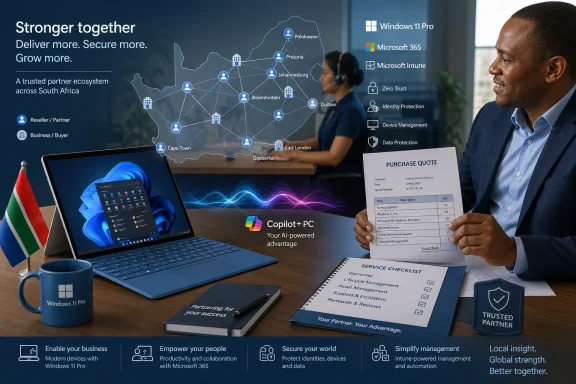 Microsoft’s Surface Strategy Runs Through the People Who Still Know the Customer
Microsoft Surface has always occupied an awkward place in the Windows ecosystem. It is first-party hardware from a company that built its PC empire by licensing software to other manufacturers, yet it is also a showcase product meant to demonstrate what Windows devices can be when hardware, firmware, accessories, security, and cloud services are treated as one stack.In South Africa and the wider Sub-Saharan market, that showcase cannot scale on Microsoft branding alone. It needs credit terms, warranties, training, after-sales support, procurement relationships, and the ability to answer a customer’s very ordinary question: who do I call when something breaks?
That is where Core Group’s programme matters. Core is already known in the region as a distributor of premium consumer technology brands, including Apple, Nintendo, and Microsoft. Its Surface reseller programme is aimed at small and mid-sized resellers that want access to Surface for Business devices without navigating an enterprise-only maze of certifications.
John Press, Core Group’s Surface Business Unit Head, frames the model as a practical answer to how hardware still reaches customers in the region. The old supply chain has not disappeared: appointed distributors serve channel partners, those partners serve customers, and value often comes from the relationship as much as the device. The channel may sound old-fashioned next to hyperscale cloud marketplaces, but for business PCs it remains the route through which financing, deployment, and support become real.
The deeper point is that Microsoft is not trying to turn Surface into a direct-sales phenomenon in this market. The Surface business described in the podcast relies completely on the reseller network, which spans thousands of partners across software and hardware channels. That is a very different posture from the consumer electronics fantasy of a customer clicking “buy now” and letting global logistics do the rest.
The Reseller Programme Is a Bet on Breadth, Not Exclusivity
The most interesting feature of Core’s programme is what it does not require. Press says becoming a reseller does not demand a vast ladder of certifications. Microsoft and Core are looking for basic technological capability, business compliance, and a defined target market.That sounds modest, but it reflects a strategic shift. Microsoft does not need every reseller to become a Surface evangelist with a laminated badge and a 200-page playbook. It needs enough competent partners to put Surface into more customer conversations, especially among small and medium-sized businesses that may not have dedicated procurement departments or global hardware contracts.
For those resellers, Surface can be a margin story, a services story, or a relationship story. Selling a business laptop is rarely only about the laptop. It can lead to Microsoft 365 licensing, endpoint management, security subscriptions, docking stations, extended warranties, device trade-ins, and support contracts.
The programme’s public-facing material emphasizes exactly that mix: access to Surface hardware, accessories, warranties, training, marketing resources, promotions, demo products, technical support, competitive pricing, and credit terms for qualifying resellers. In plain English, Core is trying to make Surface easier to sell as a business proposition rather than a one-off premium purchase.
That matters because the Surface brand has never been the cheapest way to buy a Windows PC. Its pitch is control, quality, integration, and business readiness. If the reseller cannot explain that pitch in terms a customer understands — security, lifecycle, productivity, repairability, manageability, total cost — then Surface becomes just another expensive laptop on a quote sheet.
Surface for Business Is Really About the Stack
The phrase Surface for Business can sound like a marketing layer applied to familiar hardware. But in Microsoft’s current strategy, it carries a heavier load. Surface is meant to be the physical front end of Windows 11 Pro, Microsoft 365, Copilot, Intune, Entra identity, Defender, firmware servicing, and an increasingly AI-shaped endpoint story.That is why the channel expansion arrives at a significant moment. Windows 10 reached end of support on October 14, 2025, and the PC market has been working through the consequences ever since. Many organizations delayed refresh cycles during the pandemic hangover and then confronted a harsher reality: aging devices, stricter security expectations, Windows 11 hardware requirements, and a vendor ecosystem now talking relentlessly about AI PCs.
Microsoft’s Copilot+ PC category sharpened that message. A Copilot+ PC is defined around a neural processing unit capable of more than 40 trillion operations per second, enabling local AI features such as Recall, improved Windows search, Click to Do, and other on-device experiences. Current Surface Pro and Surface Laptop for Business models include Intel Core Ultra Series 2 configurations with NPUs in that performance class.
But the commercial significance is not that every worker suddenly needs an NPU to summarize meetings. The significance is that Microsoft is creating a new baseline for what a modern Windows endpoint is supposed to be. In that world, Surface for Business is less a device family than a demonstration kit for Microsoft’s preferred future.
That future is attractive to some IT teams. Fewer oddball configurations, enterprise-grade firmware, predictable accessory compatibility, Windows Hello, BitLocker, TPM 2.0, Secured-core PC capabilities, and cloud management all speak the language of administrators who are tired of managing fleets assembled through opportunistic purchasing. Surface does not eliminate complexity, but it gives Microsoft a cleaner platform on which to tell the Windows story.
AI PCs Need a Channel Because AI Still Needs Explaining
The PC industry has spent the last two years insisting that AI will revive hardware demand. The argument is simple: cloud AI is useful, but local AI will require new silicon, new memory baselines, and new devices. Therefore, the next refresh cycle becomes not only a replacement cycle but an intelligence upgrade.That argument is plausible, but it is not self-executing. Most buyers do not wake up wanting an NPU. They want devices that last longer, run quietly, support Teams calls, protect data, survive travel, and do not trigger help-desk tickets every time Windows updates. AI becomes compelling only when it attaches itself to those mundane outcomes.
This is why reseller enablement matters more than the slogan. A channel partner can turn “Copilot+ PC” into a procurement conversation: which users benefit first, which applications are ready, which devices qualify, what policies govern Recall, how data is handled, and whether the organization should standardize now or wait for another hardware generation. A spec sheet cannot do that on its own.
For Microsoft, the risk is that AI PC messaging outruns buyer readiness. The company has already had to navigate privacy criticism around Recall and uneven enthusiasm for Copilot features across Windows. Business buyers are pragmatic: they may be curious about AI, but they will not rip and replace fleets because a launch video promised a new era of computing.
Core’s reseller programme gives Microsoft a way to localize that conversation. Instead of expecting smaller firms to parse global Microsoft messaging, the programme equips resellers to frame Surface in terms of South African business conditions: budget constraints, support expectations, device availability, compliance needs, and the realities of hybrid work.
The Premium PC Market Has a Distribution Problem
Surface competes against an entrenched field. Dell, HP, Lenovo, ASUS, Acer, and Apple all have credible business devices, and many have deep channel presence. Some buyers prefer ThinkPads because their IT departments know them. Some prefer Dell Latitude fleets because procurement has lived with them for years. Some executives want MacBooks because brand preference still matters.Microsoft’s challenge is not merely to make a good device. It must convince resellers that Surface is worth quoting, customers that Surface is worth paying for, and IT teams that Surface is worth standardizing. That requires a distribution model capable of supporting not just sales volume but trust.
Core brings one advantage Microsoft cannot manufacture overnight: familiarity with premium technology distribution in the region. The company’s long association with Apple is relevant not because Surface is an Apple-like product, but because premium hardware depends on more than stock movement. It depends on presentation, service, warranty handling, and partner discipline.
The awkward part is that premium distribution can also feel restrictive. Customers in smaller markets often know what it is like to pay more, wait longer, or depend on limited official channels. If Surface is to grow beyond a niche, the channel must make it easier to buy and support, not simply more formally controlled.
That is the tension at the heart of the programme. Reseller expansion suggests broader access. Authorised status suggests governance. Microsoft and Core have to find the middle ground where the programme feels open enough to recruit meaningful partner breadth but structured enough to protect the business customer experience.
South Africa Is Not a Side Quest in the Windows Hardware Story
It would be easy to treat this as a regional channel announcement with little relevance outside South Africa. That would miss the larger point. Microsoft’s Surface strategy in South Africa shows how the company is trying to make the AI-era Windows PC pitch work in markets where direct enterprise selling is not the whole game.Sub-Saharan Africa is not a monolith, and South Africa’s commercial technology market has its own dynamics. But across the region, many organizations buy through trusted intermediaries. Smaller firms often rely on resellers for advice that larger enterprises would source from internal architecture teams or global systems integrators.
That gives the channel unusual influence. A reseller can decide whether Surface appears as the recommended premium option, an alternative to incumbent PC brands, or not at all. If Microsoft wants Surface to be part of more business conversations, it needs to win the people who assemble those quotes.
This also has implications for Windows itself. Microsoft’s operating system dominance does not automatically translate into first-party hardware adoption. In fact, Windows’ historic strength came from hardware diversity. Surface must therefore justify itself without alienating the broader OEM ecosystem or looking like an indulgent side project.
In markets where procurement is relationship-driven, that justification has to be local. It has to survive currency pressure, supply constraints, warranty concerns, and the fact that a business owner may care more about a reliable reseller than about Microsoft’s global device roadmap.
The Old Supply Chain Is Becoming the New AI On-Ramp
The podcast’s most revealing detail is Press’s description of the hardware ecosystem as still operating largely on a legacy supply chain model. That could sound like a criticism. In reality, it may be Microsoft’s best chance of making AI PCs understandable.Legacy channels are not glamorous, but they are excellent at translating technology waves into sellable bundles. They know how to package a laptop with support, how to persuade a finance manager to approve a refresh, how to stage a deployment, and how to calm a customer when a vendor’s marketing promise meets a firmware update.
AI PCs need that translation layer badly. Microsoft can define the Copilot+ PC category, publish technical requirements, and ship Surface hardware. But customers still need someone to answer whether they should buy Intel, Arm, or AMD systems; whether their business apps are compatible; whether 16GB of RAM is enough; whether local AI features are policy-safe; and whether the device will still make sense three years from now.
That is where the old channel becomes the new on-ramp. Resellers are not merely moving boxes; they are being asked to explain a platform transition. The Surface reseller programme is therefore not just a commercial expansion. It is part of Microsoft’s attempt to turn the AI PC from an abstract category into a concrete buying decision.
The danger is that channel partners become responsible for cleaning up overpromising from vendors. If AI features remain uneven, if licensing gets confusing, or if customers discover that their most useful Copilot experiences still depend primarily on cloud services and subscriptions, resellers will be the ones facing the disappointment. Microsoft needs the channel, but the channel will need Microsoft to keep the story honest.
The Surface Pitch Is Strongest When It Stops Trying to Sound Magical
Surface devices have always been at their best when Microsoft lets the hardware speak in practical terms. The kickstand, the 3:2 display, the pen support, the detachable keyboard, the business security stack, the clean Windows image, the docking ecosystem — these are tangible advantages. They do not require mystical claims about the future of work.The AI layer can enhance that pitch, but it should not replace it. A Surface Laptop for Business with a capable NPU is still, first and foremost, a business laptop. A Surface Pro is still a hybrid tablet-PC whose value depends on whether the user actually benefits from that form factor. An AI feature that saves seconds is useful; a device that fails to meet everyday work needs is not redeemed by a neural processor.
For IT pros, the more persuasive argument is lifecycle coherence. Standardized devices, predictable firmware, modern security primitives, Windows 11 readiness, and management through Microsoft’s cloud stack are easier to defend in a budget meeting than vague promises of productivity transformation. AI becomes one more layer in the endpoint strategy, not the whole justification.
That distinction matters because the Windows enthusiast community is understandably skeptical of hype. Microsoft has spent years adding, renaming, repositioning, and sometimes retreating from Windows features. If Surface is sold as the ultimate AI PC and the AI features disappoint, the brand takes the hit. If Surface is sold as a premium managed Windows endpoint that is ready for the next wave of local AI, the promise is more durable.
Core’s programme can help keep the pitch grounded. Local resellers have every incentive to lead with what customers will actually use. In that sense, the channel may be less a marketing amplifier than a reality filter.
Where Resellers Can Win and Where They Can Get Burned
For small and mid-sized resellers, the programme opens a door that previously may have looked too narrow. Access to authorised status, training, marketing resources, demo products, technical support, promotions, and potentially better pricing gives them a way to compete for business device deals without pretending to be global systems integrators.But Surface is not a frictionless product line. Premium devices require careful expectation management. Accessories can materially affect the final price. Warranty and support experiences matter. Stock availability can make or break a deal. Customers comparing Surface against cheaper Windows laptops may need a clear explanation of why the extra cost is justified.
Resellers will also have to navigate the AI PC transition without overselling it. Some customers will benefit from Copilot+ PC features sooner than others. Some will not want Recall enabled. Some will care more about battery life, Teams performance, and security than local image generation or semantic search. A mature reseller will segment customers instead of treating AI readiness as a universal buying trigger.
The best opportunity may be in consultative selling to SMBs that have outgrown ad hoc device purchasing. These businesses may be ready to standardize on modern Windows hardware but lack the internal expertise to evaluate the options. Surface gives resellers a premium anchor product, and Microsoft’s broader ecosystem gives them a path to recurring services.
The worst outcome would be a race to quote Surface as a shiny object while ignoring deployment and support. That would turn the programme into another channel badge rather than a business-builder. The difference will come down to whether resellers use the programme’s resources to deepen capability or merely to access inventory.
Buyers Should Hear the Channel Pitch, Then Ask Hard Questions
For business customers, Core’s expansion should be welcomed with a raised eyebrow rather than applause. More authorised resellers can mean better access, more competition, and stronger local support. It can also mean more salespeople repeating Microsoft talking points without enough attention to actual workloads.The right way to evaluate Surface for Business is not to ask whether the device is premium. It is to ask whether the combination of hardware, Windows 11 Pro, Microsoft 365, management, security, support, and lifecycle planning solves a real problem. If the organization is already deeply invested in Microsoft’s ecosystem, Surface may offer a cleaner fit than a mixed fleet of bargain devices.
Buyers should also separate AI readiness from AI necessity. A Copilot+ PC may be a sensible forward-looking purchase for a three- or four-year refresh cycle, especially if the organization expects Windows AI features to mature over that period. But paying a premium only makes sense if the device is also strong on fundamentals.
That means asking about repair options, replacement timelines, warranty handling, keyboard and dock costs, device availability, Windows Autopilot support, Intune readiness, firmware update policies, and whether the reseller can support the business after the invoice is paid. The reseller programme should make those answers easier to obtain.
If it does not, buyers should treat that as a warning sign. A reseller who cannot explain the operational side of Surface for Business is not ready to sell it as a business platform.
The Real Test Will Come After the First Refresh Cycle
The success of Core’s Surface reseller programme will not be measured by launch enthusiasm. It will be measured when customers come back for their second purchase. Did the devices hold up? Did support work? Did the reseller add value? Did AI features become useful enough to justify the upgrade path? Did Surface make Windows management simpler, or did it merely cost more?Microsoft’s recent financial reporting has shown that Windows OEM and Devices can be volatile, affected by Windows refresh timing, inventory levels, PC market conditions, and device demand. Surface is not the center of Microsoft’s business in the way Azure or Microsoft 365 are. That makes channel execution even more important: Surface has to justify itself on product and partner value, not corporate inevitability.
The programme also lands in a market where PC buyers are more cautious than the industry would like. Memory costs, exchange rates, economic pressure, and post-Windows-10 refresh fatigue all influence buying decisions. Resellers will need to make the case that a better-managed device fleet is not a luxury but a hedge against support costs and security risk.
This is where Surface could find its lane. Not as the cheapest Windows PC, and not as a mass-market miracle machine, but as a premium business endpoint for customers who want Microsoft’s hardware and software roadmap aligned. The reseller channel can make that proposition legible to SMBs that might otherwise default to whatever laptop is cheapest this quarter.
If Core can build a partner community that understands both the technology and the local buying reality, Microsoft gains more than unit sales. It gains interpreters for the next phase of Windows hardware.
Core’s Programme Turns Surface From a Product Line Into a Local Test Case
The practical readout is clear: this is a channel expansion with strategic consequences. It brings Surface for Business closer to smaller resellers, and it gives Microsoft a better chance of translating its AI PC ambitions into actual customer deployments in South Africa.- Core Group’s programme is designed to give small and mid-sized resellers access to Microsoft Surface for Business devices, support, training, and commercial resources.
- Microsoft’s Surface business in the region depends heavily on reseller networks rather than direct sales to large enterprises.
- The programme lowers the apparent barrier to entry by emphasizing technical capability, business compliance, and a defined customer market rather than heavy certification chains.
- Surface’s strongest business pitch is not AI alone, but the combination of premium hardware, Windows 11 Pro, security, manageability, accessories, warranty options, and Microsoft 365 integration.
- Resellers that treat Copilot+ PCs as a consultative refresh opportunity will be better positioned than those that simply repeat AI marketing language.
- Buyers should use the expanded channel to demand clearer answers on support, lifecycle, management, warranty, and total cost before standardizing on Surface.
References
- Primary source: Business Day
Published: 2026-07-01T16:52:08.329545
Loading…
www.businesslive.co.za - Related coverage: core.co.za
MS Surface - The Core Group
 core.co.za
- Official source: microsoft.com
Your request has been blocked. This could be due to several reasons.
www.microsoft.com
- Related coverage: itweb.co.za
Become a Surface Reseller with Core | ITWeb
Core is inviting IT resellers to grow their businesses by joining the Microsoft Surface Reseller Program. www.itweb.co.za
- Related coverage: channelwise.co.za
Loading…
channelwise.co.za - Related coverage: twfld.com
Core Launches Microsoft Surface Reseller Program For South African Partners – TWFLD
Core, one of South Africa's leading technology distributors, has launched the Microsoft Surface Reseller Program, an initiative designed to support South African resellers in delivering Microsoft Surface hardware, accessories, and warranties to businesses across thetwfld.com
- Related coverage: bizcommunity.com
Core launches Microsoft Surface reseller programme for SA SMEs
Core has launched a Microsoft Surface Reseller Programme aimed at expanding opportunities for small and mid-sized IT resellers in SA...www.bizcommunity.com - Related coverage: tarsus.co.za
Loading…
www.tarsus.co.za - Official source: news.microsoft.com
Surface as a Service Fact Sheet_FINAL
</rdf:Alt> </dc:description> <dc:creator> <rdf:Seq> <rdf:li>Jessica Dashnews.microsoft.com
- Official source: download.microsoft.com
Loading…
download.microsoft.com - Related coverage: synnexcorp.com
Loading…
www.synnexcorp.com - Related coverage: na.ingrammicro.com
Loading…
na.ingrammicro.com - Official source: cdn.techcommunity.microsoft.com
Surface Surface devices solution guide solutionguide 110321
PDF documentcdn.techcommunity.microsoft.com
- Related coverage: windowscentral.com
Only 3.3% of Microsoft 365 users pay for Copilot | Windows Central
A new report suggests that only a fraction of the Microsoft 365 and Office 365 users who interact with Copilot Chat actually pay for it.www.windowscentral.com - Related coverage: tomshardware.com
Microsoft unveils Project Solara AI, a chip-to-cloud platform built to power a new generation of 'agent-first' enterprise devices — hardware designed to run AI agents instead of traditional apps | Tom's Hardware
Microsoft ditches Windows to build OS on Androidwww.tomshardware.com - Related coverage: pcgamer.com
Loading…
www.pcgamer.com - Related coverage: techradar.com
10 products that launched at Microsoft Build — and what happened to them | TechRadar
From Windows 8 to Copilot, here’s everything that was born at Buildwww.techradar.com - Related coverage: licenseq.com
Microsoft FY26 Q3 Results Explained by Licensing Expert
Microsoft FY26 Q3 results explained: revenue $82.9B, AI run rate $37B, Copilot past 20M seats, RPO $627B, plus Q4 outlook and what it means for customers. licenseq.com
- Official source: cdn-dynmedia-1.microsoft.com
- Related coverage: annualreports.ai