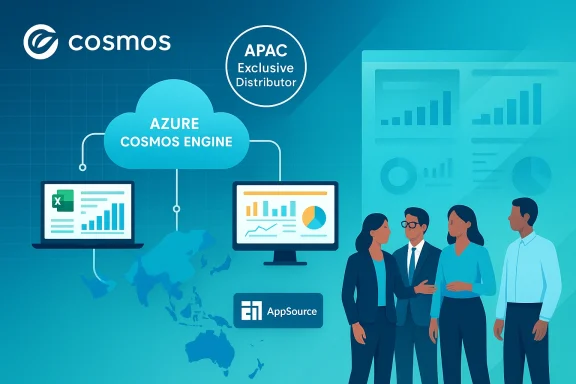
Cosmos has launched a dedicated APAC distributor and services arm, Cosmos APAC, establishing a regional hub meant to accelerate adoption of its cloud-native reporting and analytics platform for Microsoft Dynamics 365 Business Central across Asia–Pacific.
Cosmos is positioned as a cloud-first reporting and analytics platform purpose-built for Microsoft Dynamics 365 Business Central. The company’s announcement describes Cosmos APAC as an independent, New Zealand–headquartered distributor and services provider led by Tim Turner and co‑founders, charged with licensing, enablement, implementation guidance, and long‑term support for partners and customizationsstomers throughout the APAC region. Cosmos APAC joins existing regional distributors to form a networked channel approach intended to deliver local expertise while preserving partner ownership of customer relationships.
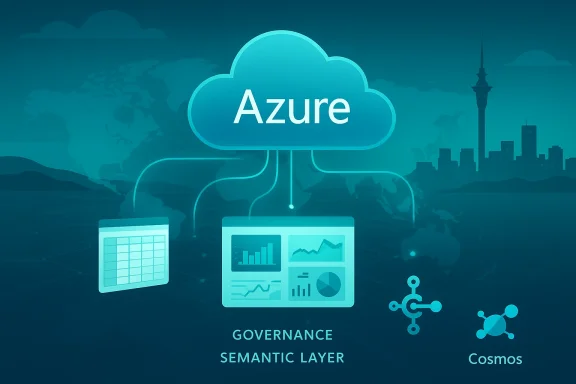
The product proposition is straightforward: a unified, Azure‑hosted reporting environment that lets users design reports in Excel or Power BI, run them in the cloud, and share governed outputs across the business. An optimized data model plus a library of prebuilt Business Central reports aims to shorten the path from implementation to insight, lowering dependence on scarce technical resources.
This development matters because many Business Central customers continue to wrestle with fragmented reporting approaches—manual Excel exports, custom SQL reports, and disconnected dashboard solutions—that slow decision making and increase governance risk. A dedicated APAC distributor seeks to remove friction for regional partners and customers by offering local licensing, services, and support, while providing a partner-friendly channel to keep delivery and customer relationships in partner hands.
Recommendation: Request explicit documentation on data residency, regional Azure tenancy, and contractual commitments before procurement.
Recommendation: Run a proof‑of‑concept against representative datasets and peak-load scenarios; request SLAs tied to performance.
Recommendation: Evaluate the prebuilt data model against customizations and request a clear process and pricing model for model extensions.
Recommendation: Clarify support boundaries, escalation SLAs, and how roadmap input from APAC customers will be handled.
Recommendation: Produce a multi-year TCO comparison that includes licensing, implementation, support, and change management costs.
Recommendation: Confirm export formats, APIs, and a migration plan to avoid lock-in.
Recommendation: Ask for a list of available templates by country and a roadmap for localization coverage.
However, regional success requires more than a good product. It requires local trust, rapid and competent support, and the ability to meet country‑specific compliance and tax needs. A properly staffed and experienced APAC distributor improves the odds of success, but the distributor must also demonstrate technical depth and commercial flexibility.
If Cosmos APAC can deliver timely localization, robust performance across APAC geographies, and a partner-first commercial model, it will likely be well received by the channel. Conversely, missed expectations around residency, integration complexity, or unclear pricing could slow adoption.
At the same time, prospective customers and channel partners should approach the offering with pragmatic diligence. Key risks that require confirmation include data residency and sovereignty handling, performance across APAC regions, model extensibility for heavily customized Business Central instances, and clear licensing and support boundaries between partner and distributor.
Practical next steps for any organization considering Cosmos APAC:
Cosmos APAC’s effectiveness will be judged not just by product features but by its ability to translate a global platform into reliable, locally compliant, and partner-friendly outcomes across a highly diverse APAC region.
Source: The Manila Times Cosmos Launches Dedicated APAC Distributor to Expand Global Business Central Reporting Reach
 Background
Cosmos is positioned as a cloud-first reporting and analytics platform purpose-built for Microsoft Dynamics 365 Business Central. The company’s announcement describes Cosmos APAC as an independent, New Zealand–headquartered distributor and services provider led by Tim Turner and co‑founders, charged with licensing, enablement, implementation guidance, and long‑term support for partners and customizationsstomers throughout the APAC region. Cosmos APAC joins existing regional distributors to form a networked channel approach intended to deliver local expertise while preserving partner ownership of customer relationships.The product proposition is straightforward: a unified, Azure‑hosted reporting environment that lets users design reports in Excel or Power BI, run them in the cloud, and share governed outputs across the business. An optimized data model plus a library of prebuilt Business Central reports aims to shorten the path from implementation to insight, lowering dependence on scarce technical resources.
This development matters because many Business Central customers continue to wrestle with fragmented reporting approaches—manual Excel exports, custom SQL reports, and disconnected dashboard solutions—that slow decision making and increase governance risk. A dedicated APAC distributor seeks to remove friction for regional partners and customers by offering local licensing, services, and support, while providing a partner-friendly channel to keep delivery and customer relationships in partner hands.
Cosmos APAC: what it does and why it matters
A regional hub for licensing, enablement, and delivery
Cosmos APAC’s stated remit covers three core activities:- Manage regional licensing and commercial relationships for Cosmos in APAC.
- Provide enablement, training, and implementation guidance to Microsoft Dynamics partners.
- Deliver ongoing support and services to ensure customers can adopt and sustain Cosmos-based reporting.
Local presence, global product
Positioning Cosmos APAC in New Zealand is strategic: it offers timezone overlap across many APAC markets, English-language operations, and a location commonly used as a regional base for software services. The real advantage, however, is the promise of local expertise—regional knowledge of Business Central deployments, tax and regulatory differences, and enterprise procurement practices—combined with centralized platform development and Azure hosting.Partner-friendly channel design
Under the announced model, partners retain ownership of customer relationships and project delivery while leaning on the distributor for Cosmos licensing and platform support. That model reduces partner friction for onboarding new customers and helps smaller partners who lack deep internal reporting expertise deliver modern Business Central reporting more quickly.Technical overview and product positioning
Core technical claims
Cosmos markets itself on several technical differentiators:- Azure-hosted platform: running in Microsoft Azure to leverage cloud scale, security, and integration with Business Central.
- Excel and Power BI native experience: users design reports in familiar tools and publish them to a governed cloud environment.
- Optimized Business Central data model: a prebuilt semantic layer intended to reduce ETL and model-building work.
- Library of prebuilt reports: business‑ready report templates that accelerate time to insight.
How Cosmos fits into a typical Business Central architecture
In typical deployments, Business Central customers rely on a combination of:- Native report layouts and embedded Business Central reporting.
- Manual Excel extracts for ad hoc analysis and reconciliations.
- Power BI for executive dashboards, often requiring an ETL layer or data warehouse.
- Third‑party reporting tools or custom development for consolidated and regulatory reporting.
Strengths and opportunities
1. Purpose-built for Business Central
A reporting solution architected specifically for Business Central has a natural advantage. Prebuilt business logic, a tuned semantic layer, and report templates accelerate implementation and reduce errors that arise from incorrectly mapping Business Central tables or business rules.2. Familiar user experience
Allowing business users to continue working in Excel while hosting reports centrally addresses adoption friction. Many finance teams prefer Excel for its flexibility; a governed cloud runtime preserves that familiarity while removing risky spreadsheet-based distribution.3. Faster time to insight
Prebuilt reports and an optimized data model can dramatically reduce the weeks or months typically required to model ERP data and validate financial reports. That speed is especially valuable for mid-market organizations that lack dedicated BI teams.4. Partner enablement through a distributor model
Cosmos APAC’s distributor model can expand ecosystem coverage quickly. Local licensing and support reduce procurement friction, and centralizing platform operations lets partners focus on implementation and value delivery rather than platform housekeeping.5. Azure-native benefits
Running on Azure can deliver reliable infrastructure, built-in security features, and easy integration with Dynamics 365 services and Power Platform components—features many customers expect for enterprise reporting.Risks, unknowns, and cautionary points
1. Data residency and local compliance
APAC is not monolithic: data residency, privacy, and cross‑border rules differ significantly across Australia, New Zealand, Singapore, India, Japan, China, and Southeast Asia. The announcement indicates Azure hosting but does not specify regional data-residency guarantees, local cloud regions used, or options for onshore data storage. Organizations subject to strict data sovereignty or industry-specific regulations should verify exactly where data will be stored and processed.Recommendation: Request explicit documentation on data residency, regional Azure tenancy, and contractual commitments before procurement.
2. Performance and scale for local deployments
Cloud-hosted reporting reduces on‑prem hardware concerns but raises questions about latency and performance across large geographic distances. APAC customers operating from locations with limited bandwidth or heavy transactional loads will need performance benchmarks and real-world POC results to validate responsiveness.Recommendation: Run a proof‑of‑concept against representative datasets and peak-load scenarios; request SLAs tied to performance.
3. Integration with highly customized Business Central implementations
Many Business Central installations include partner customizations, industry-specific extensions, and localized tax logic. A prebuilt model will bring speed but may require significant customization to map bespoke extensions and localized tables.Recommendation: Evaluate the prebuilt data model against customizations and request a clear process and pricing model for model extensions.
4. Channel and support model details
While the distributor model promises partner-first delivery, questions remain about support escalation, service credits, and the division of responsibilities between Cosmos APAC and partner teams. Who owns first-line support? How are bug fixes and roadmap requests prioritized for APAC customers?Recommendation: Clarify support boundaries, escalation SLAs, and how roadmap input from APAC customers will be handled.
5. Licensing and total cost of ownership
Cloud platform licenses can be simple or complex. Hidden costs—per-user, per-report, data storage, or premium connector fees—can change TCO calculations significantly versus expected outcomes from traditional Excel-based reporting.Recommendation: Produce a multi-year TCO comparison that includes licensing, implementation, support, and change management costs.
6. Vendor lock-in and exportability
A managed semantic layer accelerates delivery but may create dependence on vendor tooling for ongoing report generation and historical analytics. Organizations should confirm the ease of data export, model extraction, and continuity planning in case of partner change.Recommendation: Confirm export formats, APIs, and a migration plan to avoid lock-in.
7. Localisation of reports and regulatory templates
APAC markets often require country-specific financial statements, statutory reports, and tax calculations. It's not yet clear how comprehensive Cosmos’ prebuilt templates are for APAC jurisdictions or how quickly regional requirements will be added.Recommendation: Ask for a list of available templates by country and a roadmap for localization coverage.
Practical evaluation checklist for customers and partners
When evaluating Cosmos APAC and the Cosmos platform, use the following checklist to structure vendor diligence and pilot programs.- Data residency and compliance
- Where will production and backup data be stored (specific Azure regions)?
- What contractual guarantees exist for data residency?
- How does the vendor handle subject access requests and data erasure?
- Security and resilience
- Encryption at rest and in transit details.
- Identity and access controls (Azure AD integration, SSO).
- Backup frequency, retention, and disaster recovery RTO/RPO.
- Integration and model extensibility
- How are Business Central customizations mapped into the semantic model?
- Is there a documented API for model changes and data extraction?
- What tools or services are provided to map custom tables?
- Performance and scalability
- Benchmarks for report execution and concurrent users.
- Expected latency for users across APAC geographies.
- Load testing options and SLA commitments.
- Support and service model
- First-line support responsibilities (partner vs distributor).
- Support hours, response targets, and escalation procedures.
- Local support availability and language capabilities.
- Licensing and pricing transparency
- Cost per user, per report, or per data volume clarifications.
- Any additional fees for connectors, storage, or add-on modules.
- Pricing for development, staging, and production instances.
- Partner enablement and commercial terms
- Training programs and certifications for partner consultants.
- Revenue share, margin structure, and deal registration policies.
- Marketing and co-selling support from the distributor.
- Localization and template coverage
- Inventory of prebuilt reports for national statutory and tax reporting.
- Roadmap and timeline for adding country-specific templates.
- Exit and portability
- Methods for exporting the model and report definitions.
- Data extraction options for historical data retention.
- Terms for decommissioning and transferring customer data.
Implementation roadmap for a typical mid‑market APAC deployment
- Discovery and scoping
- Map current reporting pain points, key reports, and stakeholders.
- Identify Business Central customizations and integrations.
- Proof of concept (2–4 weeks)
- Deploy a sandbox connected to a sanitized Business Central dataset.
- Validate key reports using the prebuilt templates and custom mappings.
- Run performance tests from representative locations.
- Model extension and validation (2–6 weeks)
- Extend the semantic model to accommodate custom tables and logic.
- Reconcile report outputs against source data and statutory requirements.
- User training and adoption
- Deliver hands‑on Excel and Power BI sessions for report authors.
- Roll out role-based permissions and governance processes.
- Production cutover and support
- Plan phased go-live: finance close reports first, then operational reports.
- Establish support handover between partner and Cosmos APAC.
- Continuous improvement
- Track report usage, performance, and feature requests.
- Prioritize backlog for localization and additional automation.
Channel dynamics and what partners should expect
A dedicated regional distributor changes partner economics and operational responsibilities in several ways:- It can lower barriers for smaller partners to sell Cosmos because licensing, onboarding, and platform updates are handled by the distributor.
- Partners maintain direct customer relationships and capture implementation revenue, but margins and deal structures may shift depending on distributor pricing and rebates.
- The distributor model requires effective communication and clear SLAs; partners should expect onboarding programs, certified training, and joint go‑to‑market resources to be available.
Market outlook and strategic implications
Business Central adoption across APAC has been accelerating as organizations seek cloud ERP capabilities without the complexity of heavier SAP or Oracle systems. Reporting and analytics remain a persistent pain point for growing mid-market companies. A vendor that can deliver governed, Excel-friendly reporting from the cloud addresses a broad segment of this demand.However, regional success requires more than a good product. It requires local trust, rapid and competent support, and the ability to meet country‑specific compliance and tax needs. A properly staffed and experienced APAC distributor improves the odds of success, but the distributor must also demonstrate technical depth and commercial flexibility.
If Cosmos APAC can deliver timely localization, robust performance across APAC geographies, and a partner-first commercial model, it will likely be well received by the channel. Conversely, missed expectations around residency, integration complexity, or unclear pricing could slow adoption.
Final assessment — strengths, caution, and next steps
Cosmos’ announcement of an APAC distributor is a meaningful step for any vendor seeking broad Business Central adoption across diverse markets. The strengths are clear: a purpose-built, Azure‑hosted reporting platform that lets users keep using Excel and Power BI; faster time to insight via a prebuilt data model; and a distributor model designed to remove partner friction.At the same time, prospective customers and channel partners should approach the offering with pragmatic diligence. Key risks that require confirmation include data residency and sovereignty handling, performance across APAC regions, model extensibility for heavily customized Business Central instances, and clear licensing and support boundaries between partner and distributor.
Practical next steps for any organization considering Cosmos APAC:
- Request explicit documentation on data location, encryption, and compliance practices.
- Run a time‑boxed proof‑of‑concept using representative data and peak-load scenarios.
- Validate the semantic model against real customizations and statutory reporting needs.
- Secure transparent multi‑year TCO figures that capture licensing, implementation, and ongoing support.
- Define support ownership and escalation paths before contract signature.
Cosmos APAC’s effectiveness will be judged not just by product features but by its ability to translate a global platform into reliable, locally compliant, and partner-friendly outcomes across a highly diverse APAC region.
Source: The Manila Times Cosmos Launches Dedicated APAC Distributor to Expand Global Business Central Reporting Reach