

CISA’s updated Cross‑Sector Cybersecurity Performance Goals — CPG 2.0 — mark a decisive shift from checklist-style guidance to measurable, governance‑backed outcomes for critical infrastructure owners and operators, placing accountability and enterprise risk management alongside technical controls as the foundation for resilient IT and OT environments. The update reframes the CPGs to align with NIST CSF 2.0, adds explicit governance requirements, and refines the prior goals into outcome‑driven actions intended to be measurable, sector‑agnostic, and practically implementable across small and large organizations alike.
Source: CISA Cybersecurity Performance Goals 2.0 for Critical Infrastructure | CISA
 Background / Overview
The evolution of the CPGs and why CPG 2.0 matters
Since their debut, CISA’s Cybersecurity Performance Goals (CPGs) have been a prioritized, bite‑sized set of actions meant to help critical infrastructure reduce the most impactful risks with a small, high‑leverage set of controls. CPG 2.0 updates that baseline with two central changes: formal alignment to NIST CSF 2.0 and the addition of a Govern dimension that elevates decision‑level accountability, risk tolerance, and supply‑chain oversight. These changes mirror the broader federal shift toward treating cybersecurity as enterprise risk and aim to translate risk management into repeatable, measurable outcomes. NIST’s CSF 2.0 introduced the Govern function precisely to bring cybersecurity to the boardroom and to formalize supply‑chain and policy responsibilities; CPG 2.0 is explicitly reorganized to map to CSF 2.0’s functions so that operators can move from “what to do” to “how to show progress.”What “measurable” means in CPG 2.0
CPG 2.0 emphasizes outcomes — for example, not just “implement MFA” but “ensure phishing‑resistant MFA is enforced for all privileged accounts and measure successful/failed enrollment rates and authentication anomalies.” The intent is to let organizations demonstrate improvement over time with quantifiable indicators rather than ambiguous checkboxes, which supports prioritization, grant justification, and procurement decisions. CISA’s FAQs clarify that measurable goals were chosen so organizations of different sizes can self‑assess, justify investments, and report progress.What’s new in CPG 2.0
1) Governance as a first‑class element
CPG 2.0 explicitly builds governance into the baseline. Governance in this context includes:- Board and executive‑level accountability for cybersecurity risk.
- Defined risk tolerance and measurable risk metrics translated into operational objectives.
- Policy, oversight, and assurance processes that ensure controls remain effective and that exceptions are tracked and approved.
- Supply‑chain and third‑party lifecycle management — from procurement due diligence to ongoing monitoring and contract terms (e.g., secure‑by‑design requirements, SBOMs).
2) Stronger IT/OT parity and OT realism
CPG 2.0 retains the original cross‑sector focus on both information technology (IT) and operational technology (OT) while improving specificity for OT constraints. Where earlier guidance sometimes presumed frequent patch windows and modern management tooling, CPG 2.0 offers recommended measured actions and compensating controls that are realistic for safety‑critical, long‑lifecycle systems (for example, isolating internet‑exposed engineering workstations, enforcing the removal of default credentials, and centralizing OT logging). This reflects lessons learned from repeated ICS advisories and the operational reality that many control systems cannot be patched on demand. Practical mitigation playbooks and prioritized checklists remain essential for operators lacking vendor fixes.3) Outcome‑driven, mapped to NIST CSF 2.0 functions
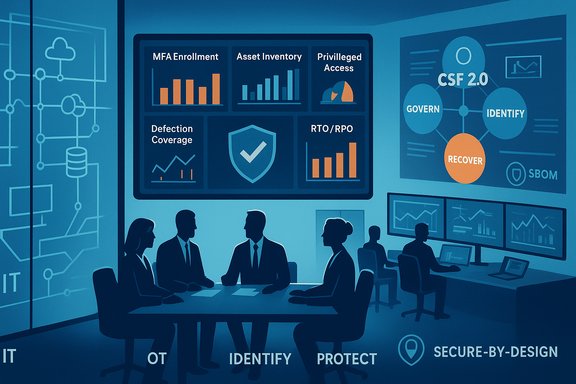
CPG 2.0 is organized to map to the CSF 2.0 functions — Govern, Identify, Protect, Detect, Respond, Recover — making it easier for organizations to integrate CPGs into an enterprise risk management workflow, to align vendor contracts and procurement with enterprise policy, and to track progress with consistent metrics. CISA’s intent is to make the CPGs a practical subset of the broader CSF, not a replacement, and to ensure that sector‑specific goals (SSGs) build on the cross‑sector baseline.What CPG 2.0 requires in practice
Key measurable actions (high‑impact examples)
The updated goals translate into measurable actions across IT and OT. Representative actions include:- Enforce phishing‑resistant multi‑factor authentication for privileged and remote access and track coverage and failures.
- Maintain a complete asset inventory (IT and OT) with verification cadence and unknown‑asset reduction metrics.
- Apply least privilege and privileged access management with periodic attestation and privileged session logging.
- Enable centralized logging and detection for IT and OT telemetry, with defined detection coverage metrics and mean time to detect (MTTD) targets.
- Implement incident reporting and disclosure pathways so that critical incidents are reported to CISA and sector partners within defined timeframes.
- Document device configurations, network topology, and recovery plans, and exercise recovery with measurable RTO/RPO test results.
Short, medium, long‑term implementation roadmap
- Immediate (0–3 months): Inventory internet‑accessible assets, disable default credentials, enforce MFA for remote admin accounts, and isolate critical engineering workstations.
- Near term (3–9 months): Centralize log collection and set detection rules for OT protocols, implement privileged access management, and begin executive‑level governance reporting.
- Mid term (9–18 months): Migrate to identity‑first architectures, automate containment playbooks, run cross‑functional incident exercises with proven recovery metrics.
- Long term (18+ months): Institutionalize continuous assurance, vendor contracting for secure‑by‑design hardware, and contribute operational playbooks to sector partners.
Critical analysis — strengths, gaps, and operational risks
Strengths
- Clear, measurable outcomes remove ambiguity from “what good looks like” and make it easier for boards and auditors to quantify progress. This helps justify budgets and prioritize high‑leverage actions.
- Governance elevation forces executive engagement, which is the single biggest predictor of sustained security investment and cross‑team cooperation. Aligning CPG 2.0 with NIST CSF 2.0’s Govern function consolidates industry and government expectations.
- Practical IT/OT parity that acknowledges OT constraints — with compensating controls and detection amplification — reduces the risk of unrealistic mandates that operators cannot safely implement. Practical guidance and prioritized mitigations are emphasized across advisories and practitioner forums.
Gaps and challenges
- Voluntary nature vs. market pressure: CPGs remain voluntary. That is useful politically, but it risks uneven adoption unless regulators, large buyers, and insurers use procurement and contractual levers to require measurable CPG outcomes. Small operators may continue to lag without direct funding, managed services, or regulatory incentives.
- Measurement fidelity and comparability: Different organizations will measure the same outcome differently (e.g., what counts as “phishing‑resistant MFA”?. Without standardized metrics and external validation, some reported progress may be superficial. CISA acknowledges this and encourages sector‑specific tailoring, but comparability across sectors will remain a challenge.
- Vendor and supply‑chain dependencies: Many OT devices lack secure update mechanisms. Operators who cannot patch must rely on compensating controls and vendor cooperation; CPG 2.0 encourages vendor accountability but cannot compel legacy vendors to redesign devices. Operators will need contractual leverage or regulatory pressure to force secure‑by‑design practices. Practitioner communities have highlighted vendor limitations as a persistent gap.
- Resource constraints for small utilities and municipalities: The “hard parts” — continuous monitoring, centralized logging, and identity‑first architectures — require staff, tooling, and operational expertise. Without targeted funding or managed service models, many small operators will struggle to meet measurable targets. Forum analyses and incident playbooks repeatedly emphasize this implementation gap.
Potential risks if CPG 2.0 is misunderstood or misapplied
- Treating CPG 2.0 as a checklist can lead to superficial compliance that misses systemic risk (e.g., changing a password vs. implementing privileged session controls).
- Overly prescriptive measurements could encourage gaming metrics rather than reducing real risk.
- Forcing rapid OT changes without robust rollback and test plans could create safety incidents or downtime in production environments. Practical OT guidance warns strongly to test firmware changes and maintain rollback plans.
How to implement CPG 2.0: an actionable playbook for operators
Executive & governance actions (board & C‑suite)
- Create a cyber risk dashboard that maps CPG 2.0 outcomes to business impact and tracks a small number of executive metrics (e.g., percent of privileged accounts with phishing‑resistant MFA, mean time to detect).
- Formally assign roles and responsibilities for CPG achievement in the enterprise risk register; fund remediation per risk‑based prioritization.
- Require supplier security assurance as part of procurement: SBOMs, signed firmware, secure update methods, and minimum‑viable logging.
Technical and operational actions (IT & OT teams)
- Inventory and classification:
- Build a single asset registry capturing IT/OT, remote access paths, and maintenance connections.
- Prioritize internet‑accessible and remote management assets for immediate isolation or hardening.
- Identity and access:
- Enforce phishing‑resistant MFA for all privileged accounts and maintenance access.
- Deploy privileged access management and just‑in‑time elevation where possible.
- Network and segmentation:
- Enforce strict IT/OT segmentation; utilize jump servers, bastions, or unidirectional gateways for sensitive control networks.
- Block or filter unsupported protocols at demarcation points.
- Detection and logging:
- Centralize OT and IT logs to an immutable collector and tune detection rules for OT‑specific TTPs.
- Measure detection coverage and set MTTD targets; automate alerts for anomalous control logic changes.
- Incident readiness and recovery:
- Maintain tested runbooks and recovery playbooks with defined RTO/RPO targets.
- Conduct cross‑functional tabletop and live recovery exercises with measurable outcomes.
These steps mirror the prioritization frameworks used by practitioners and defense advisories; they are intentionally sequenced to reduce highest probable risks first.
What vendors and procurement teams must do
- Adopt secure‑by‑default product designs: no default credentials, built‑in logging, secure update channels, and MFA for management interfaces.
- Publish SBOMs to enable faster exposure assessments and to meet CPG 2.0 supply‑chain expectations.
- Support customers with signed firmware updates and clear, testable update guidance so operators can safely apply patches in OT environments.
Forum analysis and CISA advisories repeatedly call for vendor accountability as a prerequisite for sector‑level resilience; without vendor changes, many operators will continue to rely on compensating network controls.
How CPG 2.0 intersects with regulation, insurance, and procurement
- CPG 2.0 is voluntary, but it will be used by insurers, large corporate purchasers, and regulators as a de‑facto baseline when assessing cyber risk and contractual adequacy.
- Expect procurement clauses to increasingly demand CPG‑mapped assurances, especially in government and regulatory contracts; organizations that cannot demonstrate measurable progress may face higher insurance premiums or procurement exclusion.
- Grant programs and federal funding initiatives are likely targets for CPG‑based conditions, which can help smaller operators close resource gaps — but only if programs explicitly attach funds to measurable outcomes.
Practical examples: a small utility and a regional hospital
- Small utility (water/wastewater): Immediate actions should include inventory of internet‑facing devices, removal of default credentials, MFA for remote maintenance, and creation of a recovery playbook that’s exercised annually. If vendor patches are unavailable, implement network level access controls and isolated jump hosts. Practitioner guidance stresses that small utilities will need managed services or federal funding to operationalize these changes.
- Regional hospital: Prioritize asset inventory for clinical systems, enforce EDR and centralized logging for Windows‑based engineering and HMI hosts, and implement privileged access management for staff with device‑configuration capabilities. Healthcare SSGs will extend CPGs with sector‑specific controls, and hospital executives must align cyber risk metrics with patient‑safety KPIs.
Verification, caveats, and what remains unconfirmed
- The broad policy shifts and functional mappings described above are documented on CISA’s CPG pages and in CISA FAQs; NIST’s CSF 2.0 materials independently confirm the governance shift and the addition of the Govern function. These two sources form the backbone of the public record for this update.
- The specific CISA alert page referenced in the original notice may contain additional details (dates, exact phrasing, and immediate implementation resources). Automated access to that specific alert URL returned a restricted response for the public crawler at the time of review; readers and implementers should confirm the precise text, publication date, and downloadable materials directly from CISA’s site or through their organizational CISA liaison. This caveat is important because implementation timelines and downloadable checklists sometimes appear in the alert text but not in the higher‑level CPG pages.
Bottom line for WindowsForum readers and IT professionals
- Treat CPG 2.0 as the practical baseline for critical infrastructure cyber risk that will increasingly influence procurement, insurance, and regulatory expectations. Focus on measurable outcomes, not just checkbox compliance.
- For Windows‑centric environments that interface with OT: inventory engineering workstations and HMI servers, isolate them from general purpose workstations, ensure up‑to‑date patching and EDR/AV coverage, and enforce privileged access controls and phishing‑resistant MFA. Forum discussions and ICS advisories repeatedly show Windows hosts as high‑value pivot points for adversaries.
- Demand vendor accountability. If procurement doesn’t require secure‑by‑default products, operators and defenders will be forced into brittle compensating controls that are costly and fragile. Multiple advisories call on vendors to publish SBOMs, remove default credentials, and provide signed updates.
Conclusion
CPG 2.0 is the most consequential practical update to CISA’s performance guidance to date: it turns high‑level advice into measurable outcomes, elevates governance to the same level as technical controls, and aligns CISA’s priorities with NIST CSF 2.0’s enterprise‑risk approach. For critical infrastructure operators, success will require bridging boardroom decisions with on‑the‑ground operational changes — securing Windows endpoints, modernizing identity and access, centralizing detection across IT and OT, and holding vendors to secure‑by‑design standards. The update is a major opportunity to move beyond fragmented compliance toward demonstrable resilience — provided that the public sector, large buyers, insurers, and vendors collaborate to fund and operationalize those measurable outcomes at scale.Source: CISA Cybersecurity Performance Goals 2.0 for Critical Infrastructure | CISA
