

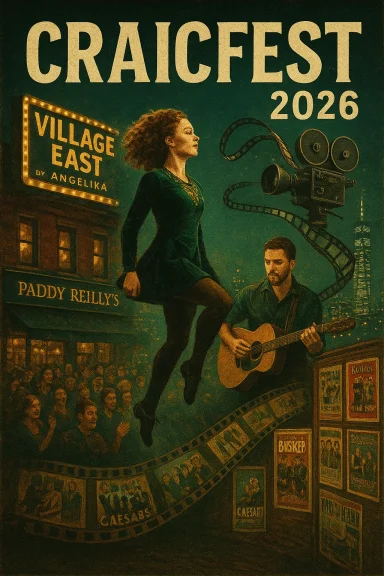
CraicFest returns to New York this March with a compact, high-energy program that blends contemporary Irish music, boundary-pushing dance, and a tightly curated selection of feature and short films — anchored by the New York City premiere of Saipan: A World Cup Feud on March 5 and capped by the U.S. premiere of Ballroom Boom on March 7, a music documentary narrated by U2’s Adam Clayton. The festival opens informally with a free kickoff at Paddy Reilly’s Music Bar on March 4, continues with a lineup of shorts and features at Village East by Angelika, and stitches together concerts, dance, Q&As, and after-parties that make CraicFest as much a nightlife event as a film festival. For New Yorkers and Irish-culture fans, the next few days promise storytelling that ranges from sport-and-scandal to the intimate histories of showbands and Travellers’ lives — all staged across familiar lower-Manhattan venues and rounded out with parties at Solas and Factory 380.
CraicFest began as a niche celebration of Irish film and music and, over its run, has evolved into a recurring showcase where filmmakers, musicians, and community audiences intersect. This year’s program is compact but strategic: three principal days of programming (March 5–7), anchored by screenings at Village East by Angelika with evening after-parties and a complementary kickoff on March 4 at Paddy Reilly’s Music Bar. The festival has long positioned itself as a bridge between diasporic Irish creative expression and New York’s festival culture; its mix of documentary, feature, shorts programming, and live performance reflects that hybrid identity.
Two pieces anchor this iteration: Saipan: A World Cup Feud, a sports-documentary drama revisiting the infamous 2002 Roy Keane–Mick McCarthy breakdown, and Ballroom Boom, a music documentary exploring Ireland’s showband era, newly expanded and narrated by Adam Clayton. Both films interrogate cultural identity — one through the pressure-cooker world of national sport, the other by tracing how live entertainment ecosystems shaped modern Irish music. The juxtaposition of these narratives — leadership and professionalism vs. popular entertainment and dance-floor economies — gives the festival a thematic breadth that will appeal to cinephiles, music historians, and general audiences alike.
Why this matters: live kickoffs do two things well. They create word-of-mouth momentum and they give filmmakers a social setting to meet local audiences in an informal way. For visitors traveling into the city for the festival, the kickoff is a smart chance to sample work and meet creators without committing to a ticketed screening.
What to expect from the screening: thoughtful reconstructive sequences, archival material, and interviews that attempt to move the narrative beyond spectacle into a conversation about standards and professionalism. Saipan’s journalistic subject matter makes it an ideal opener for a festival that wants to foreground Irish stories with real-world cultural impact.
Importantly, Ballroom Boom arrives with festival momentum: it was presented at MIP and has expanded in recent cuts, and its U.S. debut at CraicFest places the festival on the map for international music-documentary programmers. Adam Clayton’s participation as narrator adds star cachet without turning the film into a vanity project — provided the material preserves the historical centers and doesn’t over-privilege celebrity framing.
Practical notes:
For diaspora communities, CraicFest functions as cultural infrastructure: a predictable place to see work that reflects home histories, updated through documentary and performance. For the city’s broader cultural ecosystem, the festival adds a targeted, festival-season alternative to the major institutional offerings, giving programmers and audiences short but intense engagements with Irish art.
But prospective attendees should temper expectations: confirm guest appearances and stay alert to last-minute schedule changes; small venues mean quick sellouts; and promotional claims about star associations should be taken as festival copy unless corroborated.
If you plan to attend:
Source: Times Square Chronicles The Best Music Downloader Apps for Windows PC in 2017
 Background
CraicFest began as a niche celebration of Irish film and music and, over its run, has evolved into a recurring showcase where filmmakers, musicians, and community audiences intersect. This year’s program is compact but strategic: three principal days of programming (March 5–7), anchored by screenings at Village East by Angelika with evening after-parties and a complementary kickoff on March 4 at Paddy Reilly’s Music Bar. The festival has long positioned itself as a bridge between diasporic Irish creative expression and New York’s festival culture; its mix of documentary, feature, shorts programming, and live performance reflects that hybrid identity.Two pieces anchor this iteration: Saipan: A World Cup Feud, a sports-documentary drama revisiting the infamous 2002 Roy Keane–Mick McCarthy breakdown, and Ballroom Boom, a music documentary exploring Ireland’s showband era, newly expanded and narrated by Adam Clayton. Both films interrogate cultural identity — one through the pressure-cooker world of national sport, the other by tracing how live entertainment ecosystems shaped modern Irish music. The juxtaposition of these narratives — leadership and professionalism vs. popular entertainment and dance-floor economies — gives the festival a thematic breadth that will appeal to cinephiles, music historians, and general audiences alike.
Opening night and the kickoff: music, dance, and the case for live culture
Paddy Reilly’s kickoff — a free, RSVP-only celebration
The festival’s kickoff on Wednesday, March 4 at Paddy Reilly’s Music Bar functions as an appetizer and a community convening. It’s billed as a free event with limited capacity, featuring contemporary folk artist Graham Smith and an Irish dance performance by Kait Rock. This kind of grassroots opener is an effective festival tool: it lowers the barrier for casual participants while delivering a taste of the festival’s atmosphere the night before the official screenings begin.Why this matters: live kickoffs do two things well. They create word-of-mouth momentum and they give filmmakers a social setting to meet local audiences in an informal way. For visitors traveling into the city for the festival, the kickoff is a smart chance to sample work and meet creators without committing to a ticketed screening.
Graham Smith — contemporary folk and acoustic storytelling
Graham Smith’s inclusion is both deliberate and wise. The program positions him as a bridge between tradition and modern songwriting; his set is described as rooted in contemporary Irish folk with an emphasis on storytelling. Acoustic performances work well in the intimacy of venues like Paddy Reilly’s, and they reinforce a festival narrative that values rooted, live musical expression over mere nostalgia.Kait Rock and the choreography of reinvention
Kait Rock is billed as an internationally acclaimed Irish dancer who pushes the boundaries of traditional form — an intriguing programming choice that signals the festival’s appetite for reinterpretation. The festival copy suggests she was recently on a major pop tour; that claim should be read as promotional copy unless independently verified by tour credits. Regardless, presenting Irish dance in contemporary, cross-genre contexts helps the festival avoid a reductive “culture museum” posture and instead positions it as alive, evolving, and locally relevant.The film lineup: what to see and why it matters
Saipan: A World Cup Feud — a sports story about standards and representation
Saipan, directed by Glenn Leyburn and Lisa Barros D’Sa, dramatizes the notorious 2002 Saipan incident between Roy Keane and Mick McCarthy. More than a retelling of a football row, the film interrogates leadership, preparation under public scrutiny, and the cultural weight of representing a nation on the international stage. The CraicFest screening on March 5 includes a Q&A with the directors, which is an important draw: sports films translate into provoked conversation when the filmmakers can contextualize sources, access to participants, and the ethical choices behind dramatization.What to expect from the screening: thoughtful reconstructive sequences, archival material, and interviews that attempt to move the narrative beyond spectacle into a conversation about standards and professionalism. Saipan’s journalistic subject matter makes it an ideal opener for a festival that wants to foreground Irish stories with real-world cultural impact.
Shorts Night — a curated cross-section of emerging Irish voices
Short-form programming is where festivals often demonstrate curatorial muscle. CraicFest’s Shorts Night (March 6) assembles a mix of drama and wit, with selections like “Mouse,” “I Do,” “HomeTime,” and others. Short films are the industry’s proving grounds: they reveal technical skill, voice, and the thematic directions likely to surface in the next generation of Irish feature filmmaking. For local filmmakers and audiences, Shorts Night is also a networking hub — an opportunity to celebrate risk and innovation without the weight of a feature-length screening.Where the Road Meets the Sky — Irish Travellers and the politics of memory
The inclusion of Where the Road Meets the Sky — an experimental film centering Chrissy Donaghue Ward — is one of the festival’s strongest moves. By centering Irish Traveller history and oral storytelling, the film expands the festival’s scope beyond urban or commercial narratives and acknowledges historically marginalized communities within Irish cultural life. Films like this can be both politically resonant and aesthetically challenging, which is vital for a program that wants to be more than crowd-pleasing docs and biopics.BP Fallon Rock’N’Roll Wizard Vol. 1 — reinvention and the rock biography
BP Fallon’s film traces an arc from early British rock to unexpected late-career reinvention, intersecting with icons from The Beatles to Jack White. Rock biographies are a comfortable fit for a festival that celebrates music; their strength lies in archival storytelling and access. If CraicFest’s audience includes music obsessives, a documentary like this, timed after Shorts Night and preceding the closing documentary, forms a tidy thematic chain: past musical ecosystems, individual reinvention, and the social infrastructures that make music careers possible.Ballroom Boom — closing with a musical excavation
Ending the festival with Ballroom Boom — a documentary on Ireland’s showband era and narrated by Adam Clayton — is thematically resonant and, in festival terms, theatrical. The showband era shaped the social life of mid-20th century Ireland: ballrooms, working-class dance crowds, and a professional circuit that kept hundreds of musicians working night after night. Ballroom Boom’s focus on the scale of that industry (dozens of bands, thousands of musicians) is a vivid corrective to music histories that focus solely on international breakout acts; it insists that performance culture and rehearsal floors are cultural engines in their own right.Importantly, Ballroom Boom arrives with festival momentum: it was presented at MIP and has expanded in recent cuts, and its U.S. debut at CraicFest places the festival on the map for international music-documentary programmers. Adam Clayton’s participation as narrator adds star cachet without turning the film into a vanity project — provided the material preserves the historical centers and doesn’t over-privilege celebrity framing.
Venues, parties, and community dynamics
Village East by Angelika acts as CraicFest’s cinematic hub for screenings and Q&As, while after-parties at Solas and Factory 380 keep the events social and musical. The afterparty model is intentional: it extends the experience, gives filmmakers a chance to talk directly with audiences, and allows musicians to continue the conversation the films start. From an attendee standpoint, these transitions matter: they convert passive viewing into active cultural exchange.Practical notes:
- Capacity matters. The kickoff is free but RSVP-only; arrive early. Festival copy warns space is limited, and that’s not marketing puff — small venues fill quickly.
- Q&As and director attendance can change at short notice. Expect program updates and check festival communications before traveling.
- After-parties often have capacity/age limits and may be hosted at venues with their own entry policies. Carry ID.
Programming analysis: strengths, strategy, and a few caveats
Strengths
- Curatorial coherence: The program threads a clear thematic needle — the political and cultural weight of Irish identity expressed through sport, music, and immersive storytelling.
- Smart pairing of film and live performance: A kickoff at a music bar, followed by film nights and after-parties, creates a festival ecology where films are part of a larger cultural weekend rather than standalone screenings.
- Diversity of voices: The inclusion of Irish Travellers’ stories and short films from rising filmmakers signals an investment in both heritage and new perspectives.
- Festival reach for music documentary: Landing Ballroom Boom and a BP Fallon feature gives CraicFest traction in music-documentary circles, which can draw both local music fans and international programmers.
Caveats and potential risks
- Promotional hyperbole vs. verifiable claims: Festival copy highlights certain résumé items (for instance, suggesting guest performers recently appeared on major global tours). Promotional copy can inflate connections to boost ticket interest; independent verification is advisable for claims involving high-profile tours or celebrity appearances.
- Venue scale vs. demand mismatch: A compact program in small venues has charm but can disenfranchise audiences if demand outstrips capacity. Clear ticketing and communication practices are essential.
- Rights, clearance, and distribution: Music documentaries, especially those involving archival recordings and performance footage, must navigate rights clearances. Films that haven’t resolved music rights can run into screening limitations or restricted distribution; festival programmers and audiences should remain attentive to whether films are screening with full clearances.
- Festival identity drift: There’s a balance between programming for the local Irish diaspora and programming designed to attract broader festival cinephiles. CraicFest must maintain focus so it doesn’t oscillate between grassroots celebration and a plug-in festival for transitory premieres.
What Ballroom Boom means in context
Ballroom Boom is not simply a nostalgia reel. Its excavation of Ireland’s showband economy reframes how we understand music industries. Many music histories privilege the act of international success; Ballroom Boom instead examines the dense, domestic circuit — ballrooms, weekly engagements, regional promoters — that made music a nightly livelihood for thousands. That matters for two reasons:- It shows that commercial music ecosystems are multilayered. International fame is visible, but nightly work sustains a music ecosystem in far deeper ways.
- It restores agency to performers and communities whose labor shaped popular tastes and trained the next generation of artists.
Saipan: a case study in sports storytelling and cultural memory
Saipan’s focus on the Keane–McCarthy conflict is emblematic of a modern storytelling impulse: reexamine moments that twisted national narratives. The film’s power comes from:- Reconstructive journalism that rescues nuance from memory.
- Ethical interrogation of leadership and professionalism.
- The chance to situate a sports incident within broader cultural attitudes about representation, accountability, and celebrity.
Accessibility, tickets, and practical advice for attendees
- RSVP early for the free kickoff; limited capacity means early arrival.
- For screenings at Village East by Angelika, arrive at least 20–30 minutes before showtime to manage lines and bag checks.
- If you plan to attend after-parties at Solas or Factory 380, confirm age policies and door lists. After-parties may be included with certain ticket tiers, but capacity limits still apply.
- For traveling attendees: Village East and the festival venues are concentrated in lower Manhattan; plan transit in advance and check for late-night service changes.
- If you have mobility needs, contact festival organizers ahead of time to confirm accommodations at each venue.
Cultural significance: why CraicFest still matters
Small festivals that curate both film and music — especially those that center diasporic voices — play a unique civic role. CraicFest’s programming choices make visible the continuities and ruptures in Irish cultural production: the evolution from showbands to global rock icons, the migration of stories across oceans, and the persistence of local storytelling forms like dance and oral history.For diaspora communities, CraicFest functions as cultural infrastructure: a predictable place to see work that reflects home histories, updated through documentary and performance. For the city’s broader cultural ecosystem, the festival adds a targeted, festival-season alternative to the major institutional offerings, giving programmers and audiences short but intense engagements with Irish art.
Final assessment and recommendations
CraicFest 2026 is a compact, thoughtfully programmed festival that leverages music and film to interrogate Irish cultural histories. Its strengths lie in thematic coherence, the balance of music-first programming and hard-hitting documentaries, and the festival’s knack for pairing screenings with live community events. Ballroom Boom and Saipan give the festival two clear headliners that should attract both local audiences and visitors interested in music documentary and sports narrative.But prospective attendees should temper expectations: confirm guest appearances and stay alert to last-minute schedule changes; small venues mean quick sellouts; and promotional claims about star associations should be taken as festival copy unless corroborated.
If you plan to attend:
- RSVP for the kickoff if you want the free night of music and dance.
- Book screenings early and arrive ahead of time.
- Factor after-parties into your evening plans but verify details on arrival.
- Follow the festival’s official channels for program updates and any guest additions or changes.
Source: Times Square Chronicles The Best Music Downloader Apps for Windows PC in 2017